


Views: 222 Author: CNDY-Press Publish Time: 2026-05-17 Origin: Site


Metal forming is where theory meets steel. As an engineer who has spent years around CNC press brakes, laser cutters, and full sheet-metal lines, I see every day how the "right" forming process directly translates into lower scrap rates, better tolerances, and more reliable downstream assembly. In this guide, I want to walk through metal forming not as an abstract list of processes, but as a practical roadmap for buyers, engineers, and fabrication leaders who need to choose the best technology for real-world projects.
Metal forming is the controlled reshaping of metal by applying force—usually without removing material—to reach a desired geometry, thickness, or surface condition. Depending on the process, that force may be compressive (pressing), tensile (stretching), or a combination of both, often supported by specialized dies and tooling.
In today's factories, metal forming is no longer just hammer-and-anvil work; it is a data-driven system integrated with CNC press brakes, servo-controlled rollers, fiber lasers, and automated handling lines. For OEMs and ODMs, the goal is consistent, repeatable forming at scale—with enough flexibility to support rapid design changes and small batch customization.
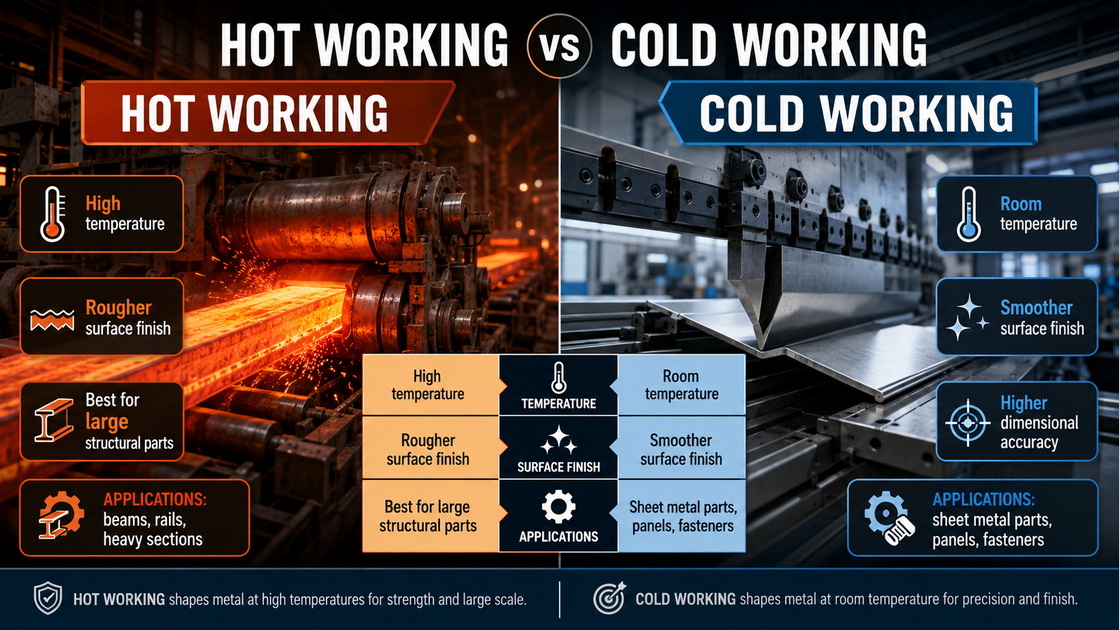
Hot working means forming metal at temperatures above its recrystallization point—typically above 60% of the melting temperature—so the material can flow plastically with relatively low force. For common steels, that often means roughly 900–1250 °C in rolling mills, forging lines, or hot extrusion cells.
Key advantages of hot working
- High ductility for complex shapes and large reductions in thickness.
- Lower forming forces, which allows heavy forming of large cross sections.
- Grain refinement and reduced residual stresses, improving toughness in critical parts like shafts or aircraft forgings.
Main limitations
- Oxidation and scale on the surface, which can hurt cosmetic quality and precision.
- Higher energy consumption and tighter temperature control requirements.
- Lower dimensional accuracy compared with precision cold forming.
Hot working is the backbone of heavy industry—think hot strip mills for automotive steel, large forgings for construction equipment, or hot extrusions for structural profiles.
Cold working is performed at or near room temperature, below the metal's recrystallization temperature. Instead of relying on thermal softening, it uses high forming forces and induces work hardening, which increases strength and hardness.
Key advantages of cold working
- Higher strength and hardness through strain hardening, ideal for high-load parts.
- Better surface finish and tighter dimensional tolerances, crucial in precision sheet metal.
- No scale formation and more energy-efficient than hot working.
Main limitations
- Much higher press forces and more robust tooling are required.
- Ductility drops as work hardening accumulates, increasing risk of cracking.
- Often better suited to thinner sections or requires intermediate annealing for thick materials.
In modern sheet-metal fabrication, most press brake bending, cold rolling, wire drawing, and many deep drawing operations fall into this cold working category. For CNC press brake users, understanding how cold forming hardens the material is critical when defining bend allowances, springback compensation, and tooling choices.
Compressive forming methods "push" metal into shape and are central to high-volume industrial production.
- Rolling: Metal passes through rotating rolls to reduce thickness and achieve uniform sheet or plate. It is the workhorse process for coils, plates, rails, and structural profiles.
- Extrusion: Heated or cold billets are forced through a die to produce constant cross-section profiles, such as frames, rails, or heat sink fins.
- Die forming and forging: Presses and hammers shape metal into near-net shapes using dies, delivering excellent strength and fatigue performance.
These processes are often upstream of CNC press brake operations: rolled coils are slit and then bent; forged blanks are later machined; extruded sections are cut and assembled.
Tensile forming stretches material rather than compressing it.
- Stretching: Used to form large, thin panels like aircraft skins where a uniform, smooth surface is critical.
- Expanding: Converts solid sheets into expanded mesh for walkways, filters, or architectural panels.
- Recessing: Creates depressions or textures without cutting material, useful for grip patterns or visual design.
These methods shine when manufacturers need lightweight but stiff structures and are common in transportation and architectural applications.
Combined processes use both tension and compression, allowing complex, deep, or rotational shapes.
- Deep drawing: Transforms flat blank sheets into deep cups, housings, or containers like pans, casings, or body shells.
- Spinning: Rotational forming for cones, domes, and circular components.
- Tandem rolling, pulling through a die, flange forming, and upset bulging broaden the toolbox for hollow or flanged parts.
For OEMs, these processes often sit alongside bending and welding on the same line, creating multi-step forming routes from flat sheet to finished assembly.

Among all processes, sheet metal bending is one of the most strategic for custom fabrication, enclosure manufacturing, and industrial equipment frames. It involves deforming a metal sheet around an axis using tools (punch and die), typically on a press brake.
Modern CNC press brakes combine servo or hydraulic force control with high-resolution backgauges, real-time angle measurement, and sometimes dynamic crowning to compensate for deflection. This allows manufacturers to achieve: [alpha-cnc]
- Tighter angle tolerances and better repeatability across the entire bend length. [alpha-cnc]
- Faster setup through automatic tooling selection, bend sequence simulation, and collision checks.
- Lower cost per part in batch production while still supporting low-volume custom work. [chinese.alibaba]
For materials like carbon steel, stainless steel, aluminum, and high-strength steel, advanced crowning technology keeps the bend angle consistent from edge to center, even under high tonnage. That consistency directly reduces rework and improves assembly fit, especially in sectors with tight tolerances such as elevators, machinery housings, and automotive structures. [alpha-cnc]
Common use cases for CNC press brakes in OEM and ODM environments include:
- Machine frames, electrical cabinets, doors, and panels.
- Brackets, supports, and mounting plates for industrial equipment.
- Custom enclosures and chassis for electronics or automation systems.
For buyers, one useful rule of thumb: if the geometry can be produced from standard sheet thickness with a handful of bends and cutouts, a CNC press brake plus laser cutting is often the most cost-effective route.
Even in a facility centered on press brakes, a full forming line typically includes several other key processes.
- Shearing uses mechanical blades to cut straight lines in sheets, ideal for simple blanking and high-volume, rectangular pieces.
- Laser cutting uses a focused laser beam to cut highly complex shapes with tight tolerances and minimal burr, making it the standard for modern flat-sheet preparation.
Fiber lasers integrated with automation enable lights-out production of blanks that then flow directly to CNC press brakes, reducing manual handling and lead time.
Punching uses a punch and die to create holes or patterns in sheet metal, from mounting holes to louvers and ventilation slots. When parts need extensive repetitive features, a turret punch or CNC punching line can outperform laser cutting in cycle time.
While not always part of "sheet-metal only" operations, casting and welding are fundamental forming and joining steps in broader metal manufacturing.
- Casting produces complex, thick-walled shapes like motor housings or pump bodies that are later machined and assembled.
- Welding joins formed and machined components into load-bearing structures, frames, or pressure-retaining assemblies.
In many OEM projects, the optimal route combines cast or machined blocks for high-mass sections with bent and welded sheet-metal for enclosures, guards, and covers.
From an engineering and procurement perspective, selecting the correct forming process is about aligning material, geometry, tolerance, and volume.
- Material properties: Yield strength, ductility, and thickness determine whether hot or cold working, deep drawing, or simple bending is feasible.
- Part complexity: Simple brackets favor bending; deep, boxy housings may need a combination of bending and welding or deep drawing.
- Tolerance and surface quality: High cosmetic demands point toward cold forming, precision bending, and laser cutting.
- Production volume: High-volume, standardized parts often justify custom dies and automated presses; low-volume or customized OEM parts benefit from flexible CNC press brakes and laser cutting.
- Ignoring springback and material work hardening in bend design, leading to angle drift and assembly issues.
- Selecting a process based solely on machine availability rather than total cost of ownership and quality.
- Underestimating tooling quality—precision-ground tools and properly maintained dies often deliver more value than raw machine tonnage.

From the shop floor perspective, strong forming performance usually comes down to a few core practices.
- Optimize material use: Match sheet thickness, grade, and coil width to the design to reduce scrap and weight.
- Maintain equipment: Regularly service press brakes, lasers, and tooling to keep angles, cut edges, and tolerances in spec.
- Invest in precision tooling: High-quality dies and punches reduce burr, distortion, and tooling marks, cutting downstream finishing work.
- Leverage digital tools: Use CAD/CAM, offline bending simulations, and nesting software to improve throughput and first-part quality. [gushwork]
For OEM and ODM customers, partnering with a supplier that systematically applies these practices is often more important than choosing a specific machine brand.

High-tonnage machinery demands disciplined safety practices. Experienced operators know that a clean, well-guarded bending cell is a productivity asset, not a distraction.
Key elements include:
- Thorough operator training on press brakes, shears, and lasers.
- Use of PPE such as gloves, eye protection, and hearing protection.
- Routine inspections of guards, emergency stops, and interlocks.
- Clear, documented emergency procedures and safe handling standards for heavy sheets.
From a leadership standpoint, investing in operator experience and safety directly supports E-E-A-T: it demonstrates that real professionals are behind the processes described in your content. [pageoptimizer]
For many advanced fabricators, the process chain looks like this:
1. Coil or sheet preparation via rolling and shearing.
2. Precision blanking with fiber laser cutting or punching.
3. Bending and forming on CNC press brakes (often with crowning and angle measurement).
4. Welding and mechanical joining.
5. Surface treatment and final assembly.
In this chain, CNC press brakes are the central forming system that turns flat blanks into three-dimensional, high-precision parts, bridging digital designs and physical assemblies. For OEM and ODM programs—especially when product lines change frequently—flexible bending capacity is typically the bottleneck that determines how fast new designs can reach market.

If you are planning a new product, looking to localize an existing design, or seeking a more flexible OEM/ODM partner, the next step is to connect theory with your actual drawings. A specialist CNC press brake and sheet-metal forming team can review your 2D/3D files, recommend optimal materials and forming routes, and propose cost-effective batch or long-run solutions.
You can prepare:
- CAD drawings or sample parts.
- Target volumes and delivery timelines.
- Any special requirements for tolerances, finishes, or certifications.
With that information, an experienced metal forming partner can turn your specifications into a clear, manufacturable forming plan and a transparent quotation.
1. What is the main difference between metal forming and metal cutting?
Metal forming reshapes metal without removing material, using processes like bending, rolling, or extrusion, while cutting removes material through shearing, laser cutting, or machining.
2. When should I choose bending on a CNC press brake instead of welding?
If your geometry can be made by bending from a single piece of sheet metal, bending usually offers better strength, fewer joints, and lower assembly time than multiple welded pieces.
3. How does crowning improve bending accuracy?
Crowning compensates for press brake deflection under load so the punch and die maintain consistent distance across the full length, keeping the bend angle uniform from side to side. [alpha-cnc]
4. Are hot working processes still relevant if I mainly use cold-formed sheet metal?
Yes. Many sheets and profiles you bend on a CNC press brake were first hot-rolled or hot-forged upstream, so understanding hot working helps in material selection and performance expectations.
5. What information should I share with a metal forming supplier to get an accurate quote?
Provide material grade and thickness, drawings or models, tolerance requirements, surface finish expectations, target quantities, and any standards or certifications you need.
1. Accurl. "What is Metal Forming: Definition, Types, Processes and Tips." [Link].
2. Alpha CNC. "CNC Press Brake Bending Accuracy Explained: How Crowning Technology Ensures Precision Forming." [Link]. [alpha-cnc]
3. Alibaba / Accurl Product Listing. "Automatic CNC Metal Sheet Plate Bending Press Brake Equipment." [Link]. [chinese.alibaba]
4. Gushwork AI. "SEO for CNC Companies: Strategies That Drive High-Intent Leads." [Link]. [gushwork]
5. PageOptimizer Pro. "Effective Strategies for E-E-A-T Implementation on Websites." [Link]. [pageoptimizer]


