


Views: 217 Author: CNDY-Press Publish Time: 2026-10-23 Origin: Site


Content Menu
● Why Consider Chinese Press Brake Manufacturers?
>> What Recent Industry Data Actually Shows
● How These Manufacturers Were Selected
● Capacity, MOQ, and Certification
● 1. CNDY-Press: Flexible OEM and ODM Support for Developing Manufacturers
>> Strengths and Customization Scope
● 2. ACCURL: CNC Bending and Automation-Oriented Equipment
>> Strengths and Customization Scope
● 3. ADH Machine Tool: Broad Sheet-Metal Equipment Manufacturing
>> Strengths and Customization Scope
● 4. HARSLE: Export-Oriented CNC Press Brake Options
>> Strengths and Customization Scope
● 5. Jiangsu Yawei: Automated Sheet-Metal Processing
>> Strengths and Customization Scope
● 6. Yangli Group: Forming Equipment and Integrated Production
>> Strengths and Customization Scope
● 7. JFY: Bending Equipment with an International Service Network
>> Strengths and Customization Scope
● 8. SC Shenchong: Customized Bending and Automation
>> Strengths and Customization Scope
● 9. Anhui ZYMT CNC: Electro-Hydraulic Bending Options
>> Strengths and Customization Scope
● 10. PRIMAPRESS: OEM-Oriented Sheet-Metal Equipment Supply
>> Strengths and Customization Scope
● How to Specify a Press Brake for Battery Enclosures
>> Start with Material Grade and Temper
>> Check Geometry Before Selecting Tonnage
>> Protect Sealing and Assembly Features
● Accepting the Best Part Instead of the Process
● Compliance, Factory Verification, and Logistics
>> Check Applicable Machinery Requirements
>> Verify Factory and Delivery Responsibilities
>> 1. How Can I Verify That a Supplier's ISO Certificate Is Still Valid?
>> 2. Can One Press Brake Produce Both Aluminum and Steel Enclosures?
>> 3. Does a CE-Marked Press Brake Make the Battery Enclosure Compliant?
>> 4. How Should We Specify Repeatability Without Demanding an Unsupported Accuracy Claim?
>> 5. Who Is Responsible When a Robot Is Added to the Press Brake?
Choosing a press brake for battery enclosures requires more than comparing bending force, controller brands, and machine prices. Procurement managers need evidence that the proposed equipment can consistently form their actual parts, protect critical surfaces, and support downstream welding, sealing, and assembly.
This guide evaluates ten China-based manufacturers using practical purchasing criteria: structural engineering, application development, quality controls, service support, customization scope, and manufacturing transparency.
Before requesting quotations, distinguish your application. A sheet-metal energy storage cabinet, an electrical battery box, and an electric vehicle battery tray can require very different manufacturing processes. A press brake may form panels, covers, brackets, and selected tray components, but it is not a universal substitute for extrusion, stamping, casting, or joining equipment.
The following list is a procurement shortlist, not an independently audited market-share ranking. CNDY-Press appears first as the publisher's company. Inclusion does not establish that every manufacturer has verified references for battery enclosure production.
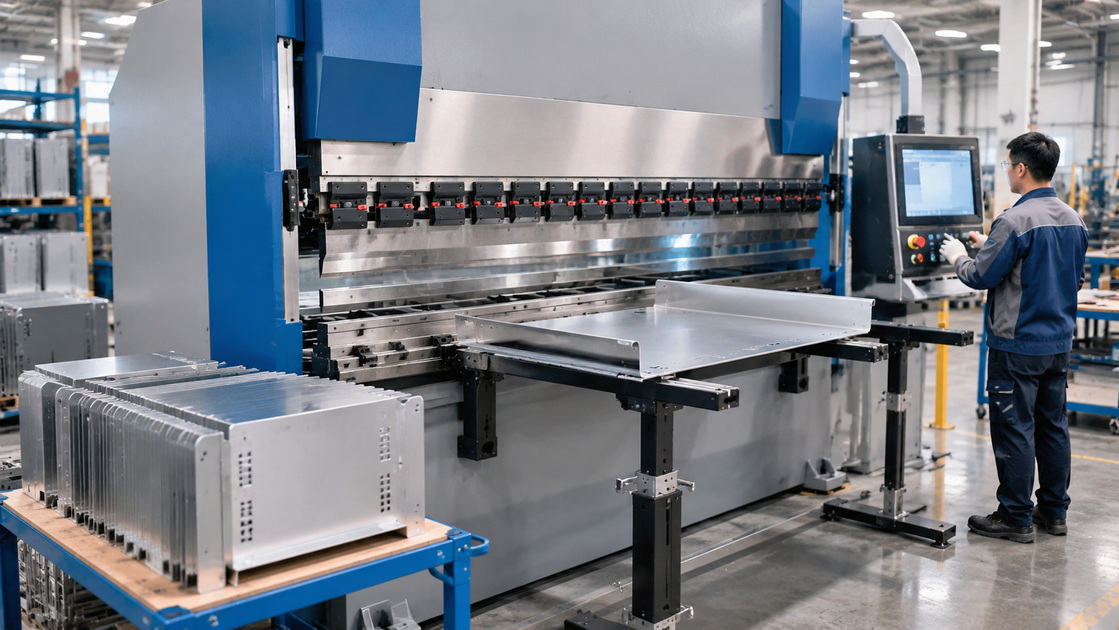
China offers a broad machine-tool supply base, with established metal-forming equipment clusters around Ma'anshan and Bowang in Anhui, Nanjing and Yangzhou in Jiangsu, and Wuxi.
These locations support access to machine builders, tooling suppliers, automation integrators, and related sheet-metal equipment manufacturers.
For international buyers, the advantages can include competitive equipment configurations, customized machine dimensions, integrated cutting-and-bending packages, and export-oriented service.
A March 2026 report from AMT—The Association For Manufacturing Technology—states that China's machine-tool industry recorded total imports and exports of US$33.48 billion in 2025, up 5% year over year.
This is broad machine-tool trade data. It does not measure press brakes specifically, and it does not identify sales of machines used for battery enclosures.
The practical conclusion is that China has a substantial international machine-tool supply chain. Individual supplier quality still requires direct verification.
The assessment prioritizes capabilities relevant to long-term industrial purchasing:
1. Product relevance: documented CNC press brake offerings.
2. Engineering capability: structural development, tooling support, crowning, backgauges, or automation.
3. Manufacturing transparency: identifiable company information and production locations.
4. Quality assurance: inspection procedures and certification evidence requiring verification.
5. Commercial support: installation, training, maintenance, and export coordination.
6. Customization: machine configuration, application engineering, and documented OEM services where available.
Public websites rarely disclose comparable press-brake-only production capacity or binding minimum order quantities. Accordingly, missing figures are marked rather than estimated.
OEM manufacturing, private labeling, and application customization are also different services. A supplier offering customized tooling does not automatically accept third-party branding.
Capacity means annual manufacturing output—not bending force. Published figures covering multiple equipment categories should not be treated as press brake capacity.
| Manufacturer | Published production-capacity evidence | MOQ position | Certification verification |
|---|---|---|---|
| CNDY-Press / Maanshan Deyan | No comparable annual figure identified | Confirm single-machine and OEM project terms | Request current company and machine-specific documentation |
| ACCURL | No comparable annual figure used here | Confirm by configuration | Verify documents for the quoted model and supplying entity |
| ADH Machine Tool | Company materials state over 5,000 assorted machine tools annually; not press brakes alone | Confirm by configuration | Request current certificates and scope |
| HARSLE | No verified annual press brake figure established | Confirm by configuration | Verify quoted-machine conformity and current certificates |
| Jiangsu Yawei | No comparable annual figure used here | Confirm machine or cell scope | Request relevant site and model documents |
| Yangli Group | Broad equipment portfolio; no comparable press brake figure used | Confirm project scope | Verify supplying division and applicable documentation |
| JFY | No current comparable annual figure established | Confirm with regional channel | Verify manufacturer, model, and destination requirements |
| SC Shenchong | No comparable annual figure established | Confirm standard versus custom terms | Historical ISO 9001 and TÜV CE claims require current verification |
| Anhui ZYMT CNC | No comparable annual figure established | Confirm by configuration | Verify legal entity and current documents |
| PRIMAPRESS | No comparable annual figure established | Confirm standard and OEM terms | Check contracted entity and machine-specific evidence |
"No comparable figure" does not mean limited capacity. It means buyers should obtain a project-specific production commitment rather than infer capacity from factory photographs or land area.
Maanshan Deyan Precision Machinery Technology Co., Ltd., operating as CNDY-Press, describes its business as the research, development, manufacture, sale, and service of sheet-metal processing equipment.
The reviewed company page does not disclose a founding year or a regional sales breakdown. These details should be confirmed during qualification.
Its stated applications include automotive, aerospace, shipbuilding, engineering machinery, and other industrial sectors.
CNDY-Press explicitly offers OEM and ODM manufacturing and customer-specific production. Its product scope includes CNC press brakes, fiber laser cutters, shears, plate rolling machines, and grooving machines.
This makes it worth evaluating for small and midsize manufacturers seeking a cost-conscious, development-oriented partner.
For battery enclosure projects, request a proposal covering tooling access, usable bending length, part support, controller functionality, and the intended material range.
Flexibility and communication efficiency should be demonstrated through a named engineer, consolidated technical feedback, controlled drawing revisions, and written approval milestones—not assumed from marketing claims.
ACCURL states that its brand was founded in 2014 and manufactures equipment in Ma'anshan, Anhui.
Its published portfolio includes CNC press brakes, laser cutting machines, panel benders, turret punches, and other metalworking equipment for industrial buyers.
ACCURL is a relevant candidate when buyers want to compare CNC bending with automation or alternative forming routes.
For battery cabinet panels and covers, ask whether the proposed press brake remains preferable to a panel bender after accounting for part geometry, batch size, and handling.
Application engineering and configuration should be specified in the quotation. Private-label OEM or ODM arrangements require separate written confirmation.
ADH identifies 2002 as its establishment year and describes earlier machine-tool roots. Its manufacturing base is in Ma'anshan.
Company materials describe international sales covering regions including Europe, Southeast Asia, South America, and the Middle East.
ADH manufactures press brakes, laser cutting equipment, panel benders, and automation systems.
Its published capacity statement exceeds 5,000 assorted machine tools annually. Buyers should not interpret that figure as annual press brake output or immediate available capacity.
ADH is worth considering for coordinated cutting-and-bending projects. Request application-specific engineering and clarify whether any requested OEM branding, software customization, or integration is included.
HARSLE offers CNC and electric press brakes and presents international sales and support arrangements, including a North American stock program.
Its public materials use inconsistent founding references, including 2007 and 2008. Confirm the incorporation date of the contracting entity instead of relying on brand-history summaries.
HARSLE is relevant for buyers comparing different bending configurations and regional delivery options.
For enclosure production, request a complete configuration list covering axes, crowning, tooling, clamping, guarding, and control software.
Confirm application customization separately from private labeling. Regional inventory also does not prove that a stocked machine matches your required enclosure geometry.
Founded in 1956, Jiangsu Yawei manufactures CNC press brakes and other sheet-metal processing equipment.
Its published offering includes laser processing, panel bending, robotic equipment, and flexible manufacturing solutions for domestic and international customers.
Yawei is a relevant candidate for manufacturers planning beyond a standalone machine.
Its broader portfolio supports discussions about production cells, material flow, and automation.
For battery enclosure work, request evidence of the proposed bend sequence and automated handling feasibility. Custom cell engineering should not be confused with an offer to manufacture under another brand; OEM terms require confirmation.
Yangli Group was established in 1966 in Yangzhou, Jiangsu.
Its official materials describe equipment serving automotive, appliances, aviation, shipbuilding, new energy, and other industrial applications.
Yangli's portfolio spans stamping, sheet-metal processing, forging, and laser equipment.
Its published CNC press brake range includes electro-hydraulic synchronization, crowning, and multi-axis backgauge options.
The company is worth evaluating when enclosure components may require several forming processes. Request the appropriate manufacturing division and define project engineering, automation interfaces, and any OEM requirements explicitly.
JFY is based in Yangzhou. A historical company presentation traces its development to 1989, while 1997 refers to privatization rather than the beginning of all operations.
TRUMPF documents acquiring a majority stake in JFY in 2013. JFY's current international website describes a network of more than 40 sales and service partners.
JFY presents press brakes, bending software, and automation-related offerings.
It is relevant to buyers who place particular value on software workflow and regional service coordination.
Request trials using your own enclosure drawings. Confirm the available integration scope, tooling package, software licensing, and service responsibilities. Do not assume private-label OEM availability.
Wuxi Shenchong Forging Machine Co., Ltd. states that it was established in 2002.
The company reports exports to more than 120 countries and offers press brakes, shears, rolling equipment, and automated sheet-metal solutions.
Shenchong explicitly describes customized cutting-and-bending solutions and OEM services.
It is worth evaluating where battery enclosure work requires special handling, tandem arrangements, or integration with other fabrication operations.
The company publishes historical ISO 9001 and TÜV CE information. Obtain current documents and check the quoted machine's coverage rather than relying on historic certification dates.
Anhui ZYMT CNC Machine Tool Co., Ltd. states that it was founded in February 2001.
Its published range includes electro-hydraulic CNC press brakes, shearing equipment, and laser cutting systems for industrial customers.
ZYMT's product range supports comparisons between different hydraulic and servo-related bending configurations.
It is a relevant candidate for buyers seeking conventional fabrication equipment alongside CNC bending.
Because similar ZYMT names appear across different websites and corporate descriptions, verify the exact legal entity, manufacturing address, bank beneficiary, and warranty provider. OEM or ODM scope should be confirmed directly.
A PRIMAPRESS company article states that the business was founded in 1999. Other Prima-branded websites publish different historical dates.
Buyers should establish the contracting entity and confirm its legal incorporation history.
Published customer examples include Finland and the United States, although these examples do not establish the company's largest markets.
PRIMAPRESS explicitly advertises OEM services for sheet-metal bending and cutting machinery.
Its broad equipment offering can suit buyers seeking coordinated procurement.
Before ordering, confirm who manufactures the proposed press brake, who owns the drawings and modifications, and which entity provides commissioning, replacement parts, and warranty support.
Do not request a machine merely for "aluminum battery boxes."
Identify the exact alloy, temper, thickness range, rolling direction where relevant, and permitted surface condition. Steel and stainless steel require similarly specific definitions.
Different material conditions affect springback, bend radius, tooling choice, and cracking risk.
Provide actual production material for trials when possible. A sample made from a convenient substitute does not prove your process.
The required specification depends on more than force and nominal bending length.
Review:
- Throat depth and distance between uprights.
- Daylight, stroke, and tool stack height.
- Backgauge travel and finger access.
- Deep-box clearance and part extraction.
- Minimum flange requirements.
- Crowning and angle correction.
- Tool load limits and support requirements.
Ask the supplier to demonstrate the complete bend sequence. A machine may form the first three sides successfully yet encounter a collision on the final return flange.
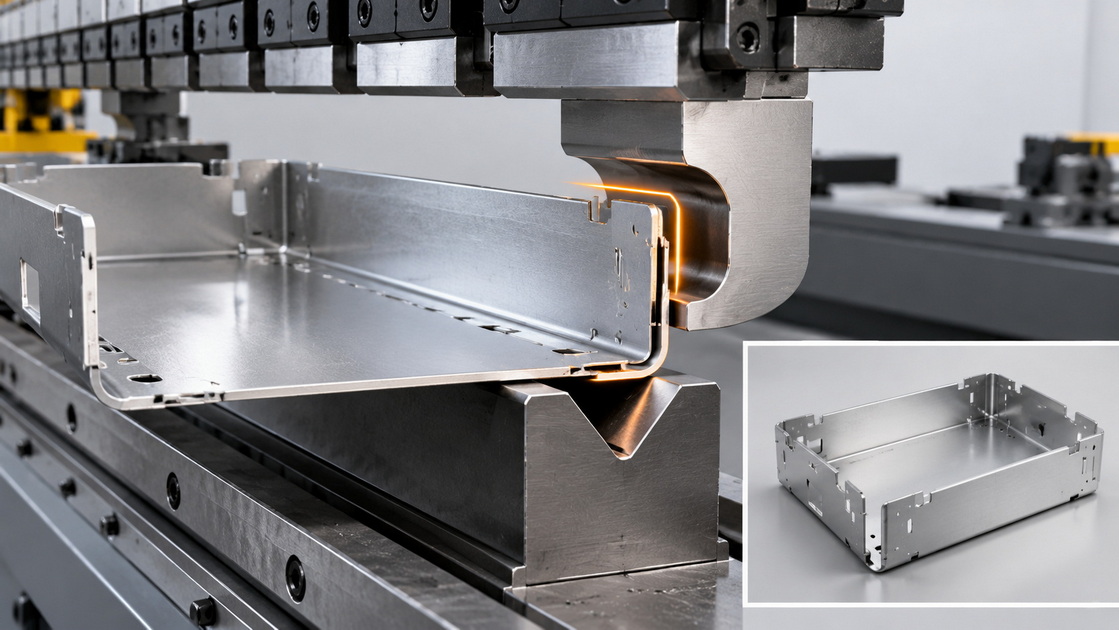
Identify gasket lands, welded seams, fastening locations, and cosmetic surfaces before tooling approval.
Special tooling or surface-protection arrangements may be needed to reduce marks. Tool suppliers also offer coatings intended to limit aluminum or zinc adhesion.
However, a successful bending trial does not prove enclosure leak tightness. Validate welding, sealing, fastening, and final assembly separately.
A supplier can sometimes produce one acceptable enclosure after extensive manual adjustment.
That proves feasibility—not production repeatability.
Define a production-equivalent factory acceptance test that includes:
1. Your specified material and thickness.
2. The contracted machine, tooling, and software.
3. A consecutive batch rather than one selected part.
4. Cold-start and warmed-up operation.
5. Changeover and program recall.
6. Measured dimensions without unapproved hand correction.
7. An agreed inspection method and measurement uncertainty.
Evaluate finished-part geometry as well as machine positioning figures. Ram repeatability alone does not establish enclosure fit, flange alignment, or assembly quality.
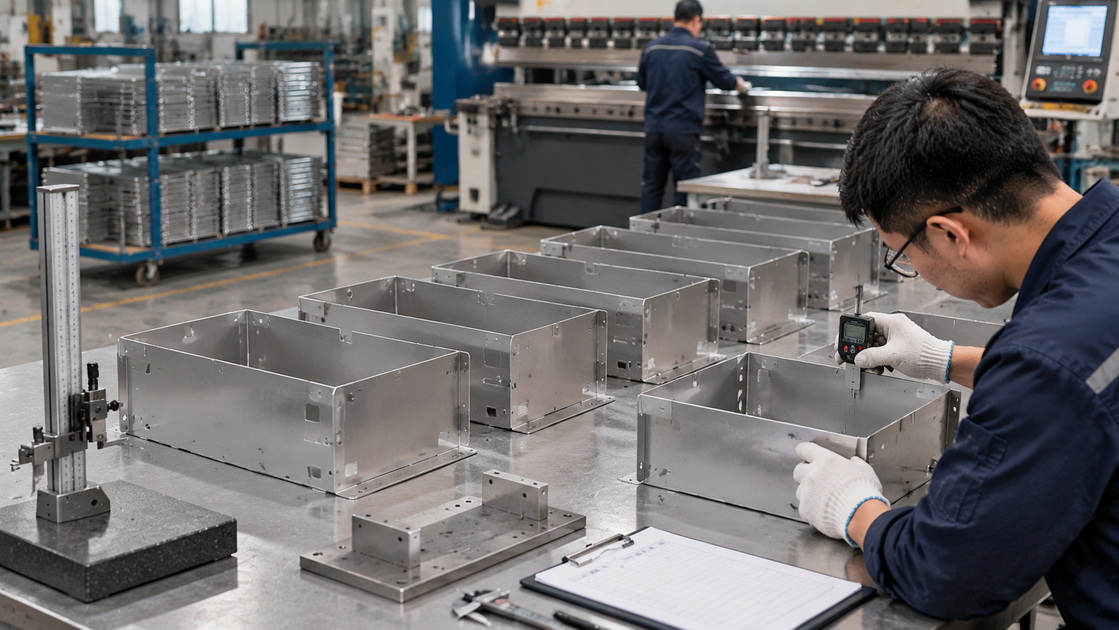
For EU projects, the applicable machinery framework depends on when the equipment is first placed on the market.
The Machinery Directive 2006/42/EC remains relevant before January 20, 2027. Regulation (EU) 2023/1230 becomes mandatory from that date.
Request the appropriate declaration of conformity, machine identification, operating instructions, and safety documentation. A generic "CE certificate" is not a substitute for a complete conformity assessment.
RoHS is not a universal environmental approval for industrial machinery. Its applicability and exclusions require assessment for the actual equipment configuration.
Before paying a deposit:
- Match the contract, business registration, and bank beneficiary.
- Verify certificates with the issuer or relevant database.
- Confirm subcontracted manufacturing and assembly.
- Record critical component models and substitution rules.
- Define acceptance, training, and warranty obligations.
For shipment, obtain machine weight, center-of-gravity information, lifting instructions, packing details, corrosion protection, and foundation requirements.
Separate factory completion from installation readiness. Electrical supply, unloading equipment, tooling delivery, and technician availability can all affect commissioning.
The right Chinese supplier is not necessarily the one offering the highest tonnage or the most recognizable controller.
It is the manufacturer that can validate your enclosure geometry, document the contracted configuration, demonstrate repeatable results, and support the machine after installation.
Search the certificate number and legal entity through IAF CertSearch where available. Check status, scope, site address, issuer, and validity. Resolve missing or inconsistent records directly with the certification body. ISO 9001 certification does not establish a particular machine's bending capability.
Potentially, but validate both material ranges. Required force, tooling, radii, springback compensation, surface protection, and handling may differ. Ask for trials using representative parts from each material family rather than assuming one successful trial covers all production.
No. Machine conformity concerns the equipment and its applicable requirements. The enclosure and complete battery system have separate design, safety, validation, and customer requirements. Keep machine acceptance and finished-product qualification as distinct workstreams.
Define measurable finished-part characteristics, sample size, material conditions, operating sequence, and inspection method. Agree on the acceptance criteria before ordering. Avoid substituting a controller resolution or backgauge positioning figure for demonstrated part capability.
Assign responsibility in writing for risk assessment, safeguarding, interfaces, programming, documentation, and conformity of the completed system. Do not assume separate equipment documents automatically cover the integrated cell. Identify the accountable integrator before purchase.
1. [CNDY-Press — About Us]. Primary source for product range, OEM and ODM services, customization, technical support, and stated industrial applications. The page does not disclose a founding year. [cndypress]
2. [AMT — International News From the Field: China Posts Record Auto and Machine Tool Output, March 10, 2026]. Industry-association reporting on China's 2025 machine-tool trade; not battery-enclosure-specific data. [amtonline]
3. [ACCURL — About Us]. Brand establishment in 2014, Ma'anshan manufacturing, and equipment portfolio. [accurl]
4. [ADH Machine Tool — Company Website] and [Official Company Presentation]. Establishment history, markets, equipment portfolio, and self-reported capacity covering assorted machine tools. [adhmt]
5. [HARSLE — Press Brake Range], [Company-Published Manufacturer Overview], and [North American Stock Program]. Product and service context; reviewed pages contain inconsistent founding references. [harsle]
6. [Jiangsu Yawei — Official Website]. Founding year, CNC bending, automation, and wider equipment portfolio. [en.yawei]
7. [Yangli Group — Enterprise Introduction] and [PB Series CNC Press Brake]. Company history, served industries, and published machine features. [yangli]
8. [TRUMPF — Company History, 2013–2019]. Primary-source record of the 2013 acquisition of a majority stake in JFY. [trumpf]
9. [JFY — Historical Company Presentation], [International Website], and [Sales Network]. Historical milestones, bending offerings, and international support network. [visionmachinery.com]
10. [SC Shenchong — About Us]. Establishment, products, export claims, OEM services, and historical certification statements. [shen-chong]
11. [Anhui ZYMT CNC — Company Profile]. Company-stated establishment in February 2001 and product portfolio. [zymtcnc]
12. [PRIMAPRESS — Company Article Identifying 1999 Establishment] and [Published OEM Service Statement]. Company history claim, customer example, and OEM scope. [prima-press]
13. [TRUMPF — Bending Tools]. Tool geometry, material interaction, springback-related tooling, and surface-protection context. [trumpf]
14. [European Commission — Machinery]. Official explanation of the transition to Regulation (EU) 2023/1230 on January 20, 2027. [single-market-economy.ec.europa]
15. [European Commission — RoHS Directive]. Scope of hazardous-substance restrictions and equipment-related exclusions. [environment.ec.europa]
16. [IAF CertSearch — Certificate Verification]. Verification of accredited management-system certification status and associated information. [iafcertsearch]


