


Views: 212 Author: CNDY-Press Publish Time: 2026-10-23 Origin: Site


Content Menu
● What Is the Difference Between a Large and Tandem Press Brake?
>> Large Press Brake: One Integrated Machine
>> Tandem Press Brake: Two Coordinated Machines
● Large Press Brake vs Tandem Press Brake
● Why Combined Tonnage Can Be Misleading
>> Check Three Capacity Limits
● Synchronization Is Only Part of the Answer
>> Backgauging and Tool Alignment
● The Constraints Buyers Often Miss
>> Nominal Length Is Not the Usable Envelope
>> Handling Can Determine Actual Throughput
● Three Practical Scenarios for Choosing the Configuration
>> Scenario 1: Regular Long-Panel Production
>> Scenario 2: Mixed Long and Short Components
>> Scenario 3: Shorter Parts Requiring High Force
● Compare Cost per Accepted Part
● Assuming Tandem Means Automatic Redundancy
● A Five-Step Selection and Acceptance Plan
>> Step 1: Build a Representative Part Matrix
>> Step 2: Validate Force and Geometry
>> Step 3: Simulate Scheduling
>> Step 4: Run Representative Trials
>> Step 5: Agree on Acceptance and Support
● How CNDY-Press Can Support Your Decision
>> 1. Is a Tandem Press Brake More Accurate Than a Single Large Machine?
>> 2. Can Two Existing Press Brakes Be Converted into a Tandem System?
>> 3. Can I Use the Full Combined Tonnage on a Short Workpiece?
>> 4. Will a Tandem System Continue Working if One Machine Fails?
>> 5. What Should a Long-Bending Acceptance Test Include?
Choosing between a large press brake vs tandem press brake starts with your production mix. A single large press brake often suits sustained long-part production or applications requiring substantial force within one machine's permitted loading envelope. A tandem press brake can offer greater scheduling flexibility when the same equipment must alternate between long components and shorter jobs.
Neither arrangement automatically delivers better accuracy, lower operating costs, or higher output. The right choice depends on bending length, force distribution, part geometry, handling, and the proportion of work that benefits from independent operation.
At CNDY-Press, we manufacture sheet-metal processing equipment and undertake OEM and ODM projects. Our recommended starting point is a representative part list—not a preferred machine size. Define what the equipment must produce before deciding how many machines should produce it.
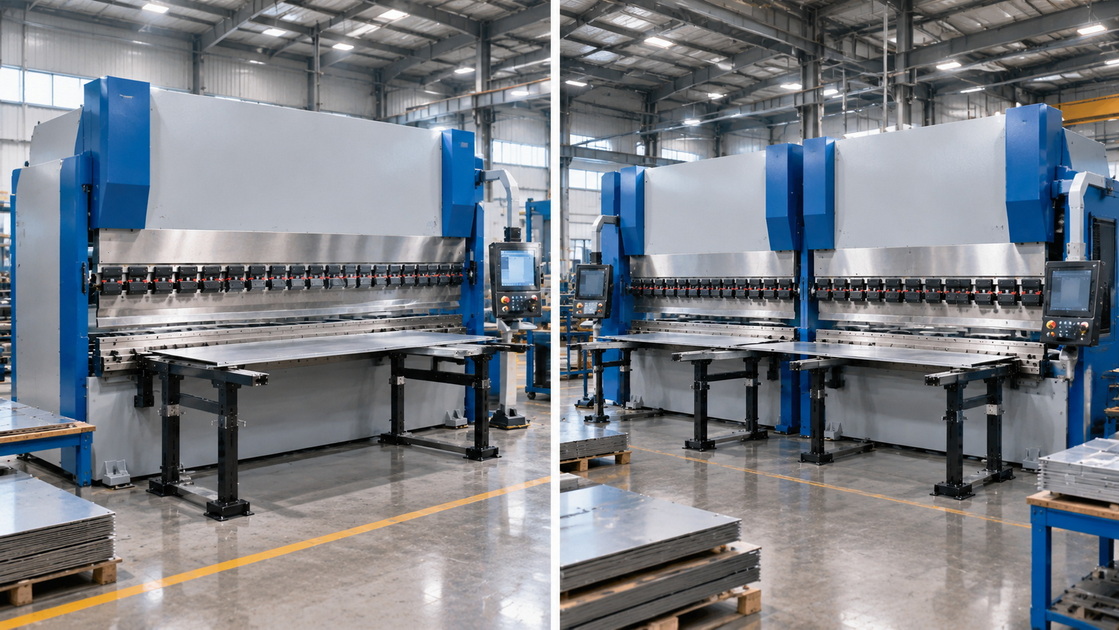
Here, "large press brake" means one machine with sufficient bending length and force for the intended application.
Its integrated working arrangement avoids the interface between two neighboring machines. However, it still requires suitable crowning, tooling alignment, backgauging, and material support.
Large does not necessarily mean monolithic construction. Shipping and installation arrangements depend on the manufacturer's design.
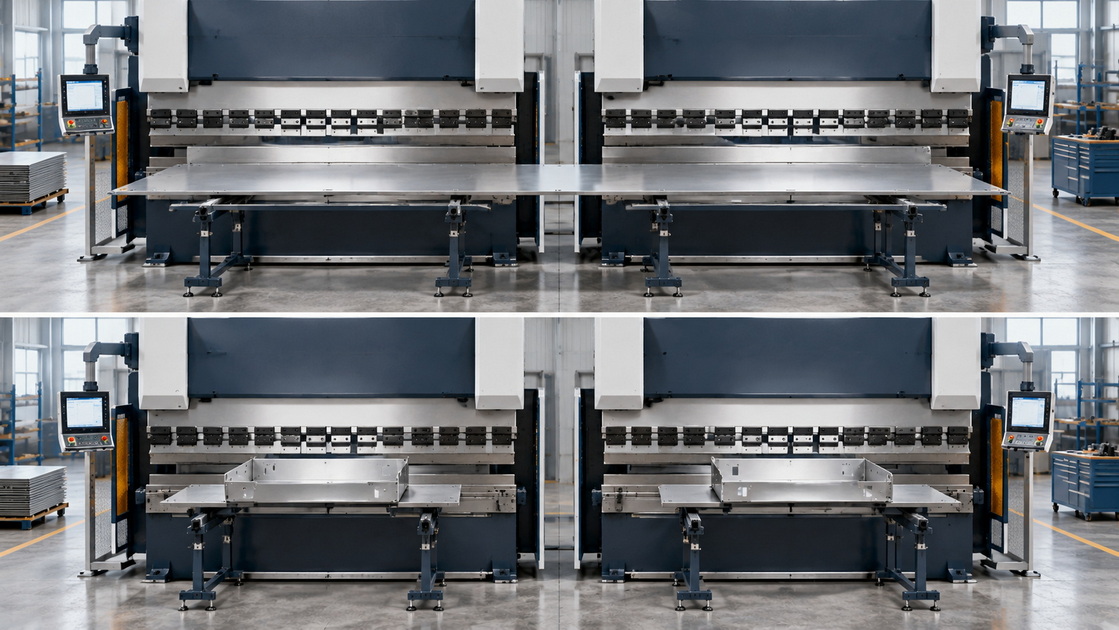
A tandem press brake combines two compatible machines operating synchronously to bend one long workpiece.
Where the system is designed accordingly, the machines can also operate independently on shorter components.
This capability is not achieved simply by placing two standard press brakes together. Mechanical alignment, controls, hydraulic behavior, guarding, tooling, and backgauges must function as an engineered system.
Published equipment ranges demonstrate that both configurations can serve substantial applications. For example, Bystronic lists individual bending lengths up to 10,200 mm and tandem configurations up to 20 meters within its Xpert 250–1000 offering. These are product-specific figures, not universal limits.
| Purchasing factor | Single large press brake | Tandem press brake |
|---|---|---|
| Main advantage | Integrated platform for the required bending envelope | Long-part capability with potential independent operation |
| Production mix | Often attractive for consistent long-part demand | Often attractive for mixed long and short work |
| Force availability | Restricted by the machine’s loading rules | Restricted by each machine and the combined loading arrangement |
| Accuracy requirements | Crowning, alignment, tooling, and material control | The same requirements plus cross-machine coordination |
| Setup | No machine-to-machine interface | Alignment and tandem calibration require attention |
| Handling | Support must cover the full workpiece | Support must suit both tandem and independent modes |
| Maintenance | One machine platform | Two machines plus coordination systems |
| Installation | Large-machine transport and foundation planning | Positioning, foundations, alignment, and connection planning |
| Downtime | Machine failure affects its production | Independent operation during faults depends on system design |
| Cost comparison | Assess the complete installed solution | Assess the complete installed solution—not two base prices |
The most consequential comparison is load distribution, not the sum of nameplate ratings.
Two 300-ton machines do not provide 600 tons at every location along the tandem bed. A short component positioned on one machine remains subject to that machine's permitted capacity, load position, and tooling limits.
Likewise, a single large press brake cannot automatically apply its entire rated force over any short tool section.
Ask the supplier to verify:
1. Total forming force for the proposed material and process.
2. Permitted loading at the intended position and bend length.
3. Tooling, clamping, and table load limits.
Material strength, thickness, die opening, bend length, and forming method all affect force requirements.
A configuration suitable for a long, relatively thin panel may be unsuitable for a shorter, thick high-strength component. The bed length alone cannot resolve that difference.
Require a documented loading assessment for your most demanding parts.
A well-engineered tandem system can produce accurate long bends. A single machine can also produce inconsistent results if its compensation, tooling, or material assumptions are wrong.
Machine structures deflect under forming load. Crowning compensates for that behavior to help maintain the bend angle along the workpiece.
For tandem operation, the compensation systems must work together across both machines.
The critical inspection locations include:
- Both workpiece ends.
- Intermediate positions.
- The transition between machines.
- Areas affected by changing material or geometry.
Do not accept a single angle measurement as proof of full-length accuracy.
Long parts can be sensitive to gauge alignment, blank straightness, and support conditions.
In a tandem arrangement, tool heights, bed positions, and coordinated backgauges require particular attention. Correct cylinder synchronization cannot compensate for incorrectly aligned tooling.
Specify finished-part tolerances and inspection methods rather than relying solely on machine positioning specifications.
Confirm more than the advertised bed length:
- Distance between uprights.
- Throat depth.
- Daylight and stroke.
- Tool stack height.
- Backgauge travel.
- Part rotation and extraction space.
- Clearance around an already formed flange.
For tandem systems, ask specifically about the usable tooling and support arrangement near the machine interface.
A supplier should demonstrate the complete bend sequence, including removal of the finished part.
A long workpiece may require cranes, lifting devices, front supports, followers, or a dedicated handling system.
Compare the complete cycle:
1. Retrieve and position the blank.
2. Locate it against the gauges.
3. Form the bend.
4. Support and rotate the component.
5. Complete subsequent bends.
6. Inspect and unload.
A faster ram does not necessarily create a faster production process.
If two tandem machines run independently, check whether operators, cranes, and unloading areas can support both simultaneously. Otherwise, the theoretical output advantage may disappear.
The following are illustrative decision scenarios, not customer case studies.
A manufacturer produces similar long panels throughout most shifts.
A single large press brake deserves close consideration because independent short-part operation adds little value.
However, a tandem proposal may still be competitive if its handling, installation, and forming performance suit the application. Compare complete production cycles rather than assuming the single-machine arrangement wins.
A fabrication business receives occasional long-part orders but produces shorter components daily.
A tandem system may improve scheduling flexibility by operating as two machines between long jobs.
Calculate the realistic benefit after allowing for mode changes, tooling setup, staffing, and handling resources.
Two independently operable machines do not automatically produce twice as much.
A manufacturer forms thick components that do not need an exceptionally long bed.
A suitably rated single machine may be more relevant than a tandem arrangement selected primarily for length.
The deciding factors are permitted concentrated loading, tooling capacity, clearance, and the actual forming process.
Neither configuration is inherently cheaper.
Request quotations that include equivalent scope:
| Cost category | What to clarify |
|---|---|
| Machine configuration | Force, length, axes, controls, and compensation |
| Tooling | Quantity, length, load rating, and clamping |
| Handling | Supports, followers, lifting, and unloading |
| Installation | Freight, foundations, positioning, and commissioning |
| Software | Programming, licenses, and integration |
| Service | Training, travel, spare parts, and response arrangements |
| Production losses | Setup, inspection, scrap, and downtime |
For tandem equipment, include cross-machine calibration and any additional infrastructure needed for independent operation.
For a single large machine, investigate transport access, lifting arrangements, and foundation requirements early.
Compare energy consumption using the same representative production cycle. Machine count or installed motor power alone does not establish energy cost.
Two machines can provide flexibility, but they do not guarantee uninterrupted production.
A shared safety fault, control problem, or interlock may prevent operation. Whether one machine can continue independently depends on the engineered architecture and the nature of the fault.
Before purchase, ask:
- Which faults stop both machines?
- Can one machine be isolated safely?
- What procedure restores independent operation?
- Does mode switching require recalibration?
- Which parts and service tools are needed?
Demonstrate the agreed operating modes during commissioning.
This is more useful than a general promise that "one machine keeps working if the other stops."
Include drawings, materials, thicknesses, maximum bend lengths, critical tolerances, and annual quantities.
Separate frequent work from occasional extreme jobs. Designing around one rare component may create unnecessary operating costs.
Ask each supplier to document the loading envelope, tooling, clearances, and bend sequence for the same parts.
Do not compare proposals based on different assumptions.
Estimate the hours spent in long-part operation, independent short-part operation, changeovers, maintenance, and handling.
This reveals whether tandem flexibility has commercial value.
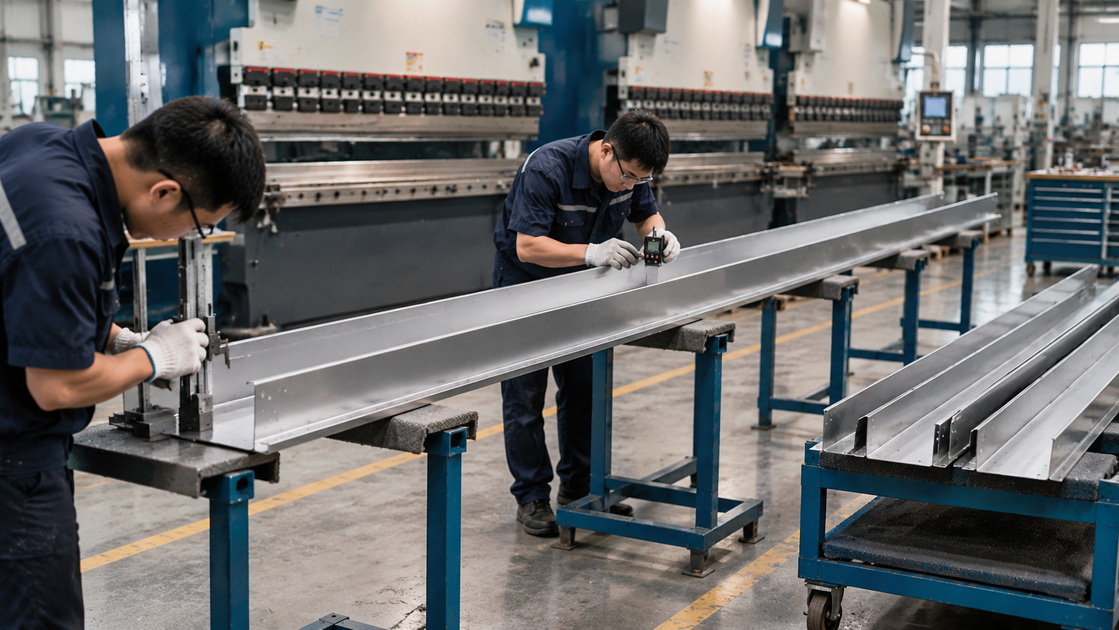
Use production-equivalent material and inspect multiple consecutive parts.
Include measurements across the full bend length, setup repeatability, program recall, and the required operating modes.
Document tolerances, measurement methods, delivery scope, installation responsibilities, training, warranty, and corrective-action procedures.
Purchase a validated process—not an isolated demonstration part.
CNDY-Press provides CNC press brakes and related sheet-metal equipment, with OEM, ODM, and customized production services.
For a long-bending project, send our team:
- Representative part drawings.
- Material grades and thickness ranges.
- Maximum bending length.
- Required tolerances.
- Expected production mix.
- Handling and installation constraints.
- Destination and commissioning requirements.
Not inherently. Accuracy depends on structure, compensation, tooling, gauges, material, and setup. Tandem equipment adds cross-machine alignment and synchronization requirements. Compare finished parts under equivalent test conditions.
Possibly, but only after an engineering assessment. Controls, hydraulics, structures, guarding, and alignment may require substantial changes. Matching tonnage and bed length alone does not establish compatibility.
Not automatically. Each machine, tool section, and load position has limits. Obtain written approval for the proposed loading arrangement rather than treating combined tonnage as universally available.
Sometimes, depending on the fault and system design. Confirm safe isolation, independent-mode capability, and recovery procedures before purchase. Do not treat redundancy as a standard feature.
Use specified material, representative geometries, consecutive parts, full-length inspection, and agreed handling conditions. For tandem systems, test synchronized operation, independent operation where specified, and mode-change repeatability.
1. [The Fabricator — What You Need to Know About Tandem Press Brakes]. Industry guidance on independent operation, synchronization, calibration, loading limitations, tooling capacity, and handling. [thefabricator]
2. [The Fabricator — Overcome Productivity Challenges in Large-Workpiece Bending]. Discussion of tandem alignment, force distribution, material handling, and production flexibility. [thefabricator]
3. [The Fabricator — Better Bend Accuracy on the Press Brake Through Crowning]. Technical explanation of deflection compensation and coordinated crowning in multi-machine systems. [thefabricator]
4. [LVD — PPEC Precision Press Brake]. Manufacturer documentation confirming synchronized tandem operation and independent operation using separate controllers on the specified equipment. [lvdgroup]
5. [Bystronic — Xpert 250–1000]. Product-specific bending lengths, tandem capacity, clearance specifications, and application options. Published figures are not universal equipment limits. [bystronic]
6. [The Fabricator — Big Bending Jobs Lead to High-Tonnage Press Brake]. Application context distinguishing high-force requirements from the need for additional bending length. [thefabricator]
7. [CNDY-Press — About Us]. Company-provided information on equipment manufacturing, OEM and ODM projects, customization, training, and maintenance support. [cndypress]


