


Views: 217 Author: CNDY-Press Publish Time: 2026-08-28 Origin: Site


Content Menu
● What Is the Main Difference Between Turret Punching and Laser Cutting?
● How a CNC Turret Punch Press Works
>> Where turret punching delivers the most value
>> The unique advantage: sheet metal forming
● How a Fiber Laser Cutting Machine Works
>> Where fiber laser cutting delivers the most value
● Turret Punch vs. Fiber Laser: Performance Comparison
>> Speed: compare complete part cycle time, not headline machine speed
>> Material thickness and material type
● The Real Cost Comparison: Tooling vs. Operating Expense
● A Practical Machine-Selection Framework
>> Choose a CNC turret punch press when:
>> Choose a fiber laser cutting machine when:
>> Consider a combined production strategy when:
● Questions to Ask Before You Buy
● FAQ
>> 1. Is a turret punch press faster than a fiber laser cutting machine?
>> 2. Can a fiber laser cutting machine replace a turret punch press?
>> 3. Which machine is better for electrical enclosures?
>> 4. Do fiber laser cutting machines require tooling?
>> 5. What is the biggest operating cost of fiber laser cutting?
For sheet metal manufacturers, job shops, and OEM buyers, choosing between a CNC turret punch press and a fiber laser cutting machine affects more than cutting speed. It shapes tooling costs, production flexibility, part quality, labor requirements, and long-term profitability.
At CNDY-Press, we work with manufacturers that need scalable sheet metal fabrication equipment for OEM, ODM, and customized production. In practice, neither machine is universally "better." A turret punch press is often the stronger choice for high-volume punched and formed parts, while a fiber laser cutting machine is usually the more flexible solution for complex profiles, frequent design changes, and mixed-batch orders.
This guide explains the practical differences between turret punching and laser cutting, including cost drivers, material capability, forming needs, automation options, and an expert framework for selecting the right machine.
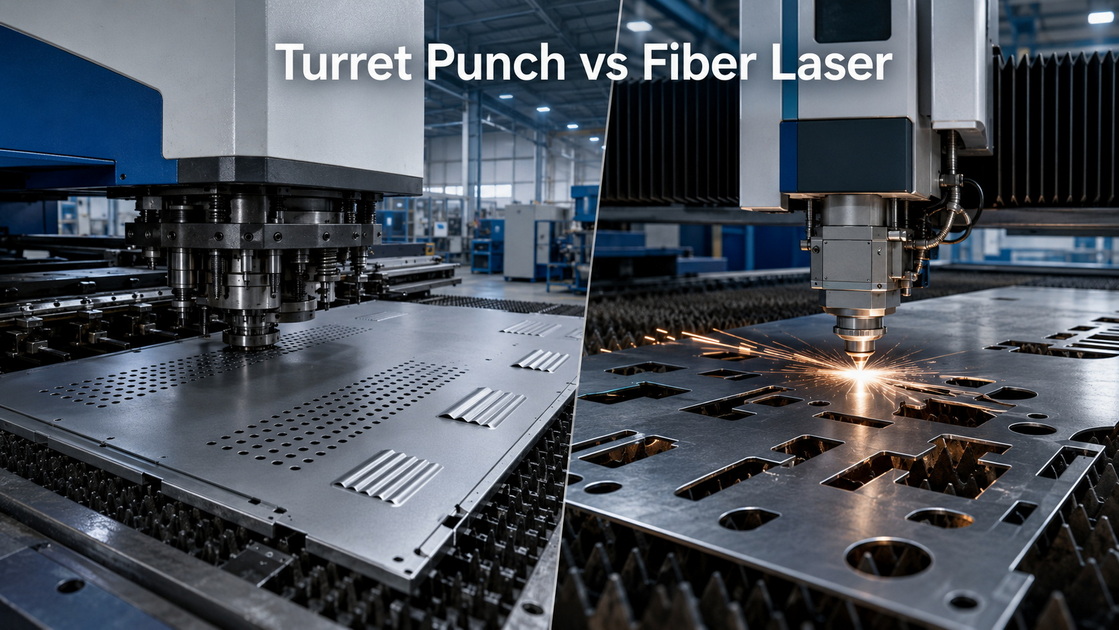
The fundamental difference is the processing method.
A CNC turret punch press uses mechanical force and dedicated tooling to punch, shear, nibble, emboss, form, or create holes in sheet metal. A fiber laser cutting machine uses a focused laser beam and assist gas to melt or vaporize material along a programmed cutting path.
| Factor | CNC Turret Punch Press | Fiber Laser Cutting Machine |
|---|---|---|
| Processing method | Mechanical punching and forming | Non-contact thermal cutting |
| Primary tool | Punch and die tooling | Focused laser beam |
| Tooling requirement | Required for each shape or forming feature | No physical die required |
| Best for | Repeated holes, standard parts, formed features | Complex contours, prototypes, customized parts |
| Flexibility | Lower when new tooling is needed | Very high; change parts by changing the program |
| 3D forming capability | Yes—louvers, embossing, countersinks, flanges | No—mainly 2D cutting |
| Edge condition | May need deburring; nibbling can leave marks | Usually narrow kerf and cleaner contours |
| Typical cost driver | Tooling, maintenance, setup | Electricity, assist gas, laser source, optics |
| Ideal production model | Stable, high-volume production | High-mix, low-to-medium volume production |
In simple terms: the punch press creates features through force; the laser creates profiles through heat.
A CNC turret punch press positions a metal sheet under a punch-and-die set. The machine then applies force—typically through servo-electric, hydraulic, or mechanical drive systems—to shear or form the material.
The turret holds multiple tools, allowing the machine to switch rapidly between standard shapes such as circles, squares, rectangles, slots, and specialty forming tools.
A turret punch press performs especially well when the part has:
- Large quantities of repeated round, square, or slot holes
- Ventilation patterns in electrical cabinets or server enclosures
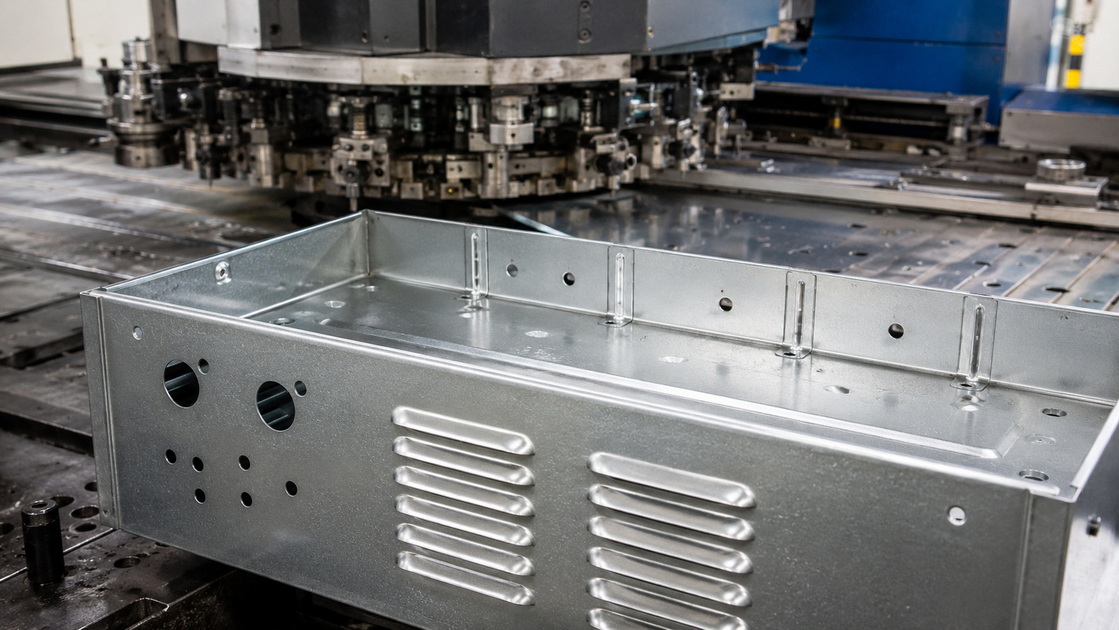
- Louvers, stiffening ribs, embossments, countersinks, or bridge forms
- Stable dimensions and repeat production demand
- High-volume sheet metal parts with an established die library
For example, a control cabinet door may require hundreds of ventilation holes, mounting holes, cable-entry openings, louvers, and embossed grounding points. A punch press can complete many of these operations in one setup, especially if the manufacturer already owns the required tools.
The most important advantage of a CNC turret punch press is not simply punching speed—it is in-machine forming.
With suitable tooling, turret punching can create features including:
- Louvers for airflow and heat dissipation
- Countersinks for flush fasteners
- Embossed logos or identification marks
- Extrusions and bosses
- Stiffening ribs and beads
- Tabs, bridges, and shallow drawn features
A laser cutter can cut the outline of a louver, but it cannot form the raised three-dimensional geometry. That requires a secondary operation such as stamping, bending, or another forming process.
For enclosure manufacturing, HVAC components, elevator panels, telecom cabinets, and electrical distribution equipment, this difference can significantly reduce production steps.
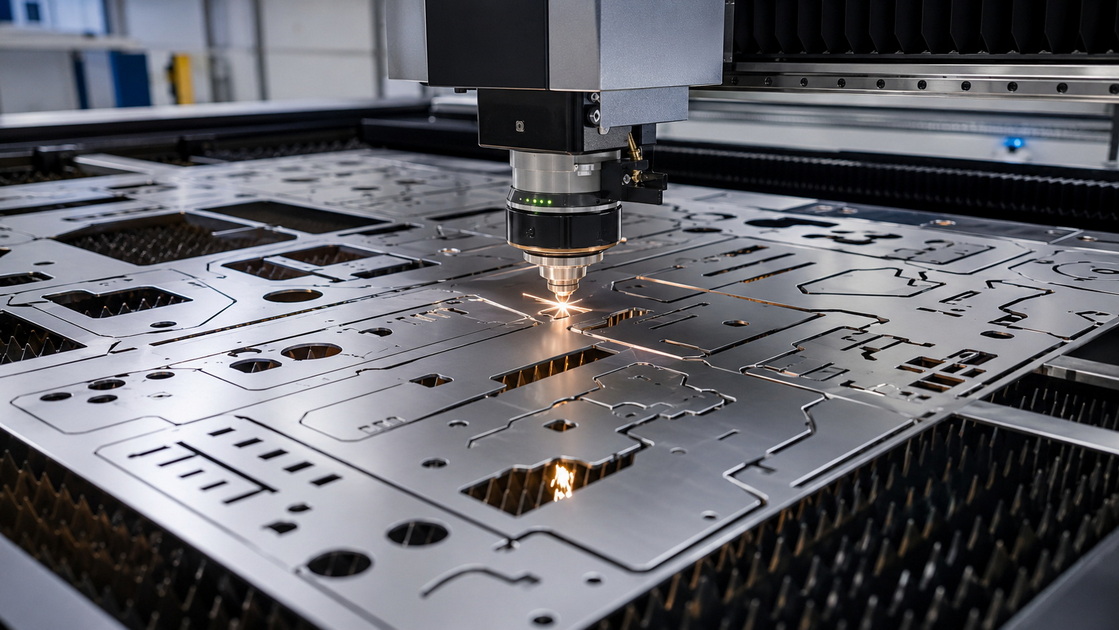
A fiber laser cutting machine converts electrical energy into a concentrated laser beam. The beam is delivered through an optical fiber, focused through the cutting head, and directed onto the sheet material.
At the cutting point, the material melts or vaporizes. Assist gas—usually oxygen, nitrogen, compressed air, or a controlled gas mixture—removes molten material and influences cut speed, oxidation, burr formation, and edge quality.
Fiber laser systems are now the mainstream choice for metal sheet cutting because they combine high beam quality, relatively compact laser sources, high productivity, and broad material capability. Major machine builders continue to emphasize that higher fiber-laser power can increase productivity and enable more economical processing of thicker sheet, although real results still depend on material, gas, optics, cutting parameters, and part geometry.
Fiber laser cutting is usually the better option for:
- Complex contours, curves, sharp internal corners, and custom cutouts
- Prototype production and short production runs
- High-mix sheet metal job shops
- Frequent engineering changes
- Decorative metal panels, signage, furniture components, and custom brackets
- Stainless steel, aluminum, copper, brass, and other metal applications
- Buyers who want to avoid upfront die investment
The key benefit is program-driven flexibility. An operator can change from one design to another by loading a new nesting file, rather than installing new dies.
A common mistake is to compare only strokes per minute or meters per minute. That does not reveal the true cost per finished part.
A turret punch press can be exceptionally fast for repetitive holes. If a panel requires 400 identical round holes, the press can strike each hole rapidly with one matching tool. Tooling designed to improve slug removal can also reduce punching time and support faster processing.
However, if the same panel includes irregular curves, multiple hole sizes, internal radii, custom logos, and frequent engineering revisions, laser cutting may become more efficient because it eliminates tool changes, die requirements, and nibbling operations.
Expert rule: Compare total cycle time from blank sheet to completed, usable part—not just machine movement speed.
Fiber laser cutting generally offers stronger contour flexibility and cleaner edge geometry for intricate profiles. It produces a narrow kerf and avoids the physical force exerted by punching tools.
However, laser quality depends heavily on setup. Material condition, focus position, nozzle alignment, gas purity, lens condition, sheet flatness, and cutting parameters all affect the final edge.
Turret punching can also achieve excellent hole location accuracy when tooling, die clearance, machine condition, and material are properly controlled. But nibbling large contours can create small "scallop" marks, and punched edges may require deburring.
There is no single thickness figure that applies to all machines.
Actual cutting capability depends on:
- Laser power
- Material grade and surface condition
- Material thickness
- Assist gas and gas pressure
- Required edge quality
- Desired cutting speed
- Machine optics and process database
Higher-power fiber lasers can process thicker sheet more economically, but thick-plate laser cutting is not automatically the lowest-cost method. As thickness increases, cutting speed often falls while power use and assist-gas consumption rise.
Bystronic states that high laser power can increase productivity, improve cutting quality, and support more economical processing of thicker sheet; its fiber laser range is specified for steel, aluminum, and non-ferrous metals, with certain models handling material up to 50 mm. Buyers should treat published maximum thickness as a capability limit—not necessarily the best daily production range.
Turret punch presses are typically most effective in thin-to-medium sheet applications. Their practical range depends on tonnage, material type, tool geometry, and the feature being punched or formed.
The cheapest machine to buy is not always the lowest-cost system to operate. A robust purchase decision should account for total cost per completed part.
| Cost Category | Turret Punch Press | Fiber Laser Cutting Machine |
|---|---|---|
| Initial tooling | Potentially high, especially for custom tools | Very low for new 2D profiles |
| Tool maintenance | Die sharpening, replacement, storage, setup | Nozzle, protective lens, optics maintenance |
| Energy use | Depends on drive type and cycle | Depends on laser power, duty cycle, chiller, extraction |
| Assist gas | Usually not a major process cost | Can be a significant recurring expense |
| Changeover | Faster with an existing, organized die library | Fast through program and nesting changes |
| Secondary operations | May need deburring; may eliminate forming steps | May need bending or forming after cutting |
| Best economic case | High-volume, repeat parts | Variable, custom, and complex parts |
Assist gas deserves special attention. Nitrogen is commonly used where oxide-free edges or high-quality finishes are important, but it can increase operating cost. Some fiber laser applications can use compressed air for selected materials and thicknesses, which may reduce gas expense. TRUMPF notes that compressed air can be used for some aluminum applications up to 3 mm, depending on material type and laser output.
TRUMPF also reports that automated nitrogen/oxygen gas-mixing strategies can reduce burr formation under appropriate conditions, while its Highspeed process can reduce nitrogen consumption by an average of 60% in applicable cutting scenarios. These are manufacturer-specific claims, so manufacturers should validate them through their own material trials.
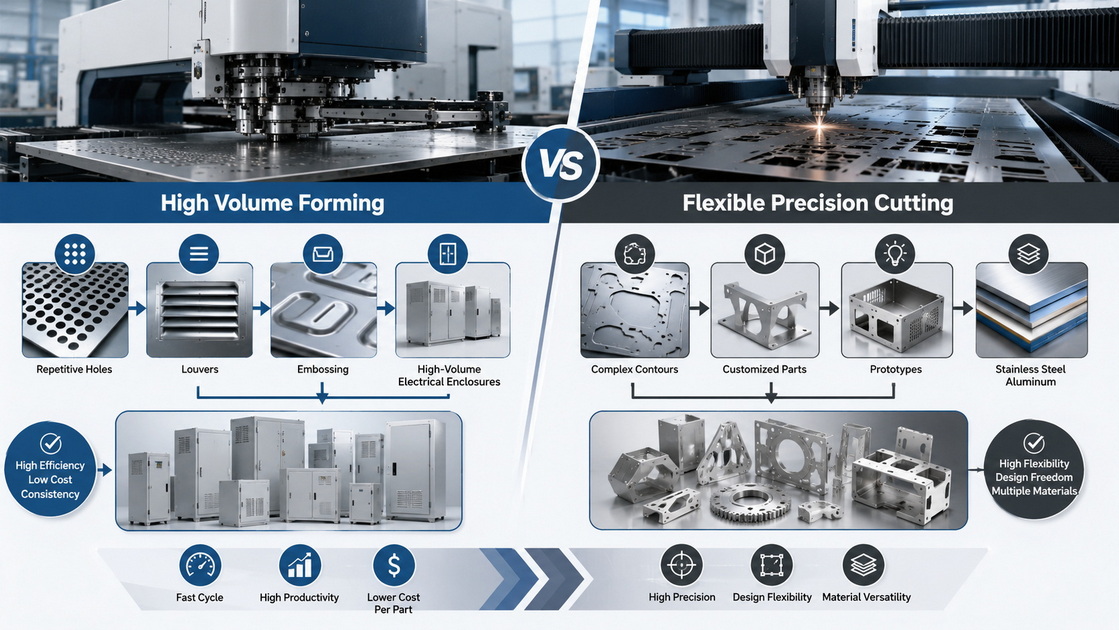
Before purchasing a turret punch press or fiber laser cutting machine, review your actual order history—not just your future wish list.
- Your production includes large volumes of repetitive holes
- Your product designs are stable for long production cycles
- You need louvers, embossing, countersinks, ribs, or other formed features
- You manufacture cabinets, enclosures, panels, HVAC components, or electrical equipment
- You have an existing tooling library or can justify die investment
- You want to reduce downstream forming operations
- Your business handles high-mix, low-volume, or customized orders
- Customers frequently modify drawings
- You process complex contours and precision profiles
- You need short lead times for prototypes or small batches
- You cut different material types and thicknesses
- You want to launch new parts without waiting for tooling
- You produce both repeat enclosure parts and custom profiles
- You need laser flexibility but also require formed features
- You want to separate high-volume punching work from complex laser-cut jobs
- Your factory is building an automated sheet metal production line
In many mature factories, the best answer is not "punch or laser." It is laser cutting for flexible blanking, turret punching for repeated holes and forming, and press brakes for final bending.
Ask your equipment supplier to provide more than a brochure. Request sample cutting or punching trials using your actual material and part drawings.
Use this checklist:
1. What are our top 20 recurring part families by annual volume?
2. What percentage of parts need formed features such as louvers or countersinks?
3. How much do we currently spend on tooling, nitrogen, deburring, and rework?
4. Which material grades and thicknesses generate the largest share of revenue?
5. What edge quality is required for welding, powder coating, plating, or visible surfaces?
6. How often do customers change drawings after initial approval?
7. Can the machine integrate with automatic loading, unloading, storage, sorting, or MES systems?
8. What local service, training, spare-parts support, and response time can the supplier provide?
A machine should be selected based on your actual part mix, production volume, downstream processes, and total cost per part.
CNDY-Press provides sheet metal fabrication equipment solutions for manufacturers, OEM projects, ODM programs, and customized production requirements. Whether you need a fiber laser cutting machine for flexible, high-precision profiles or a turret punch solution for high-volume punching and forming, our team can help evaluate the right configuration for your materials, part drawings, output targets, and automation plan.
Send CNDY-Press your drawings, material specifications, thickness range, and monthly production volume to receive a customized machine recommendation and sample-processing assessment.
It can be faster for large quantities of identical holes or repeated standard features. Fiber laser cutting is often faster overall for complex contours, frequent design changes, and parts that would require extensive nibbling on a punch press.
Not completely. A fiber laser can replace many 2D cutting operations, but it cannot create formed features such as louvers, embossments, extrusions, and countersinks without secondary equipment.
A turret punch press is often highly effective for standard enclosure panels because it can punch repetitive holes and form louvers or stiffening features. A fiber laser is valuable for customized cabinets, low-volume orders, and complex panel designs.
No physical dies are required for standard 2D cutting. Operators create or import a CAD/CAM program, nest the parts, and cut the profile. Consumables such as nozzles and protective lenses are still required.
It varies by application, but major costs commonly include electricity, assist gas, consumables, extraction, maintenance, and labor. Nitrogen use can be especially important in high-volume stainless-steel or aluminum cutting.
1. CNDY-Press / MYT CNC. "[Turret Punch vs Laser Cutting Machine]." Accessed August 2026.
2. TRUMPF. "[Advantages of 2D Laser Cutting Machines]." Accessed August 2026.
3. TRUMPF. "[TruLaser 1030 Fiber / 1040 Fiber / 1060 Fiber]." Accessed August 2026.
4. TRUMPF. "[Automotive Specialist Installs UK's First TRUMPF TruLaser 1030]." February 7, 2020.
5. Bystronic. "[ByStar Fiber High-Speed Fiber Laser Cutting]." Accessed August 2026.
6. AMADA America. "[Thick Turret Tooling]." Accessed August 2026.


