


Views: 284 Author: CNDY-Press Publish Time: 2026-08-31 Origin: Site


Content Menu
● What Is Fiber Laser Metal Cutting?
● How a Fiber Laser Cuts Metal
>> 1. The CNC Program Defines the Toolpath
>> 2. The Laser Beam Heats the Cutting Zone
>> 3. Assist Gas Removes Molten Metal
>> 4. The Motion System Produces the Final Shape
● Which Metals Can a Fiber Laser Cutting Machine Cut?
● Fiber Laser Cutting Parameters That Matter Most
>> Laser Power
>> Assist Gas Purity and Pressure
● Step-by-Step: How to Cut Metal With a Fiber Laser
>> Step 1: Confirm the Material
>> Step 2: Select the Correct Gas Strategy
>> Step 3: Load Verified Cutting Parameters
>> Step 4: Optimize Nesting and Cutting Sequence
>> Step 5: Monitor the First Production Sheet
>> Step 6: Document the Approved Process
● Common Fiber Laser Cutting Problems and Solutions
● Choosing a Fiber Laser Cutting Machine for OEM and ODM Production
>> Ask These Questions Before Buying
● Safety and Preventive Maintenance
>> 1. Can a fiber laser cutting machine cut stainless steel?
>> 2. What gas should I use for fiber laser cutting carbon steel?
>> 3. Is nitrogen more expensive than oxygen for laser cutting?
>> 4. Can a fiber laser cut aluminum, brass, and copper?
>> 5. How can I reduce dross on laser-cut parts?
Cutting metal with a fiber laser cutting machine is one of the most efficient ways to produce precise sheet-metal parts at scale. The best results do not come from laser power alone: material type, thickness, assist gas, nozzle condition, focal position, nesting strategy, and operator process control all determine cut speed, edge quality, and total cost per part.
At CNDY-Press, we design and manufacture fiber laser cutting machines and complete sheet-metal processing equipment for OEM, ODM, and customized production projects. From my perspective as someone evaluating laser-cutting applications for real fabrication workflows, the first question should not be "How many kilowatts do I need?" It should be: What parts do I need to make, at what quality level, and at what total production cost?
This guide explains how fiber laser cutting works, how to choose the correct process for carbon steel, stainless steel, aluminum, brass, and copper, and how manufacturers can build a repeatable, production-ready cutting workflow.
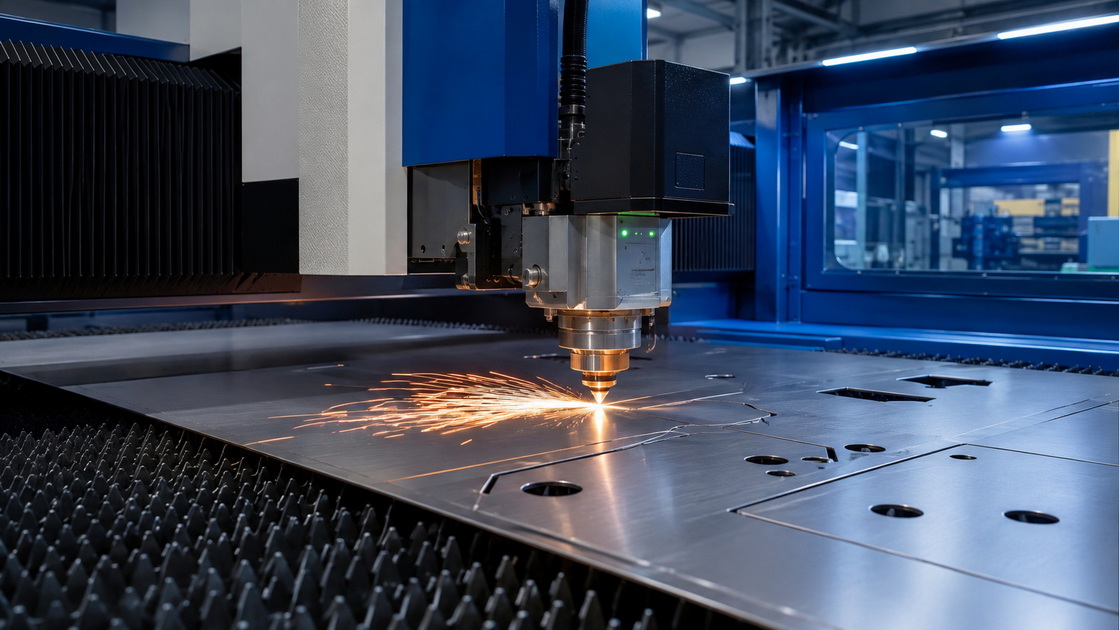
A fiber laser cutting machine uses a solid-state laser source to generate a highly concentrated beam of light. The beam is transmitted through an optical fiber, guided to the laser cutting head, focused into a very small spot, and used to melt or vaporize material along a programmed cutting path.
A CNC system controls movement of the cutting head or worktable. Meanwhile, an assist gas—typically nitrogen, oxygen, or compressed air—blows molten material out of the kerf and influences the final edge condition.
For modern sheet-metal production, fiber laser technology is widely used because it can deliver:
- High cutting speed, especially on thin and medium-thickness metal sheet.
- Precise contours, holes, slots, logos, and complex nested parts.
- Less mechanical contact than traditional punching or sawing.
- Strong performance on reflective metals such as aluminum, brass, and copper.
- Flexible production, from one-off prototypes to high-volume OEM parts.
- Integration potential with automatic loading, unloading, storage, and production-management systems.
Unlike the low-wattage CO₂ laser approach described in the reference article, which emphasizes light-gauge applications, fiber laser cutting is generally the more scalable option for mainstream metal fabrication because it is purpose-built for production cutting of sheet metal across a broader range of materials and thicknesses. The correct machine configuration still depends on the customer's application, duty cycle, target material mix, and finishing requirements.
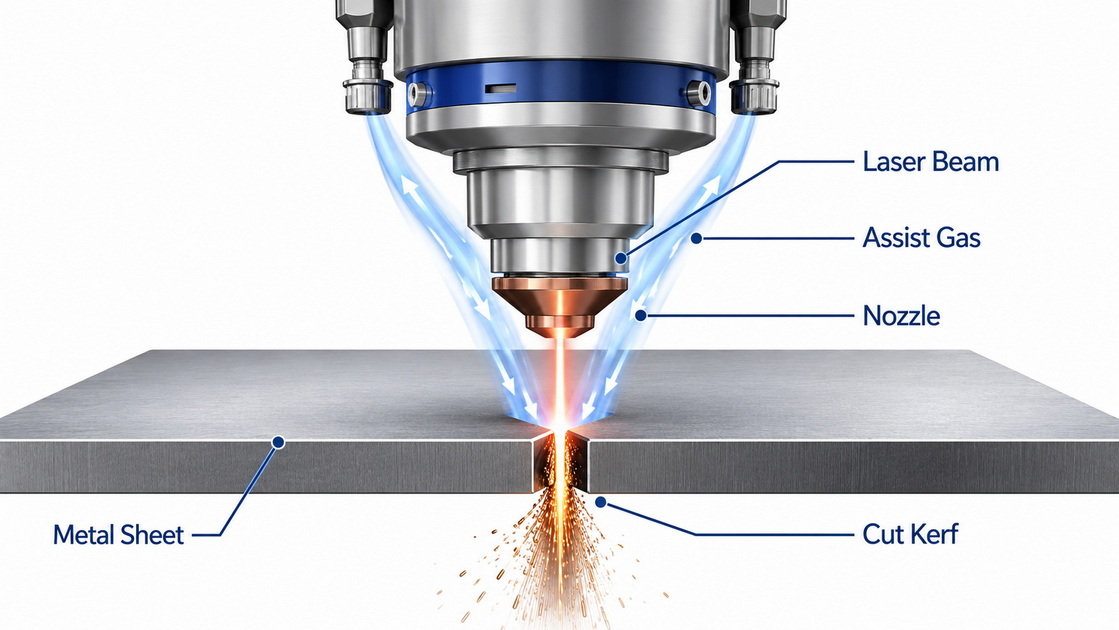
The cutting process looks simple from the outside, but consistent quality requires several systems to work together.
The operator imports a DXF, DWG, or other compatible part file into nesting and cutting software. The software arranges parts on the sheet to reduce material waste, creates lead-ins and lead-outs, assigns micro-joints where needed, and generates the cutting sequence.
Good nesting can have a major effect on material utilization. For OEM and ODM projects, this matters because raw material is often one of the largest contributors to final part cost.
The fiber laser focuses energy onto a small point of the metal surface. This rapidly heats the material to its melting point. The machine then moves along the programmed contour to form the desired geometry.
The focus position must be matched to the material, thickness, nozzle, and gas process. A poorly set focus can cause excessive dross, rough cut walls, incomplete cutting, or unstable piercing.
Assist gas is not merely an accessory. It is a core part of the cutting process.
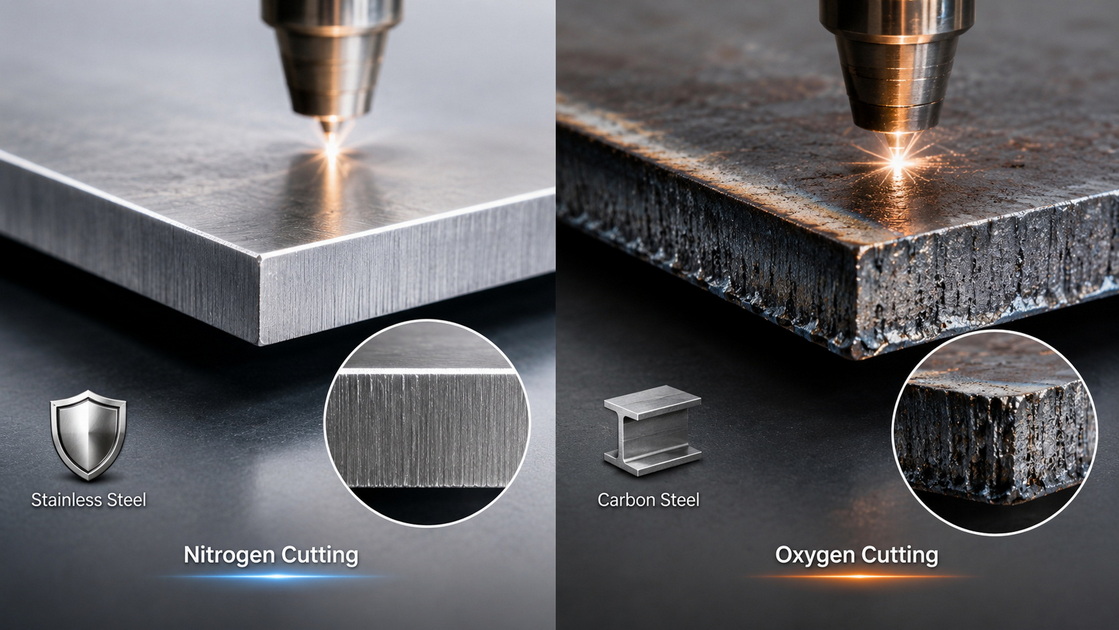
- Nitrogen is an inert gas. It pushes molten metal from the cut while helping produce a bright, low-oxidation edge. It is commonly used for stainless steel, aluminum, and parts that will be welded, painted, polished, or used in visible applications.
- Oxygen reacts with carbon steel and adds heat through an exothermic process. It can support productive cutting of thicker mild steel, although it typically leaves an oxide layer on the cut edge.
- Compressed air can be a lower-cost option for selected materials and less appearance-critical components. However, it may not deliver the same edge finish as high-purity nitrogen.
The machine's frame, servo motors, guide rails, rack-and-pinion system, and control system determine how accurately and consistently the cutting head follows the programmed path.
For parts with tight tolerances, small holes, sharp corners, or detailed decorative patterns, machine rigidity and motion control are just as important as laser source power.
Fiber laser cutting machines are commonly used for both ferrous and non-ferrous metals. Actual cutting capacity varies by laser power, source quality, machine design, material grade, sheet condition, assist gas, and required edge quality.
| Material | Typical Assist Gas | Common Fiber Laser Application | Key Consideration |
|---|---|---|---|
| Carbon steel / mild steel | Oxygen, nitrogen, air | Structural parts, brackets, panels, machinery components | Oxygen can improve thick-section cutting productivity but can leave oxide scale |
| Stainless steel | Nitrogen | Food equipment, enclosures, cabinets, decorative panels, medical-related fabrication | Nitrogen supports cleaner, oxidation-reduced edges |
| Aluminum | Nitrogen | Transport parts, housings, lightweight structures, electrical enclosures | Requires stable parameters because aluminum is reflective and thermally conductive |
| Brass | Nitrogen | Decorative panels, electrical parts, architectural elements | Correct setup is important for reflective material processing |
| Copper | Nitrogen | Busbars, electrical components, heat-transfer applications | Requires a capable fiber laser system and carefully developed parameters |
| Galvanized steel | Nitrogen, air, oxygen depending on needs | Cabinets, HVAC components, enclosures | Coating condition and edge requirements should guide gas selection |
A production buyer should avoid relying only on "maximum thickness" claims. The more useful metric is stable production thickness at your target quality and throughput. A machine may technically cut a material, but that does not always mean it can deliver the edge condition, cycle time, and reliability required for commercial manufacturing.
A practical fiber laser cutting process depends on a balanced parameter set. Changing one item often requires adjustment elsewhere.
Higher laser power can improve cutting speed and increase viable thickness ranges, but it is not automatically the best choice for every factory.
For example:
- A company cutting mostly thin stainless-steel kitchen panels may prioritize high speed, automation, and low operating cost.
- A heavy equipment supplier cutting thicker carbon-steel brackets may require a higher-power configuration and oxygen-capable process.
- A job shop serving diverse customers may need flexibility across stainless, carbon steel, aluminum, brass, and copper.
Power should be selected from the actual part mix—not from a marketing comparison alone.
The ideal speed is the fastest speed that still achieves the required cut quality. If speed is too high, the cut may not penetrate fully or may leave rough edges. If it is too low, heat input increases and production capacity falls.
Modern nozzle design and cutting-process development can materially improve feed rates and gas efficiency. TRUMPF, for example, has reported process improvements that increased feed rates by up to 100% in certain solid-state laser fusion-cutting applications while reducing nitrogen consumption. Results depend on machine configuration and the material application, so manufacturers should validate claims through sample cutting and production trials.
Focus position controls where laser energy is concentrated inside the material thickness.
A good starting point is not a final setting. Operators should conduct controlled test cuts, inspect the top and bottom edge, evaluate dross and striations, and then refine the focal point, speed, gas pressure, and nozzle selection. Test cutting and saving proven parameter libraries are essential for repeatable stainless-steel fabrication.
A nozzle must be correctly centered relative to the beam. Even a small alignment issue can disturb gas flow and reduce cutting quality.
Inspect nozzles regularly for:
- Physical damage.
- Spatter accumulation.
- Incorrect aperture size.
- Poor concentricity.
- Unstable nozzle-to-sheet distance.
For high-quality stainless cutting with nitrogen, a single-nozzle setup is often recommended, while double nozzles are more commonly associated with oxygen cutting of carbon steel.
Gas quality affects part appearance, weld preparation, paint adhesion, and downstream finishing time.
Nitrogen is commonly preferred for stainless steel and aluminum because it supports cleaner, low-oxidation cut edges. For high-specification applications—such as food-grade equipment, medical equipment, or architectural stainless—gas purity requirements can be more demanding.
A disciplined setup process prevents costly scrap and improves consistency between shifts.
Verify the material type, thickness, grade, surface condition, protective film, and flatness. Do not assume that all "stainless steel" or all "aluminum" behaves identically.
For critical jobs, record:
- Material supplier and grade.
- Sheet thickness tolerance.
- Coating or protective-film condition.
- Batch number.
- Flatness or warpage observations.
Use nitrogen when edge appearance, corrosion resistance, welding readiness, or coating performance is important. Use oxygen when carbon-steel productivity and thickness capability are the priority and a slight oxide layer is acceptable.
Before production, clarify the downstream process:
- Will the part be welded?
- Will it be powder coated?
- Is it a visible decorative surface?
- Is edge grinding acceptable?
- Does the component need food-grade or clean-environment suitability?
These questions should drive the gas choice.
Begin with a proven parameter library based on material and thickness. Then perform a sample cut before starting a production batch.
Check:
- Pierce quality.
- Cut-through consistency.
- Dross on the lower edge.
- Surface burn marks.
- Kerf width.
- Small-hole accuracy.
- Corner quality.
- Part deformation.
Place parts efficiently across the sheet while maintaining enough distance to control heat buildup. Sequence cuts so that smaller internal features are completed before external contours.
For thin sheet, poor sequencing can cause part movement, heat distortion, or collision risk. Micro-joints and suitable part-support methods help retain small components until the cutting cycle is complete.
The first sheet should be inspected more carefully than later sheets. Observe the pierce, listen for irregular cutting behavior, and inspect edge quality from multiple part locations.
Do not rely only on the top surface. The lower edge often reveals problems first.
Once the part meets requirements, save the program and parameter set with clear naming.
| Problem | Likely Causes | Practical Actions |
|---|---|---|
| Excessive bottom dross | Speed too low or high, incorrect focus, weak gas flow, damaged nozzle | Check nozzle condition and centering; adjust focus and speed through test cuts |
| Incomplete cutting | Insufficient energy, incorrect focus, contaminated optics, unstable material | Inspect protective lens; confirm material thickness; reduce speed or refine focus |
| Rough edge striations | Poor parameter match, motion instability, gas-flow issues | Recheck speed, focus, gas pressure, nozzle gap, and machine maintenance |
| Burn marks or discoloration | Inappropriate gas strategy, excessive heat input, protective-film issues | Review gas selection; improve cutting sequence; validate film compatibility |
| Poor small-hole quality | Hole diameter too small for thickness, incorrect pierce or speed setting | Use optimized small-hole parameters and verify suitable hole-to-thickness design rules |
| Frequent lens contamination | Spatter, poor piercing process, material coating, gas contamination | Inspect pierce conditions, nozzle alignment, gas quality, and protective-lens maintenance |
The most efficient troubleshooting method is to change one variable at a time. If an operator simultaneously changes speed, focus, pressure, and nozzle type, it becomes difficult to identify the real cause of the improvement or failure.
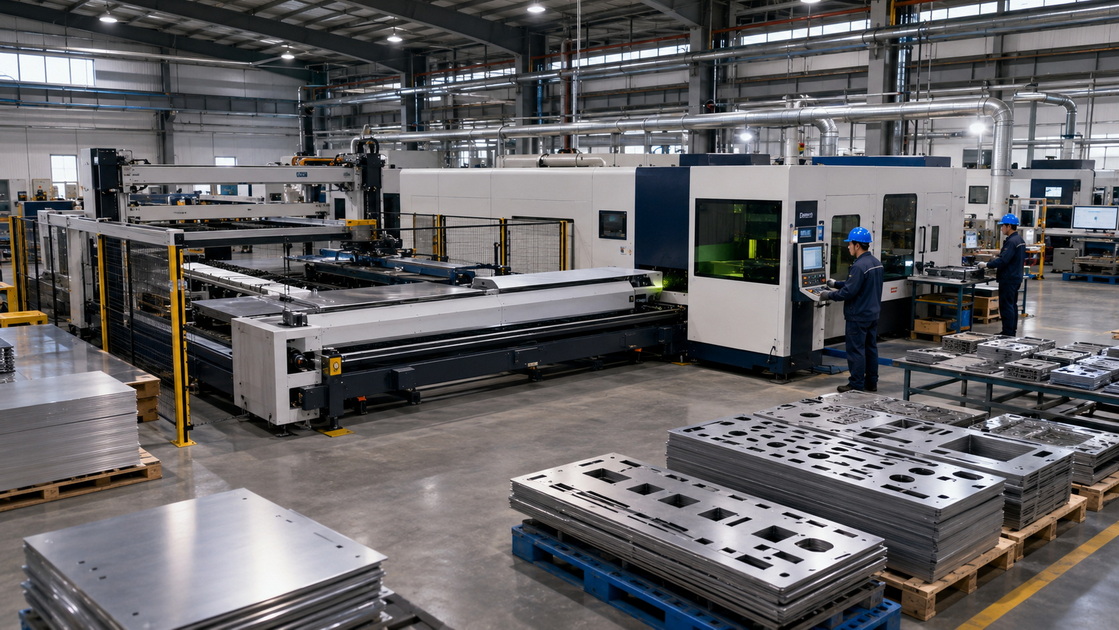
For OEM and ODM buyers, a machine purchase should be evaluated as a production system—not just as a laser source and a price quotation.
1. What materials and thicknesses will represent most of your monthly production volume?
2. What edge condition does the finished part require?
3. How many sheets must be processed per shift?
4. Do you need manual loading, semi-automatic loading, or full automation?
5. What is the acceptable downtime if a key component fails?
6. Are spare parts, remote diagnostics, installation, training, and local service available?
7. Can the supplier provide sample cuts using your actual drawings and materials?
8. Does the supplier have the engineering capability to customize the machine around your workflow?
A standard machine may be sufficient for a simple cutting application. But integrated sheet-metal production often requires custom engineering around:
- Working-table size.
- Laser power level.
- Rotary attachment for tube and profile cutting.
- Automatic sheet loading and unloading.
- Material storage systems.
- Conveyor and scrap-removal configuration.
- Fume extraction and filtration.
- Software integration.
- Safety enclosure requirements.
- Integration with bending, welding, sorting, or other downstream equipment.
At CNDY-Press, our role as a manufacturer is to help customers translate a parts list and output target into an equipment configuration that supports real production—not only a theoretical specification sheet. We provide OEM, ODM, and customized manufacturing support for fiber laser cutting machines and complete sheet-metal processing solutions.
Fiber laser cutting systems must be operated according to the machine manufacturer's instructions, local regulations, and recognized laser-safety practices. Laser safety standards address hazard classification, safety controls, measurements, protective equipment, and the responsibilities of laser safety personnel.
Key operating practices include:
- Keep protective doors, interlocks, and enclosures functional.
- Never bypass machine safety systems.
- Use appropriate extraction and filtration for metal fumes.
- Inspect optics, nozzles, sensors, and assist-gas lines routinely.
- Maintain clean, dry gas supply systems.
- Train operators on startup, shutdown, alarms, emergency stops, and material-handling risks.
- Establish a preventive-maintenance schedule instead of waiting for cut quality to decline.
A well-maintained machine protects more than uptime. It protects the quality consistency that OEM customers expect from every batch.
The best fiber laser cutting result is achieved when machine power, material, gas selection, nozzle design, focus position, software, nesting, automation, and operator discipline work as one system.
For stainless steel and aluminum, nitrogen is often chosen when a cleaner, low-oxidation edge is needed. For thicker carbon steel, oxygen can be valuable when productivity matters more than a bright, oxide-free edge. But every claim should be validated on your own material, with your own drawings, quality requirements, and production targets.
If you are sourcing a fiber laser cutting machine, planning an OEM equipment project, or building a customized sheet-metal production line, CNDY-Press can help assess your application and recommend a practical configuration based on your material range, thickness, output goals, automation needs, and budget.
Yes. Fiber lasers are widely used to cut stainless steel. Nitrogen is commonly selected because it helps create a cleaner edge with reduced oxidation, which is valuable for visible components, welding, coating, food equipment, and architectural fabrication.
Oxygen is commonly used for carbon steel because it reacts with the material and can add heat to the cutting process, especially for thicker applications. Nitrogen may be selected when edge condition and lower oxidation are more important than gas cost.
Nitrogen is often a significant operating-cost item in laser cutting, particularly for high-pressure cutting of stainless steel and aluminum. However, its cleaner edge can reduce downstream grinding, cleaning, and finishing work, so the correct comparison is total cost per finished part—not gas price alone.
Yes. Fiber laser systems can process aluminum, brass, and copper, which are reflective metals. Machine capability, proper parameters, stable gas delivery, and operator experience are important for achieving consistent results.
Start by checking nozzle condition and beam centering, then fine-tune focus position, cutting speed, gas pressure, and nozzle gap. Confirm that the protective lens is clean and that the material thickness matches the programmed parameters. Change one variable at a time and save the approved process once quality is stable.
1. Kern Laser Systems. "[How to Cut Metal With a CO2 Laser]." Accessed August 31, 2026. The original reference article describes low-wattage CO₂ laser metal-cutting applications, example materials, and the role of oxygen and nitrogen assist gas. [kernlasers]
2. TRUMPF. "[Twice the Cutting Speed]." November 5, 2017. Source for reported feed-rate and nitrogen-consumption improvements associated with nozzle and fusion-cutting process development. [trumpf]
3. Maintecx. "[Fiber Laser Assist Gas Selection on TRUMPF 2D Lasers]." June 29, 2026. Source for practical distinctions between nitrogen, oxygen, and mixed-gas strategies in fiber laser cutting. [maintecx]
4. Laguna Tools. "[How to Perfectly Cut Stainless Steel with a Fiber Laser]." February 17, 2025. Source for setup considerations including nitrogen supply, nozzle selection, test cutting, focus adjustment, and parameter documentation. [info.lagunatools]
5. Arcus CNC. "[Nitrogen vs. Oxygen vs. Air: Assist Gas Selection Laser Cutting Guide]." March 13, 2026. Source for gas-use guidance and high-purity nitrogen examples for stainless-steel and aluminum applications. [arcuscnc]
6. Bodor Laser. "[How to Choose Assist Gas for Laser Cutting]." Source for general guidance on nitrogen, oxygen, and air in laser cutting. [bodor]
7. Laser Institute of America. "[Laser Safety Standards]." Source for ANSI Z136 laser safety standards and safety-program context. [lia]
8. Mid Atlantic Machinery. "[Choosing the Right Cutting Machine: TRUMPF Fiber Lasers]." November 4, 2021. Source for example discussion of laser power, speed, and nitrogen operating-cost considerations. [midatlanticmachinery]


