


Views: 228 Author: CNDY-Press Publish Time: 2026-09-02 Origin: Site


Content Menu
● What Is a Servo Electric Press Brake?
● Why Servo Electric Press Brakes Are Growing in 2026
>> Energy Efficiency and Idle-Time Savings
>> Faster Response and Shorter Cycle Times
>> Reduced Hydraulic Maintenance
● 5 Notable Servo Electric Press Brake Solutions
>> 1. CNDY Press Custom Servo Electric Press Brake Solution
>> 3. Cincinnati Goform Electric Press Brake
● Comparison Framework for Buyers
● How to Calculate Electric Press Brake ROI
>> Calculate Energy Savings Carefully
>> Measure Productivity as Parts Per Shift
● When a Servo Electric Press Brake Is the Right Choice
● When a Hydraulic or Hybrid Press Brake May Be Better
● Factory Acceptance Test Checklist
● FAQ
>> 1. What is a servo electric press brake?
>> 2. Are servo electric press brakes more energy efficient?
>> 3. How much energy can an electric press brake save?
>> 4. Can a servo electric press brake bend stainless steel?
>> 5. What tonnage do I need for a servo electric press brake?
A servo electric press brake can be an excellent investment for manufacturers producing thin-to-medium-gauge sheet-metal parts that require high repeatability, fast cycles, lower idle energy use, and reduced hydraulic maintenance. However, the "best" servo electric press brake is not a single universal model—it is the machine whose force range, bending length, tooling, automation, accuracy, safety system, and service support match your actual production mix.
For buyers comparing the best servo electric press brakes in 2026, the central decision is not simply electric versus hydraulic. It is whether your parts, annual volume, material range, cycle-time targets, shop-floor conditions, and total-cost-of-ownership goals support a fully electric bending platform.
CNDY-Press develops, manufactures, sells, and services CNC press brakes and integrated sheet-metal fabrication equipment. We also support OEM, ODM, and customized production projects. From an equipment-manufacturing perspective, we recommend that buyers compare published claims with verifiable machine specifications, sample-part trials, energy measurements, tooling compatibility, safety configuration, and after-sales capability.
Buyer takeaway: Servo electric press brakes are usually strongest in high-repeatability work involving smaller parts, thin-to-medium sheet, frequent idle time, and production environments where energy use, noise, oil-free operation, and low maintenance are priorities.
A servo electric press brake is a sheet-metal bending machine in which electric servo motors generate and control ram motion rather than relying on a conventional continuously operating hydraulic power system.
Depending on the machine architecture, the servo motor may transmit force through:
- Ball screws
- Planetary roller screws
- Belt-and-pulley systems
- Gear systems
- Linkage mechanisms
- Direct electromechanical drive systems
The CNC controller coordinates ram position, speed, backgauge movement, bend sequence, crowning where applicable, and safety functions. This allows the press brake to produce repeatable bends while consuming energy primarily when the ram is moving.
In contrast, a traditional hydraulic press brake uses hydraulic fluid, pumps, valves, cylinders, and pressure-control components to move the ram. Hydraulic technology remains valuable for high-tonnage, long-bed, heavy-plate, and demanding forming applications. But it may consume power when idling and requires hydraulic-oil management.
| Feature | Servo Electric Press Brake | Hydraulic Press Brake |
|---|---|---|
| Main drive | Electric servo motor and mechanical transmission | Hydraulic pump, valves, cylinders, and oil |
| Energy use at idle | Usually low because motors operate on demand | Often higher because pumps may maintain system pressure |
| Maintenance focus | Mechanical drive, electronics, lubrication, belts or screws depending on design | Oil, filters, valves, hoses, seals, pumps, cylinders |
| Noise level | Often lower | Often higher due to hydraulic pumps |
| Typical strengths | Fast response, high repeatability, energy efficiency, clean operation | Higher tonnage availability, long-bed capability, broad heavy-duty versatility |
| Best-fit applications | Precision parts, electronics, appliances, HVAC, light fabrication | Thick plate, long workpieces, heavy fabrication, broad material range |
| Oil use | No hydraulic oil in fully electric systems | Hydraulic oil required |
Electric press-brake systems generally use power primarily when the ram moves, while hydraulic machines may run pumps to maintain pressure even when waiting for the next bend. This difference explains why electric machines are frequently positioned as lower-energy and lower-maintenance solutions for suitable applications.
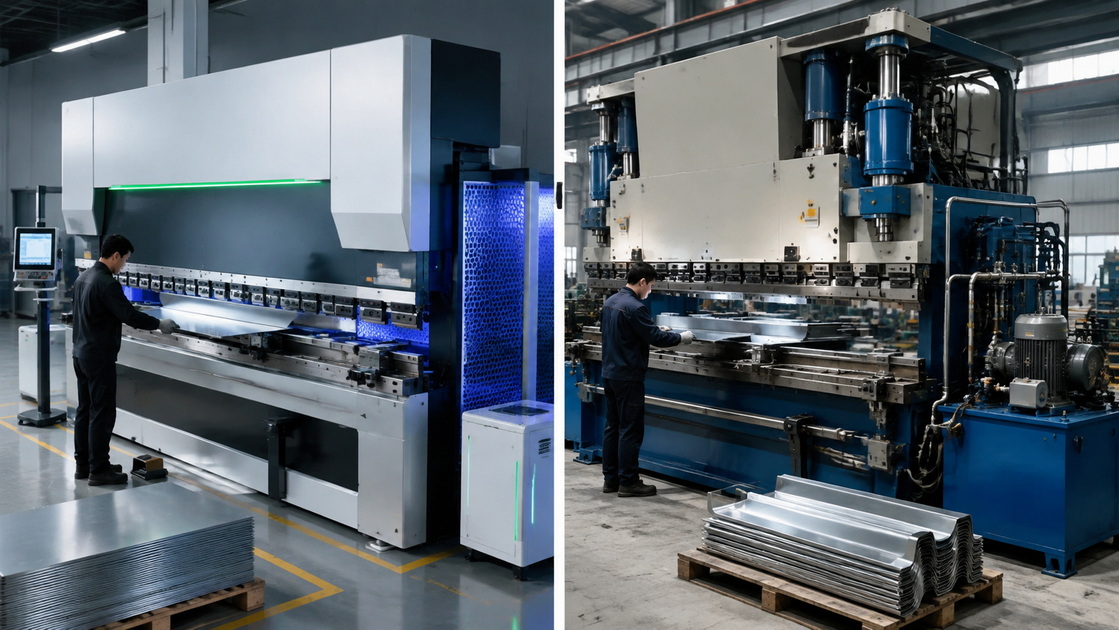
Manufacturers are under pressure to reduce unit cost, improve consistency, shorten lead times, document sustainability progress, and operate safely with skilled-labor constraints. Servo electric press brakes address several of these needs, but only when applied to the right work.
A fully electric press brake does not require hydraulic oil circulation. Its servo motors typically draw significant power only when the ram is approaching, bending, returning, or repositioning.
A report from "The Fabricator"cites supplier estimates that electric press brakes can use approximately 50% less energy than comparable hydraulic systems in certain operating scenarios. The same report emphasizes that results depend on machine design and utilization, so buyers should request site-specific energy data rather than assuming a universal percentage.
Prima Power states that its eP Series can achieve cycle-time reductions of up to 30% or more compared with conventional press brakes, while also reducing power consumption and eliminating hydraulic-oil purchasing and disposal.
Servo motors can accelerate, decelerate, and change direction quickly. In a production environment with repetitive small parts, the reduction in non-cutting and non-forming time can improve parts per hour.
However, maximum ram speed should never be evaluated alone. A meaningful comparison should consider:
- Approach speed
- Bending speed
- Return speed
- Backgauge movement time
- Tool-change time
- Part handling time
- Operator reach and ergonomics
- Safety-system behavior
- Program changeover time
- First-part approval time
If an operator spends most of the cycle loading and unloading a large panel, a faster ram may provide limited total productivity improvement. If the machine bends many small, repeatable components per hour, a faster electric drive can have a stronger commercial impact.
Fully electric systems eliminate several hydraulic-service tasks, including oil replacement, filtration, fluid disposal, hose inspection, and leak management. This may reduce routine maintenance burden and support cleaner working environments.
That does not mean electric press brakes are maintenance-free. Buyers still need to plan for:
- Mechanical-drive inspection
- Lubrication where required
- Belt, screw, or transmission checks
- Electrical-cabinet maintenance
- CNC-controller updates
- Backgauge calibration
- Tooling care
- Safety-device testing
- Operator training
Expert perspective: "Oil-free" does not mean "zero maintenance." It means maintenance shifts from hydraulic components toward precision mechanical, electrical, software, and safety systems.
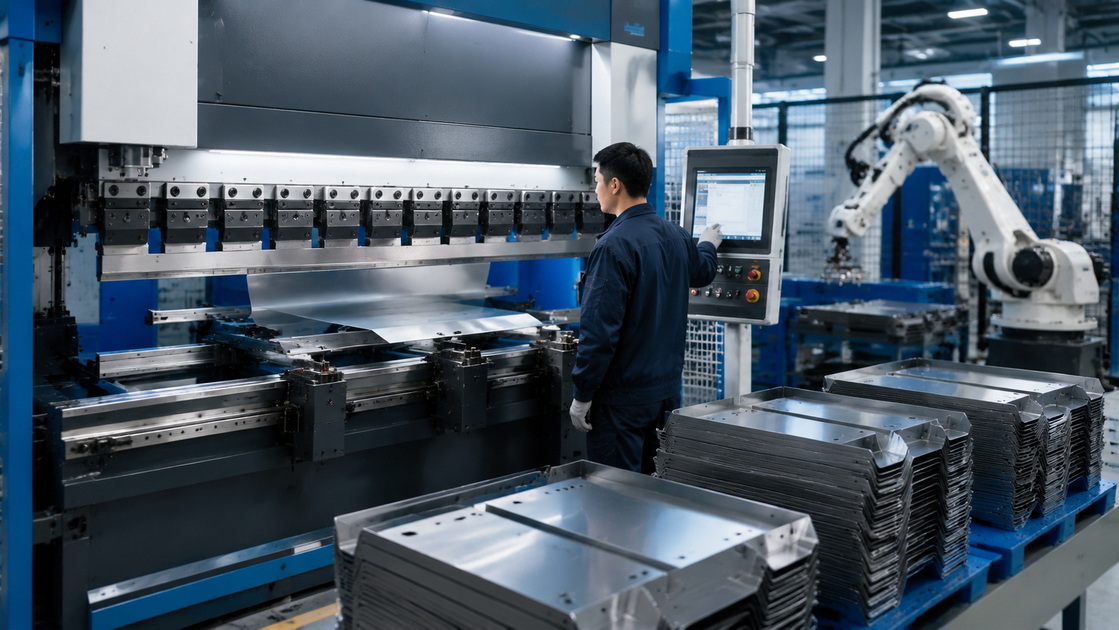
The following machines are notable reference points for buyers researching the servo electric press brake market. They are not a universal ranking, because suitability depends on material thickness, bending length, required force, automation level, regional service coverage, and project budget.
A CNDY-Press servo electric press brake solution is designed around the customer's part requirements rather than a one-size-fits-all machine list. For sheet-metal fabricators, OEM brands, appliance manufacturers, cabinet producers, electrical-enclosure suppliers, HVAC companies, and precision component producers, the key value is configuration flexibility.
A customized servo electric press brake project can include:
- Tonnage and bending-length selection
- CNC control-system configuration
- Backgauge axis selection
- Servo drive and transmission architecture
- Tooling-clamp system
- Crowning configuration
- Front support arms
- Safety-laser or light-curtain options
- Automation interfaces
- Custom electrical requirements
- OEM branding and appearance
- Export packing and installation documentation
Best for: Buyers who need an application-specific machine, OEM branding, tailored controls, specialized tooling, or a press brake integrated into a broader sheet-metal production line.
Buying question: Can the supplier verify machine performance with your actual material, bend sequence, tooling, and representative part drawings before final configuration?
Prima Power's eP Series is one of the most recognized servo-electric press-brake references for manufacturers emphasizing productivity, sustainability, and low operating consumption. The series uses servo-electric drive technology and is positioned for reduced cycle times, lower energy use, lower maintenance needs, and oil-free operation.
Prima Power states that its eP technology can reduce cycle times by up to 30% or more compared with conventional press brakes. Its product information also emphasizes lower environmental impact, less maintenance, and elimination of hydraulic-oil purchasing and disposal.
Best for: High-repeatability applications, production environments focused on energy efficiency, and manufacturers that value integrated automation and established global technology support.
Consider before buying: Confirm the available tonnage, working length, tooling standard, local spare-parts availability, software integration, and the machine's performance with your material range.
The Cincinnati Goform is an all-electric press-brake solution designed around compactness, flexible use, and an electric-drive architecture. The source article highlights a planetary roller screw design, portable configuration, a 10-inch stroke, and a six-axis backgauge option.
The key commercial advantage of this type of machine is its suitability for manufacturers that need accurate bending in limited floor space, flexible cell layouts, and quick adaptation across a changing part mix. The machine concept can be especially relevant for job shops, prototype departments, low-to-medium volume producers, and facilities with limited room for a conventional hydraulic power unit.
Best for: Compact manufacturing cells, flexible sheet-metal production, prototype work, and shops prioritizing footprint and portability.
Consider before buying: Compare actual force capacity, throat depth, daylight, stroke, tool-height limits, service coverage, and whether the machine's physical configuration supports your largest part.
AMADA's EGBe Series represents a high-technology all-electric press-brake category aimed at precise, automated, and digitally integrated manufacturing. The source article describes the EGBe Series as featuring electric drive, AMNC 4ie controls, advanced operator-interface functions, and a backgauge designed to support asymmetric workpieces.
For buyers operating in high-mix, high-value manufacturing, the appeal of this kind of solution lies in the combination of CNC usability, repeatable forming control, automation compatibility, and productivity-oriented ergonomic features.
Best for: Electronics enclosures, appliance components, automotive parts, precision fabricated assemblies, and manufacturers pursuing digitalized fabrication workflows.
Consider before buying: Advanced controls and automation functions can provide value, but buyers should assess training requirements, software usability, integration with existing ERP/MES systems, and local service response capability.
The LVD Dyna-Press is a compact electric-drive press brake designed for speed, bending accuracy, energy savings, and lower maintenance requirements. LVD positions the machine as a flexible bending solution for applications that benefit from a compact all-electric configuration.
Published Dyna-Press specifications show working speeds up to 25 mm/s, depending on model configuration, and cite low connected electrical consumption for specific machines. The available models and specifications vary, so buyers should verify current data directly with the manufacturer or local distributor.
Best for: Smaller precision components, high-frequency repeat bends, compact production spaces, and manufacturers that need low operating consumption with reliable repeatability.
Consider before buying: Evaluate maximum part dimensions, tooling capacity, backgauge axes, throat depth, automation integration, and compatibility with your planned product growth.
A list of models is useful only when it supports a practical comparison. Use the following framework to evaluate any electric CNC press brake.
| Evaluation Factor | Why It Matters | What to Request |
|---|---|---|
| Maximum force | Determines whether the machine can bend the required material and length | Verified tonnage calculation using your material and V-die |
| Bending length | Limits maximum workpiece size | Usable bending length, distance between frames, throat depth |
| Drive design | Influences speed, maintenance, force behavior, and noise | Servo type, screw or belt design, service intervals |
| Ram accuracy | Affects bend consistency and rework | Positioning and repeatability specifications, test results |
| Backgauge axes | Determines setup flexibility for complex parts | X, R, Z1, Z2, X1, X2 axis configuration |
| Crowning | Supports angle consistency on long parts | Mechanical or CNC-controlled crowning details |
| Tooling system | Affects setup time and product flexibility | Tooling standard, clamps, segmented tooling options |
| Safety | Protects operators and supports compliance | Risk assessment, laser protection, guards, emergency stops |
| Automation | Supports productivity and labor efficiency | Robot interface, tool changer, sheet handling options |
| Energy data | Helps calculate operating cost | Measured kWh per part or kWh per operating hour |
| Service capability | Determines uptime after installation | Local technician coverage, parts lead times, remote diagnostics |
| Acceptance testing | Verifies real-world capability | Factory acceptance test using representative parts |
Energy savings are valuable, but they should not be the only reason to buy a servo electric press brake. A robust ROI model should include labor, cycle time, quality, maintenance, energy, tooling, and production capacity.
Annual ROI=Annual Savings and Added Gross Profit/Total Investment×100
A more useful annual-benefit calculation is:
Annual Benefit=Energy Savings+Maintenance Savings+Labor Savings+Scrap Reduction+Added Contribution Margin
Use actual electricity data, not generic marketing percentages.
Annual Energy Cost=Measured Annual kWh×Electricity Price per kWh
Then:
Energy Savings=Hydraulic Press Brake Energy Cost−Servo Electric Press Brake Energy Cost
Illustrative example only: If a hydraulic press brake consumes 35,000 kWh annually and a comparable electric machine consumes 17,500 kWh annually, at an electricity price of $0.14 per kWh, the estimated annual energy difference is:
(35,000−17,500)×0.14=$2,450
This scenario was cited by an electric-press-brake supplier in "The Fabricator" and should be treated as an example—not a guaranteed result. Actual energy use changes with tonnage, duty cycle, material, bend program, machine configuration, idle time, maintenance condition, and local electricity cost.
Do not compare only "cycle time per bend." Compare productive output.
Parts per Shift=Available Shift Time×Machine Availability/Average Total Time per Part
Average total time per part should include:
- Loading
- Backgauge movement
- Ram movement
- Bending
- Turning or repositioning the part
- Unloading
- Inspection
- Tool changes
- Program changes
- Minor stoppages
An electric press brake may have a substantial technical speed advantage, but ROI is strongest when operators can use that advantage without waiting for material handling, inspection, or downstream operations.
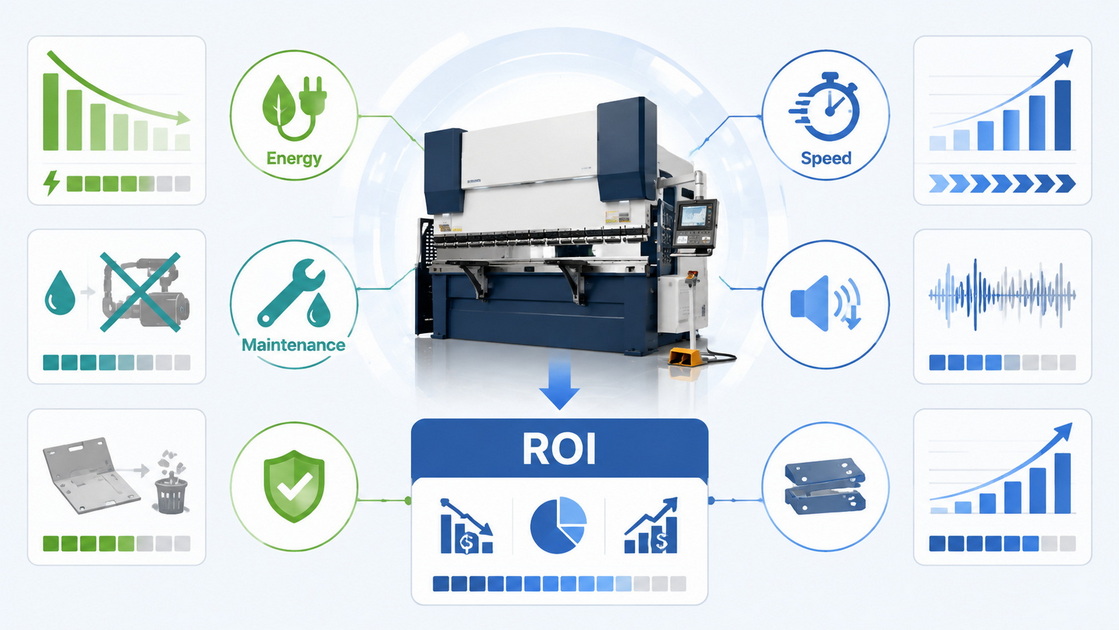
A servo electric press brake is often a strong fit when your production includes:
- Thin-to-medium-gauge sheet metal
- Smaller or medium-size components
- High repeatability requirements
- Frequent short cycles
- High-volume repetitive parts
- Precision brackets and enclosures
- Electrical cabinets
- Appliance parts
- HVAC components
- Electronics housings
- Medical-equipment components
- Automotive brackets
- Clean manufacturing areas
- Noise-sensitive workshops
- Sustainability or energy-reduction objectives
Electric machines are particularly compelling when they replace a hydraulic machine that spends substantial time idling. Since electric drives can draw much less energy while waiting between bends, utilization patterns matter as much as total annual production volume.
A fully electric machine is not automatically the best option for every sheet-metal project.
Consider hydraulic or hybrid servo-hydraulic alternatives when you need:
- Very high tonnage
- Long bending lengths
- Heavy plate bending
- Large structural parts
- Wide or unusually deep tooling
- Broad variation in heavy material thickness
- High forming force across long parts
- A machine type already supported by your maintenance team
- A specific capital-budget target where hydraulic equipment offers a better fit
Hydraulic press brakes remain widely used because they can offer strong force-generation capability and broad configurations for heavy-duty work. Hybrid servo-hydraulic systems may provide a middle path by retaining hydraulic-force capability while reducing idle energy use through servo-controlled pump technology.
Selection principle: Buy the press brake for your most demanding profitable production parts—not for the average bend or the largest headline specification.
Before approving a custom servo electric press brake, conduct a structured Factory Acceptance Test, commonly called an FAT. This is one of the most valuable steps missing from many high-level machine comparison articles.
Ask the supplier to run representative customer parts using your actual or equivalent material, your preferred tooling, and the intended production sequence.
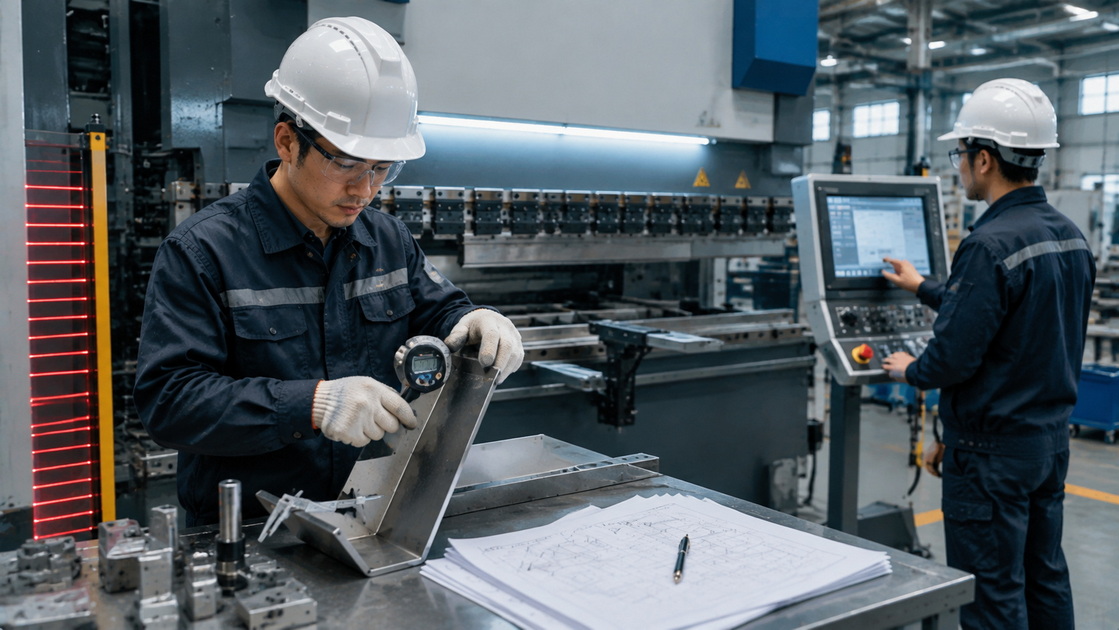
1. Verify machine model, tonnage, bending length, electrical configuration, and agreed accessories.
2. Confirm the CNC controller, software version, backgauge axes, crowning system, clamps, and safety devices.
3. Run bends using representative part drawings and production materials.
4. Measure flange dimensions, inside bend radius, bend angle, and repeatability across multiple cycles.
5. Test long-part angle consistency and crowning performance.
6. Record actual cycle time, including backgauge movements and program changes.
7. Measure energy use with an appropriate power meter during a defined test cycle.
8. Inspect tooling alignment, ram movement, backgauge positioning, and machine noise.
9. Verify emergency stop, guarding, light protection, and safety functions according to the agreed risk assessment.
10. Confirm packaging, export documents, installation instructions, training plan, warranty terms, and spare-parts list.
A documented FAT shifts the conversation from catalog claims to measurable evidence. It gives both buyer and manufacturer a clearer basis for machine acceptance and future support.
The best servo electric press brake solution for 2026 is the one that matches your actual material range, part geometry, bending length, tonnage, annual volume, labor model, and energy objectives.
For precision sheet-metal production involving smaller parts, high repetition, short cycle times, clean-shop requirements, and strong energy-efficiency goals, a fully electric press brake can offer compelling advantages. Published supplier and industry sources consistently emphasize lower idle energy use, faster drive response, reduced hydraulic maintenance, and potential cycle-time improvement.
For long-bed, high-tonnage, or heavy-plate work, hydraulic or hybrid servo-hydraulic press brakes may still provide the more appropriate force, flexibility, and investment profile.
CNDY-Press supports CNC press brake projects from initial technical consultation through custom configuration, OEM and ODM manufacturing, factory acceptance testing, installation support, and service planning.
A servo electric press brake is a sheet-metal bending machine that uses electric servo motors and a mechanical drive system, such as belts, ball screws, or roller screws, to move the ram. Unlike a conventional hydraulic press brake, it does not rely on hydraulic oil for its primary bending motion.
They can be, especially in applications with meaningful idle time and repetitive short-cycle work. Electric machines commonly use power mainly when the ram moves, whereas traditional hydraulic systems may consume energy while maintaining pressure. Reported savings vary by machine design, production cycle, and duty pattern, so request measured energy data for your application.
Some suppliers report energy reductions of around 50% compared with comparable hydraulic machines under particular conditions. However, this is not a universal guarantee. Savings depend on machine size, production volume, idle time, bend program, material, operator workflow, and electricity cost.
Yes, provided the machine has sufficient tonnage, appropriate tooling, correct V-die opening, and a configuration suitable for the stainless-steel thickness, tensile strength, bend length, and bend method. Always calculate required bending force using actual material data.
Required tonnage depends on material tensile strength, thickness, bend length, die opening, bend radius, tooling, and whether you are air bending, bottoming, or coining. Ask the manufacturer to verify calculations using your part drawings and materials. Include a reasonable capacity margin, but do not oversize the machine without an application reason.
1. CNHAWE. "[5 Best Servo Electric Press Brake Solutions for 2026]." The original article used as the source framework for the five referenced machine solutions and selection considerations. [cnhawe]
2. The Fabricator. "[Electric Press Brakes Surge Forward]." Provides supplier perspectives on electric press-brake speed, energy use, idle consumption, and maintenance differences compared with hydraulic systems. [thefabricator]
3. Prima Power. "[eP Series]." Describes servo-electric drive benefits, lower energy consumption, oil-free operation, and potential cycle-time reduction of up to 30% or more. [primapower]
4. Canadian Metalworking. "[Electric Press Brakes Can Double Bending Productivity, Increase Accuracy, and Save Dollars]." Discusses electric-drive productivity, idle-energy characteristics, and supplier-reported energy and cycle-time benefits. [canadianmetalworking]
5. LVD. "[Dyna-Press: Flexible Bending]." Describes the compact electric-drive Dyna-Press and its focus on energy savings, processing efficiency, bending accuracy, and maintenance cost. [lvdgroup]
6. LVD. "[Dyna-Press Series Technical Brochure]." Provides representative Dyna-Press technical data, including working speed, electrical consumption, dimensions, and available machine configurations. [newtech]
7. Power & Motion. "[Servo Driven vs Hydraulic Press Brakes: Comparing Their Capabilities and Use Cases]." Explains response time, idle energy use, heat generation, and noise differences between servo-driven and hydraulic press brakes. [powermotiontech]
8. Accurl. "[What Is an Electric Press Brake? Definition, Types, and Benefits]." Provides background on fully electric and hybrid press brake designs, energy efficiency, and operating differences. [accurl]


