


Views: 209 Author: CNDY-Press Publish Time: 2026-07-08 Origin: Site


Content Menu
● What Do We Mean by Bending Accuracy?
● Torsion Bar Synchronization – How It Works and Where It Excels
>> Mechanical Synchronization via Torsion Shaft
>> Practical Bending Accuracy in Real Workshops
● Electro-Hydraulic Synchronization – The CNC Accuracy Engine
>> Servo-Controlled Cylinders and Real-Time Feedback
>> Angle Control, Springback Management, and Data
● Market and Application Trends – Why Accuracy Matters More Now
● Torsion Bar vs. Electro-Hydraulic – Bending Accuracy Comparison Table
● Expert-Level Considerations for OEM / ODM Projects
>> Matching Machine Capability to Project Requirements
● Practical Steps to Improve Bending Accuracy on Any System
● How CNDY‑Press Can Guide Your Machine Selection
● FAQ
As a CNC press brake user and manufacturing partner, I've seen shops move from torsion bar NC presses to electro-hydraulic CNC systems as their accuracy, traceability, and automation requirements grow. For a manufacturer like CNDY‑Press, which undertakes OEM and ODM projects, choosing the right synchronization technology is not a theoretical exercise—it directly affects angle tolerance, scrap rate, and customer confidence. In this article, we'll look at torsion bar and electro-hydraulic synchronization from the perspective of a plant engineer, an equipment supplier, and an end customer, with a specific focus on bending accuracy and long‑term profitability. [vistmac]
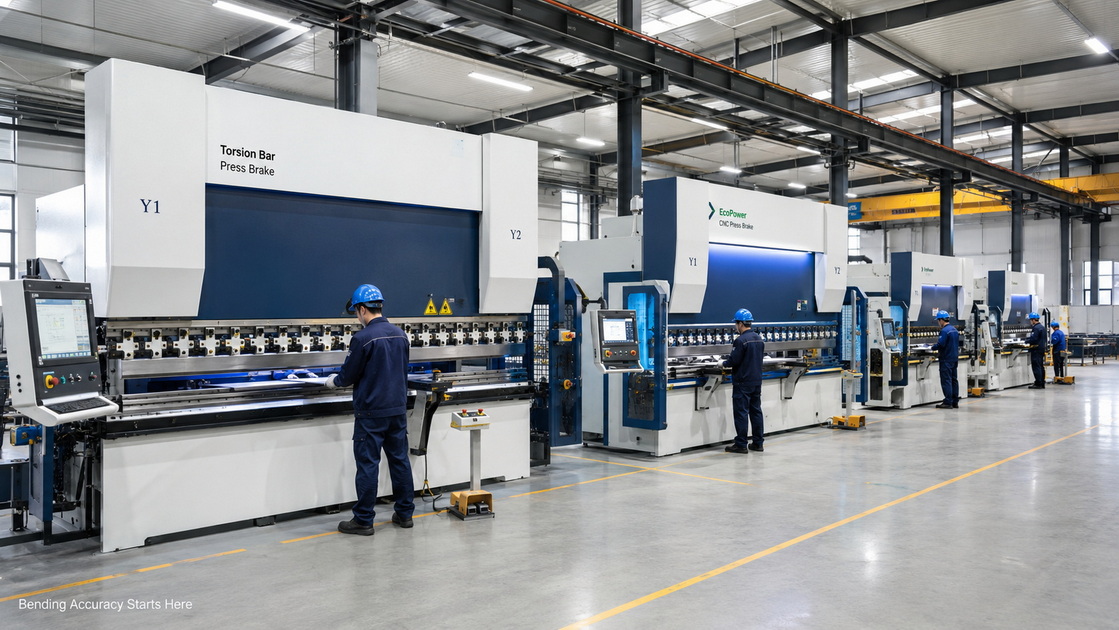
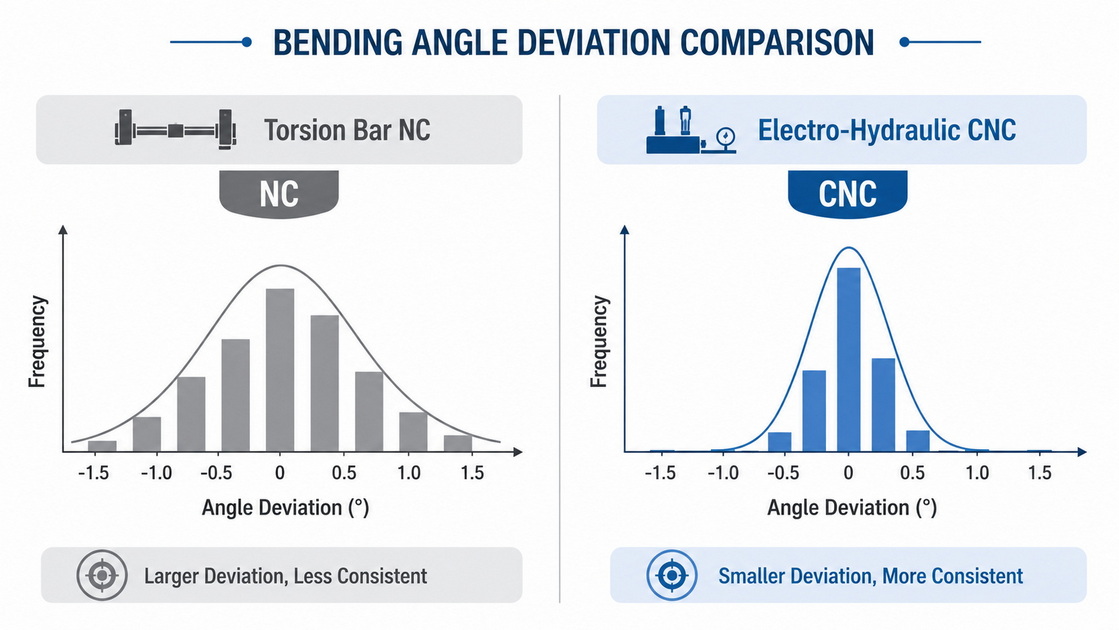
In sheet metal fabrication, bending accuracy usually refers to the deviation between the target angle and the actual angle delivered by the press brake, measured in degrees or millimeters at the part edge. High‑precision production typically aims for angle tolerances within ±0.5° to ±1.0°, supported by proper tooling, control systems, and process management. Accuracy is influenced by material properties, springback, machine stiffness, synchronization of left and right cylinders, and operator consistency. [jialipress]
- Angle tolerance: Gap between design angle and measured angle on the part. [novafabrication]
- Repeatability: Ability to hit the same angle over long runs with minimal adjustment. [jialipress]
- Process capability: How reliably a line meets customer specs across batches and materials. [xometry]
For OEM and ODM projects, where customers often specify tight GD&T on critical bends, this accuracy is no longer a "nice to have"—it is a contractual requirement tied to quality audits and supplier scorecards. [novafabrication]
A torsion bar press brake uses a high-strength steel torsion shaft to mechanically link the left and right sides of the ram. As the cylinders move, the bar twists to equalize motion, keeping the beam roughly level across the working length. Because the synchronization is purely mechanical, there is no real‑time error feedback or digital compensation. [cnhawe]
Key characteristics:
- NC control, limited axes (typically 3 axes such as Y, X, and a simple R). [velxunmachine]
- Lower synchronization accuracy, especially under off‑center loading and variable material thickness. [vistmac]
- No error feedback to correct deflection or material‑driven angle drift. [vistmac]
From a user's standpoint, torsion bar machines generally deliver acceptable accuracy for general-purpose bending, brackets, frames, and medium‑tolerance parts. They perform well when: [pressmachine-world]
- Material thickness is stable and mostly within light to medium ranges. [xometry]
- Parts do not require extremely tight angles or complex multi‑bend sequences. [pressmachine-world]
- Production involves small batches or occasional bending tasks. [facebook]
However, torsion bar presses show limitations when facing off‑center loads (for example, bending only one side of a long panel) and when the shop needs consistent ±0.5° accuracy across shifts and operators. Without sensors and automatic crowning, operators must rely on manual corrections, test pieces, and experience, which increases setup time and risk of scrap. [jialipress]
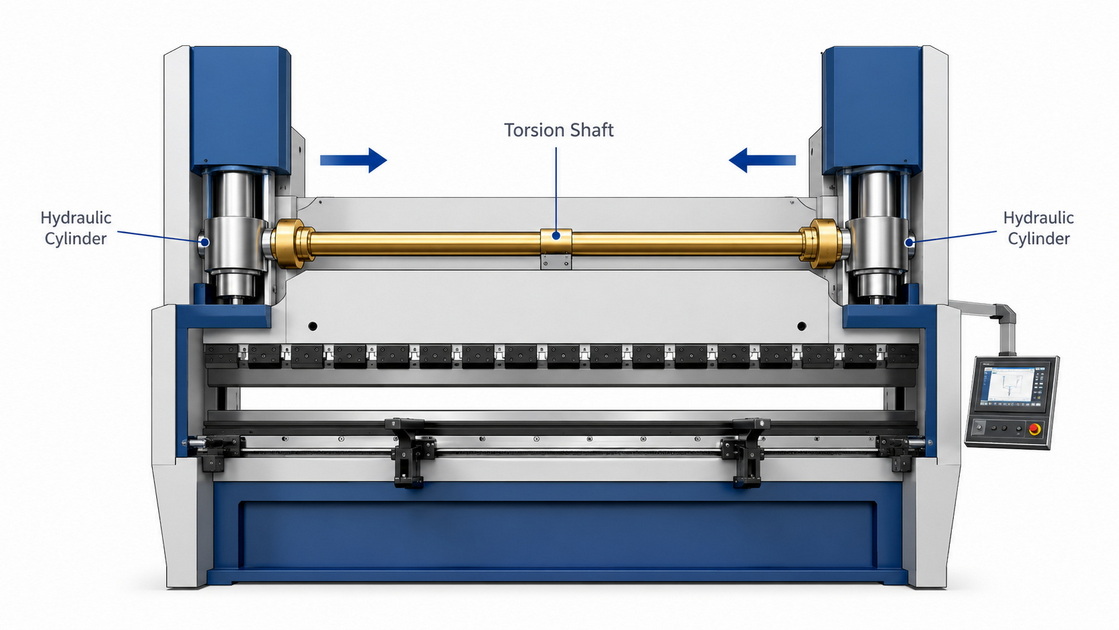
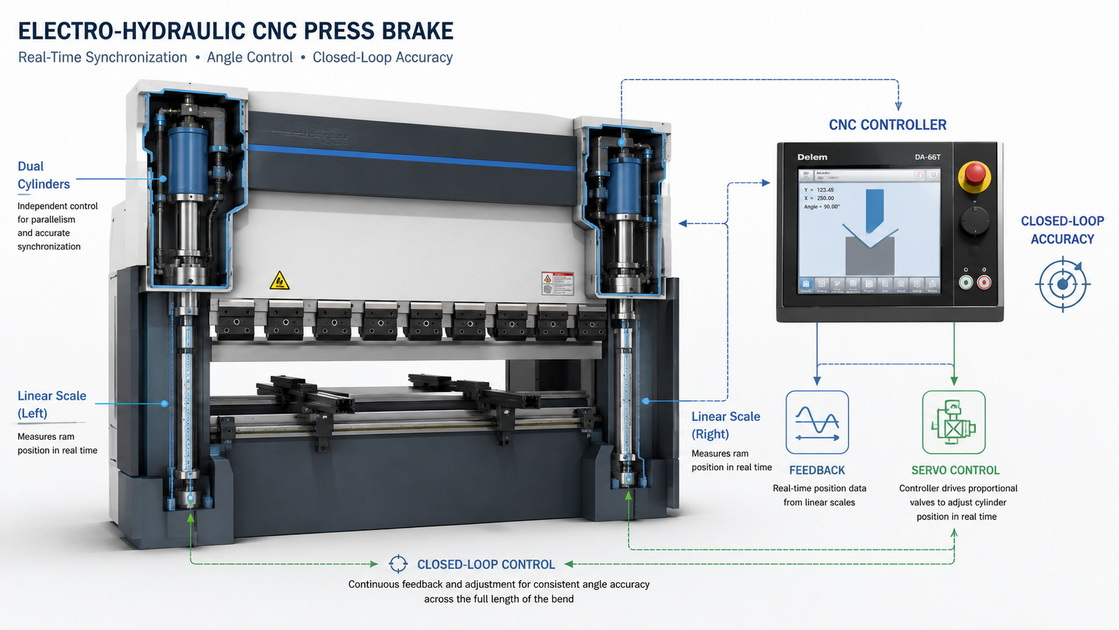
Electro-hydraulic CNC press brakes synchronize the left and right cylinders using servo valves and closed‑loop feedback from linear scales or encoders. The controller constantly monitors ram position and corrects deviations within milliseconds, keeping the beam level and the angle stable. [raymaxbending]
Typical features:
- Multi-axis CNC control, often including Y1/Y2, X, R, Z1/Z2, and optional angle measurement systems. [durmapress]
- Higher bending accuracy and repeatability, particularly for complex parts and long runs. [durmapress]
- Better resistance to off‑center loading, as the control system actively compensates for deflection. [raymaxbending]
Modern systems use electro-hydraulic servo technology to achieve significantly higher accuracy compared with traditional torsion bar designs, especially in industries with stringent quality control like automotive, aerospace, and precision enclosures. [pressmachine-world]
Electro-hydraulic machines also integrate angle measurement and compensation, either via external angle sensors or by using calibrated bending tables in the CNC. When combined with proper springback models—such as overbending based on material thickness, radius, and strength—they deliver tighter and more predictable results. [novafabrication]
Best practices for accuracy on electro-hydraulic systems include:
1. Use high-precision control systems and maintain linear scales and hydraulic components. [raymaxbending]
2. Match material properties with bending parameters, accounting for springback and yield strength. [xometry]
3. Optimize tooling and die design, including punch radius, die opening, and crowning. [jialipress]
4. Implement automation and measurement technologies, such as automatic angle measurement and offline programming. [raymaxbending]
5. Enhance operator training and SOPs to ensure consistent setups and checks. [jialipress]
For OEM customers who require process validation, electro-hydraulic presses also provide valuable production data: angles, batch records, and maintenance logs that can be tied to quality documentation and audits. [novafabrication]
The global CNC press brake market reached about USD 8.2 billion in 2025 and is expected to grow to around USD 13.7 billion by 2034, driven by a CAGR of roughly 6.8%. This growth is fueled by increasing demand for high‑precision sheet metal components in sectors such as EVs, industrial automation, and smart infrastructure. [dataintelo]
Modern buyers are no longer only purchasing tonnage; they are buying reliable bending accuracy and the ability to integrate machines into automated production lines. That's why electro-hydraulic CNC press brakes are often positioned as the default choice for new high‑precision lines, while torsion bar NC machines remain attractive entry‑level solutions or secondary stations. [velxunmachine]
| Aspect | Torsion bar NC press brake | Electro-hydraulic CNC press brake |
|---|---|---|
| Synchronization method | Mechanical torsion shaft linking left/right sides (cnhawe) | Servo‑controlled cylinders with closed‑loop feedback (durmapress) |
| Typical control level | NC, limited axes, basic backgauge control (durmapress) | Full CNC, multi‑axis (Y1/Y2, X, R, Z1/Z2, angle control) (durmapress) |
| Bending accuracy | Adequate for general tasks; lower synchronization accuracy, no error feedback (vistmac) | High precision and repeatability; better angle tolerance and off‑center load handling (durmapress) |
| Springback compensation | Mostly manual via operator experience and trial parts (jialipress) | Software‑based compensation plus angle measurement options (jialipress) |
| Best‑fit applications | Standard parts, moderate tolerances, smaller shops, occasional bending (vistmac) | High‑precision parts, complex geometries, automated lines, long production runs (pressmachine-world) |
| Investment and ROI | Lower upfront cost, simple maintenance, suitable for budgets with moderate accuracy needs (velxunmachine) | Higher initial investment, stronger long‑term ROI in high‑throughput, quality‑critical environments (pressmachine-world) |
From an OEM/ODM perspective, the most important question is not "Which technology is more advanced?" but "Which technology best fits the tolerance, volume, and lifecycle of the parts we produce?" For example, if more than 70% of your throughput involves thick plate above 6 mm, the inherent material variation may limit the practical benefit of ultra‑precise servo systems, and a robust hydraulic solution with well‑engineered tooling could be enough. [adhmt]
Conversely, for thin‑gauge enclosures, EV battery modules, or control cabinets with many bends per part and tight angles, the process capability of electro-hydraulic CNC presses becomes critical to avoid cumulative errors. In these cases, not only the press brake but also the "matching logic"—how you combine machine, tooling, and process flow—determines whether your investment delivers real value. [adhmt]
In many shops, torsion bar presses are used as support machines for simpler bends, while electro-hydraulic CNC presses handle precision assemblies. A typical configuration might be: [pressmachine-world]
- Torsion bar press brake for brackets, simple frames, and low‑volume jobs. [vistmac]
- Electro-hydraulic CNC press brake for critical housings, symmetrical parts, and automated cells linked with laser cutting and robotic handling. [adhmt]
For a manufacturer like CNDY‑Press, being able to advise customers on this mix—and to supply equipment or capacity accordingly—is part of delivering trusted, expert OEM/ODM services. [dataintelo]
Even before upgrading equipment, there are concrete steps that fabrication teams can take to improve accuracy. [xometry]
1. Standardize material data and bending charts. Document thickness ranges, yield strengths, and springback behavior for your main materials and keep these references at the machine. [novafabrication]
2. Optimize tooling selection. Use high-precision punches and dies and choose die openings and radii that match your thickness and target angle. [xometry]
3. Maintain machines regularly. Check hydraulic systems, linear scales, torsion shafts, and backgauges for wear or misalignment. [raymaxbending]
4. Train operators on angle control. Teach them to read angle measurement tools correctly and to apply consistent correction strategies. [jialipress]
5. Implement in-process inspection. Set quality checkpoints for critical parts to catch drift early in the batch. [novafabrication]
On electro-hydraulic CNC presses, these steps interact with advanced control to produce a much higher ceiling of achievable accuracy; on torsion bar machines, they still make a visible difference to everyday results and customer satisfaction. [raymaxbending]
For customers deciding between torsion bar and electro-hydraulic synchronization (or a combination of both), a manufacturer with broad experience across projects can provide an evidence‑based roadmap. Based on typical industry practice: [adhmt]
- We assess your order profile (thickness, materials, batch sizes, angle tolerances). [adhmt]
- We map your process flow, from cutting to bending to downstream assembly. [adhmt]
- We align equipment choices with actual accuracy needs and ROI expectations, not just catalog numbers. [adhmt]
For many OEM/ODM customers, the end result is a hybrid solution: torsion bar NC presses for flexible, cost‑effective general work and electro-hydraulic CNC presses as precision "backbones" of their sheet metal lines. [velxunmachine]
Torsion bar press brakes remain a reliable, cost-effective choice for general-purpose bending with moderate accuracy requirements, while electro-hydraulic CNC presses deliver high bending accuracy, repeatability, and automation-readiness for precision work. For OEM and ODM projects, the smartest move is to match synchronization technology with actual part requirements, throughput, and long‑term quality targets rather than chasing specifications in isolation. [velxunmachine]
If you are planning a new line or upgrading existing capacity and want to strike the right balance between torsion bar and electro-hydraulic press brakes, reach out to CNDY‑Press to discuss your materials, tolerances, and project roadmap—we can help translate technical options into concrete productivity and quality gains. [dataintelo]
1: Which press brake type is better for high-volume, tight-tolerance production?
Electro-hydraulic CNC press brakes are generally better suited for high-volume, tight-tolerance work because they use closed-loop feedback and servo control to maintain accurate angles over long runs. [durmapress]
2: Are torsion bar press brakes still relevant in modern fabrication shops?
Yes, torsion bar NC press brakes remain relevant as entry-level or secondary machines for general fabrication, standard tolerances, and shops where budget and simplicity matter more than extreme accuracy. [vistmac]
3: How big is the practical accuracy gap between NC torsion bar and CNC electro-hydraulic presses?
While exact numbers depend on material, tooling, and maintenance, CNC electro-hydraulic systems typically show significantly tighter angle tolerance and better repeatability than torsion bar presses, especially for complex, multi-bend parts. [durmapress]
4: What else besides synchronization affects bending accuracy?
Tooling quality, material properties, springback behavior, machine stiffness, crowning, and operator training all affect bending accuracy, regardless of whether the machine is NC or CNC. [xometry]
5: How can an OEM/ODM partner help me choose the right press brake?
An experienced OEM/ODM partner can analyze your typical orders, tolerance needs, and growth plans, then recommend a mix of torsion bar and electro-hydraulic machines that balances cost, accuracy, and scalability. [adhmt]
1. Durmapress – "9 Major Differences Between Electro-hydraulic CNC Press Brake and Torsion Axis CNC Press Brake." [durmapress]
2. Hawe – "Understanding Torsion Bar Press Brakes: NC Hydraulic Press Brake Machine Guide." [cnhawe]
3. Vistmac – "NC Torsion Bar Press Brake Vs. CNC Press Brake Different List." [vistmac]
4. Facebook Group – "How to choose between a torsion axis bending machine …" [facebook]
5. Velxun Machine – "9 Differences Between NC and CNC Press Brake." [velxunmachine]
6. Pressmachine-world – "NC Press Brake Vs. CNC Press Brake: Comparative Analysis." [pressmachine-world]
7. Jiali Press – "Top 5 Methods to Increase Precision Bending Accuracy: A Sheet Metal Bending Guide." [jialipress]
8. ADH Machine Tool – "Press Brake Types and Bending Methods" and related selection logic. [adhmt]
9. Raymax – "How to Choose the Right Press Brake Machine." [raymaxbending]
10. Rucheng Machinery – "Top 10 CNC Press Brake Manufacturers in the World (2026)" and market overview. [ruchengmachinery]
11. Nova Fabrication – "Which Bending Methods Can Be Used for Metal Forming?" [novafabrication]
12. ADH Machine Tool – "Hydraulic vs Electro-hydraulic Servo CNC Press Brakes: Precision, Cost and Profitability." [adhmt]
13. Xometry – "Sheet Metal Bending Design Tips." [xometry]


