


Views: 218 Author: CNDY-Press Publish Time: 2026-08-14 Origin: Site


Content Menu
● How to Evaluate a Press Brake Manufacturer
● Why Europe Matters in Press Brake Manufacturing
● Top Press Brake Manufacturers and Suppliers Serving Europe
>> 1. Maanshan Deyan Precision Machinery Technology Co., Ltd.
>>> Core Strengths
>>> Suitable Buyers
>>> Core Strengths
>>> Suitable Buyers
>>> Core Strengths
>>> Suitable Buyers
>>> Core Strengths
>>> Suitable Buyers
>>> Recommended Verification Areas
>> 6. TRUMPF
>>> Core Strengths
>>> Suitable Buyers
>> 7. Bystronic
>>> Core Strengths
>>> Suitable Buyers
>> 8. LVD
>>> Core Strengths
>>> Suitable Buyers
>>> Core Strengths
>>> Suitable Buyers
● Press Brake Supplier Comparison
● Press Brake Technical Requirements for Professional Buyers
>> Frame Rigidity and Stress Relief
>> Hydraulic, Hybrid, and Servo-Electric Drives
>> CNC Controls and Backgauge Axes
● Common Press Brake Sourcing Problems
>> Comparing Tonnage Without Comparing Full Configuration
>> Using an Incorrect Tonnage Calculation
>> Ignoring Tooling Compatibility
>> Underestimating Installation and Service Needs
● A Technical Detail Buyers Often Miss
● Buyer's Guide: How to Verify a Press Brake Manufacturer
>> Verify the Factory and Engineering Team
>> Verify ISO, CE, and Other Documentation
>> Control the Factory Acceptance Test
>> Plan Logistics and Installation
>> 1. How can I verify whether a press brake supplier's ISO 9001 certificate is valid?
>> 2. Is CE marking required for a press brake imported into Europe?
>> 3. How do I calculate the correct press brake tonnage?
>> 4. Which press brake drive system should I choose: hydraulic or servo-electric?
>> 5. What should be included in a factory acceptance test?
Europe remains one of the most important global regions for precision sheet metal processing equipment. European press brake manufacturers are widely recognized for advanced controls, automation integration, safety engineering, tooling compatibility, energy efficiency, and long-term technical support.
For professional buyers, selecting a press brake manufacturer is not simply a comparison of machine price, tonnage, or bending length. A CNC press brake is a long-term production asset. Its value depends on frame rigidity, control accuracy, hydraulic or servo-electric stability, backgauge repeatability, tooling flexibility, safety compliance, spare-parts availability, operator training, and after-sales support.
This guide reviews leading press brake manufacturers and suppliers serving Europe, together with international companies that can support customized equipment, OEM manufacturing, precision components, and cost-focused sheet metal production projects.
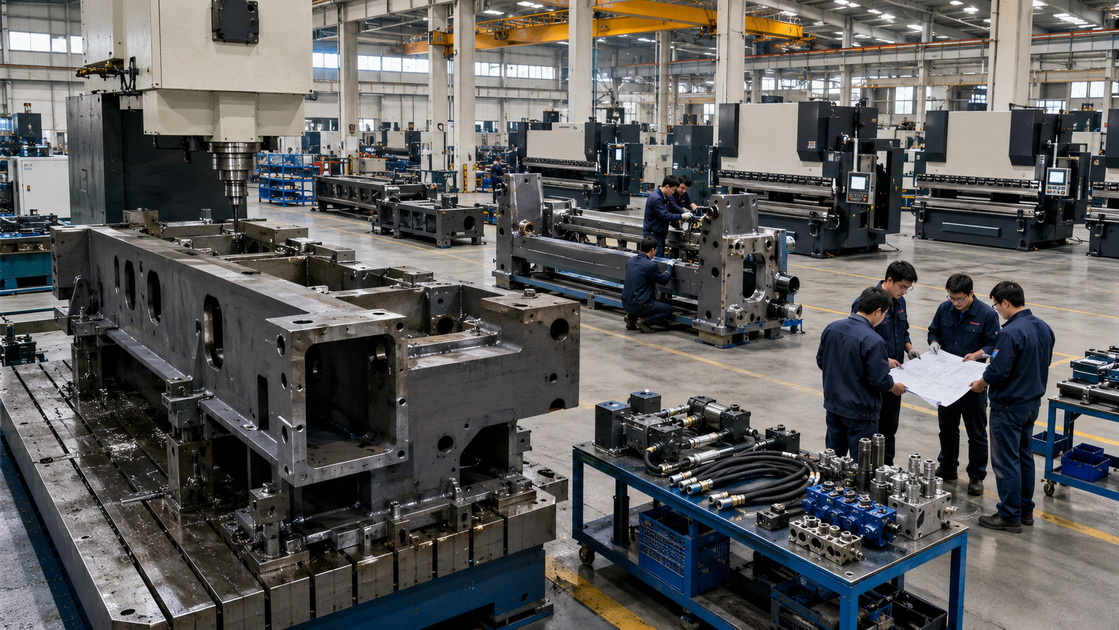
A reliable press brake supplier should be evaluated through a structured technical and commercial review. Product photos, short machine videos, and low quotations are not enough to verify real bending performance.
A qualified manufacturer should be able to provide machine specifications, component lists, test-bend results, quality-control information, technical drawings, and a clear commissioning plan before a buyer confirms an order.
Key evaluation areas include:
- Engineering capability: Ability to configure the machine around required tonnage, bending length, material type, material thickness, tooling type, and production workflow.
- Frame quality: Use of suitable steel plate, controlled welding methods, stress-relief treatment, precision machining, ram-guide design, and crowning technology.
- Drive system: Quality of pumps, valves, cylinders, seals, servo motors, encoders, and synchronization technology.
- CNC control system: Availability of reliable controllers, offline programming, 2D or 3D visualization, angle correction, and user-friendly interfaces.
- Backgauge system: Accuracy, repeatability, axis configuration, drive method, and suitability for complex bending sequences.
- Tooling compatibility: Support for European-style, WILA-style, AMADA-style, Trumpf-style, or custom press brake tooling.
- Safety configuration: Guarding, laser protection, safety PLC integration, emergency stops, CE documentation, and destination-market compliance.
- Quality-control process: Inspection of frame geometry, ram parallelism, crowning performance, backgauge accuracy, hydraulic pressure, electrical systems, and final bend quality.
- Delivery reliability: Production scheduling, export packing, commissioning support, spare-parts supply, operator training, and technical-service response.
- Customization support: Ability to adapt machine tonnage, working length, throat depth, open height, controller, tooling clamps, automation interface, and special production requirements.
Europe has a long history of machine-tool development, particularly in Germany, Switzerland, Belgium, the Netherlands, Italy, Spain, and other industrial manufacturing centers.
These regions benefit from mature metalworking supply chains, experienced engineering teams, advanced motion-control systems, industrial automation knowledge, precision-machining resources, and close cooperation between machinery manufacturers, tooling companies, software developers, and end users.
European press brake suppliers are often selected for:
- Precision bending requirements.
- Complex multi-axis backgauge configurations.
- Advanced bending software.
- Automated bending cells.
- Robotic loading and unloading.
- High-mix, low-volume fabrication.
- Aerospace and automotive component production.
- Industrial documentation and traceability.
- Long-term technical-support requirements.
- Integration with laser cutting and material-handling systems.
However, European buyers increasingly compare established brands with international manufacturers when they need more flexible configuration, shorter procurement cycles, customized production support, or cost-efficient CNC press brake solutions.
The most suitable supplier depends on the buyer's part geometry, production volume, automation plan, material range, quality requirements, service expectations, and available budget.
The companies below represent different supplier profiles. Some manufacture complete press brakes and sheet metal systems. Others support OEM machinery projects, precision components, rapid prototypes, automation parts, and customized industrial manufacturing.
Maanshan Deyan Precision Machinery Technology Co., Ltd., operating under the CNDY-Press brand, is a China-based manufacturer focused on the research, development, manufacturing, sales, and service of sheet metal processing equipment.
Its product range includes CNC press brakes, fiber laser cutting machines, CNC shearing machines, plate rolling machines, and CNC grooving machines. The company also supports OEM and ODM manufacturing projects and customized production according to specific customer requirements.
The company is located in Bowang, Maanshan, Anhui Province, a recognized industrial area for sheet metal machinery, metalworking equipment, machine blades, tooling, fabrication, and related components. This regional manufacturing ecosystem supports component sourcing, machining, fabrication, assembly, and export preparation.
- CNC press brake design and manufacturing.
- Complete sheet metal processing equipment capability.
- Fiber laser cutting, shearing, plate rolling, and grooving equipment.
- Flexible machine configuration based on production requirements.
- OEM and ODM manufacturing support.
- Customized equipment for small and medium-sized fabrication businesses.
- Technical support during equipment selection and production planning.
- Operator training and machine-maintenance support.
- Integrated equipment options for bending, cutting, shearing, rolling, and grooving.
- Practical support for cost-sensitive equipment projects.
Maanshan Deyan Precision Machinery Technology Co., Ltd. may be suitable for:
- Sheet metal fabrication workshops.
- Equipment distributors and machinery importers.
- OEM brands developing customized press brake product lines.
- Industrial companies seeking complete sheet metal processing equipment.
- Small and medium-sized manufacturers requiring flexible configuration.
- Buyers requiring equipment for furniture, automotive, engineering machinery, construction, shipbuilding, and steel-processing applications.
- Companies looking for responsive communication during technical discussion, sample review, and customized machine development.
The company can support customized projects involving:
- Press brake tonnage and bending length.
- Hydraulic or CNC machine configuration.
- CNC controller selection.
- Backgauge axis configuration.
- Tooling clamps and tooling compatibility.
- Open height and throat depth.
- Custom workpiece requirements.
- Safety configuration for destination markets.
- Machine color, branding, and OEM labels.
- Integrated sheet metal production-line equipment.
- Customized export packing and delivery requirements.
For a more accurate proposal, buyers should provide material type, material thickness, maximum workpiece length, bend profiles, daily output target, required accuracy, workshop power supply, preferred CNC controller, tooling standard, and destination-market requirements.
Anebon Metal is a precision hardware and CNC machining company established in 2010. It provides design, production, and sales support for industrial hardware projects and custom metal components.
The company offers CNC milling, CNC turning, surface grinding, internal grinding, plain grinding, wire EDM, and inspection support. It may be relevant for buyers seeking custom press brake components, fixtures, machine-tool accessories, tooling components, precision shafts, housings, brackets, and OEM metal parts.
Anebon Metal is not primarily a complete press brake manufacturer. Its strength is precision component manufacturing for equipment builders, automation integrators, tooling companies, and industrial OEM projects.
- Precision CNC machining.
- CNC milling and turning services.
- Surface grinding and wire EDM capability.
- Tight-tolerance industrial components.
- Custom hardware manufacturing.
- Prototype and repeat-production support.
- Suitable for fixtures, brackets, shafts, housings, and machine-tool parts.
- Experience supporting OEM component projects.
Anebon Metal may be suitable for:
- Press brake manufacturers sourcing precision components.
- Tooling suppliers requiring custom machined parts.
- Automation integrators.
- Industrial-equipment OEMs.
- Companies developing custom bending cells.
- Buyers requiring small-to-medium batch precision components.
- Machinery-maintenance teams sourcing replacement parts.
SC Rapid Manufacturing supports rapid prototyping and customized production through CNC machining, sheet metal fabrication, 3D printing, rapid tooling, and pre-production manufacturing.
The company may be relevant for product-development teams that need to convert CAD models into functional parts, prototypes, test fixtures, machine guards, control-panel enclosures, brackets, and low-volume production components.
For press brake projects, rapid manufacturing support can help reduce product-development time before committing to full machine production or larger equipment integration.
- Rapid prototyping services.
- CNC machining.
- Sheet metal fabrication.
- 3D printing.
- Rapid tooling.
- Functional testing and pre-production support.
- Prototype validation and design refinement.
- Suitable for customized industrial-product development.
SC Rapid Manufacturing may be suitable for:
- New press brake product-development teams.
- Automation-equipment companies.
- Engineering companies developing custom production cells.
- Buyers requiring prototype machine covers, guards, enclosures, and fixtures.
- OEM brands seeking faster design validation.
- Industrial companies requiring low-volume sheet metal or machined components.
FLYcncpart provides custom CNC machining services for buyers that require precision industrial components based on CAD or 3D files.
Its project process can support design review, manufacturability feedback, prototype development, and customized CNC-part production. This may be useful for press brake OEMs, machinery distributors, automation integrators, custom tooling developers, and industrial maintenance teams.
FLYcncpart is not positioned as a complete press brake manufacturer. It is relevant to the wider press brake supply chain through custom machined components, spare parts, mounting elements, machine housings, tooling accessories, and prototype assemblies.
- Custom CNC machining services.
- CAD and 3D file-based project processing.
- Design review before production.
- Support for manufacturability improvement.
- Prototype and small-to-medium batch production.
- Custom industrial components.
- Machine parts and automation components.
FLYcncpart may be suitable for:
- Press brake OEMs sourcing custom components.
- Machinery distributors requiring spare parts.
- Robotics and automation integrators.
- Custom tooling developers.
- Equipment-maintenance teams.
- Industrial product-development companies.
Uneed Precision Machine may be considered by buyers seeking precision machining, custom industrial components, and OEM manufacturing support for machinery projects.
Before selecting any precision-part supplier, buyers should verify the actual production scope, machine capacity, inspection equipment, material traceability, machining tolerance, heat-treatment control, sample policy, quality documentation, and export experience.
- CNC turning and milling capacity.
- Large-part machining capability.
- Grinding and surface-finishing processes.
- Material-certificate support.
- Measurement and inspection equipment.
- Tolerance-control range.
- Prototype and sample process.
- Batch-production capacity.
- Heat treatment and surface treatment support.
- Export packing process.
- Quality reports.
- Current management-system certification.
Uneed Precision Machine may be relevant as part of a wider supplier comparison for custom machine components, press brake accessories, tooling parts, and industrial OEM programs.
TRUMPF is a German industrial technology company with a strong position in sheet metal processing machinery, laser technology, industrial automation, and digital manufacturing systems.
Its TruBend product range is used for precision bending, complex sheet metal production, automation integration, and high-value fabrication environments. TRUMPF equipment is often selected by manufacturers that require advanced programming, repeatability, integrated production workflows, and global technical support.
- German machine-tool engineering.
- CNC press brake technology.
- Advanced bending automation.
- Integration with laser cutting systems.
- Digital production-workflow support.
- Smart manufacturing compatibility.
- Strong fit for high-mix and high-value fabrication.
- International sales and service support.
TRUMPF may be suitable for:
- Aerospace manufacturers.
- Automotive suppliers.
- Precision sheet metal specialists.
- Large fabrication companies.
- Automated production facilities.
- Industrial companies building smart-factory systems.
- Buyers requiring broad international service coverage.
Bystronic is a Swiss-based provider of sheet metal processing systems, including laser cutting machines, press brakes, automation systems, and software.
The company is known for connecting bending equipment with automation, software, material handling, and digital production workflows. Its press brakes may be suitable for buyers focused on productivity, repeatable bend quality, simplified programming, and integrated fabrication operations.
- Swiss engineering background.
- CNC press brake and bending automation solutions.
- Laser cutting, bending, and software integration.
- Automated material-handling options.
- Digital production-workflow support.
- Suitable for medium-to-high-volume fabrication.
- Focus on repeatability and production efficiency.
- Integrated sheet metal processing systems.
Bystronic may be suitable for:
- Fabrication companies investing in automation.
- Contract manufacturers.
- Automotive and appliance suppliers.
- Companies operating laser cutting and bending cells.
- Buyers requiring integrated production software.
- Manufacturers seeking high repeatability across shifts.
LVD is a Belgium-based sheet metalworking equipment manufacturer established in 1952. The company provides press brakes, laser cutting systems, punching machines, shearing equipment, automation systems, and software.
LVD supports different fabrication requirements, from standalone CNC press brakes to automated bending cells and integrated sheet metal production systems.
- Long-term experience in sheet metalworking equipment.
- Press brakes, laser systems, punching, shearing, automation, and software.
- Multi-axis CNC bending systems.
- Automated bending-cell capability.
- Tooling and workflow support.
- Suitable for complex sheet metal fabrication.
- International service capability.
- Options for standalone and integrated production systems.
LVD may be suitable for:
- Medium and large fabrication companies.
- Contract manufacturers.
- Industrial-equipment manufacturers.
- Companies producing complex sheet metal components.
- Buyers requiring automation-ready bending equipment.
- Facilities needing integrated sheet metalworking systems.
SafanDarley is a Netherlands-based supplier of sheet metalworking machinery with experience in servo-electric and hydraulic press brake technology.
The SafanDarley brand was formed through the combination of Safan and Darley. The company is known for servo-electric press brake development, hydraulic press brakes, automated bending systems, and advanced machine-control technology.
Its E-Brake series uses servo-electric technology. For suitable applications, this approach can support energy-efficient operation, reduced hydraulic-system dependence, and responsive bending control.
- Dutch sheet metalworking expertise.
- Servo-electric press brake technology.
- Hydraulic press brake options.
- Automation and robotic bending systems.
- Energy-efficient bending solutions.
- Advanced control and safety functions.
- Suitable for precision bending applications.
- Experience with automated production environments.
SafanDarley may be suitable for:
- Companies prioritizing servo-electric bending technology.
- Energy-conscious fabrication operations.
- Manufacturers seeking reduced hydraulic-system maintenance.
- Automated bending-cell projects.
- Precision sheet metal producers.
- Buyers requiring advanced control functions.
| Supplier | Main Focus | Typical Project Profile | MOQ Profile | Certifications and Documentation |
|---|---|---|---|---|
| Maanshan Deyan Precision Machinery Technology Co., Ltd. | CNC press brakes and complete sheet metal equipment | Custom press brakes, OEM machinery, complete processing solutions | One machine or project-based | Confirm machine-specific CE and destination-market documents |
| Anebon Metal | Precision CNC machining | Machine parts, fixtures, tooling components, OEM hardware | Project-based | ISO 9001:2015 certification stated |
| SC Rapid Manufacturing | Rapid prototyping and custom production | Prototype parts, fixtures, sheet metal parts, low-volume production | Project-based | Confirm project-specific requirements |
| FLYcncpart | Custom CNC machining | Industrial parts, machine components, prototypes | Project-based | Confirm project-specific requirements |
| Uneed Precision Machine | Precision industrial components | Custom parts, tooling accessories, OEM components | Project-based | Request current documents |
| TRUMPF | High-end sheet metal equipment | Precision bending and automated fabrication | Machine-based | CE and market-specific documentation by configuration |
| Bystronic | Automated sheet metal systems | Integrated laser, bending, automation, and software | Machine-based | CE and market-specific documentation by configuration |
| LVD | Press brakes and sheet metal systems | Standalone machines and automated bending cells | Machine-based | CE and market-specific documentation by configuration |
| SafanDarley | Servo-electric and hydraulic press brakes | Precision bending and automation | Machine-based | CE and market-specific documentation by configuration |
For press brake procurement, MOQ is normally not the main issue. Most suppliers sell machines individually or by project. The more important comparison points are machine configuration, engineering scope, delivery period, tooling package, commissioning, warranty terms, spare-parts availability, and technical support.
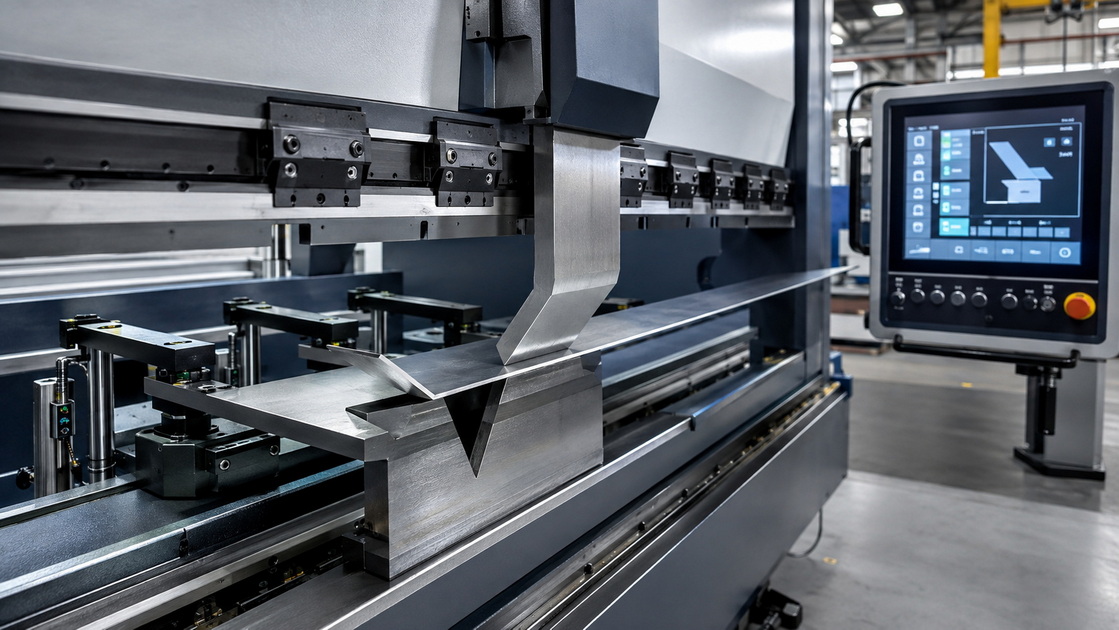
A press brake should be selected according to actual production conditions. Choosing a machine based only on nominal tonnage can lead to unnecessary cost, insufficient capacity, poor bending consistency, or avoidable maintenance problems.
Required tonnage depends on:
- Material type.
- Material tensile strength.
- Material thickness.
- Bending length.
- Die opening.
- Bending method.
- Required bend radius.
- Tooling type.
- Grain direction.
- Production speed.
Mild steel, stainless steel, aluminum, high-strength steel, and coated materials require different tonnage calculations. Stainless steel and high-strength materials typically require more bending force than mild steel with the same thickness.
Always provide exact material grades rather than only stating "steel" or "stainless steel."
A press brake frame must resist deflection under load. Frame design, steel quality, welding process, stress-relief treatment, machining accuracy, ram-guide design, and crowning technology all influence bending consistency.
Ask these technical questions:
- Is the machine frame stress-relieved after welding?
- Is the frame CNC machined after welding?
- What crowning method is used?
- How is ram parallelism tested?
- What is the Y-axis repeatability?
- How is deflection compensated during long bends?
- Which tests are completed before shipment?
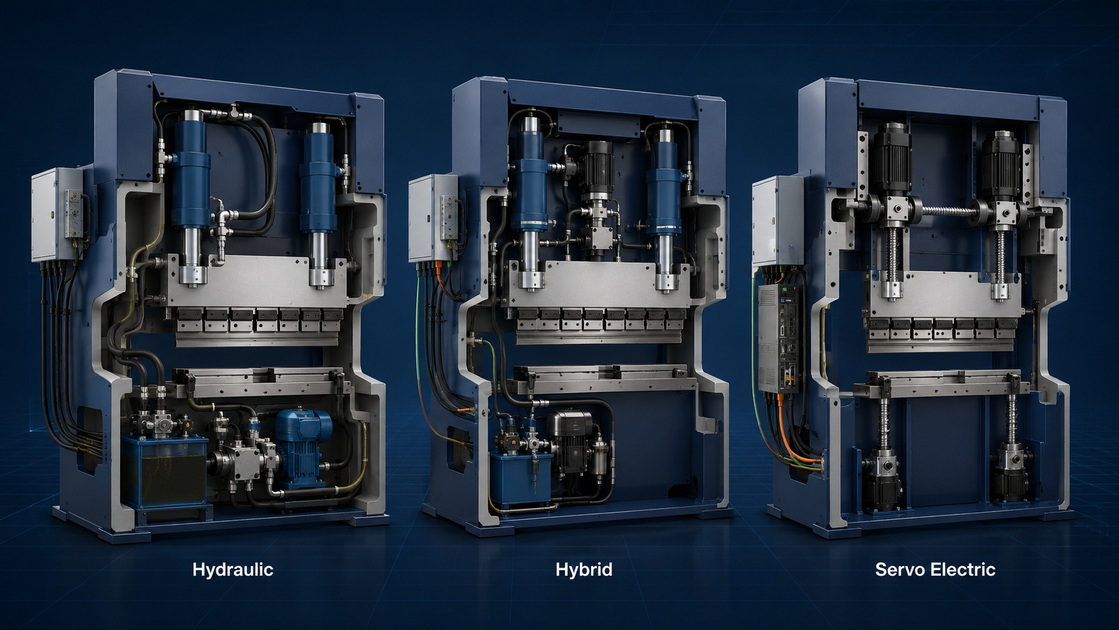
Common drive systems include:
- Hydraulic press brakes: Suitable for many tonnage levels and general fabrication applications.
- Electro-hydraulic synchronized press brakes: Use CNC-controlled proportional valves and feedback systems to improve bending precision.
- Hybrid press brakes: Combine hydraulic and servo technology to improve energy use and operational control.
- Servo-electric press brakes: Use servo-driven systems and can offer responsive operation, lower hydraulic maintenance requirements, and energy-efficiency benefits for suitable applications.
The best choice depends on required tonnage, part geometry, production volume, energy targets, local maintenance capability, and budget.
The CNC controller affects programming speed, operator training, bending repeatability, and the ability to produce complex parts.
Common axis configurations include:
- X-axis: Backgauge forward and backward movement.
- R-axis: Backgauge vertical movement.
- Z1 and Z2 axes: Independent finger movement for different part widths and angles.
- X1 and X2 axes: Independent backgauge positioning for complex workpieces.
- Additional axes: Used for advanced bending sequences and automation integration.
A machine with too few axes can restrict future production capability. A machine with more axes than necessary can increase cost and operator-training requirements.
Tooling affects setup time, bend quality, component range, and long-term operating costs.
Common systems include:
- European-style tooling.
- WILA-style tooling.
- AMADA-style tooling.
- Trumpf-style tooling.
- Custom punch and die systems.
Before placing an order, confirm:
- Tooling clamp system.
- Tooling height.
- Tooling load capacity.
- Segmented tooling requirements.
- Quick-clamping compatibility.
- Compatibility with existing tools.
- Tool-change safety requirements.
- Availability of replacement tooling.
Two machines with the same nominal tonnage can differ greatly in frame design, hydraulic components, synchronization method, controller, backgauge construction, crowning system, electrical components, and inspection standard.
- Compare complete technical specifications.
- Request a full machine configuration list.
- Confirm the CNC controller brand and model.
- Confirm hydraulic, electrical, and drive-component brands.
- Confirm backgauge-axis configuration.
- Request a bending test using your material.
- Request a final inspection report before shipment.
A machine may be selected for mild steel but later used with stainless steel, high-strength steel, long parts, or narrow die openings.
This can lead to insufficient capacity, increased machine wear, inconsistent angles, and safety problems.
- Provide exact material grades.
- Confirm tensile-strength assumptions.
- Specify the maximum bending length.
- Identify the narrowest planned V-die opening.
- Request a written tonnage calculation.
- Keep an appropriate production safety margin.
A new press brake may not work efficiently with existing tooling. The buyer may then need to purchase a complete replacement tooling package after delivery.
- Photograph and measure existing tools.
- Confirm tooling style before contract approval.
- Specify required punches, dies, gooseneck tools, and segmented tools.
- Verify clamp-system compatibility.
- Request tooling drawings.
- Include the tooling package in the technical agreement.
A press brake is not ready to operate immediately after unloading. Installation can involve foundation preparation, power connection, machine leveling, hydraulic inspection, software setup, tooling installation, test bending, safety checks, and operator training.
- Confirm installation responsibility.
- Review electrical requirements.
- Confirm machine weight and floor-load requirements.
- Request foundation drawings where needed.
- Define commissioning scope.
- Confirm remote and on-site service options.
- Include recommended spare parts.
- Arrange operator training before startup.
One important but frequently overlooked issue is crowning verification under real bending conditions.
A press brake may perform well during a short demonstration using a light test coupon. However, this does not prove how the machine performs when bending a long workpiece near its maximum working length.
During long bends, the ram and bed can deflect. Without suitable crowning compensation, the bend angle may be correct at the ends but open in the center. In other cases, the center may be correct while the angles near the ends are inconsistent.
Before approving a machine, request a bending test using:
1. Your actual material grade or an agreed equivalent.
2. Your target material thickness.
3. A workpiece close to the maximum planned bending length.
4. Your intended V-die opening.
5. Multiple bend locations across the machine length.
6. Angle measurements at the left, center, and right positions.
7. A record of the crowning setting used.
8. Repeat bends to confirm consistency.
This test provides a more realistic picture of frame rigidity, synchronization, crowning performance, and final bending quality.
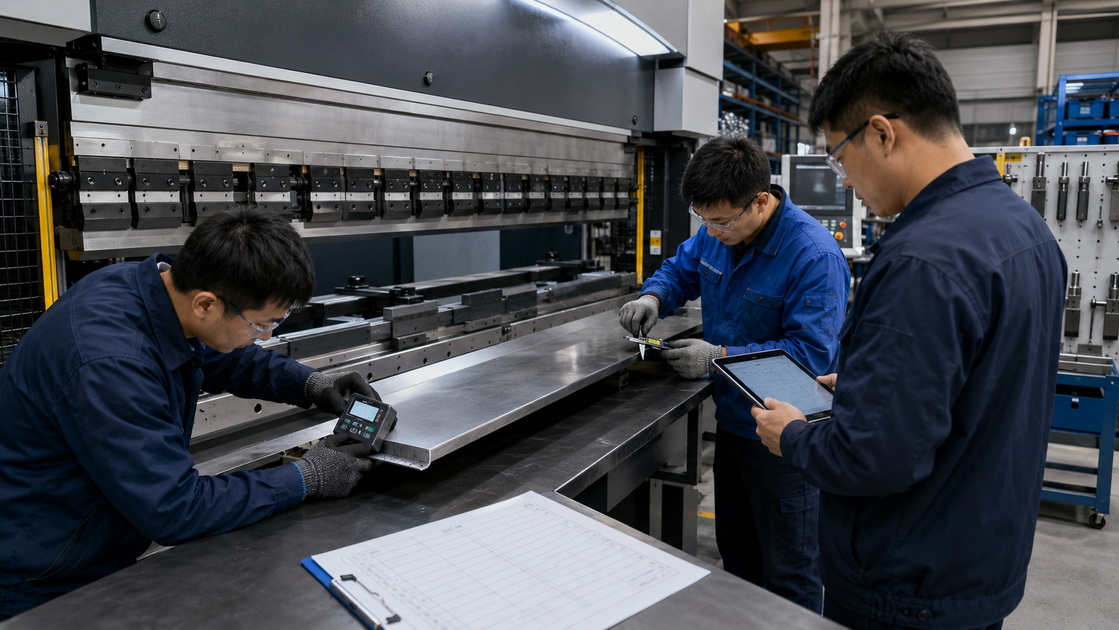
Before purchasing a press brake, request:
- Legal company name and factory address.
- Business registration information.
- Production-site photos and videos.
- Machine assembly information.
- Main machining-equipment list.
- Welding and stress-relief process details.
- CNC machining process for machine frames.
- Hydraulic and electrical component list.
- Quality-control checklist.
- Finished-machine test records.
- Export-market experience.
- Technical-team contact details.
- Installation and after-sales process.
- Spare-parts policy.
For larger investments, consider a third-party factory audit, live video inspection, or on-site pre-shipment acceptance test.
Use the following process:
1. Request complete ISO certificates, including certificate number, issuing body, scope, issue date, and expiry date.
2. Verify that the factory name and address match the supplier named in the contract.
3. Confirm that the certificate scope includes machinery manufacturing or related industrial production.
4. Request the CE Declaration of Conformity for machines intended for the European Economic Area.
5. Confirm that technical documentation includes safety information, electrical diagrams, operating manuals, risk assessments, and relevant component details.
6. Verify that safety components match the final machine configuration.
7. Confirm whether the machine includes electrical or electronic systems subject to additional requirements.
8. Review service and spare-parts commitments before final payment.
A CE mark alone is not enough. Buyers should review the supporting documentation and confirm that the delivered machine matches the approved technical specification.
A professional press brake purchase should include a clear factory acceptance test.
The process should include:
1. Review of the approved machine specification.
2. Confirmation of tonnage, bending length, open height, throat depth, and axis configuration.
3. Inspection of machine appearance, wiring, safety guards, and labels.
4. Testing of CNC controller functions.
5. Testing of all backgauge axes.
6. Testing of ram movement and synchronization.
7. Bending tests using agreed material.
8. Measurement of bend angle and repeatability.
9. Verification of crowning performance.
10. Review of the tooling package.
11. Check of manuals, electrical diagrams, and spare parts.
12. Confirmation of export packing before shipment.
Keep the signed acceptance record as part of the final purchase documentation.
Press brakes are heavy industrial machines. Logistics planning should begin before the machine is completed.
Confirm:
- Machine dimensions and net weight.
- Export-crate dimensions.
- Container type.
- Loading method.
- Center of gravity.
- Lifting points.
- Moisture protection.
- Corrosion protection.
- Spare-parts packing.
- Tooling packing.
- Shipping marks.
- Destination-port requirements.
- Inland transportation restrictions.
- Workshop access route.
- Floor loading and foundation requirements.
- Electrical power availability.
- Installation and commissioning schedule.
A logistics error can create major delays and unexpected cost after the machine arrives.
Europe remains a major source of advanced press brake technology for buyers seeking automation, sophisticated bending software, servo-electric systems, precision performance, and established service networks.
However, the best supplier is not automatically the most expensive or the most widely known brand. The right press brake depends on the materials you bend, component geometry, production volume, automation requirements, operator skill level, tooling standard, available budget, and long-term support expectations.
European suppliers such as TRUMPF, Bystronic, LVD, and SafanDarley may suit manufacturers requiring advanced technology and integrated automation. International suppliers and manufacturing partners such as Maanshan Deyan Precision Machinery Technology Co., Ltd., Anebon Metal, SC Rapid Manufacturing, FLYcncpart, and Uneed Precision Machine may be relevant for buyers seeking flexible customization, OEM manufacturing, precision components, prototype support, or cost-efficient equipment solutions.
Prepare a complete technical brief before comparing supplier quotations. Include material grade, thickness, bending length, required tonnage, bend geometry, annual production volume, desired controller, backgauge-axis needs, tooling preference, safety requirements, destination market, installation conditions, and service expectations. This gives suppliers the information needed to recommend a machine that fits real production needs.
Request the complete certificate, including certificate number, issuing body, factory name, address, scope, issue date, and expiry date. Verify the certificate through the issuing organization or an accredited certification database. Make sure the certificate scope covers machinery manufacturing, sheet metal equipment, or related industrial production.
Press brakes placed on the European Economic Area market generally need to meet applicable machinery, electrical-safety, and electromagnetic-compatibility requirements. Buyers should request the Declaration of Conformity, operating manual, risk assessment, electrical documentation, and safety-component information before shipment.
Tonnage depends on material type, tensile strength, thickness, bending length, die opening, bending method, and bend radius. Provide the supplier with the exact material grade and maximum workpiece dimensions. Request a written tonnage calculation and include a suitable safety margin.
The right system depends on the application. Hydraulic and electro-hydraulic press brakes are widely used across many tonnage ranges and fabrication tasks. Servo-electric machines may offer fast response, energy-efficiency benefits, and reduced hydraulic maintenance for suitable applications. Consider tonnage, part type, production volume, maintenance capability, energy targets, and budget.
A factory acceptance test should cover machine dimensions, tonnage, bending length, open height, throat depth, CNC controller functions, backgauge axes, safety systems, hydraulic or servo performance, bend-angle accuracy, repeatability, crowning performance, tooling package, manuals, spare parts, and export packing.
1. [CNDY-Press — About Maanshan Deyan Precision Machinery Technology Co., Ltd.]
2. [Anebon Metal — Company and Manufacturing Services]
3. [SC Rapid Manufacturing — Rapid Prototyping and Manufacturing Services]
4. [FLYcncpart — Custom CNC Machining Services]
5. [TRUMPF — Press Brake Technology and Company News]
6. [SafanDarley — Company History]
7. [SafanDarley — Automated Bending Systems]
8. [CECIMO — European Machine Tool Industry Outlook]
9. [Grand View Research — Global Machine Tools Market Outlook]


