


Views: 208 Author: CNDY-Press Publish Time: 2026-08-27 Origin: Site


Content Menu
● What Is a Single Table Laser Cutter?
>> Typical Single Table Workflow
>> Where Single Table Machines Perform Well
● What Is an Exchange Table Laser Cutter?
>> Typical Exchange Table Workflow
● Single Table vs. Exchange Table Laser Cutters
● The Throughput Difference Explained
>> The Practical Throughput Formula
● When a Single Table Laser Cutter Is Better
>> Choose a Single Table Machine When
>> Advantages for Emerging Operations
● When an Exchange Table Laser Cutter Is Better
>> Choose an Exchange Table Machine When
● Beyond the Table: The Real Bottleneck
>> A Better Equipment Evaluation Method
● Build a Scalable Production Cell
● How CNDY-Press Supports the Right Choice
● FAQ
>> 1. Is an exchange table laser cutter always faster?
>> 2. How much throughput can an exchange table improve?
>> 3. Is a single table laser cutter suitable for commercial production?
>> 4. Does an exchange table require more factory space?
>> 5. Can an exchange table machine be automated later?
Choosing between a single table laser cutter and an exchange table laser cutter is not simply a question of laser power or purchase price. It is a decision about material flow, operator time, floor space, daily sheet volume, and how consistently a factory can keep its fiber laser cutting machine producing parts.
From our experience working with sheet metal processing projects, the key issue is straightforward: Does your laser wait for operators, or do operators prepare material while the laser keeps cutting? For many custom fabrication shops, a single table machine provides practical capacity and lower investment. For higher-volume manufacturers, an exchange table laser cutter can reduce sheet-change downtime and raise effective throughput.
CNDY-Press develops and manufactures fiber laser cutting machines, press brakes, and complete sheet metal processing solutions. We also support OEM, ODM, and customized manufacturing projects. This article compares both table configurations from a production-management perspective to help buyers match equipment to actual factory conditions.
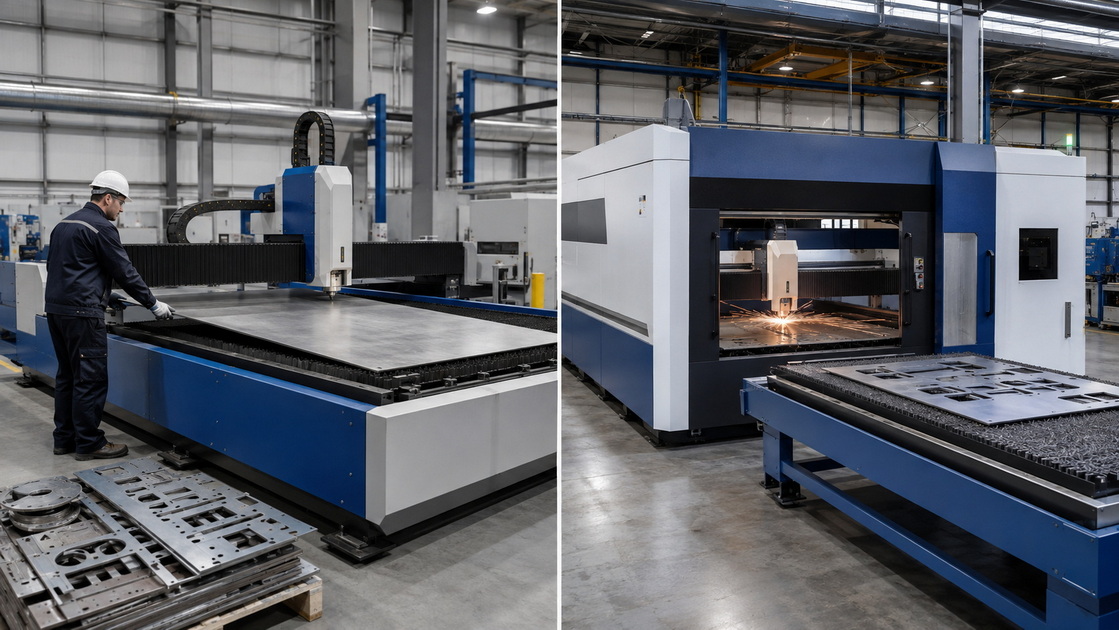
A single table fiber laser cutting machine uses one working platform. The operator loads a metal sheet onto the table, starts the cutting program, removes finished parts and the scrap skeleton, then prepares the next sheet on the same platform.
This is the most direct machine layout. It is widely used in small and medium-sized fabrication shops because it is easier to install, operate, and maintain.
1. Load a raw sheet onto the cutting table
2. Position and align the material
3. Run the cutting program
4. Wait for cutting to finish
5. Remove parts and scrap
6. Load the next sheet
7. Start the next program
The laser cannot cut a new sheet while the operator is unloading the finished sheet. Therefore, the machine's productive cutting time depends partly on how quickly the material-handling process is completed.
A single table laser cutter is often the right choice for factories with flexible production rather than continuous high-volume output.
It is well suited to:
- Custom sheet metal fabrication shops
- Prototype and low-volume manufacturers
- Signage and display equipment producers
- Electrical enclosure and cabinet workshops
- Job shops with frequent material changes
- Businesses bringing laser cutting in-house for the first time
- Factories with limited floor space
- OEM projects with variable part designs and order quantities
The main advantage is not maximum automation. It is practical flexibility at a controlled investment level.
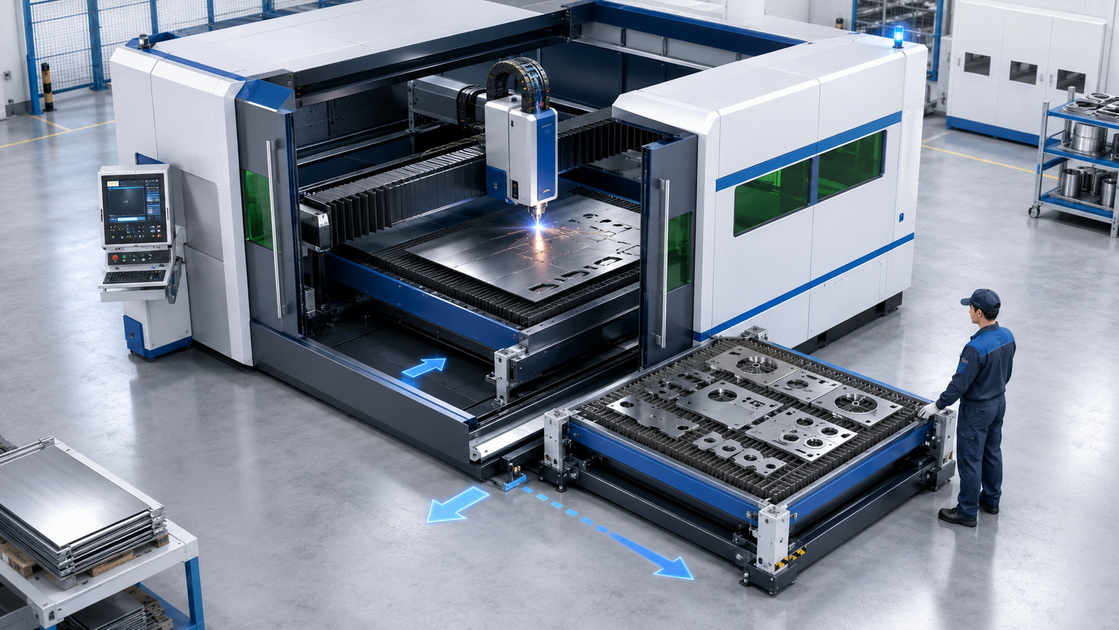
An exchange table laser cutter, also called a shuttle table laser cutter or dual-table fiber laser cutting machine, uses two working tables. One table stays inside the enclosed cutting area, while the other remains outside for material loading and unloading.
When one cutting program finishes, the two tables exchange positions. The next prepared sheet enters the cutting zone, and the completed sheet moves outside for unloading.
This structure allows cutting and material preparation to happen in parallel.
1. Table A enters the cutting enclosure
2. The laser cuts the sheet on Table A
3. The operator loads Table B outside the enclosure
4. The operator removes cut parts from Table B
5. Table A and Table B exchange positions
6. The laser immediately begins the next sheet
The primary advantage is clear: the laser spends less time waiting between sheets.
| Factor | Single Table Laser Cutter | Exchange Table Laser Cutter |
|---|---|---|
| Working tables | One table | Two exchange tables |
| Sheet loading | Completed on the cutting table | Completed outside the cutting area |
| Machine idle time | Higher during loading and unloading | Lower during sheet change |
| Initial investment | Usually lower | Usually higher |
| Floor-space requirement | More compact | Requires additional space |
| Operator workflow | Sequential | Parallel material handling |
| Best production type | Mixed jobs and moderate output | Repeat production and higher sheet volume |
| Automation readiness | Can be upgraded in some cases | Better foundation for loading and unloading automation |
| Safety separation | More open material handling | Operators can work outside the enclosed cutting zone |
| Main business value | Lower entry cost and flexibility | Higher effective machine utilization |
The cutting head, laser source, motion system, assist gas, nesting quality, and material condition all affect cutting performance. However, the table configuration affects something equally important: how much of the shift is spent producing parts instead of waiting for the next sheet.
A fiber laser may have high power, fast acceleration, and optimized cutting parameters. Yet the machine still loses productive time if operators need several minutes to unload finished parts, clear the skeleton, inspect components, and load the next sheet.
For example, consider a workshop with the following production conditions:
| Production Variable | Example Value |
|---|---|
| Average cutting time per sheet | 12 minutes |
| Manual loading and unloading time | 4 minutes |
| Sheets processed per shift | 30 sheets |
| Shift length | 8 hours |
With a single table configuration, every sheet may require a 4-minute interruption after cutting. Across 30 sheets, that is up to 120 minutes of non-cutting time per shift.
With an exchange table machine, much of that 4-minute material-preparation process can happen while the laser is cutting the previous sheet. The remaining interruption is mainly the pallet exchange cycle and any necessary safety checks.
This does not mean every factory will gain two extra hours of output. Results depend on nesting complexity, cutting time, operator discipline, material type, part removal, and shift planning. However, it explains why an exchange table can create meaningful value in stable, sheet-intensive production.
Major automation suppliers position loading, unloading, material storage, and part sorting as methods to reduce idle time, improve material flow, and support longer autonomous operation. [trumpf]
Use this calculation before choosing a machine:
Potential Daily Time Recovered=Sheets Per Day×Average Handling Time Saved Per Sheet
Then estimate the commercial value:
Potential Daily Capacity Value=Recovered Cutting Hours×Machine Contribution Per Hour
Do not calculate return on investment using cutting speed alone. Include:
- Operator labor allocation
- Overtime requirements
- Urgent-order capacity
- Delivery lead-time improvement
- Outsourcing costs avoided
- Utilization of downstream press brakes and welding stations
- Number of daily material changes
- Expected growth in sheet volume
A higher-capacity configuration is not automatically the better purchase. A single table fiber laser cutter can be the more profitable choice when production does not yet justify the added cost and footprint of a shuttle table system.
- Daily sheet volume is moderate
- The workshop runs frequent job changes
- Orders have high mix and low repetition
- Floor space is limited
- Operators need open access for part handling
- Equipment budget is tightly controlled
- The company is replacing outsourcing or older cutting methods
- Cutting programs are long enough that sheet-change time has little impact
For example, a metal fabrication business producing custom brackets, electrical cabinets, panels, small machinery covers, and prototype components may prioritize flexibility over maximum sheet-per-hour output.
If every job uses a different thickness, alloy, sheet size, or nesting layout, the material flow may not be repetitive enough to fully benefit from an exchange table.
For start-up fabrication lines and growing OEM suppliers, a single table configuration can offer:
- Lower initial capital commitment
- Simpler workshop layout
- Easier operator training
- Direct access for sample work and prototyping
- Lower complexity during installation
- A practical path to establish in-house cutting capability
The decision should be based on utilization rather than appearance. A fully utilized single table machine is often a better investment than an underused exchange table machine.
An exchange table laser cutter becomes compelling when manual sheet handling is visibly limiting output. The warning sign is simple: the cutting process ends, but the machine repeatedly waits for the next sheet.
This is common in factories that process repetitive batches of carbon steel, stainless steel, galvanized sheet, aluminum, brass, or copper.
- The machine processes many sheets per shift
- Orders are stable and repeatable
- Cutting time per sheet is relatively short
- Operators spend significant time loading and unloading
- The business runs extended shifts
- Delivery speed is a competitive advantage
- Labor is difficult to recruit or retain
- Future automatic loading and unloading is planned
- The shop produces standard products in recurring volume
Typical applications include:
- Electrical cabinet production
- Elevator component manufacturing
- Kitchen equipment fabrication
- HVAC duct and enclosure production
- Agricultural machinery components
- Construction equipment parts
- Automotive supplier parts
- Contract laser-cutting services
- High-volume OEM sheet metal projects
Bystronic notes that automated laser loading and unloading systems can optimize material flow, increase productivity, improve process reliability, and support low-manned production. Its extended systems use additional cassettes to increase autonomy and accommodate large-part handling. [bystronic]
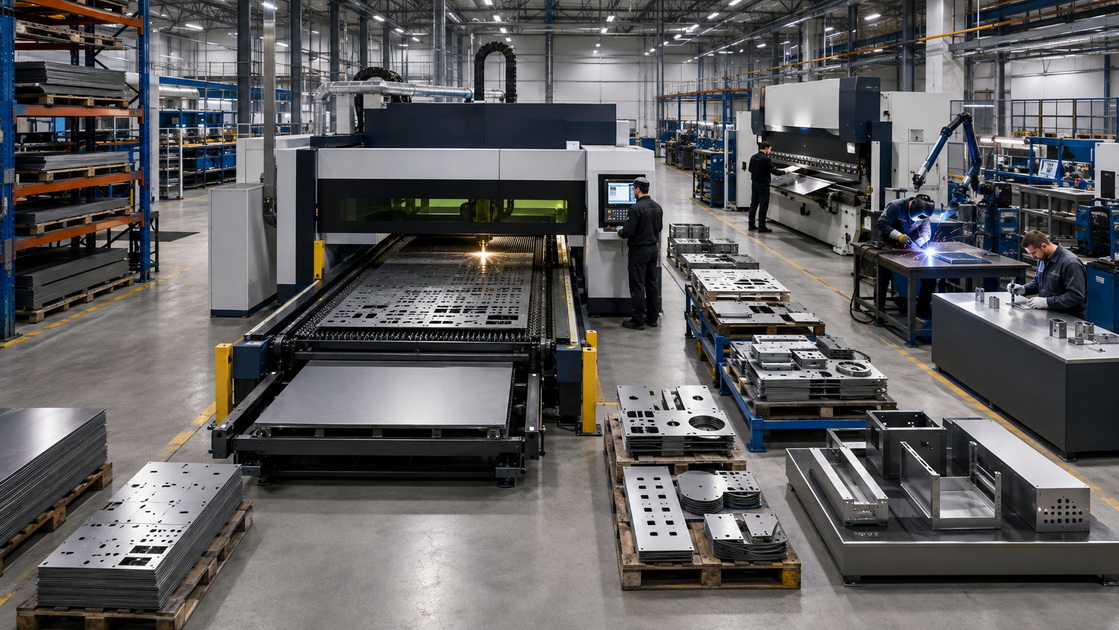
A common mistake is to solve only the loading problem. In real manufacturing, an exchange table may reduce laser downtime but expose a new bottleneck elsewhere.
For example, the laser may produce parts faster than the team can:
- Sort cut components
- Remove micro-joint parts
- Separate scrap skeletons
- Deburr sharp edges
- Feed parts into press brakes
- Stage parts for welding
- Perform quality inspection
- Pack finished components
This is why machine selection should start with a full process map.
Before selecting a single table or exchange table laser cutter, measure one representative week of production.
1. Record sheets processed each day
2. Measure average cutting time per sheet
3. Measure loading, unloading, and sorting time
4. Identify how often the laser waits for material
5. Track part-removal delays caused by complex nests
6. Check press brake and welding capacity after cutting
7. Review available floor space and material-storage access
8. Estimate expected order growth over 12 to 36 months
This process creates a stronger purchasing decision than comparing machine price or laser wattage alone.
For manufacturers planning growth, the best question is not "Which table is faster?" It is "Which system fits our next stage of production?"
A scalable sheet metal production cell may include:
- Fiber laser cutting machine
- Exchange table system
- Automatic sheet loading unit
- Unloading and sorting solution
- Raw-material storage tower
- CNC press brake
- Welding equipment
- Production-management software
- Quality-control stations
TRUMPF describes automation options ranging from automatic raw-sheet loading to connected storage, unloading, pallet handling, and automatic sorting. These systems are designed to improve material flow and enable more continuous production. [trumpf]
For CNDY-Press customers, this approach is especially relevant when the project involves OEM, ODM, or customized manufacturing. The right solution must match sheet size, material grades, thickness range, part geometry, workshop layout, local safety requirements, labor availability, and planned capacity expansion.
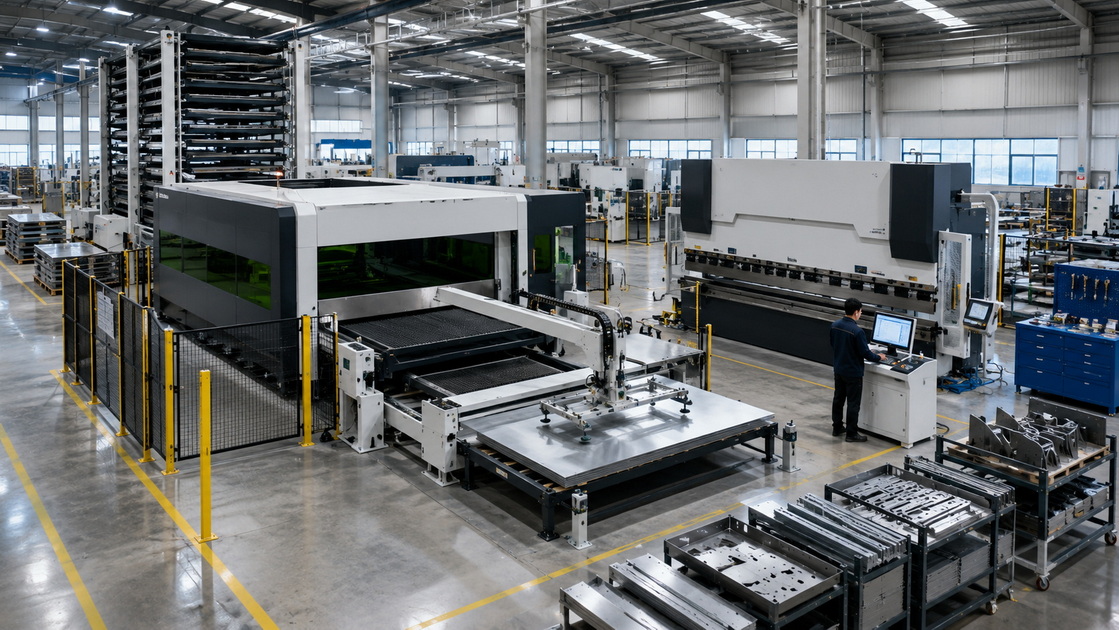
CNDY-Press provides fiber laser cutting and sheet metal processing equipment for manufacturers that need reliable production performance rather than a one-size-fits-all configuration.
A well-planned solution can be customized around:
- 3015, 4020, 6020, or other working formats
- Laser power and material-thickness requirements
- Single table or exchange table structure
- Open or enclosed machine design
- Automatic loading and unloading options
- High-volume OEM production needs
- Workshop space and material flow
- Integration with press brakes and downstream processing
The best machine is the one that protects throughput without creating unnecessary capital cost or operational complexity.
If your laser currently waits for loading, unloading, or sheet preparation, an exchange table system may unlock meaningful capacity. If your business runs mixed, low-volume, or frequently changing jobs, a single table configuration may deliver stronger value and a faster path to return.
Contact CNDY-Press with your sheet dimensions, materials, thicknesses, average sheets per shift, production schedule, layout drawing, and future capacity plan. Our engineering team can help evaluate the most suitable fiber laser cutting configuration for your production goals.
No. The laser's actual cutting speed depends on laser power, material type, sheet thickness, assist gas, nozzle condition, cutting parameters, and nesting design. An exchange table mainly improves effective throughput by reducing non-cutting time during sheet changes.
The gain varies by application. It depends on the number of sheets processed, average manual handling time, cutting duration, exchange speed, part complexity, and operator workflow. The greatest benefit usually appears in repeat production with frequent sheet changes.
Yes. A single table machine can be highly effective for custom metal fabrication, medium-volume cutting, prototypes, varied materials, and businesses with limited floor space or investment budgets.
Yes. Exchange table machines normally require more installation space because the second pallet must move outside the cutting enclosure for loading and unloading. Buyers should review the full footprint, access clearances, material staging, and service space before installation.
Many exchange table configurations provide a stronger base for future loading, unloading, storage, and sorting automation. Compatibility should be confirmed during the purchase stage because interfaces, space, material flow, and safety planning affect future upgrades.
1. [TRUMPF — Automation for 2D Laser Cutting Machines] — Information on automated sheet loading, unloading, pallet handling, storage connectivity, and sorting systems. [trumpf]
2. [Bystronic — ByTrans and ByTrans Extended Laser Automation] — Technical overview of laser loading/unloading systems, dual cassettes, large-part removal, material-flow benefits, and production autonomy. [bystronic]
3. [TRUMPF — Third Pallet Station] — Manufacturer information on using an additional pallet position to reduce interruptions and optimize material flow. [trumpf]
4. [TRUMPF — Automated Sorting Development] — Example of separating cutting, sorting, and material-handling processes to improve machine utilization. [trumpf]
5. [WiseCut — Single Table vs. Exchange Table Fiber Laser Cutting Machine] — Industry comparison of single-platform and exchange-table workflows, buyer considerations, and capacity evaluation principles. [wisecutlaser]


