


Views: 272 Author: CNDY-Press Publish Time: 2026-10-10 Origin: Site


Content Menu
● How a Finger Brake and a Press Brake Work
>> Finger Brake: Clamping and Folding
>> CNC Press Brake: Punch and Die Forming
● Press Brake vs Finger Brake Comparison
● Avoid Universal Thickness Claims
>> Finger Brake Capacity Is Model-Specific
>> Press Brake Tonnage Is Only One Requirement
● What Buyers Should Actually Compare
>> CNC Press Brake Performance
● Bend Sequence and Part Escape
>> Finger Brake Setup Is Not Tool-Free
>> Press Brake Tooling Controls More Than the Angle
● Productivity: Measure the Complete Workflow
● Calculate Cost Per Accepted Part
● Manual Operation Does Not Eliminate Risk
● A Practical Equipment Selection Process
>> Step 1: Review Your Actual Job Mix
>> Step 2: Screen for Capability
>> Step 3: Request Representative Samples
>> Step 4: Time Setup and Production
>> Step 5: Agree on Acceptance
● When Keeping Both Machines Makes Sense
● Planning a CNC Press Brake with CNDY-Press
● FAQ
>> 1. Can a Finger Brake Bend Stainless Steel?
>> 2. Can a Press Brake Make Boxes and Pans?
>> 3. Is a CNC Press Brake Always Faster?
>> 4. Does Higher Tonnage Improve Accuracy?
>> 5. Can a Finger Brake Replace a CNC Folding Machine?
The press brake vs finger brake decision depends on the parts your workshop makes—not simply its size. A finger brake can suit thin-sheet boxes, trays, and custom work. A CNC press brake can support a wider range of forming requirements through suitable tooling, programmed positioning, and controlled ram movement.
Neither machine is automatically the better investment.
My recommended starting point is geometry: can the proposed machine complete every bend, in sequence, without collisions or inaccessible flanges? Only after answering that question should you compare capacity, output, and cost.
This guide compares a conventional manual box and pan brake with a CNC press brake. Powered finger brakes and CNC folding machines are separate equipment categories and may offer capabilities beyond those described here.
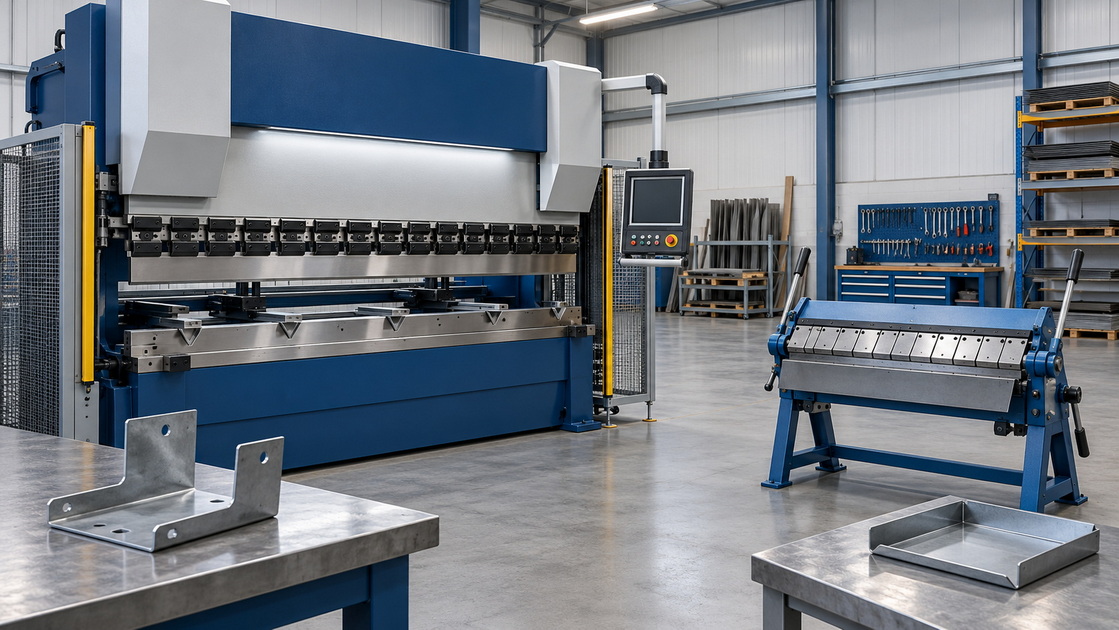
A finger brake, also called a box and pan brake, clamps sheet metal beneath a segmented upper beam.
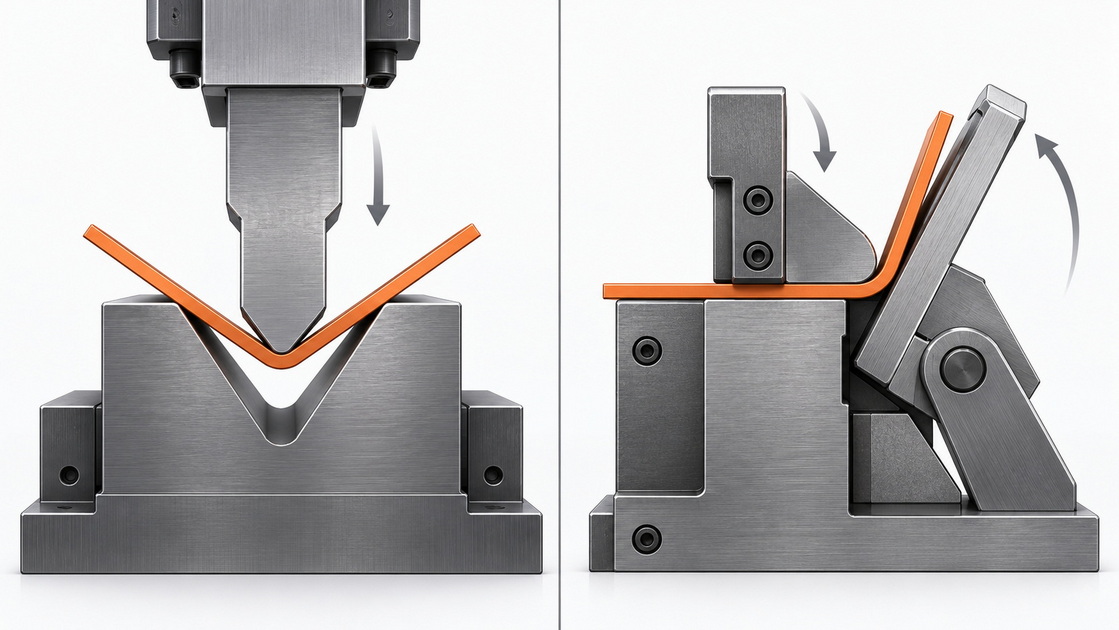
The operator raises a hinged bending apron to fold the projecting sheet around the clamping edge. Removable fingers provide clearance for previously formed flanges.
This differs from pressing a punch into a V-die. The sheet is clamped, and the apron produces the bend.
Finger arrangement, clamping adjustment, bend allowance, and operator technique influence the result.
A press brake moves a punch toward a die to form the sheet.
In air bending, the material contacts the punch and the die shoulders without fully conforming to the tooling. Other forming methods require different tooling, forces, and operating conditions.
CNC systems can control ram movement, backgauge positioning, and programmed sequences. Depending on the configuration, they may also incorporate crowning or angle measurement.
These features support repeatability, but they do not eliminate material variation, setup errors, or tooling limitations.
| Selection factor | Manual Finger Brake | CNC Press Brake |
|---|---|---|
| Bending method | Clamps and folds with a hinged apron | Forms material between punch and die |
| Typical applications | Boxes, trays, covers, and custom thin-sheet work | Brackets, panels, enclosures, and production parts |
| Capacity assessment | Model-specific material and length rating | Force, tooling, material, length, and machine limits |
| Setup | Finger arrangement and mechanical adjustment | Tool selection, program, backgauge, and compensation |
| Repeatability | Depends on setup, stops, material, and technique | Supported by controlled axes and repeatable setup |
| Clearance limits | Fingers, beam, apron, and box depth | Tool shape, opening, throat, stroke, and bend sequence |
| Automation | Conventional manual operation | Automation possible with appropriate integration |
| Investment | Often lower for basic equipment | Higher equipment and integration commitment |
Use this comparison as a screening tool—not as a substitute for testing your actual parts.
Do not assume every finger brake handles the same material thickness.
For example, Baileigh rates its BB-4814 for 14-gauge mild steel and 18-gauge stainless steel across a 48-inch working width. That difference demonstrates why a mild-steel rating cannot be transferred directly to stainless steel.
A different model may have a different capacity.
Ask for ratings covering:
- Material grade and strength.
- Thickness in millimeters.
- Bend length.
- Required bend angle.
- Operating restrictions.
Do not assume a shorter bend permits thicker material unless the manufacturer explicitly approves it.
Press brake selection must consider material strength, thickness, bend length, die opening, and forming method.
A machine may have sufficient total force but still be unsuitable because of tooling limits, concentrated loading, insufficient opening, or poor part clearance.
Request a documented calculation for representative parts. Require the supplier to verify both machine and tooling suitability.
A CNC controller does not guarantee a finished-part tolerance.
Results also depend on material thickness, springback, tooling, setup, part positioning, and measurement.
A well-adjusted finger brake can produce useful, consistent results within its application range. Stops and disciplined working methods can improve repeatability.
However, manual handling and adjustment remain important. Measure several parts rather than judging one successful sample.
Programmed axes support repeated positioning and reusable setups.
Crowning and angle-control systems may help manage relevant variation, but their capabilities depend on the installed configuration.
Separate the supplier's axis-positioning specification from your required bend angle and flange-length tolerances. They are different acceptance criteria.
A part can be within the thickness rating and still be impossible to finish.
Removing fingers creates space for some formed flanges. It does not provide unlimited clearance.
Check:
- Box depth.
- Adjacent flange height.
- Finger width and arrangement.
- Access for the final bend.
- Ability to remove the finished part.
Baileigh's BB-4814, for example, specifies a four-inch maximum box depth. This is a model-specific limit, not a universal characteristic of finger brakes.
Assess punch shape, die height, machine opening, throat depth, and the entire forming sequence.
Deep returns may need suitable gooseneck tooling or another process. Tall flanges can interfere with the tooling or machine.
Before buying, submit the complete 3D model—not just a flat pattern. Ask the supplier to demonstrate the proposed sequence and part removal.
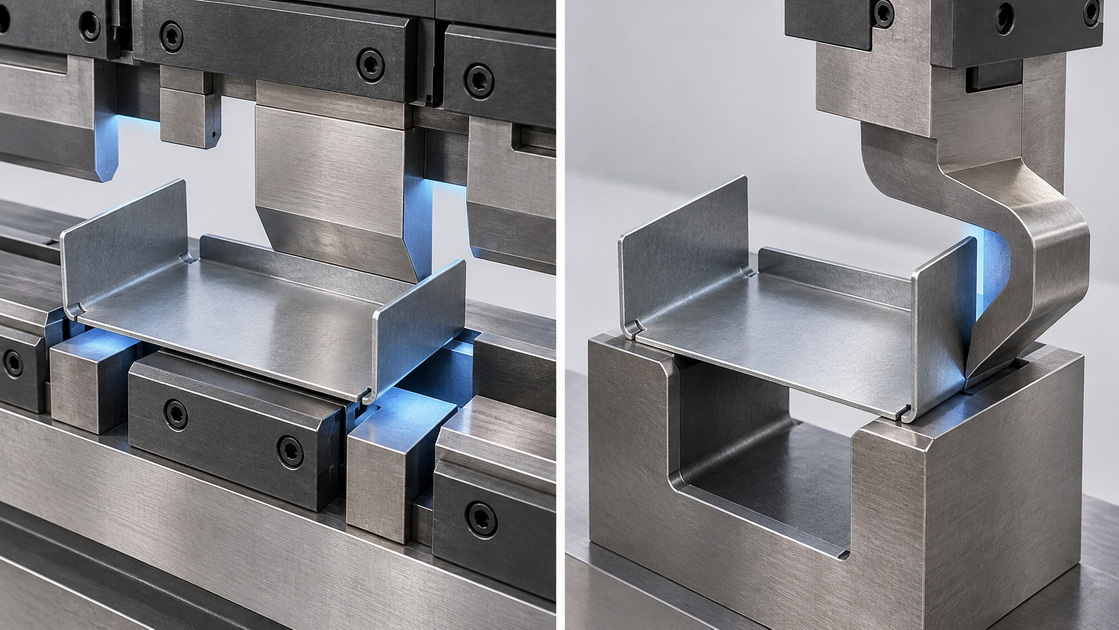
Repositioning fingers still takes time. Different jobs may require clamping and bend adjustments.
Inspect the clamping surfaces and consider how contact affects coated or cosmetic material.
Do not assume simple construction means zero setup effort.
Die opening influences force, bend radius, and the shortest supported flange.
Industry guidance describes relationships between V-opening, inside radius, and minimum flange length for specified air-bending conditions. These are useful planning rules, not universal guarantees for every alloy or tool.
A wider opening can reduce force but increase the natural radius and required flange support. A narrower opening can create different force and marking requirements.
Include cosmetic surfaces in sample approval. Protective films or tooling accessories must also be checked for suitability.
Ram speed and apron movement do not equal production output.
Measure the entire process:
1. Retrieve and identify the blank.
2. Position the material.
3. Complete the bend.
4. Reorient the part.
5. Inspect the result.
6. Stack the finished component.
7. Replenish material or change the setup.
For large sheets, handling may dominate cycle time. For small batches, programming and setup may matter more than bending speed.
A finger brake can be economical for an occasional simple job. A CNC press brake can be valuable for recurring work—but neither conclusion should replace timed trials.
Compare more than purchase price.
Include equipment, tooling, transport, installation, training, maintenance, labor, and rework.
A useful internal calculation is:
Cost Per Accepted Part=(Allocated Equipment Cost + Setup + Labor + Consumables + Rework)/Accepted Parts
Use observed or carefully justified inputs.
Do not include hypothetical labor savings as guaranteed savings. If employees remain necessary for handling, inspection, or setup, account for that work.
For a growth investment, compare realistic workload scenarios rather than assuming full utilization immediately.
Finger brakes have clamping points, moving aprons, sharp sheet edges, and handling hazards.
Press brakes introduce high-force forming and additional movement hazards.
Both require suitable training and machine-specific procedures.
For powered press brakes, safeguarding must address the actual task and machine configuration. OSHA guidance requires protection against hazardous machine energy; a CNC controller is not itself a safeguarding system.
Maintenance and interventions exposing personnel to unexpected movement require appropriate hazardous-energy control. An emergency stop does not replace isolation.
Never bypass safeguards to complete a part that the proposed setup cannot accommodate safely.
Collect representative drawings and production records.
Identify recurring parts, difficult geometries, material ranges, batch sizes, and current quality problems.
Remove machines that cannot meet the required capacity, clearance, or forming method.
Do this before comparing prices.
Ask suppliers to form your important parts using documented material and tooling.
Inspect consecutive parts, not only the best sample.
Measure the complete workflow with the intended handling method.
Include changeovers and inspection.
Define part tolerances, sample quantity, operating conditions, measurement methods, and installation checks.
Retain the tested configuration in the purchase specification.
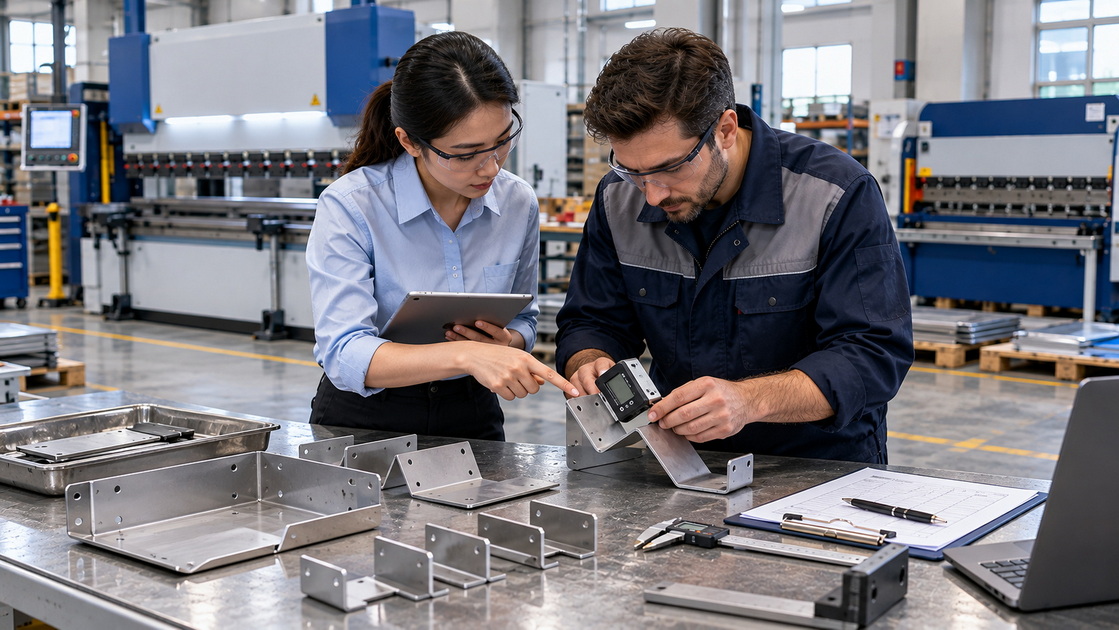
The choice does not always need to be exclusive.
A workshop may retain a finger brake for occasional covers, prototypes, or suitable repair work while using a CNC press brake for recurring production.
This can prevent a small interruption from occupying the primary production machine.
However, adding a second machine is justified only when workload, floor space, staffing, and safe operation support it. Equipment ownership alone does not improve throughput.
CNDY-Press develops, manufactures, sells, and services CNC press brakes and related sheet-metal equipment. Its stated services include OEM, ODM, and customized production.
For a project discussion, provide:
- Part drawings and material specifications.
- Required tolerances and quantities.
- Tooling preferences.
- Site and electrical requirements.
- Safeguarding requirements.
- Installation, training, and service expectations.
Ask for a configuration linked to your parts rather than a quotation based only on tonnage and working length.
Choose a finger brake when its folding method, capacity, and clearance match your work and manual operation remains commercially practical.
Choose a CNC press brake when your parts require suitable punch-and-die forming, controlled repeatability, broader configuration options, or planned production integration.
Send CNDY-Press your representative drawings, material range, and production targets. Request a documented bending proposal, sample plan, and itemized quotation before committing to equipment.
Yes, if the specific machine is rated for the grade, thickness, and bend length. Do not apply its mild-steel rating to stainless steel.
Yes, when suitable tooling and clearance allow the complete sequence. Verify access for the final bends and removal of the finished part.
No. Total productivity includes setup, handling, repositioning, and inspection. Compare timed workflows for your actual batch sizes.
Not automatically. Tonnage provides force capacity. Finished-part accuracy also depends on tooling, control, material, setup, and machine condition.
Not necessarily. A conventional manual finger brake differs from a CNC folding system in control, positioning, automation, and possible capacity. Compare specific models.
1. [CNHAWE — Press Brake vs Finger Brake: Choosing the Right Metal Bending Tool for Your Workshop]
Published September 26, 2025. Original article used to identify topics and claims requiring clarification. Its general thickness ranges and productivity claims are not adopted as universal specifications. [cnhawe]
2. [Baileigh Industrial — BB-4814 Box and Pan Brake]
Manufacturer specifications supporting the model-specific mild-steel and stainless-steel ratings, removable fingers, working width, and maximum box depth. [baileigh]
3. [Baileigh Industrial — BB-4816 Box and Pan Brake]
Additional manufacturer specifications demonstrating variation between finger-brake models. [baileigh]
4. [The Fabricator — The Rules of Press Brake Tool Selection]
Supports the relationship between die opening, air-bent radius, minimum flange, and tooling selection. Numerical rules require application-specific verification. [thefabricator]
5. [The Fabricator — Six Steps for Selecting the Right Die for Press Brakes]
Technical guidance connecting radius, die selection, and forming requirements. [thefabricator]
6. [OSHA — Guidelines for Point of Operation Guarding of Power Press Brakes]
U.S. regulatory guidance supporting the need for task-appropriate safeguarding. Historical guidance should be read with applicable current requirements and machine documentation. [osha]
7. [OSHA — 29 CFR 1910.147: Control of Hazardous Energy]
Supports energy isolation for covered servicing and maintenance. Facilities outside the United States must follow applicable local requirements. [osha]


