


Views: 263 Author: CNDY-Press Publish Time: 2026-10-16 Origin: Site


Content Menu
● Fiber Laser vs CO2 Laser: Key Differences at a Glance
● What Needs Updating in Conventional Laser Comparisons?
● How Fiber and CO2 Lasers Work
>> Fiber Lasers Use a Shorter Wavelength
>> Metal Cutting Requires a Complete Process
● Material Compatibility: What Will You Actually Cut?
>> Fiber Laser Cutting for Sheet Metal
>> CO2 Laser Cutting for Nonmetals
● Cutting Speed: Compare Complete Nests, Not Straight Lines
>> A More Useful Demonstration
● Thick Plate and Edge Quality: Avoid Outdated Rules
● Assist Gas Can Change the Business Case
>> Oxygen and Nitrogen Produce Different Results
>> Request Gas Consumption Under Real Conditions
● Build the Calculation Around Good Parts
>> An Illustrative Calculation
● Can the Factory Use the Extra Output?
● Maintenance, Uptime, and Service Support
● Laser Safety: Specify Engineering Controls First
● A Practical Acceptance Test Before Purchase
>> 1. Select Representative Jobs
>> 2. Agree on Quality Criteria
>> 3. Record the Configuration
>> 4. Run a Representative Production Nest
>> 5. Review Downstream Performance
>> 6. Define Factory and Site Acceptance
● How CNDY-Press Can Support a Customized Project
● FAQ
>> 1. Can a fiber laser cut acrylic and wood?
>> 2. Is CO2 always better for thick steel?
>> 3. Does fiber laser cutting require assist gas?
>> 4. Can we compare machines with equal wattage directly?
>> 5. Should an existing CO2 laser be replaced immediately?
For most businesses investing in new sheet-metal cutting capacity, a fiber laser cutting machine is the more practical starting point. A CO2 laser remains relevant for suitable nonmetal materials and for existing metal-cutting operations where proven output, available capacity, and ownership costs justify keeping it.
However, the fiber laser vs CO2 laser decision should not begin with advertised wattage or a headline cutting speed. It should begin with your material mix, required edge condition, production volume, and downstream operations.
My recommendation is to compare cost per accepted part rather than purchase price or maximum cutting speed.
This guide explains the technical differences, corrects common purchasing misconceptions, and provides a sample-testing framework for buyers evaluating standard or customized equipment from manufacturers such as CNDY-Press.

| Buying Factor | Fiber Laser Cutting Machine | CO2 Laser Cutting Machine |
|---|---|---|
| Typical wavelength | Approximately 1.06–1.08 μm | Commonly approximately 10.6 μm |
| Main purchasing fit | Industrial metal cutting | Suitable nonmetal processing and established metal-cutting applications |
| Thin-sheet productivity | Often a strong advantage | Must be evaluated against the proposed alternative |
| Thick-metal capability | Modern high-power systems have substantially expanded capability | Existing systems can remain useful for qualified applications |
| Reflective metals | Suitable configurations are available; application approval remains essential | More application-dependent |
| Assist gas | Commonly required for metal cutting | Commonly required for metal cutting |
| Maintenance | Fewer beam-delivery maintenance requirements, but not maintenance-free | Requirements depend on source and beam-delivery design |
| Investment comparison | Compare complete installed systems | Do not compare a small nonmetal cutter with an industrial metal-cutting system |
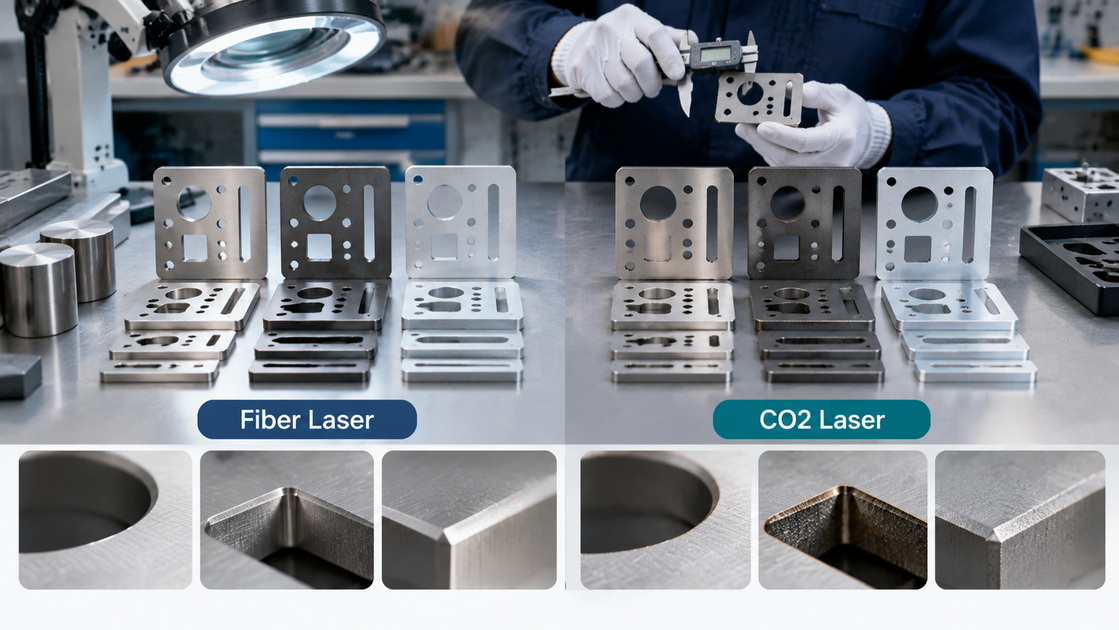
Many older comparisons mix three different equipment categories:
- Low-power CO2 engraving machines.
- Industrial CO2 metal-cutting machines.
- Industrial fiber laser cutting machines.
That makes universal price and performance statements unreliable.
Several other claims also need qualification. Fiber metal cutting does use assist gas. Modern fiber systems are not restricted to thin sheet. A laser-source lifetime claim is not a complete-machine warranty.
The supplied reference article contains these limitations and also describes fiber lasers as having a lower frequency than CO2 lasers. Their shorter wavelength actually corresponds to a higher frequency.
No customer reviews were supplied with the brief or identified in the retrieved article. This guide therefore uses a procurement perspective without inventing testimonials or personal operating experience.
Fiber laser systems generate laser energy in an active optical fiber. Industrial cutting models commonly operate around 1.06–1.08 μm.
CO2 lasers use a gas-based laser source and commonly operate around 10.6 μm.
These wavelengths interact differently with materials. This helps explain why fiber systems are widely used for metal processing, while CO2 systems remain important for suitable materials such as acrylic, wood, paper, and textiles.
Wavelength alone does not determine performance. Beam characteristics, power, focusing, motion control, and cutting parameters also matter.
The laser supplies energy, while the cutting process removes material from the kerf.
Depending on the application, assist gas may support oxidation or expel molten material. TRUMPF distinguishes oxygen-assisted flame cutting from fusion cutting using nitrogen or argon.
Consequently, "fiber lasers do not need gas" is not a sound assumption for industrial metal-cutting procurement.
A fiber laser deserves early consideration when your recurring work includes mild steel, stainless steel, aluminum, or other approved metallic materials.
For copper, brass, and other reflective materials, obtain written confirmation covering the proposed machine, source, cutting head, material, and operating conditions.
Do not assume that every fiber system is approved for every reflective-metal application.
CO2 systems are often appropriate for suitable acrylic, wood, paper, textiles, and selected polymers.
However, material compatibility must be assessed individually. "Plastic" is not a sufficiently precise specification.
Trotec identifies PVC, PTFE, and several other materials as unsuitable for its laser processing because hazardous gases or dust can be produced.
An industrial fiber metal cutter is therefore not a substitute for a properly selected nonmetal laser system.
Fiber systems can deliver substantial productivity advantages, particularly in appropriate thin-sheet applications. However, a maximum straight-line speed says little about a complex production nest.
Actual cycle time includes:
- Piercing.
- Acceleration and deceleration.
- Small contours.
- Travel between features.
- Sheet exchange.
- Loading and unloading.
- Interruptions and recovery.
A machine that cuts a long straight line quickly may deliver a smaller advantage on parts containing many holes and short contours.
Ask suppliers to process the same production drawing, material grade, thickness, and quantity.
Record the complete cycle from the agreed starting point to finished cutting. Keep loading assumptions consistent.
Request both programmed and observed times. Investigate material differences between them.
The claim that CO2 is automatically better above 5 mm is no longer a useful purchasing rule.
Modern fiber platforms offer substantial thick-plate capability. Bystronic advertises systems processing steel up to 50 mm, while TRUMPF documents high-power fiber configurations with dedicated thick-sheet capabilities.
These are machine-specific capabilities, not guarantees for every material, geometry, or edge requirement.
Before a trial, specify:
- Permitted burr or dross.
- Dimensional tolerances.
- Hole requirements.
- Edge condition.
- Allowable heat effects.
- Required preparation before welding or coating.
For many fabricators, the important question is not whether a machine can separate a plate. It is whether it can produce a usable part consistently.
Evaluate the resulting parts against the next operation, not just their appearance immediately after cutting.
Oxygen supports an exothermic cutting reaction and produces an oxidized edge.
Nitrogen helps expel molten material without the same oxidation mechanism. Bystronic identifies this prevention of edge oxidation as a key reason for selecting nitrogen.
The appropriate choice depends on material, thickness, process settings, and downstream requirements.
Ask each supplier to document:
- Gas type and required purity.
- Pressure and supply requirements.
- Consumption during the trial.
- Nozzle configuration.
- Expected process limitations.
If compressed-air cutting is proposed, include the air-treatment equipment, compressor demand, maintenance, and resulting edge quality in the comparison.
Do not treat compressed air as a universally interchangeable substitute.
A useful purchasing model is:
Cost per accepted part=Allocated ownership and operating costs/Parts meeting the agreed acceptance criteria
Include the complete installed package:
| Cost Category | What to Include |
|---|---|
| Equipment | Machine, source, automation, and software |
| Installation | Freight, rigging, foundations, and utility connections |
| Energy | Machine, cooling, extraction, and associated equipment |
| Gas | Supply, storage or generation, and consumption |
| Consumables | Nozzles, protective optics, and agreed wear items |
| Maintenance | Scheduled service, calibration, and repairs |
| Labor | Loading, sorting, supervision, and secondary work |
| Quality | Scrap, rework, and inspection |
| Finance | Funding costs and relevant ownership assumptions |
Fiber technology can reduce important operating costs compared with CO2 equipment. Nevertheless, supplier claims about percentage savings should be checked against your own process and utility rates.
Suppose one process costs $120 per operating hour and produces 60 accepted parts. Its operating cost is $2 per accepted part.
Another costs $150 per hour but produces 100 accepted parts. Its operating cost is $1.50 per accepted part.
These are hypothetical figures, not market benchmarks. They show why hourly cost and unit cost can point to different decisions.

A faster laser does not automatically create more finished shipments.
Before buying additional cutting capacity, check:
- Part sorting.
- Deburring.
- Bending.
- Welding.
- Coating.
- Inspection.
- Material handling.
If bending is already the bottleneck, faster cutting may increase work in progress rather than completed orders.
For an integrated sheet-metal equipment project, ask the supplier to consider the workflow around the laser—not just the cutting machine itself.
This is particularly relevant when discussing customized production layouts with CNDY-Press.
Fiber systems should not be described as maintenance-free.
Even when beam-delivery maintenance is reduced, the complete machine still requires inspection and servicing of relevant optics, cooling equipment, motion systems, extraction, and other components.
Similarly, a quoted laser-source operating-life figure does not establish guaranteed machine uptime.
Ask suppliers to separate:
1. Source warranty.
2. Machine warranty.
3. Consumable exclusions.
4. Preventive-maintenance requirements.
5. Remote response time.
6. On-site support arrangements.
7. Critical spare-parts availability.
Request the proposed machine's maintenance schedule and replacement-cost assumptions before finalizing the financial model.
Both technologies require a suitable safety assessment.
OSHA identifies protective housing, control of hazardous beam exposure, and adequate ventilation among relevant safeguards. Cutting can also create fire, fume, compressed-gas, and material-related hazards.
Procurement discussions should cover:
- Protective enclosure.
- Access controls and interlocks.
- Suitable viewing arrangements.
- Emergency stops.
- Extraction.
- Fire-risk controls.
- Training and maintenance procedures.
Protective eyewear, where required, must be selected for the specific hazard. Generic "laser glasses" are not an adequate specification.
Compliance documentation should match the destination market and supplied machine configuration.
Include your frequent materials and thicknesses, plus at least one difficult recurring job.
Avoid allowing the demonstration to consist entirely of unusually easy parts.
Define dimensions, edges, holes, and permitted secondary work before cutting.
Document the source, cutting head, optics, gas, nozzle, software, and relevant settings.
Observe repeated processing rather than one selected sample.
Take samples through the intended bending, welding, or coating steps.
Agree on the tests performed before shipment and after installation, including how failures will be resolved.
These are proposed procurement controls, not a universal acceptance standard.
 xq
CNDY-Press describes its business as the development, manufacture, sale, and service of sheet-metal processing equipment, including fiber laser cutting machines. The company also supports OEM, ODM, and customized manufacturing projects.
For an effective inquiry, provide:
- Material grades and thickness distribution.
- Typical drawings and sheet dimensions.
- Monthly workload and shift pattern.
- Required edge quality.
- Loading and automation preferences.
- Available utilities and floor plan.
- Destination-market requirements.
Ask for a written proposal connecting the recommended configuration to sample results, production assumptions, service responsibilities, and acceptance criteria.
Start with fiber laser cutting when evaluating new capacity for predominantly metal work. Consider CO2 for suitable nonmetal applications and assess existing industrial CO2 equipment on its actual performance and remaining economic value.
Do not decide from wattage, maximum thickness, or headline price alone.
A conventional industrial fiber metal-cutting machine is not the appropriate general-purpose choice. Suitable CO2 equipment is normally the relevant starting point, subject to material verification.
No. Modern high-power fiber systems have substantial thick-plate capability. Compare the exact configurations using representative parts and agreed quality requirements.
Industrial metal cutting commonly uses assist gas. Its type and requirements depend on the material and selected cutting process.
Not reliably. Delivered results also depend on beam characteristics, cutting head, motion performance, gas, settings, and job geometry.
Not necessarily. Compare its maintenance outlook, capacity, part quality, and remaining ownership cost with a tested replacement proposal.
1. SENFENG Laser USA — "Fiber Laser Machines VS CO2 Laser Machines." Original comparison reviewed for its scope and purchasing assumptions. [senfenglaserusa]
2. TRUMPF — "Laser cutting." Technical explanation of cutting processes, assist gases, and material removal. [trumpf]
3. TRUMPF — "24 kW of laser cutting power." Machine-specific examples of modern fiber thick-sheet capability. [trumpf]
4. Bystronic — "CO₂ vs. Fiber Laser Technology." Manufacturer comparison covering productivity, operating costs, and process developments. [bystronic]
5. Bystronic — "Laser cutting machine." Published machine-specific power and thickness capabilities. [bystronic]
6. Bystronic — "High-powered lasers and the evolution of assist gases." Explanation of nitrogen and edge oxidation. [bystronic]
7. Trotec Laser — "Overview of Different Laser Sources." Source characteristics, wavelengths, and material applications. [troteclaser]
8. Trotec Laser — "Which materials are not suitable for laser cutting and engraving?" Material exclusions and processing hazards. [troteclaser]
9. OSHA — Technical Manual, Section III, Chapter 6, "Laser Hazards." Engineering controls, ventilation, and associated hazards. [osha]


