


Views: 276 Author: CNDY-Press Publish Time: 2026-07-29 Origin: Site


Content Menu
● Why Press Brake Maintenance Matters
● Key Benefits of Routine Maintenance
● Maintenance Levels and Timing
>> Lubrication and Motion Parts
>> Electrical and Cooling Checks
● Common Problems Prevented by Maintenance
● A Smarter Maintenance Workflow
● How CNDY Press Supports Buyers
>> 1. How often should a press brake be maintained?
>> 2. What is the most important daily maintenance task?
>> 3. Why does a press brake lose accuracy over time?
>> 4. Should hydraulic oil be changed regularly?
>> 5. Can maintenance reduce press brake downtime?
A well-maintained press brake is more reliable, safer, and more accurate. For any sheet metal manufacturer, press brake maintenance is not just a repair task. It is a production strategy that protects uptime, precision, and long-term machine value.
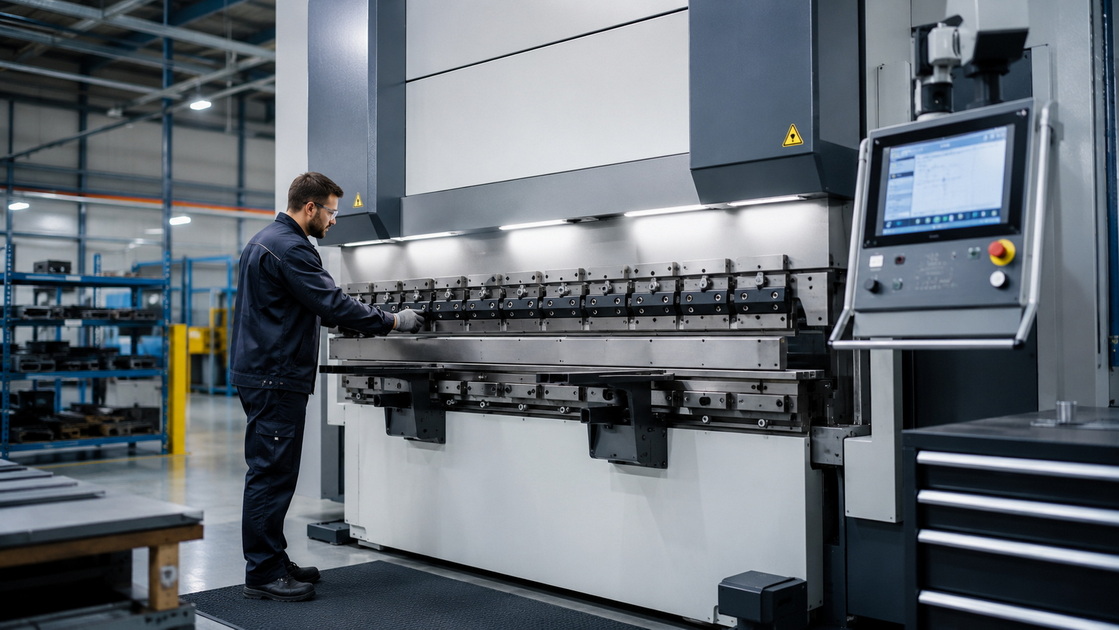
Press brakes work under heavy load, repeated motion, and demanding production conditions. Over time, dust, oil contamination, loose fasteners, worn tooling, and hydraulic issues can all reduce performance. If these problems are ignored, they can lead to inaccurate bends, unexpected stoppages, and expensive repairs.
Good maintenance helps a machine stay stable through daily production. It also supports safer operation by keeping safety devices, controls, and hydraulic systems in proper condition.
Routine maintenance delivers value in several ways:
- Longer machine life.
- Better bending accuracy.
- Lower repair costs.
- Less unplanned downtime.
- Safer operator working conditions.
- More consistent production output.
In a busy fabrication shop, these improvements quickly add up. A press brake that is checked regularly is easier to trust and easier to schedule.
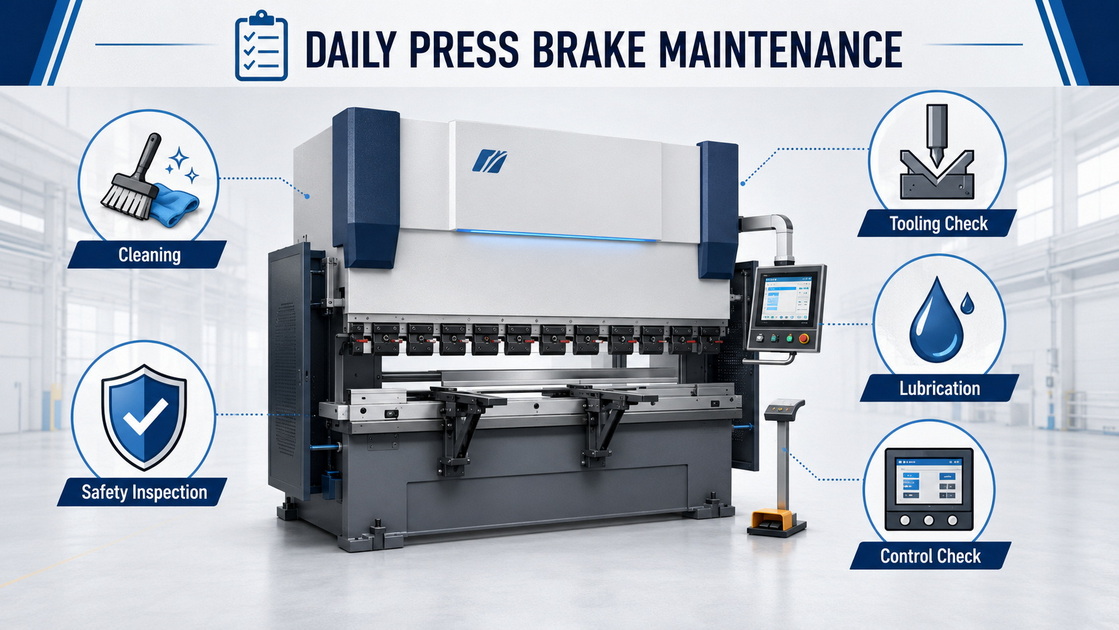
A practical maintenance plan should follow a clear schedule. Different tasks belong to different time intervals, and each interval has a specific purpose.
| Maintenance Level | Frequency | Main Focus |
|---|---|---|
| Daily | Every shift or every working day | Cleaning, safety checks, visual inspection |
| Weekly | Once a week | Safety devices, fasteners, filters, guards |
| Monthly | Once a month | Hydraulic system, lubrication, leaks, electrical cabinet cleaning |
| Annual | Once a year | Full inspection, oil change, calibration, wear evaluation |
This structure makes maintenance easier to organize and reduces the chance of overlooking important checks.
Daily maintenance should be short, practical, and consistent. It usually begins before the machine starts and ends after the shift is complete.
Before starting work, inspect the machine and confirm that the worktable and die area are free of debris, old parts, or residues from the previous shift. Check that the mold and fixtures are secure, and make sure all safety devices are functioning properly. Also confirm that the power supply, grounding, and emergency stop system are ready for use.
While the machine is running, listen for unusual sounds, vibration, or slow movement. Watch for hydraulic leaks, pressure instability, or error messages on the control screen. Monitoring these signs early can prevent small issues from becoming major failures.
At the end of the shift, clean the table, tools, supports, and backgauge carefully. Use a dry cloth to remove dust, chips, oil traces, and process residue. Keep the slide in a safe position and shut down the machine properly.
Weekly maintenance should focus on the components most likely to loosen, drift, or collect contamination during repeated use.
Check these items every week:
- Emergency stop button.
- Rear guard.
- Side guards.
- Foot pedal or three-position pedal.
- Filter clogging indicator.
- Visible bolts, connectors, and pipe fittings.
The goal is to confirm that safety systems still work correctly and that no parts have loosened under vibration or load.
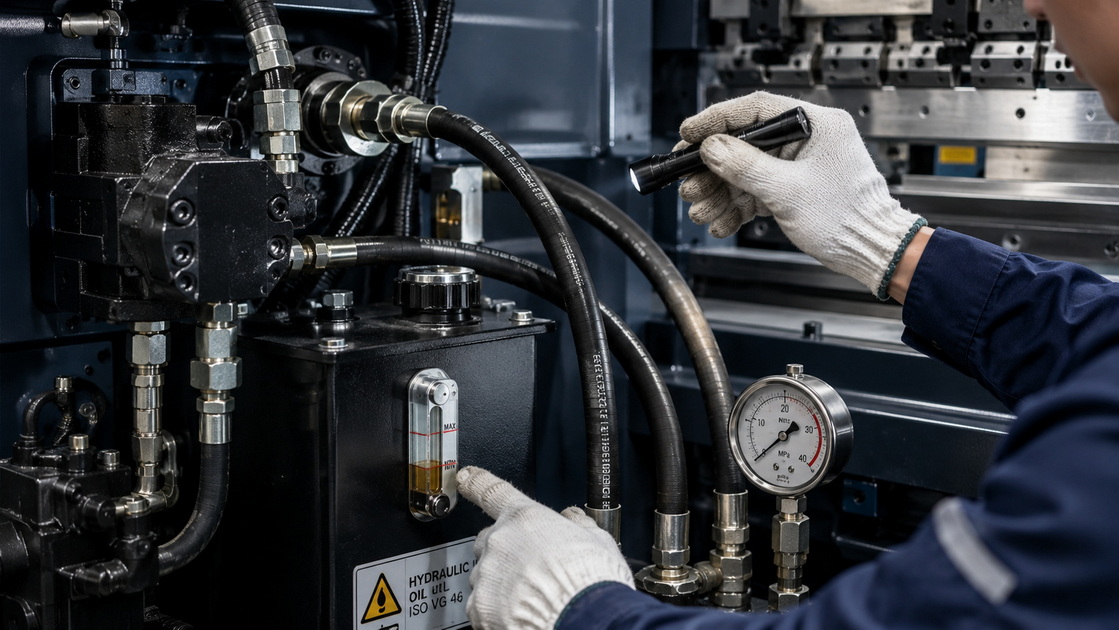
Monthly maintenance goes deeper into machine health. At this stage, the hydraulic system, lubrication points, and electrical cabinet deserve special attention.
Clean the outside of the hydraulic system, including valves, manifolds, motor-pump units, and pipes. Look for leaks, bulges, damaged hoses, or loose fittings. If needed, tighten connections and replace worn hoses before they fail.
Lubricate guides, ball screws, bearings, and moving mechanical parts according to the manufacturer's recommendations. Proper lubrication reduces friction, wear, and heat buildup. It also helps the ram and backgauge move more smoothly.
Clean dust from the electrical cabinet and control box. Confirm that cooling fans are working properly and that the cabinet remains clean and ventilated. Electrical cleanliness is important because heat and dust can reduce control reliability.
Annual maintenance should be more comprehensive than routine care. It is the right time to evaluate wear, reset accuracy, and restore the machine to a stable operating condition.
Annual tasks should include:
1. Replace hydraulic oil if required.
2. Clean the oil tank.
3. Replace filter elements.
4. Inspect and lubricate the ram guides.
5. Check machine levelness and geometric accuracy.
6. Verify backgauge positioning accuracy.
7. Inspect electrical components for aging or looseness.
8. Back up controller parameters and programs.
This annual review is especially important for equipment used in high-volume production or precision bending applications.
Maintenance work must always begin with safety. Before any repair or inspection, shut down the machine completely, isolate the power, and lock out the main disconnect switch. Depressurize the hydraulic system before opening any component or line.
Use proper protective equipment and avoid unsafe shortcuts. Never place hands in the bending zone, never climb on machine parts that are not designed for loading, and never restart the machine until all guards and safety devices are restored.
Many press brake failures are avoidable. Regular maintenance helps prevent issues such as:
- Inconsistent bend angles.
- Hydraulic pressure loss.
- Backgauge drift.
- Oil leaks.
- Electrical alarm faults.
- Safety device malfunction.
- Excessive wear on tooling and guides.
If a machine begins to show one of these symptoms, maintenance records often help identify the likely cause faster.
For manufacturers running CNC press brakes every day, a simple checklist is often not enough. A better workflow includes assignment, documentation, and recurring review.
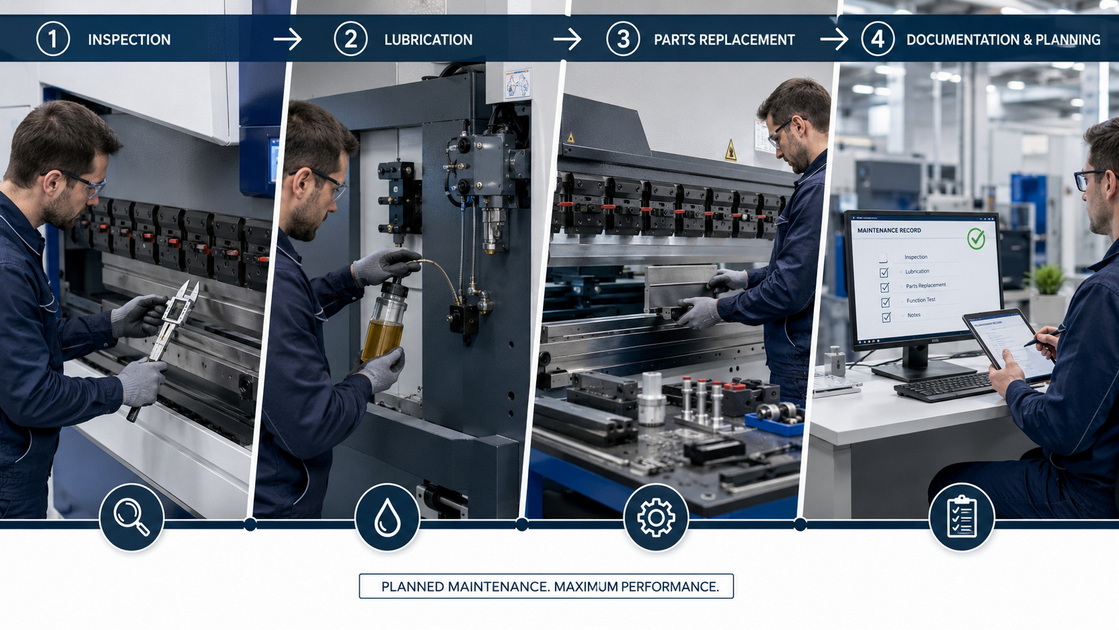
A practical maintenance workflow looks like this:
1. Assign daily, weekly, monthly, and annual tasks.
2. Record inspection results after each shift or service.
3. Track recurring issues by machine and by component.
4. Replace wear parts before failure occurs.
5. Review maintenance history during production planning.
This approach turns maintenance into a repeatable operating system instead of a reaction to breakdowns.
CNDY Press works with OEM and ODM projects and provides customized manufacturing services for sheet metal equipment buyers. That means maintenance planning can be considered not only after purchase, but also during machine selection and configuration.
For customers who need stable production and long-term service support, choosing the right press brake model, control system, and maintenance schedule together can make a significant difference in real factory performance.
Press brake maintenance is one of the most effective ways to protect machine accuracy, reduce downtime, and extend service life. A clean machine, a lubricated machine, and a properly inspected machine will always perform better than a neglected one.
For any workshop that relies on CNC bending equipment, maintenance should be treated as a core part of production management, not an afterthought.
Daily checks should be done every shift, while deeper inspections should be completed weekly, monthly, and annually depending on the task.
Cleaning the machine and checking safety devices are two of the most important daily tasks because they help prevent contamination and protect operators.
Accuracy can drop because of worn tooling, hydraulic issues, loose parts, poor lubrication, or misalignment in the backgauge and ram.
Yes. Hydraulic oil should be inspected often and changed according to machine condition and manufacturer guidance, especially if contamination or discoloration appears.
Yes. Routine maintenance helps detect small problems early, which reduces the chance of major breakdowns and unexpected production stops.
1. VICLA. "Press Brake Maintenance: The Complete Guide." [https://www.vicla.eu/en/blog/press-brake-maintenance-the-complete-guide]
2. Shen Chong. "CNC Hydraulic Press Brake Maintenance Guide For Users." [https://www.shen-chong.com/cnc-hydraulic-press-brake-maintenance-guide-for-users/]
3. RMT. "How To Maintain A Press Brake." [https://www.rmtus.com/how-to-maintain-a-press-brake]
4. Press and Shear. "9 Key Press Brake Maintenance Practices." [https://www.pressandshear.com/9-key-press-brake-maintenance-practices/]
5. Metfab. "Metal Fabrication Equipment Maintenance Tips." [https://www.metfab.com.au/metal-fabrication-equipment-maintenance-tips/]
6. Buds Machine Tools. "How Do I Maintain My Press Brake?" [https://budsmachinetools.com/blog/356-how-do-i-maintain-my-press-brake]


