


Views: 249 Author: CNDY-Press Publish Time: 2026-11-21 Origin: Site


Content Menu
● Intelligent Press Brake vs Conventional CNC Press Brake at a Glance
● 1. Adaptive Bending and Angle Measurement
>> Position Control Is Not the Same as Angle Control
>> When Adaptive Correction Matters Most
● 2. Mechanical Capability Still Comes First
>> Crowning and Angle Sensing Solve Different Problems
● 3. Offline Programming and Collision Simulation
>> Move Preparation Away from the Machine
>> Accurate Digital Models Are Essential
● 4. Tool Setup and Backgauge Features
>> Automatic Tool Changing Needs a Job-Mix Justification
>> More Backgauge Axes Are Not Automatically Better
● 5. Operator Support, Handling, and Safety
>> Evaluate Handling Across the Entire Cycle
>> Safety Must Be Assessed Independently
● 6. Connectivity, Maintenance, and Energy Use
>> Connected Data Must Support a Decision
>> Compare Support Requirements and Measured Energy
● 7. Calculate the Value of Features Before Buying
>> A Hypothetical Setup-Savings Example
>> Avoid Double-Counting Benefits
● 8. Use a Representative Acceptance Test
● Which Press Brake Configuration Fits Your Factory?
● Custom CNC Press Brake Planning with CNDY-Press
>> 1. Is an intelligent press brake always more accurate?
>> 2. Can a conventional CNC press brake use offline programming?
>> 3. Does automatic angle correction eliminate inspection?
>> 4. Is automatic tool changing worthwhile for small batches?
>> 5. Can intelligent features be added later?
An intelligent press brake vs conventional CNC press brake comparison should start with one question: which production problems must the machine solve? Both can deliver productive, accurate sheet metal bending. The difference lies in how much setup, measurement, correction, and production coordination the configured machine can handle automatically.
An intelligent press brake typically adds capabilities such as in-process angle measurement, adaptive correction, automated setup, or connected production data. A conventional CNC press brake relies more heavily on programmed positions, established process settings, and operator verification.
At CNDY-Press, our manufacturing perspective is straightforward: evaluate the complete bending process, not the appeal of a feature list. The right investment should address measurable bottlenecks while remaining practical to operate and maintain.
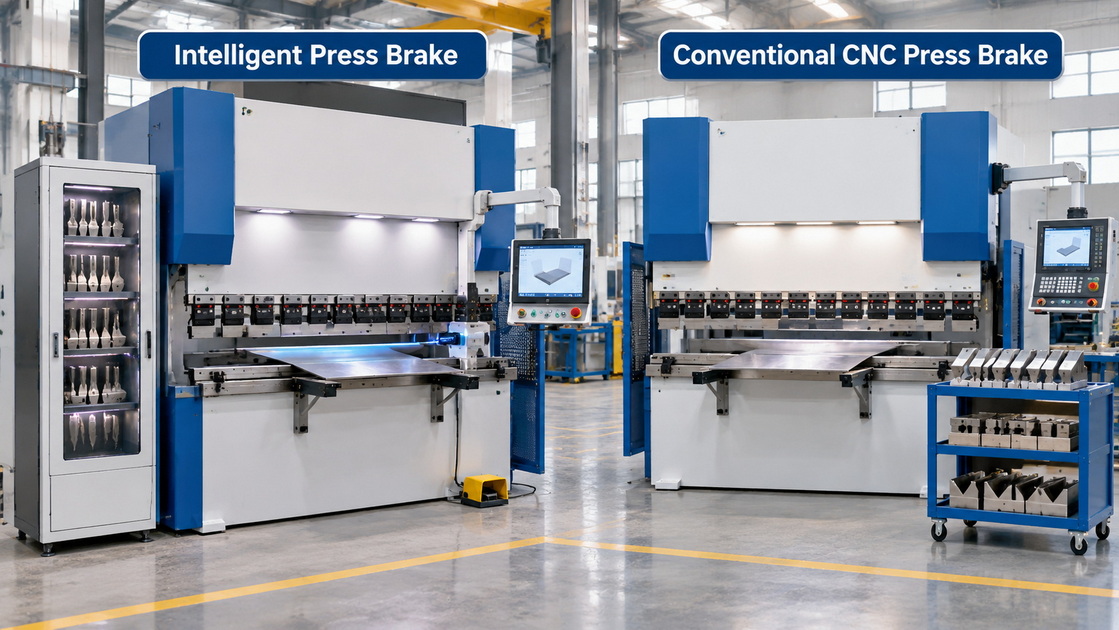
"Intelligent" is not a uniform equipment specification. Manufacturers use the term differently, and many capabilities are optional.
For this comparison, conventional CNC means a CNC-controlled machine without integrated adaptive angle correction or extensive setup automation. It does not mean a manual machine or an inherently inaccurate one.
| Production factor | Conventional CNC press brake | Intelligent press brake configuration |
|---|---|---|
| Bending control | Executes programmed positions and settings | May adjust bending using measured feedback |
| First-part approval | More dependent on trials and inspection | Can reduce adjustment where sensing is applicable |
| Programming | Machine-side or optional offline programming | Often combines simulation and digital workflows |
| Tool setup | Usually operator-led | May include tool identification or automatic changing |
| Material variation | Managed through settings and operator correction | May compensate for measured angle deviations |
| Production records | Manual or controller-dependent | May provide connected job and process records |
| Maintenance | Fewer additional systems to support | Requires support for sensors, software, and automation |
| Investment priority | Reliable bending at a controlled cost | Reducing specific setup, quality, or handling losses |
Compare quoted configurations line by line. A well-equipped conventional machine may offer more useful functionality than a poorly specified "smart" model.
A CNC press brake controls machine motion. However, repeating the same ram position does not guarantee identical finished angles across changing materials.
Springback, thickness variation, and material strength can affect the result. Tool condition and setup also matter.
In-process angle measurement adds feedback from the workpiece. Depending on the system, optical sensors or contact-based measuring tools detect the angle, and the control uses that information to adjust bending.
This is a meaningful distinction: the machine responds to the bending result rather than relying only on a stored position.
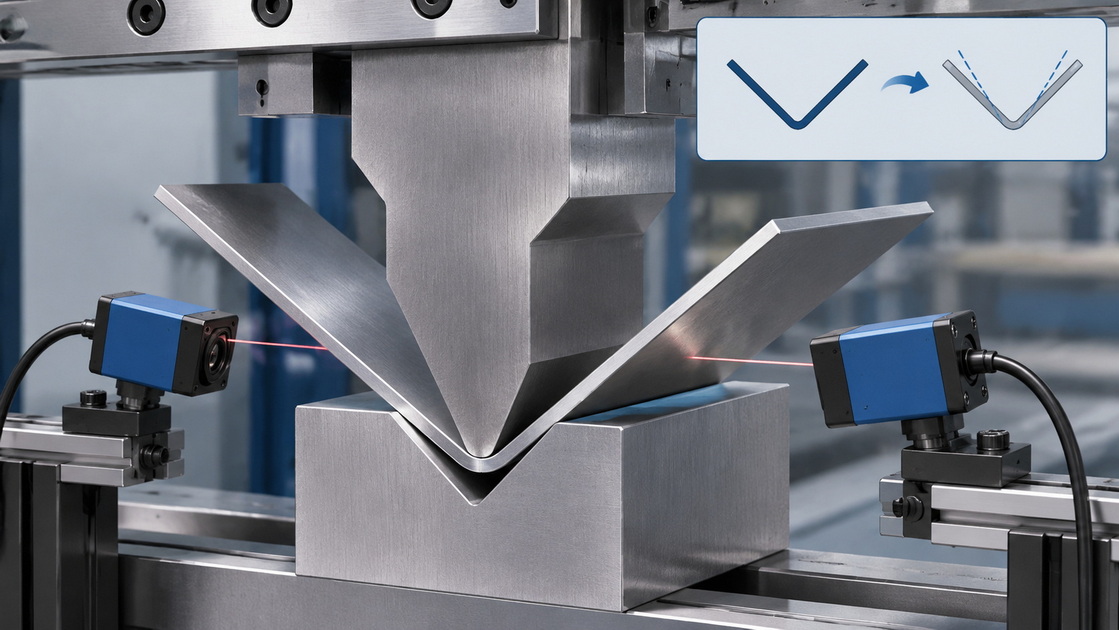
Prioritize a demonstration when your production involves:
- Frequent material-batch changes.
- Tight angular requirements.
- Expensive blanks.
- Short batches with significant first-part adjustment.
- Repeated corrections after material substitutions.
Do not assume that every sensor works on every geometry. Short flanges, obstructed measuring positions, surface characteristics, and tooling arrangements can affect suitability.
Ask the supplier to demonstrate your difficult parts, not only an uncomplicated sample.
Intelligent controls cannot compensate for an unsuitable working envelope or incorrect tooling.
Before comparing software, confirm:
- Required bending force.
- Usable bending length.
- Open height and stroke.
- Throat depth.
- Tool compatibility and load ratings.
- Backgauge travel and access.
- Part clearance throughout the sequence.
A deep enclosure may require more clearance than a flat-panel demonstration suggests. A short flange may create tooling and gauging challenges regardless of controller sophistication.
Crowning compensates for machine deflection along the bending length. Angle measurement checks the bending result at available measuring locations.
They can complement each other, but one does not automatically replace the other.
Likewise, an accurate bend angle does not prove that flange dimensions meet the drawing. Blank accuracy, gauging, tooling, and the bending sequence remain important.
Offline programming allows production preparation without occupying the press brake for every programming task.
Depending on the software, this can include:
- Importing part geometry.
- Selecting tools.
- Developing bend sequences.
- Checking possible collisions.
- Generating setup information.
- Transferring machine programs.
This can be valuable in high-mix production, where preparation consumes a substantial share of available time.
However, offline programming is not exclusive to intelligent machines. Confirm controller compatibility, software licensing, and the postprocessor included in the quotation.
Simulation depends on the quality of the machine, tool, and part data.
An incorrect tool model or outdated setup can undermine a convincing screen demonstration. Ask how custom tools enter the library, who maintains the database, and how program revisions are controlled.
Treat simulation as preparation support—not permission to skip a controlled first-part check.
Automatic tool changing can reduce manual setup work between compatible jobs. It is particularly relevant when frequent changeovers interrupt production.
However, compare it with simpler improvements:
- Quick clamping.
- Organized tool storage.
- Standardized tool sets.
- Shared setups across part families.
- Clear digital setup instructions.
If tooling stays unchanged for most of a shift, automatic changing may have limited influence on output.
Ask about compatible tool profiles, storage capacity, tool preparation, and recovery after an interrupted change.
Additional controlled movements can help position complex parts and reduce manual adjustment.
Nevertheless, axis-count labels vary. Ask the supplier to identify each movement and demonstrate its purpose on your parts.
The useful question is not "How many axes are included?" It is "Which manual positioning steps will this configuration remove?"
An intuitive controller can reduce searching and inconsistent setup practices. Useful functions include clear bend-sequence graphics, accessible correction history, and reusable job instructions.
Operators still need to understand tooling limits, part orientation, inspection, and abnormal conditions.
For large panels, loading and supporting the workpiece may take longer than the bending stroke.
Sheet followers or lifting assistance may therefore offer more value than a higher approach speed. For small parts, repeated handling and orientation can dominate the cycle.
Observe the operator as carefully as the machine during a trial.
An angle-measuring laser is not a safeguarding device.
The complete installation needs appropriate protection for its operating hazards, supported by training and safe maintenance procedures. In the United States, OSHA identifies point-of-operation safeguarding as a requirement for press brakes.
For any destination market, have qualified personnel confirm applicable requirements and assess the configured machine. Robotic integration or subsequent modifications also require a review of the complete installation.
Production connectivity can help identify delays and preserve job information. Its value depends on what is recorded and how reliably it is interpreted.
Ask whether the system can distinguish:
- Setup from productive running.
- Planned stops from faults.
- Good parts from total cycles.
- Operator corrections from program revisions.
Also confirm export formats, access permissions, backup arrangements, and operation during network interruptions.
A dashboard alone does not improve production. Someone must use its information to correct a problem.
Additional sensors and automation introduce service requirements. Request calibration procedures, diagnostic access, spare-part availability, software support terms, and a recovery plan.
Do not assume intelligence determines energy efficiency. Drive architecture and operating patterns also matter.
Compare measured energy under the same representative workload, including idle and standby periods. Energy per accepted part is more informative than motor nameplate power alone.
Assume an advanced configuration costs $45,000 more and saves 12 minutes on each of eight daily changeovers.
That releases 96 minutes per day. At an illustrative machine-and-labor burden rate of $60 per hour across 220 working days, the theoretical annual time value is $21,120.
The simple payback is approximately 2.1 years before financing, additional maintenance, software, and training.
These are hypothetical assumptions, not CNDY-Press pricing or customer results.
Most importantly, released time is not automatically cash savings. It creates economic value when it supports saleable output, reduces overtime, or removes another real cost.
If faster setup increases available production time, do not count the same recovered hours again as a separate utilization benefit.
Similarly, distinguish reduced scrap from reduced rework. Build the comparison from documented losses and realistic improvements.
The strongest business case usually targets a few recurring problems rather than assigning savings to every advertised feature.
A practical comparison needs identical parts and clearly defined conditions.
Build a test set covering routine work, difficult geometry, long bends, short flanges, and relevant material variation.
Use the following process:
1. Supply drawings, tolerances, materials, and batch expectations.
2. Agree on tooling, software, and operator assistance.
3. Record programming and physical setup separately.
4. Time the first acceptable part.
5. Inspect agreed dimensions and angles.
6. Run the batch and document corrections.
7. Record scrap, handling time, and interruptions.
For adaptive systems, include relevant material variation. For offline programming, check the actual transferred program. For automatic tool changing, include a realistic transition between jobs.
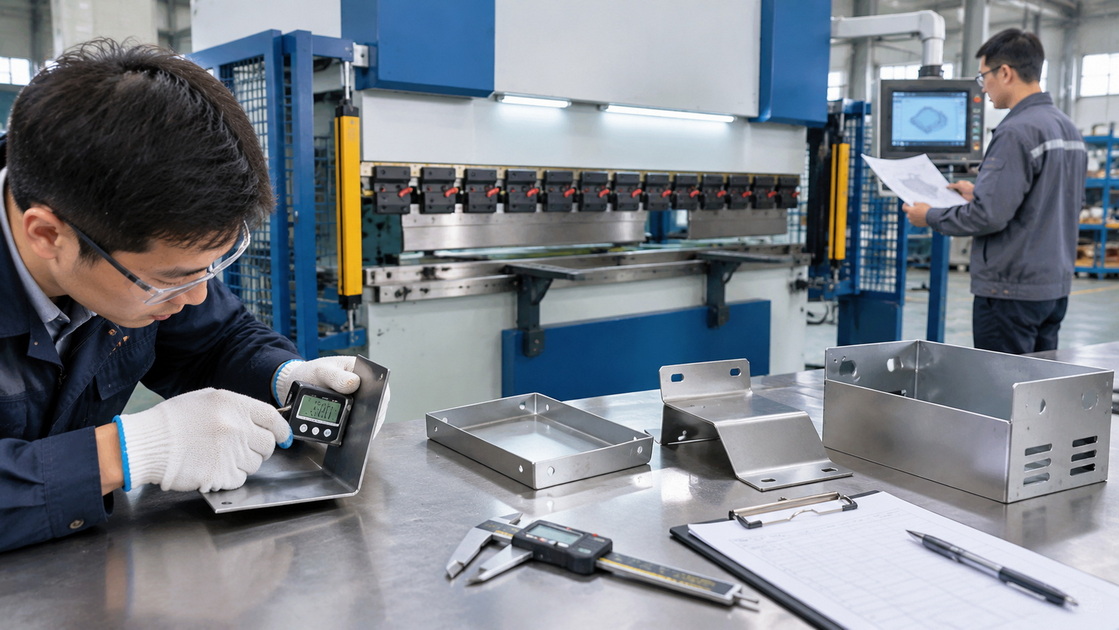
Agree on acceptance criteria before the demonstration. A supplier-selected sample cannot establish suitability for your entire workload.
| Production situation | Features to prioritize |
|---|---|
| Stable, repeat work with infrequent changes | Mechanical suitability, repeatable setup, reliable service |
| High-mix, short-run fabrication | Offline programming, setup standardization, quick tool changes |
| Variable materials and demanding angles | Demonstrated in-process measurement and correction |
| Large, difficult-to-handle panels | Suitable capacity, clearance, and handling assistance |
| Plans for robotic production | Integration capability, part consistency, complete-cell assessment |
A conventional CNC press brake can be the stronger investment when the process is stable and the main requirement is dependable capacity.
An intelligent configuration becomes more compelling when it demonstrably reduces recurring adjustments, changeovers, or coordination losses.
CNDY-Press develops, manufactures, sells, and services CNC press brakes and related sheet metal processing equipment, with OEM, ODM, and customized production available.
No. Accuracy depends on the complete process. Adaptive measurement can address certain angle variations, but it cannot correct every tooling, blank, gauging, or handling problem.
Yes, when compatible software and a suitable postprocessor are available. Confirm supported functions and licensing rather than relying on the machine's marketing category.
No. It can reduce adjustment work, but finished-part inspection remains necessary according to the drawing and your quality plan.
Potentially. Frequent tool changes can make it valuable, but compatibility, setup patterns, and actual time savings must justify the investment.
Sometimes. Feasibility depends on the frame, controller, interfaces, tooling, and software. Request written confirmation of upgrade requirements before purchase.
1. [TRUMPF — TruBend Series 5000]. Describes optical and tool-integrated angle measurement, correction, and automatic tool changing. [trumpf]
2. [TRUMPF — Press Brakes]. Explains material-related angle variation, adaptive measurement, offline programming, and setup automation. [trumpf]
3. [TRUMPF — Bending Tools]. Documents sensor tools, tool identification, and setup optimization. [trumpf]
4. [TRUMPF — Flex Cell]. Describes geometry-based programming, collision checks, clamping, and application-dependent angle measurement. [trumpf]
5. [OSHA — Powered Press Brakes]. Provides an overview of press brake point-of-operation safeguarding methods. [osha]
6. [OSHA — Machine Guarding General Requirements]. Explains guarding requirements for machinery that exposes employees to operating hazards. [osha]


