


Views: 266 Author: CNDY-Press Publish Time: 2026-08-13 Origin: Site


Content Menu
● Understanding the Two Technologies
● How Pneumatic Press Brakes Work
>> Typical Pneumatic Press Brake Applications
● How CNC Hydraulic Press Brakes Work
>> Typical CNC Hydraulic Press Brake Applications
● Pneumatic vs. CNC Hydraulic Press Brake Comparison
● Bending Force and Material Capacity
>> Why Capacity Margin Matters
● Precision, Repeatability, and Part Quality
● Productivity Beyond Cycle Speed
● Maintenance and Operating Considerations
>> Pneumatic Machine Maintenance
>> Hydraulic Machine Maintenance
● Safety Requirements for Press Brake Operations
● Choosing the Right Press Brake for Your Factory
● Customized Press Brake Solutions From CNDY-Press
>> 1. Is a pneumatic press brake faster than a CNC hydraulic press brake?
>> 2. Can pneumatic press brakes bend thick metal sheets?
>> 3. What does CNC control do on a hydraulic press brake?
>> 4. How is press brake tonnage calculated?
>> 5. Why do bend angles vary between material batches?
A pneumatic press brake and a CNC hydraulic press brake can both form sheet metal, but they serve very different production requirements. The right choice depends on more than machine price or nominal capacity. It affects part consistency, setup time, operator workload, tooling options, plant utilities, maintenance planning, and the ability to scale production.
For buyers producing brackets, cabinets, enclosures, electrical panels, chassis parts, doors, frames, or custom metal components, the decision should begin with the application. Material grade, thickness, bend length, required angle tolerance, annual volume, and part complexity are more important than a machine label alone.
At CNDY-Press, we support manufacturers that need dependable sheet metal bending equipment for standard production, OEM projects, and customized machine applications. This guide explains how pneumatic and CNC hydraulic press brakes differ and how to evaluate which configuration is suitable for your operation.
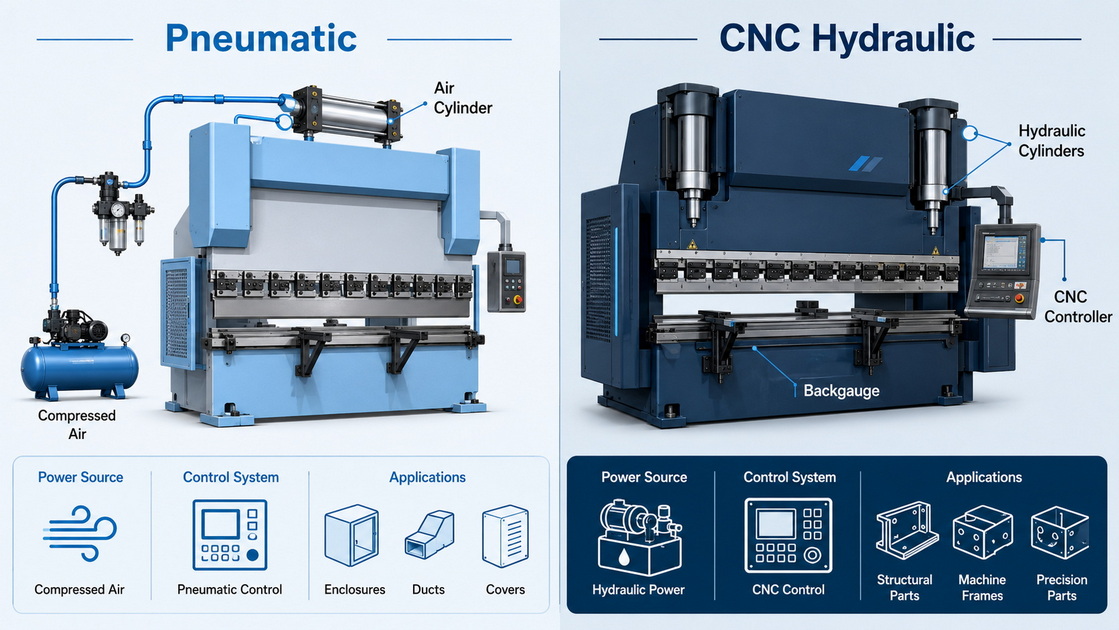
The terms "pneumatic" and "CNC hydraulic" describe different aspects of a press brake.
A pneumatic press brake is defined primarily by its power source. It uses compressed air to move an actuator or cylinder that generates force for bending sheet metal. These machines are generally used for lighter-duty forming tasks, simple parts, and applications with limited force requirements.
A CNC hydraulic press brake uses hydraulic cylinders to generate bending force and a computerized control system to manage machine movement. Depending on the configuration, the controller can regulate ram position, backgauge movement, bend sequence, dwell time, and multiple machine axes.
It is important to understand that CNC does not mean hydraulic by itself. CNC refers to the machine's control capability. A machine can have programmable functions while using different power systems. In practical purchasing decisions, buyers should compare machine specifications, process capability, safety systems, and long-term operating requirements rather than relying only on terminology.
A pneumatic press brake uses compressed air to actuate its working cylinder. When the operator activates the control system, compressed air enters the cylinder and moves the ram or forming mechanism downward. The upper tool presses the sheet metal into the lower die to create the required bend.
The system is relatively straightforward. In suitable applications, it can provide responsive movement and a simple operating process. Pneumatic press brakes may be used for small components, short bends, light-gauge sheet metal, and repetitive forming tasks.
However, compressed air has limitations. The available force depends on air pressure, cylinder size, actuator design, and the condition of the air supply system. Pressure loss, air leaks, moisture, poor filtration, or unstable compressor performance can affect machine behavior and increase operating costs.
A pneumatic press brake is not automatically the best option simply because it has a lower initial investment. Buyers should review the full cost of compressed air generation, filtration, drying, distribution, leakage management, and routine maintenance.
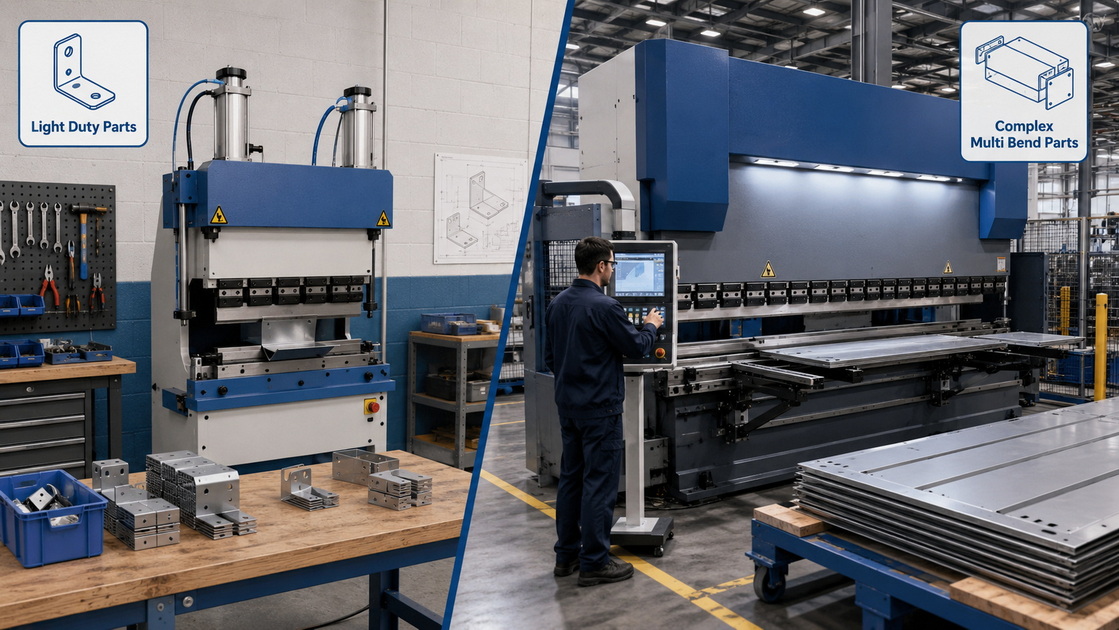
Pneumatic press brakes may be appropriate for:
- Light-gauge sheet metal components
- Small brackets, clips, tabs, and covers
- Short workpieces with simple bend geometry
- Dedicated production of one or a few stable part designs
- Low-force forming operations
- Workshops with a reliable compressed-air system already in place
The key advantage is simplicity. For a narrow, clearly defined task, a pneumatic machine can be an effective and practical solution.
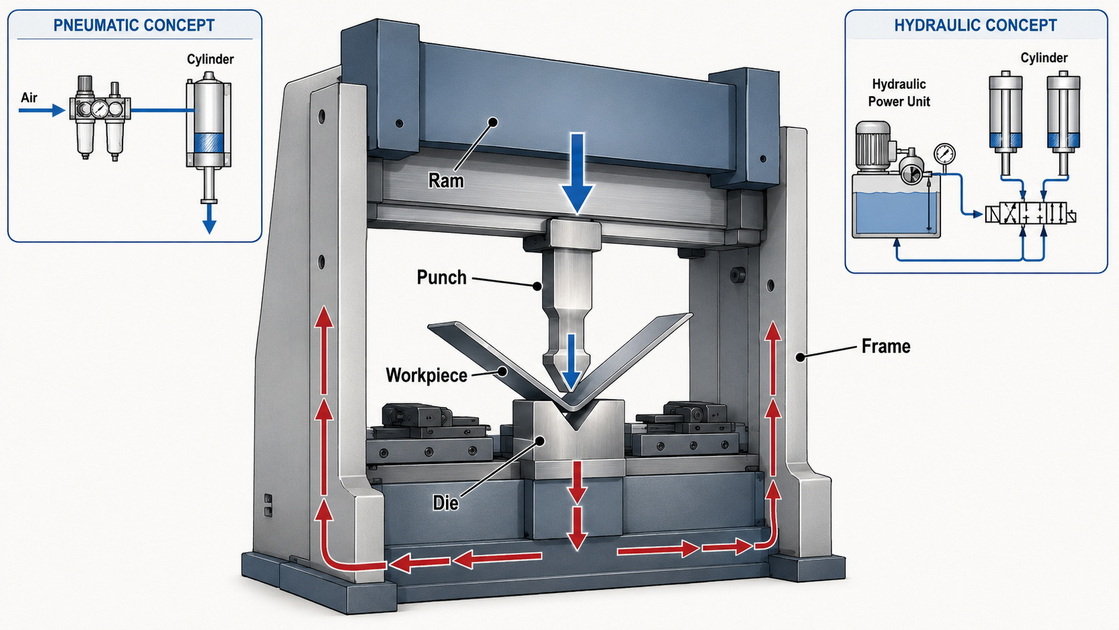
A CNC hydraulic press brake uses hydraulic pressure to drive one or more cylinders that move the ram. The system can apply controlled force through the upper punch and lower die, enabling sheet metal to be bent into precise angles and dimensions.
In electro-hydraulic servo systems, the controller receives feedback from position-measuring components and adjusts hydraulic movement accordingly. This helps maintain synchronized ram movement and supports more stable bending results, especially for longer workpieces and demanding production conditions.
The CNC controller is a major part of the machine's value. It can store bending programs, position the backgauge automatically, guide operators through bend sequences, and support repeat production of the same part.
For manufacturers with multiple part numbers, changing batch sizes, or tight dimensional requirements, this level of control can improve workflow consistency and reduce unnecessary setup variation.
CNC hydraulic press brakes are widely used for:
- Electrical cabinets and control enclosures
- Steel doors and panel components
- Stainless-steel kitchen equipment
- Metal furniture and shelving
- HVAC ducting and fabricated assemblies
- Construction and architectural metalwork
- Agricultural machinery components
- Automotive and transport-related parts
- OEM sheet metal products with repeated production requirements
The major advantage is flexibility. A properly configured CNC hydraulic press brake can handle a broad range of materials, thicknesses, bend lengths, and part geometries.
| Decision Factor | Pneumatic Press Brake | CNC Hydraulic Press Brake |
|---|---|---|
| Power source | Compressed air | Hydraulic system |
| Production role | Light-duty and straightforward bending | Medium- to heavy-duty precision bending |
| Force capability | Limited by air pressure and cylinder design | Configurable for a broad range of force requirements |
| Control functions | Manual, semi-automatic, or basic programmable operation | Programmable ram, backgauge, sequence, and optional multi-axis control |
| Part complexity | Best for simple parts | Suitable for complex and multi-bend components |
| Repeatability | Depends on setup, air quality, tooling, and operator technique | Improved through programmed positioning and controlled ram movement |
| Changeover efficiency | Suitable for simple, stable work | Better for high-mix or repeat production |
| Utility requirements | Compressed-air supply, filtration, and leak control | Electrical power and hydraulic-system maintenance |
| Initial investment | Often lower for simpler configurations | Usually higher depending on capacity and control options |
| Best-fit production type | Light, repetitive, dedicated forming | Flexible production with varying parts and tolerance requirements |
Bending force is one of the most important factors in press brake selection. However, buyers should not choose a machine by tonnage alone.
Required force depends on several variables:
- Material type and tensile strength
- Sheet thickness
- Bend length
- V-die opening
- Punch and die design
- Bend method
- Required inside radius
- Grain direction and material consistency
For example, a part made from stainless steel may require significantly more bending force than a mild-steel part of the same thickness and length. Long bends also demand careful capacity planning because force requirements increase with bend length.
A press brake should be selected using calculations based on the actual part drawing. Buyers should provide their supplier with material information, thickness range, maximum bend length, drawings, and required tolerances before confirming the machine model.
Selecting a machine that operates too close to its maximum rated capacity can create unnecessary risk. It may limit tooling options, increase wear, reduce flexibility for future products, and make it more difficult to handle material variation.
A suitable capacity margin provides more than safety. It gives the manufacturer room to accept new orders, process different materials, and maintain consistent results without pushing the machine beyond its intended working range.
Precision in sheet metal bending is not determined by the machine controller alone. It is influenced by the complete bending system.
Important variables include:
- Machine frame rigidity
- Ram guidance and synchronization
- Backgauge accuracy
- Tooling condition
- Material thickness consistency
- Material springback
- Die opening selection
- Operator setup method
- Part-support method during bending
- Crowning requirements for long workpieces
A CNC hydraulic press brake provides a stronger foundation for repeatable production because it can store programs and position the backgauge automatically. This reduces repeated manual measurement and supports more consistent setup across shifts.
However, even a high-quality CNC machine requires correct tooling and process control. If the material varies significantly between batches, the final bend angle may still change due to springback. First-piece inspection remains an important part of quality control.
When bending long sheet-metal parts, the press brake bed and ram may deflect slightly under load. This can create angle variation between the center and ends of the bend.
A crowning system is designed to compensate for this deflection. Depending on the machine configuration, it may be manual, mechanical, or CNC-controlled. For manufacturers producing long panels, cabinet doors, or enclosure components, crowning can be an important requirement for maintaining consistent bend angles across the full length.
Machine speed is useful, but it should not be the only productivity measurement. A press brake creates value only when the complete workflow is efficient.
Total production time includes:
- Loading the sheet
- Positioning against the backgauge
- Completing each bend
- Turning or rotating the part
- Checking dimensions
- Removing the finished component
- Changing tools
- Loading the next program
A pneumatic press brake may have responsive actuator movement, but it may not be the fastest option for a multi-bend component. A CNC hydraulic press brake can improve overall productivity when automatic backgauge positioning, stored programs, and guided bend sequences reduce handling mistakes and setup time.
For a shop producing one small part continuously, a simpler machine may be sufficient. For a manufacturer producing many different cabinet panels, brackets, enclosures, and custom components, programmable control can create a more efficient production flow.
Both machine types require regular maintenance. The difference lies in the systems that must be monitored.
A pneumatic press brake depends on clean and stable compressed air. Key maintenance items include:
- Air filters and moisture separators
- Regulators and lubricators where applicable
- Air hoses and fittings
- Valves and cylinders
- Pressure consistency
- Compressor performance
- Leak inspection
Air leaks can increase energy waste and reduce system stability. A poorly maintained compressed-air network can affect not only the press brake but also other equipment connected to the same supply.
A CNC hydraulic press brake requires planned maintenance for hydraulic, electrical, mechanical, and control components. Typical checks include:
- Hydraulic oil condition
- Filter replacement
- Hose and fitting inspection
- Seal condition
- Oil temperature
- Cylinder performance
- Electrical connections
- Backgauge operation
- Tool clamping system
- Controller backups and parameter settings
Hydraulic maintenance should be preventive rather than reactive. Regular inspection helps avoid unplanned downtime and protects the precision of the bending process.
Press brakes create serious pinch-point and crushing hazards. Safe operation requires more than an emergency stop button.
A complete safety approach should include:
- Appropriate point-of-operation protection
- Clearly positioned emergency-stop devices
- Safe foot-pedal design and placement
- Operator training
- Proper tooling installation
- Defined setup procedures
- Regular safety-device inspection
- Work-area organization
- Material-support equipment for large sheets
- Lockout and maintenance procedures
Large sheets may move unexpectedly during bending. Operators may need assistance from front supports, sheet followers, or material-handling equipment depending on part size and weight. The right safety system should be determined according to the machine, tooling, workpiece, and intended operating method.
Safety expectations may vary by destination market and project requirements. Buyers should define applicable standards before machine production begins.
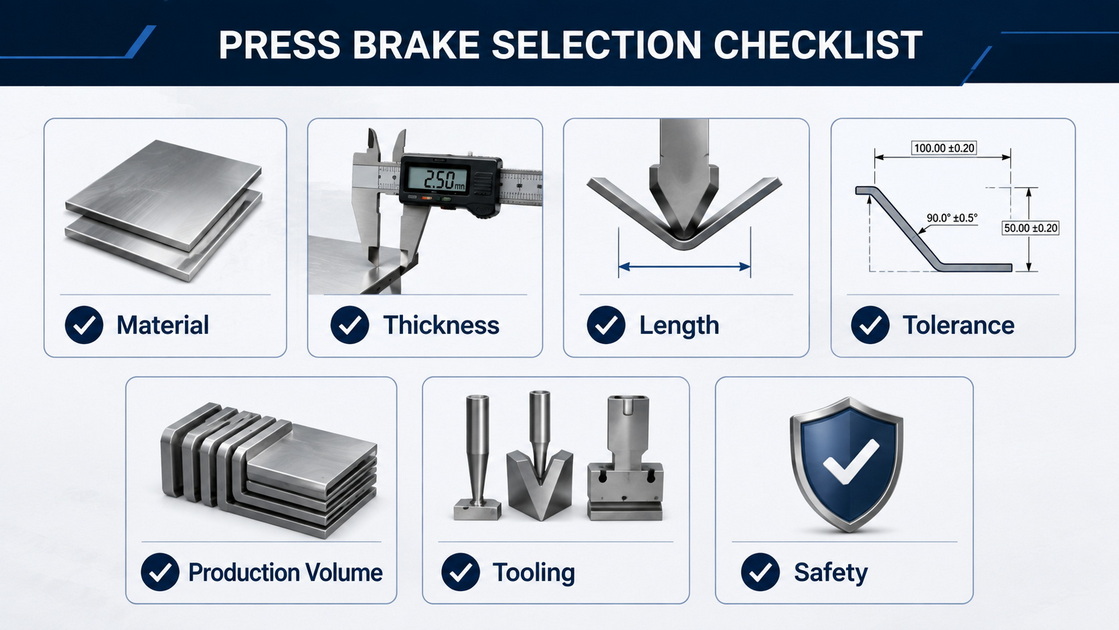
A pneumatic press brake may be the right choice if your production involves short, thin, and simple sheet-metal parts. It can be a suitable option for dedicated light-duty operations with stable work requirements.
A CNC hydraulic press brake is generally the more suitable choice when you need higher force, longer bending length, multi-step bending, repeatable part production, controlled positioning, and the ability to process a wider product range.
Before making a final decision, prepare the following information:
1. Part drawings or 3D models
2. Material grade and thickness range
3. Maximum bend length
4. Required angle and dimensional tolerance
5. Expected batch size and annual production volume
6. Number of different part types
7. Tooling requirements
8. Factory electrical and compressed-air conditions
9. Required safety features
10. Future expansion plans
This information allows the machine supplier to recommend the correct tonnage, working length, throat depth, stroke, daylight, backgauge configuration, tooling, and automation options.
CNDY-Press provides press brake solutions for sheet metal fabricators, machinery manufacturers, OEM customers, and custom equipment projects. Our team can support machine configuration based on the buyer's actual products and production requirements.
Available customization discussions may include:
- Press brake tonnage and bending length
- Throat depth, daylight, and ram stroke
- CNC controller selection
- Backgauge axes and positioning functions
- Hydraulic and electro-hydraulic servo configurations
- Standard and special bending tooling
- Front support systems and sheet followers
- Safety devices and operating accessories
- Electrical specifications and voltage requirements
- OEM branding, color, labels, and export packaging
- Technical manuals and project documentation
The goal is not simply to supply a press brake. It is to build a machine configuration that supports stable bending quality, practical operator workflow, and long-term production value.
Pneumatic and CNC hydraulic press brakes are not interchangeable solutions. Pneumatic equipment can serve light-duty and simple forming applications well, while CNC hydraulic press brakes provide the force, control, and flexibility needed for more demanding production.
The best decision starts with the workpiece. Evaluate the material, thickness, bend length, tolerance, annual output, tooling, and operator workflow before selecting the machine.
For a customized recommendation, share your drawings, material details, required bend dimensions, and expected production volume with the CNDY-Press team. We can help you evaluate the appropriate press brake configuration for your OEM, ODM, or sheet metal production project.
Not necessarily. Pneumatic systems can provide responsive motion, but overall productivity depends on loading, positioning, bend sequence, inspection, unloading, and tool-change time. CNC hydraulic press brakes can improve production efficiency for multi-bend and high-mix work through programmed backgauge positioning and stored bending programs.
This depends on the machine's actual force rating, material strength, bend length, die opening, and bend method. Pneumatic press brakes are usually better suited to lighter-duty work. Always confirm capacity using the exact material and part drawing.
CNC control can manage ram movement, backgauge positioning, bend sequence, dwell time, and optional machine axes. It helps operators reproduce the same bending process more consistently across repeated production orders.
Tonnage calculations require the material grade, tensile strength, thickness, bend length, die opening, and bending method. A machine supplier should calculate the required bending force based on real production conditions before recommending a press brake model.
Sheet-metal properties can vary between batches. Thickness, tensile strength, grain direction, and springback behavior can all influence final bend angles. First-piece testing, proper tooling selection, and controlled process settings help manage this variation.
1. HUNSONE. [What Are the Key Differences Between Pneumatic and CNC Hydraulic Press Brakes?] [hunsone]
2. U.S. Department of Energy. [Compressed Air Systems] [energy]
3. Occupational Safety and Health Administration. [Machine Guarding: Powered Press Brakes] [osha]
4. Occupational Safety and Health Administration. [Use of Laser Guarding Systems with Hydraulic Press Brakes] [osha]
5. U.S. Department of Energy. [Improving Compressed Air System Performance: A Sourcebook for Industry] [eere.energy]


