


Views: 237 Author: CNDY-Press Publish Time: 2026-09-28 Origin: Site


Content Menu
● Mini Electric vs Hydraulic Press Brake at a Glance
● Start With the Bend, Not the Drive
>> Estimate Force Before Comparing Machines
● Where a Mini Electric Press Brake Fits
● Where a Mini Hydraulic Press Brake Fits
● Measure Energy, Throughput, and Total Cost
● Run a Sample Bend Acceptance Test
● Do Not Overlook Safeguarding
● Make the Final Buying Decision
>> 1. Is an electric press brake more accurate than a hydraulic one?
>> 2. Can a mini electric press brake bend 2 mm steel?
>> 3. Does a mini hydraulic press brake use power while idle?
>> 4. Which machine has lower maintenance costs?
>> 5. Is rated tonnage enough to select the machine?
A mini electric vs hydraulic press brake decision should begin with the parts your shop must make—not a claim that one drive system is always faster, stronger, or cheaper. A compact servo-electric press brake may suit short, repeatable bends and frequent job changes. A compact hydraulic press brake may be the more practical choice when the required force, stroke, or range of work exceeds the electric machine under consideration. Yet neither label tells you whether a specific model can bend your part safely and consistently.
The useful question is: Which machine can produce your most demanding part, at the required rate and quality, for an acceptable total cost? Answer it with drawings, material specifications, bend-force estimates, sample bends, and operating-cost measurements. Thickness alone is not enough.
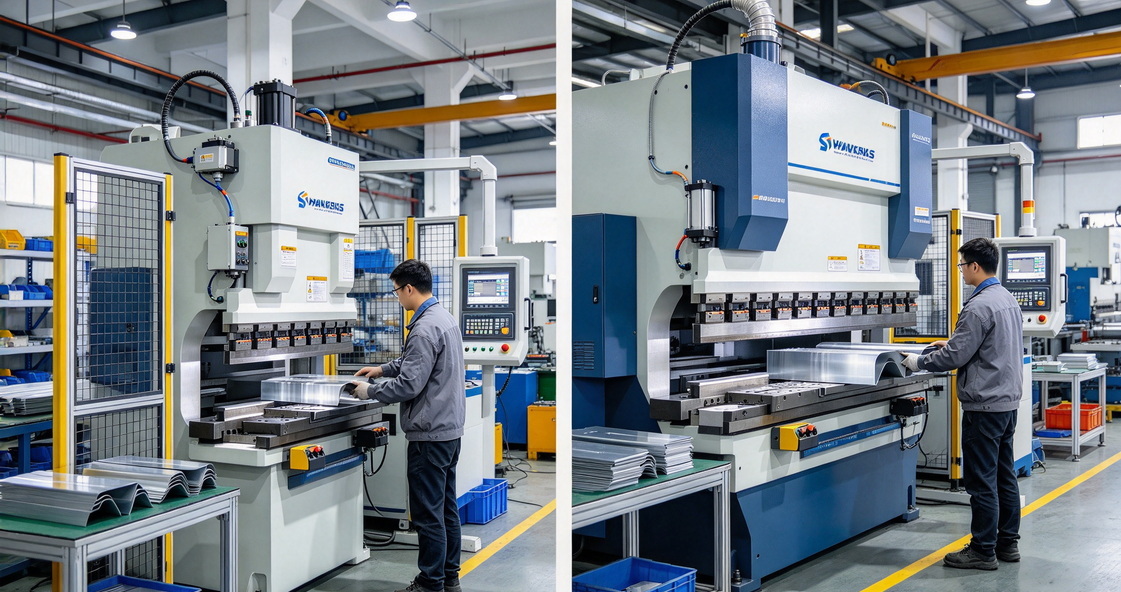
"Mini" describes a compact class of machine, not a standardized capacity. Compare actual model specifications before assuming two similarly sized press brakes can perform the same work.
| Buying criterion | Mini servo-electric press brake | Mini hydraulic press brake |
|---|---|---|
| Ram drive | Electric motors drive a mechanical transmission | Pressurized hydraulic fluid drives cylinders |
| Typical selection priority | Responsive positioning, repeatable small-part work, and avoiding a hydraulic circuit | Force capacity, stroke requirements, and a broader range of demanding bends |
| Energy evaluation | Check power across the complete production cycle, including idle time | Check pump-control design; do not assume every hydraulic model runs the same way |
| Maintenance focus | Motors, transmission, lubrication, electronics, and controls | Fluid condition, filters, seals, hoses, valves, and controls |
| Precision evaluation | Verify finished-part results rather than relying only on ram specifications | Verify finished-part results rather than assuming hydraulics cannot meet the tolerance |
| Key buying risk | Choosing a machine without enough force, usable stroke, or tooling capacity | Buying more machine than needed while overlooking energy, maintenance, or setup costs |
These are selection tendencies, not performance guarantees. Modern machines include different control and drive architectures. Manufacturer product ranges now include electric and servo-hydraulic press brakes, so a buyer should compare specific configurations rather than treating every "hydraulic" machine as an older constant-running design.
Before requesting quotations, build a short list of representative parts. Include your most common job, your longest bend, your highest-force bend, and any part with a difficult flange or tight tolerance.
For each part, record:
- Material grade and specified tensile strength.
- Actual material thickness and its permitted variation.
- Bend length, bend angle, and required inside radius.
- Proposed V-die opening and forming method.
- Minimum flange dimensions and part clearance.
- Annual quantity, batch size, and changeover frequency.
- Required angle and flange tolerances.
A 2 mm cutoff is not a reliable buying rule. Two sheets of equal thickness may need different force because they have different strengths or bend lengths. Changing the V-die opening or switching from air bending to bottoming also changes the calculation. Bystronic's bending guidance explicitly includes these variables and warns that alternative forming methods can require substantially more force.
A compact machine also needs enough usable bed length, daylight, stroke, and access around the tooling. A machine with adequate nominal tonnage can still be unsuitable if the part collides with the ram, frame, tooling, or backgauge during the bend.
For a preliminary air-bending estimate, Bystronic publishes the following relationship for a baseline steel with 60,000 psi tensile strength, using inches for thickness, die opening, and bend length:
Estimated US short tons=575×t2/V×12×L×material factor
Here, t is thickness, V is V-die opening, and L is bend length. For the cited baseline material, the material factor is 1. Other materials and forming methods need appropriate adjustments. This is a screening estimate, not a production setting or a promise of machine suitability.
For example, take a hypothetical 0.08-inch-thick steel part with a 12-inch bend, a 0.64-inch V opening, and the baseline tensile strength. The formula gives approximately 5.75 US short tons for that air bend. Keep the calculation in one unit system: a US short ton is not the same unit as a metric tonne.
The estimate still needs review. Material variation, friction, tooling, and the forming method can change the actual force. Pacific Press recommends allowing up to 20% additional capacity when sizing around its air-bending estimate and warns that a short bend can exceed a tool's allowable concentrated load even when total machine tonnage looks adequate. Check both the machine rating and the tooling's load rating with the supplier.
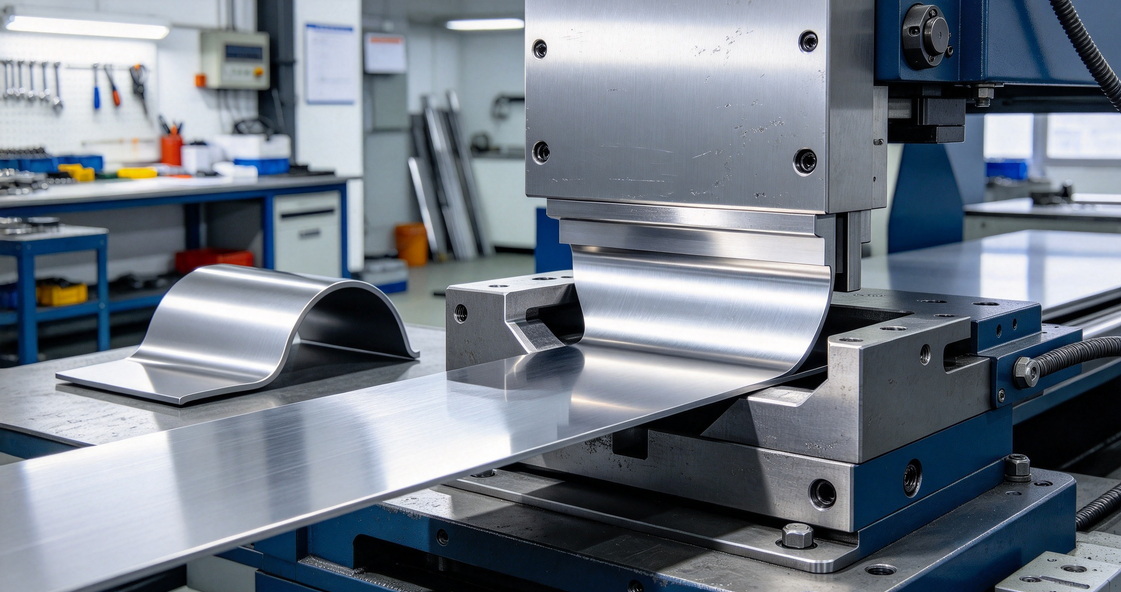
A servo-electric press brake uses motors and a mechanical drive system to control ram motion. In a suitable application, this can offer responsive positioning and repeatable cycles without a hydraulic oil circuit. It is worth evaluating for small components, short strokes, and jobs with frequent changes—provided the proposed machine has the required force and physical clearance.
Potential advantages include:
- Low-energy standby behavior: Ask for measured consumption during loading, programming, and bending—not only motor nameplate power.
- No hydraulic-fluid system: This removes oil-related maintenance tasks, though the mechanical drive and electronics still need service.
- Responsive motion: Test cycle time on your real bend sequence rather than accepting a no-load speed figure.
- Controlled positioning: Evaluate the resulting part dimensions and angles over a sample run.
Do not turn those advantages into an unsupported promise of tighter finished-part tolerances. The angle on a bent component also depends on material consistency, springback, tooling, setup, and operator or control adjustments. A precise ram position cannot, by itself, guarantee a precise part.
A hydraulic press brake uses fluid pressure to move the ram. Hydraulic designs are commonly considered when an application needs substantial force or a demanding stroke. For a compact-machine purchase, the deciding issue remains whether the specific model meets the calculated force, length, geometry, and production requirements.
Hydraulic machines can also use CNC control and achieve high accuracy. It is misleading to describe electric machines as "precise" and hydraulic machines as inherently "imprecise." Instead, compare the actual equipment, tooling, and sample-part results.
Maintenance and energy use require closer inspection. A hydraulic machine introduces fluid-system components such as hoses, seals, and valves; service requirements should be confirmed in the manufacturer's schedule. Likewise, ask whether its pump runs continuously, uses demand-based control, or follows another operating strategy. Those differences affect the value of any electric-versus-hydraulic energy claim.
A hydraulic press brake is not automatically the best answer for "thick material," either. If a job exceeds the capacity of a mini hydraulic model, the correct comparison may be with a larger machine or a different forming process—not with an undersized mini electric press brake.
The original article discusses return on investment, but a buyer needs a method that can be applied to quotations. Begin with the cost of making the same accepted parts on each candidate machine.
Ask suppliers to run the same representative production sequence. Include setup, test bends, normal loading, pauses, and the agreed batch quantity. Record:
| Measure | What to collect |
|---|---|
| Electricity | Metered kWh for the whole trial, not only rated motor power |
| Output | Accepted parts completed during the measured period |
| Labor | Setup time, cycle involvement, and any secondary adjustments |
| Quality | Scrap, rework, angle variation, and dimensional results |
| Service | Scheduled consumables and expected maintenance tasks |
| Purchase | Machine, tooling, installation, training, and support costs |
A useful operating measure is kWh per accepted part. If Machine A uses less electricity but takes longer to produce the required batch, electricity savings alone may not decide the investment. Similarly, a faster cycle has limited value if the shop spends most of its time changing tools or waiting for material.
For an annual comparison, estimate total ownership cost using your own workload:
Annualized cost=annualized purchase and installation cost+electricity+planned maintenance+labor+scrap and rework
Add downtime costs where your business has credible records. Keep assumptions visible, including electricity rates, annual hours, maintenance intervals, and expected machine life. Without an agreed duty cycle, a generic "X% energy savings" claim is not a dependable ROI forecast. Servo-electric systems can use substantially less power while stationary than conventional continuously running hydraulic systems, but the size of the advantage depends on the machines and how the shop operates them.
A supplier demonstration is most useful when it has a written pass criterion. Send the same drawing and material specification to every shortlisted supplier, then agree on tooling and the intended forming method before the test.
1. Choose representative parts. Include a typical part and at least one demanding part; do not select only the easiest thin-sheet sample.
2. Confirm the setup. Record machine model, tooling, die opening, material batch, program, and any manual corrections.
3. Measure finished parts. Check angle, flange length, surface condition, and other drawing tolerances.
4. Repeat the bends. Compare results across an agreed batch, not just the first successful piece.
5. Observe the operator's work. Note setup steps, access to the part, backgauge use, and time spent correcting bends.
6. Review machine and tool limits. Verify required force, concentrated tool load, stroke, clearance, and electrical supply with the manufacturer.
Request a short video of the complete operation if you cannot attend. It should show loading, bending, part removal, and measurement—not only a close-up of the ram completing one stroke. Keep the inspection sheet with the quotation so the purchasing and production teams evaluate the same evidence.
This approach also makes OEM or ODM discussions more productive. A custom configuration should address a documented problem, such as part clearance, tooling compatibility, control requirements, or integration—not merely add options to the quotation.
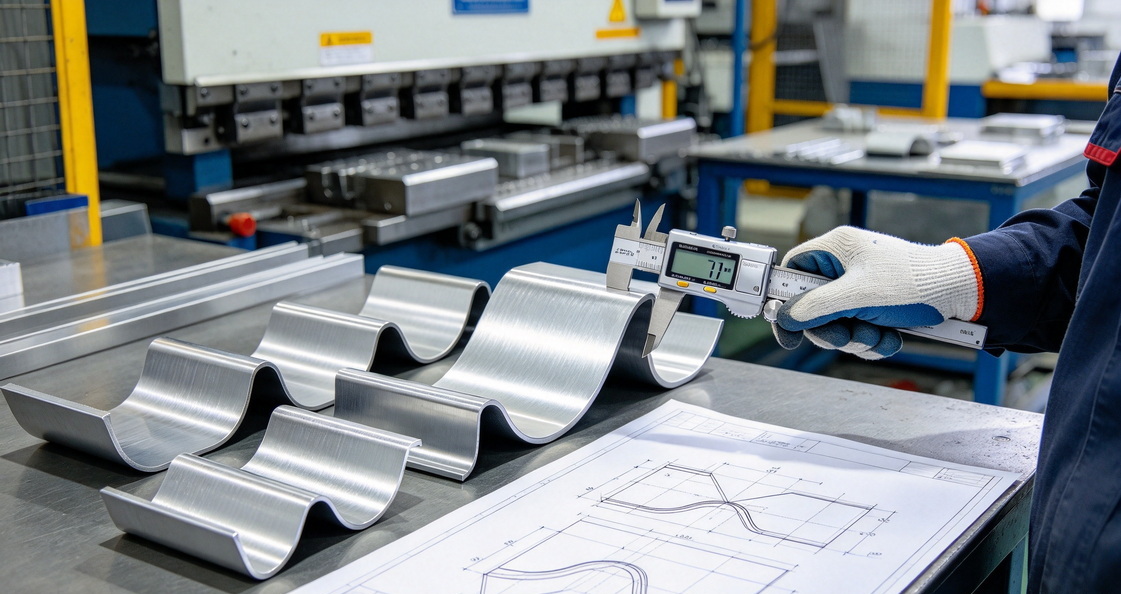
Neither drive type removes the point-of-operation hazard. OSHA notes risks around the punch and die, accidental cycling through controls, and movement of large workpieces during bending. It lists presence-sensing devices, two-hand controls, pullback devices, and restraint devices among possible safeguarding approaches. The appropriate solution depends on the operation and applicable requirements.
During the supplier review, ask how the proposed safeguards work with your smallest parts and most difficult tooling setups. Also check side and rear access, emergency-stop placement, operator training, and the process for maintenance. A safety feature that cannot be used as intended for the actual part is not a satisfactory purchasing answer.
Requirements vary by installation location. Have a qualified person assess the machine and work process against the rules that apply at the buyer's facility; do not treat a sales demonstration as a safety approval.
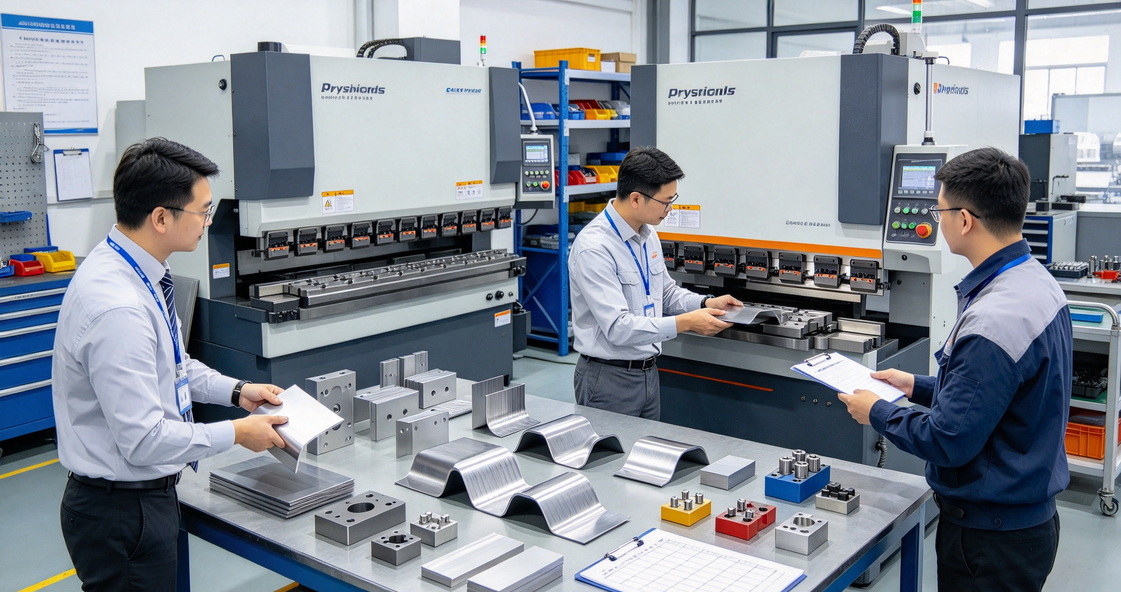
Use the same decision order for both technologies:
1. Eliminate unsuitable machines first. The candidate must meet the part geometry, calculated force, machine limits, and tooling limits.
2. Confirm part quality. Review measured sample bends across an agreed run.
3. Confirm safe operation. Evaluate safeguarding and access on the buyer's actual work.
4. Compare production performance. Measure accepted output, setup effort, and electricity under comparable conditions.
5. Compare support. Confirm training, spare parts, service response, warranty terms, and documentation.
6. Calculate ownership cost. Use stated assumptions rather than a general payback claim.
Choose a mini servo-electric press brake when a suitable model meets every force and geometry requirement and its measured workflow benefits justify the investment. Choose a mini hydraulic press brake when its capacity and configuration better serve the required parts and its full operating costs are acceptable. Consider both—or a larger machine—when one compact press brake cannot sensibly cover the entire workload.
Not automatically. Servo-electric motion control can support precise, repeatable positioning, but finished-part accuracy also depends on material, tooling, setup, and compensation. A modern CNC hydraulic machine may meet the same drawing tolerance. Compare measured parts, not drive labels.
Possibly, but thickness alone cannot answer the question. Material strength, bend length, die opening, forming method, and the specific machine and tool ratings all matter. Calculate the force and ask the supplier to test the actual part.
That depends on its pump and control configuration. Some hydraulic arrangements consume energy to keep the system ready, while different drive controls change operating behavior. Request metered whole-cycle data for the exact models being compared.
There is no guaranteed winner for every shop. Servo-electric machines avoid hydraulic-fluid service but still need drive, lubrication, electronic, and control maintenance. Hydraulic machines add fluid-system inspections. Compare service schedules, component availability, technician support, and your expected usage.
No. Check the required force for the actual bend, then confirm bend length, usable stroke, daylight, flange clearance, and tooling load limits. Pacific Press cautions that concentrated load on a short bend can exceed a tool or ram limit even when total tonnage appears sufficient.
1. [PrimaPress, "Mini Electric vs Hydraulic Press Brake: Which One to Choose?"] — Source article reviewed for its structure and selection claims; its company-specific promotional statements were not reused. [prima-press]
2. [Bystronic, "How to Calculate Press Brake Tonnage"] — Air-bending estimate and the effects of material, die opening, forming method, and tooling. [bystronic]
3. [Pacific Press, "Press Brake Bending Force Calculator"] — Force-estimate limitations, capacity allowance, and concentrated tooling-load cautions. [pacific-press]
4. [Power & Motion, "Servo-Driven vs. Hydraulic Press Brakes: Comparing Their Capabilities and Use Cases"] — Industry discussion of motion control, applications, energy use, and maintenance. [powermotiontech]
5. [AMADA AMERICA, "Press Brakes"] — Manufacturer product overview showing electric and servo-hydraulic model categories. [amada]
6. [OSHA, "Machine Guarding: Powered Press Brakes"] — Point-of-operation hazards and safeguarding approaches. [osha]
7. [Google Search Central, "Creating Helpful, Reliable, People-First Content"] — Guidance on original analysis, clear sourcing, and accurate authorship. [developers.google]


