


Views: 253 Author: CNDY-Press Publish Time: 2026-10-13 Origin: Site


Content Menu
● Define the Comparison Before Comparing Labor
● Automatic Press Brake vs Manual Bending: Quick Comparison
● Where an Automatic Press Brake Can Save Labor
>> Programming and Repeat Setup
>> Tool Handling and Changeovers
● Where Manual Sheet Metal Bending Still Makes Sense
● Measure Labor Across the Complete Bending Process
● Illustrative Labor Comparison: A 200-Part Batch
● Find the Labor Break-Even Batch Size
● The Overlooked Issue: Does Saved Time Become Usable Time?
● Quality, Rework, and Material Variation
● Safety and Ergonomics Are Part of the Decision
● A Practical Acceptance Test for Buyers
● Configure Automation Around Your Actual Production
● Choose Automation Based on Verified Labor Savings
>> 1. Does a CNC Press Brake Automatically Eliminate the Operator?
>> 2. Is Robotic Bending Only Suitable for Large Batches?
>> 3. Can One Operator Run Several Bending Cells?
>> 4. How Should We Calculate Labor Savings?
>> 5. Does Faster Bending Guarantee Faster Delivery?
An automatic press brake usually saves more labor on repeatable parts with suitable volumes, stable tooling, and reliable material flow. Manual sheet metal bending can require less total preparation for prototypes, irregular work, and jobs that are difficult to automate.
The important distinction is between saving machine time and saving human time. A faster bending cycle does not necessarily reduce labor if employees still load every blank, reposition every part, inspect every bend, and wait beside the machine.
When evaluating an automatic press brake vs manual sheet metal bending, I would start with touch time: the total time people spend preparing, handling, bending, checking, and moving accepted parts.
At CNDY-Press, our business includes developing, manufacturing, selling, and servicing CNC press brakes and related sheet metal equipment, with OEM and ODM customization. This guide explains how buyers can assess labor savings without relying on unsupported productivity percentages.

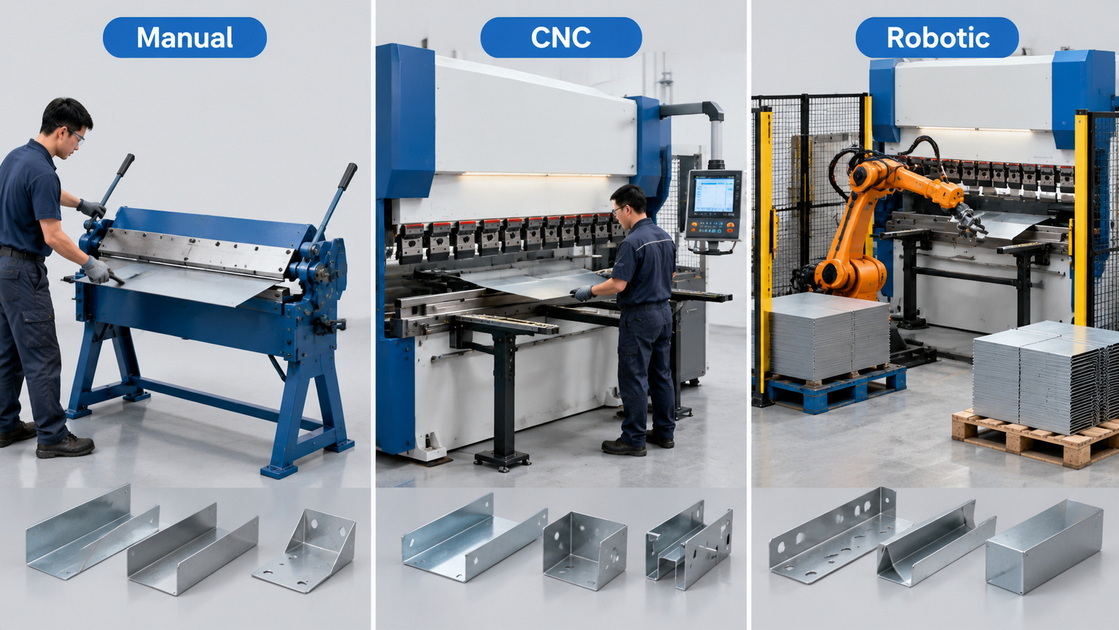
"Automatic press brake" can describe very different equipment.
A CNC machine with automated ram positioning and backgauges still requires manual loading in many configurations. A robotic bending cell can automate loading, part manipulation, bending, and unloading, but still needs programming, replenishment, inspection, and maintenance.
Likewise, "manual bending" may mean a hand-operated folding brake or a powered press brake attended by an operator.
For a meaningful purchasing comparison, distinguish these categories:
| Equipment category | What is automated | Typical remaining human work |
|---|---|---|
| Hand-operated sheet metal brake | Little or no powered process control | Positioning, clamping, bending, checking |
| Operator-loaded CNC press brake | Programmed machine motion and available positioning functions | Loading, supporting, rotating, unloading |
| Assisted CNC press brake | Selected setup or handling tasks | Supervision and tasks outside the assisted scope |
| Robotic bending cell | Defined loading, manipulation, bending, and unloading sequence | Preparation, material replenishment, exceptions, inspection |
Not every machine offers every function. Confirm the quoted configuration rather than treating the word "automatic" as a complete specification.
| Labor factor | Manual or operator-loaded bending | Automated bending system |
|---|---|---|
| Initial preparation | Can be straightforward for simple work | May require programs, gripping plans, and cell preparation |
| Repetitive handling | Performed by operators | Can be transferred to robots or handling equipment |
| Tool changes | Often manual | Automatic changing is available on selected systems |
| Part variation | Experienced operators can adapt directly | Variations must remain within validated limits |
| Production supervision | Often continuous | May be intermittent for suitable validated jobs |
| Exceptions | Operator resolves them immediately | Requires detection and a recovery procedure |
| Small-batch economics | Often favorable when preparation is minimal | Can improve with reusable programs and efficient setup |
| Labor-saving potential | Depends on operator method and handling demands | Depends on the complete workflow, not the ram alone |
The best comparison is total labor per accepted part for a defined job—not advertised machine speed.
Stored programs can reduce repeated manual adjustment. Offline programming can also move preparation away from the machine, allowing production to continue while another job is prepared.
However, offline programming does not eliminate labor. It shifts work to engineering or production planning.
Count program creation, verification, revisions, and first-part approval. Repeated orders may spread this preparation across more parts, improving the labor result.
Automatic tool changers can reduce hands-on setup work on compatible machines. This can matter in high-mix production, where frequent changeovers consume a substantial share of the shift.
Manufacturer documentation identifies automatic tool changing as useful even for small lot sizes. The implication is not that all small jobs justify automation, but that batch size alone is an incomplete decision rule.
Check tooling compatibility, available tool storage, setup verification, and the jobs that still require manual intervention.
Robotic handling can remove repeated lifting, rotation, and transfer tasks for suitable parts.
Feasibility depends on:
- Blank dimensions and weight.
- Grip locations and surface condition.
- Bend sequence.
- Tool and robot clearances.
- Regripping requirements.
- Finished-part stacking.
- Variation in incoming blanks.
A part that bends successfully once is not necessarily ready for unattended production. The handling sequence must remain reliable over the intended run.
Manual methods remain useful when the work is unpredictable or the preparation required for automation is disproportionate.
Examples include:
- One-off repair components.
- Early prototypes with changing dimensions.
- Parts needing frequent hands-on judgment.
- Jobs outside the automated cell's handling envelope.
- Small orders without reusable programs or gripping arrangements.
An operator-loaded CNC press brake often provides a middle ground. It offers programmed machine control while retaining flexible human handling.
A sensible production strategy may combine manual, assisted, and robotic resources. Automation does not need to replace every bending task to improve overall labor efficiency.
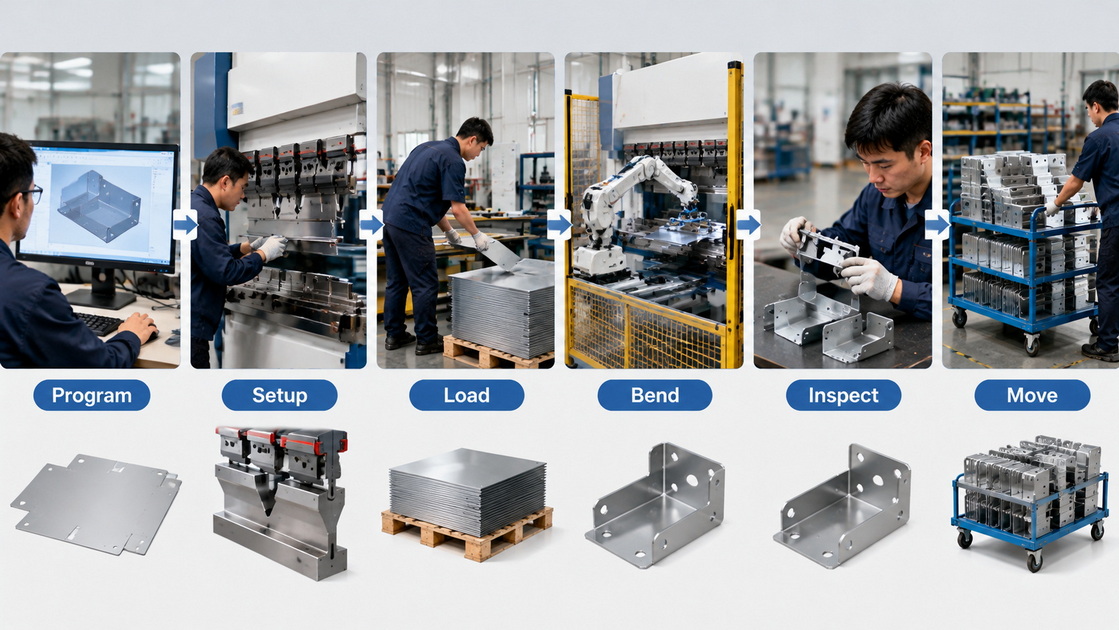
A useful labor model is:
Labor minutes per accepted part=Total attributable human minutes/Accepted parts produced
Include:
- Programming and production planning.
- Tool installation and setup verification.
- First-part inspection.
- Loading, rotation, and unloading.
- Material replenishment.
- Routine inspection.
- Fault recovery.
- Rework and handling.
- Job closeout.
Record elapsed production time separately.
For example, a cell may run for two hours but require only intermittent human attendance. Conversely, a quick cycle may still occupy one operator continuously.
When two employees handle a large sheet for ten minutes, the activity consumes twenty labor minutes. Ignoring the second employee understates the opportunity for assistance or automation.
The following example shows the calculation method. It is hypothetical—not a CNDY-Press performance claim.
Assume both processes produce 200 accepted parts.
| Human-work category | Operator-loaded process | Automated process |
|---|---|---|
| Setup, programming, and first-part approval | 45 minutes | 90 minutes |
| Production attendance and handling | 300 minutes | 70 minutes |
| Inspection and job closeout | 30 minutes | 30 minutes |
| Total labor | 375 minutes | 190 minutes |
| Labor per accepted part | 1.88 minutes | 0.95 minutes |
The automated process saves 185 labor minutes, or approximately 49%, under these assumptions.
That percentage cannot be transferred to another part or machine. Different setup requirements, faults, inspection needs, or material flow could change the result substantially.
The example also does not establish elapsed cycle time or production capacity. Human attendance and machine operating time are different measurements.
A simplified model helps identify when additional automation preparation is recovered.
Suppose:
- Manual setup requires 45 labor minutes.
- Automated setup requires 90 labor minutes.
- Manual production requires 1.5 labor minutes per part.
- Automated production requires 0.35 labor minutes per part.
The additional preparation is 45 minutes. The per-part labor saving is 1.15 minutes.
Break-even quantity=(90−45)/(1.5−0.35)≈39.1
Under these hypothetical assumptions, automation begins saving labor at approximately 40 parts.
This is a labor break-even point, not an investment payback calculation. It excludes differences in capital cost, maintenance, energy, floor space, financing, and other ownership expenses.
Reusable programs may change future-order preparation time. Track first-run and repeat-order results separately.
Reducing operator attendance does not automatically create payroll savings.
If employees must remain close to the cell and cannot perform another useful task, the nominal saving may have limited commercial value.
Ask:
- Can one person safely supervise the proposed workload?
- Is there a productive adjacent task?
- How often does the machine require intervention?
- Are material replenishment and unloading synchronized?
- Does inspection interrupt the operator unpredictably?
Labor released in scattered seconds is different from an uninterrupted block that can be reassigned.
Distinguish three outcomes:
1. Reduced overtime.
2. Increased output with existing staff.
3. Reduced staffing requirements.
Each can have value, but they require different evidence. Do not combine them into one unsupported "labor reduction" claim.
Repeatable machine motion can support consistent production, but it does not eliminate material variation.
Thickness, strength, grain direction, tooling condition, and springback can affect results. Available angle measurement or compensation functions should be evaluated for the actual material and tolerances.
Compare accepted parts rather than raw cycle counts.
A useful acceptance trial should record:
- Dimensional results.
- First-part approval time.
- Adjustment frequency.
- Rejected and reworked parts.
- Inspection labor.
- Interruptions and recovery time.
Otherwise, a process may appear faster while transferring work to inspection or rework.
Powered press brakes present point-of-operation and handling hazards. Automated cells add robot motion and other integration hazards.
Safeguarding must suit the complete application. OSHA guidance identifies press-brake hazards and safeguarding approaches, but a short checklist cannot replace a competent application-specific assessment.
Consider normal production, setup, cleaning, fault recovery, and maintenance. Never justify bypassing safeguards as a labor-saving measure.
Reduced manual handling can be valuable, especially for awkward parts. However, assess ergonomic improvement separately from staffing savings and validate the proposed work method.
Before ordering an automatic press brake or robotic bending cell, agree on a representative trial.
Include more than the supplier's easiest demonstration part:
- A frequent repeat component.
- A small-batch job.
- A part with challenging manipulation.
- A component requiring demanding tolerances.
- A representative material change.
1. Start with the agreed job-preparation condition.
2. Record programming and setup labor.
3. Verify the first accepted part.
4. Run the agreed quantity.
5. Log human interventions and stoppages.
6. Inspect output using agreed criteria.
7. Record replenishment and closeout work.
Specify whether programs already exist. A demonstration using a fully prepared program should not be compared with a manual process starting from an unprepared drawing.
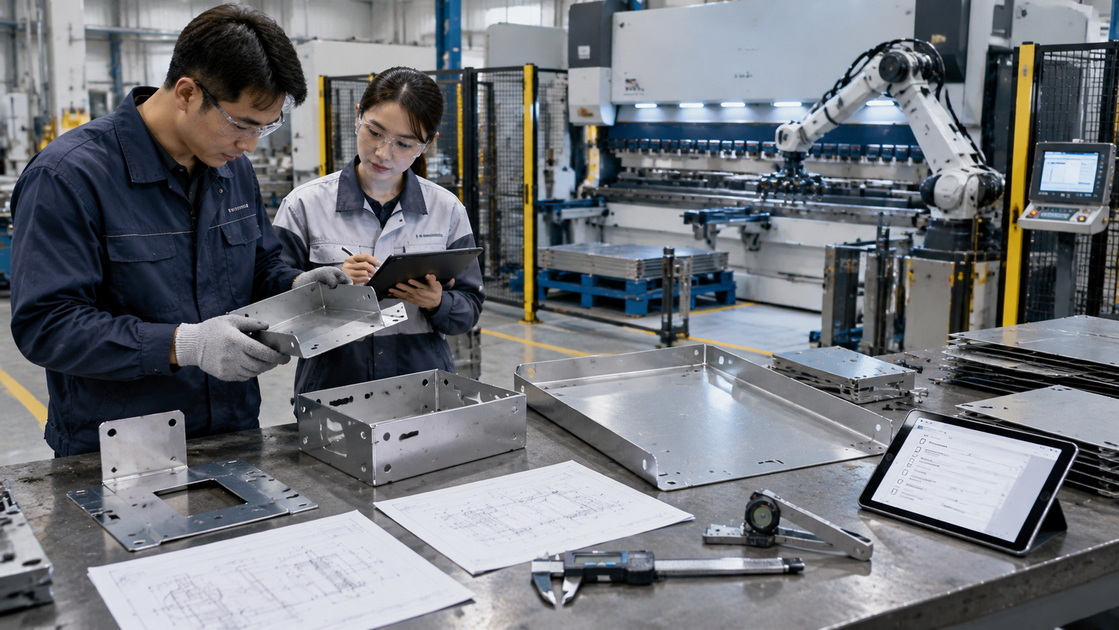
For an OEM or ODM discussion with CNDY-Press, provide:
- Part drawings and material specifications.
- Bend lengths, thicknesses, and required capacity.
- Annual demand and typical batch sizes.
- Current labor measurements.
- Tooling requirements.
- Handling and installation constraints.
- Inspection expectations.
- Destination-market requirements.
- Service and training needs.
Request a written scope identifying which tasks remain manual.
Also define software responsibility, spare-parts support, operator training, acceptance criteria, and recovery procedures. Customization should address a documented production requirement—not merely add features.
An automatic press brake generally offers greater labor-saving potential for suitable repeat work. Manual and operator-loaded bending remain practical for changing, irregular, or difficult-to-automate jobs.
The strongest investment decision compares complete workflows and identifies how released labor will be used.
No. Many CNC press brakes automate machine positioning while people still load, support, rotate, and unload parts. Confirm the material-handling scope.
No. Efficient programming, reusable jobs, and automatic tool changes can improve smaller-batch suitability. The actual preparation time and handling feasibility determine the result.
Possibly, but this requires workload, replenishment, intervention, and safety assessment. Do not assume a staffing ratio from a demonstration alone.
Count total attributable human minutes and divide by accepted output. Include preparation, inspection, faults, rework, and all employees involved.
No. Downstream welding, inspection, packing, or upstream blank preparation may remain the bottleneck. Assess the complete production route.
1. [TRUMPF — Automation for Bending Machines]. Manufacturer documentation supporting the distinction between automatic tool handling and automated material handling, including applications involving small lot sizes. It does not establish universal labor-saving percentages. [trumpf]
2. [TRUMPF — "TRUMPF Launches Easy-to-Use Press Brake in U.S. and Canadian Markets," March 4, 2025]. Source for offline programming during machine operation and positioning of operator-loaded equipment for small-to-medium batches. [trumpf]
3. [TRUMPF — Bending Machines]. Supporting information on programming, tool-setup optimization, and configurable bending automation. [trumpf]
4. [Occupational Safety and Health Administration — Machine Guarding eTool: Powered Press Brakes]. Official source for press-brake operating hazards and safeguarding considerations. This article does not prescribe a complete safeguarding design. [osha]
5. [The Fabricator — "An Overview of Press Brake Safeguarding"]. Industry discussion supporting application assessment, safeguarding integration, and operator training. Referenced standards must be checked for current applicability. [thefabricator]


