


Views: 252 Author: CNDY-Press Publish Time: 2026-07-22 Origin: Site


Content Menu
● How To Choose The Right Method
● Practical Production Considerations
>> 1. What is the main difference between air bending and bottoming?
>> 2. Which method is more accurate?
>> 3. Does air bending require less tonnage?
>> 4. Why does springback matter?
>> 5. Which method is better for custom production?
>> 6. Which method is better for repeat production?
In sheet metal fabrication, bending is never just about forming metal into an angle. It is about controlling accuracy, managing springback, protecting tooling, and producing parts that match drawing requirements with minimal rework. For manufacturers working on OEM and ODM projects, the choice between air bending and bottoming can influence everything from setup time to final cost.
Both methods are widely used on CNC press brakes, but they serve different production goals. Air bending offers flexibility and faster changeovers. Bottoming offers stronger angle consistency and lower springback. Understanding where each method performs best helps manufacturers choose a process that fits the part, the batch size, and the required precision.
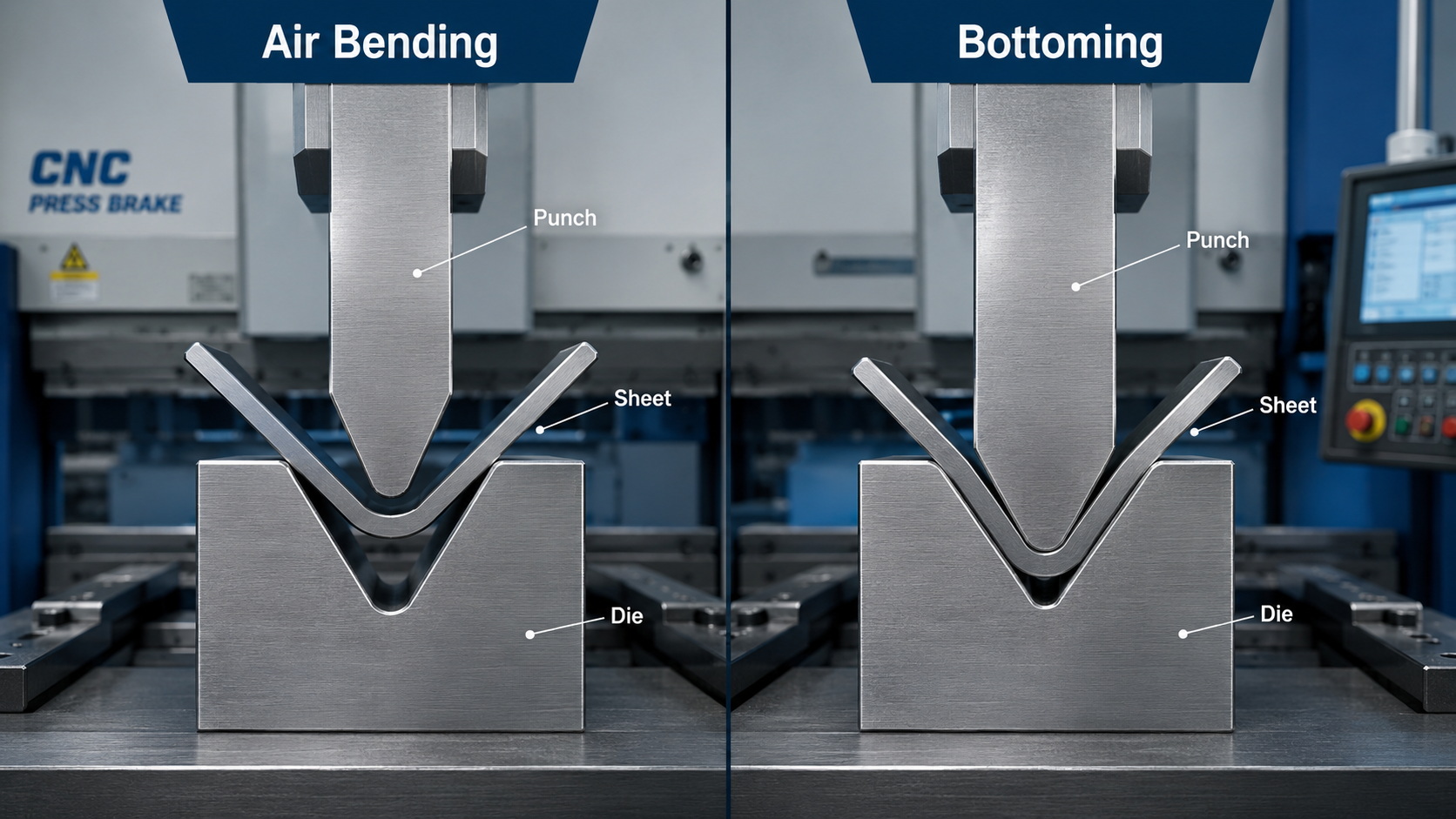
Air bending is a forming method in which the punch presses the sheet metal into the die without forcing the material fully against the bottom of the die cavity. The bend angle is controlled mainly by the depth of the punch stroke. Because the sheet does not fully seat into the die, the same tooling can often produce multiple angles.
This method is widely used in modern fabrication shops because it reduces tooling changes and supports a broad range of part designs. It also requires less tonnage than more forceful bending methods, which can help reduce machine load and extend tooling life. For mixed production environments, air bending is often the most practical option.
Another advantage of air bending is efficiency. Operators can adjust the bend angle by changing the ram position rather than replacing the tool set. This makes it especially useful for short production runs, prototype work, and custom metal parts where design changes are common.
Bottoming is a bending method in which the sheet metal is pressed much deeper into the die until it closely matches the die angle. Compared with air bending, the material makes greater contact with the tooling. This produces a more defined bend and generally reduces springback.
Because the material is formed more tightly into the die, bottoming is often selected when angle consistency is more important than flexibility. It can improve repeatability across production runs and is especially useful for parts that must maintain stable dimensions across many units.
However, bottoming usually demands more tonnage and more careful tooling control. It is less forgiving when the material changes or when the bend sequence is complex. For that reason, it is often used in more standardized production environments rather than highly variable jobs.
The best way to compare these two methods is to look at how they behave in daily production.
| Factor | Air Bending | Bottoming |
|---|---|---|
| Tool contact | Partial contact with die shoulders | Greater contact with die cavity |
| Tonnage requirement | Lower | Higher |
| Springback | More noticeable | Reduced |
| Setup flexibility | High | Lower |
| Angle changes | Easier to adjust | More tool-dependent |
| Best for | Mixed production, prototypes, custom jobs | Repeat parts, stable production, tighter consistency |
Air bending gives manufacturers more freedom. Bottoming gives them more control. The right choice depends on whether the process needs speed and adaptability or stronger repeatability and tighter angle stability.
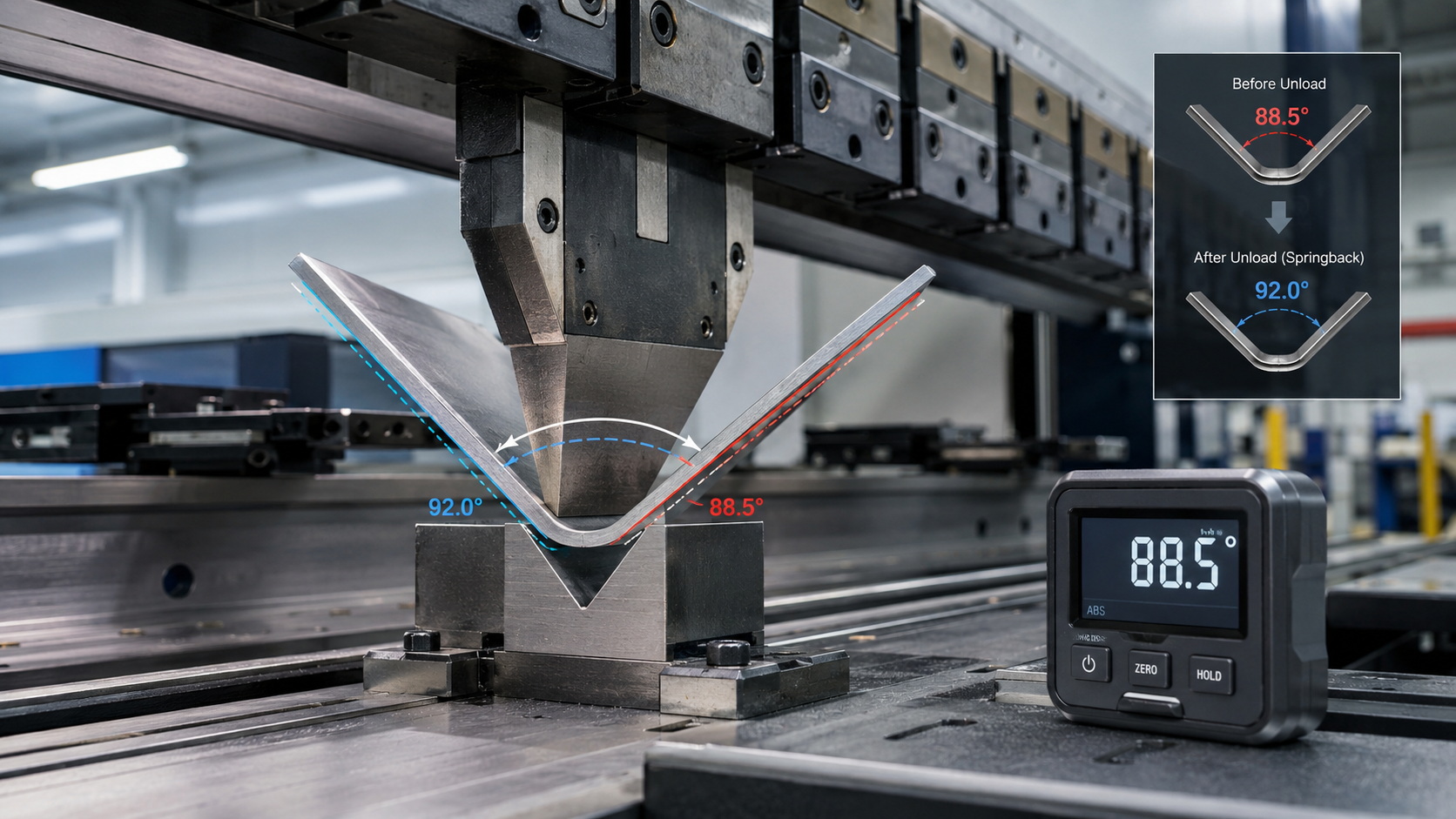
Springback is one of the most important reasons air bending and bottoming perform differently. When metal is bent, it tries to recover slightly after the force is removed. This elastic recovery changes the final angle and must be anticipated during production.
In air bending, springback is usually more visible because the material is not fully forced into the die. Operators need to compensate by controlling punch depth more precisely. Material thickness, tensile strength, grain direction, bend radius, and die opening all influence the final result.
Bottoming reduces springback because the material is shaped more closely to the die form. This often improves angle stability, but it does not eliminate the need for process control. Material variation can still affect the result, especially in jobs where multiple batches must match exactly.
For manufacturers, the key point is simple: angle accuracy comes from the combination of machine condition, tooling selection, material consistency, and operator control. No forming method can fully replace good process management.
Air bending is usually the better choice when production requires flexibility. It is well suited for shops that handle many different part numbers, frequent design changes, and a wide range of bend angles.
It is especially effective in these situations:
- Prototype and sample production.
- Small to medium batch jobs.
- Parts with multiple bend angles.
- Projects that need faster setup and lower tooling cost.
- OEM and ODM work with changing specifications.
Air bending is also a strong choice when a shop wants to reduce tooling inventory. Since one tooling setup can often support multiple bend angles, it can simplify operation and reduce downtime. For many modern manufacturing environments, that advantage is significant.
Bottoming is often the better choice when production demands stronger consistency. It is particularly useful for parts that repeat frequently and must match the same bend angle across large batches.
It is a good fit for:
- Standardized parts with stable dimensions.
- Higher-volume repetitive production.
- Applications where angle consistency is more important than flexibility.
- Jobs where the tooling can remain dedicated to one part family.
- Parts where reduced springback is essential.
Bottoming is especially valuable when a company needs to minimize variation between operators or shifts. Because the material is formed more tightly into the die, the process can be easier to standardize once the tooling and machine setup are correct.
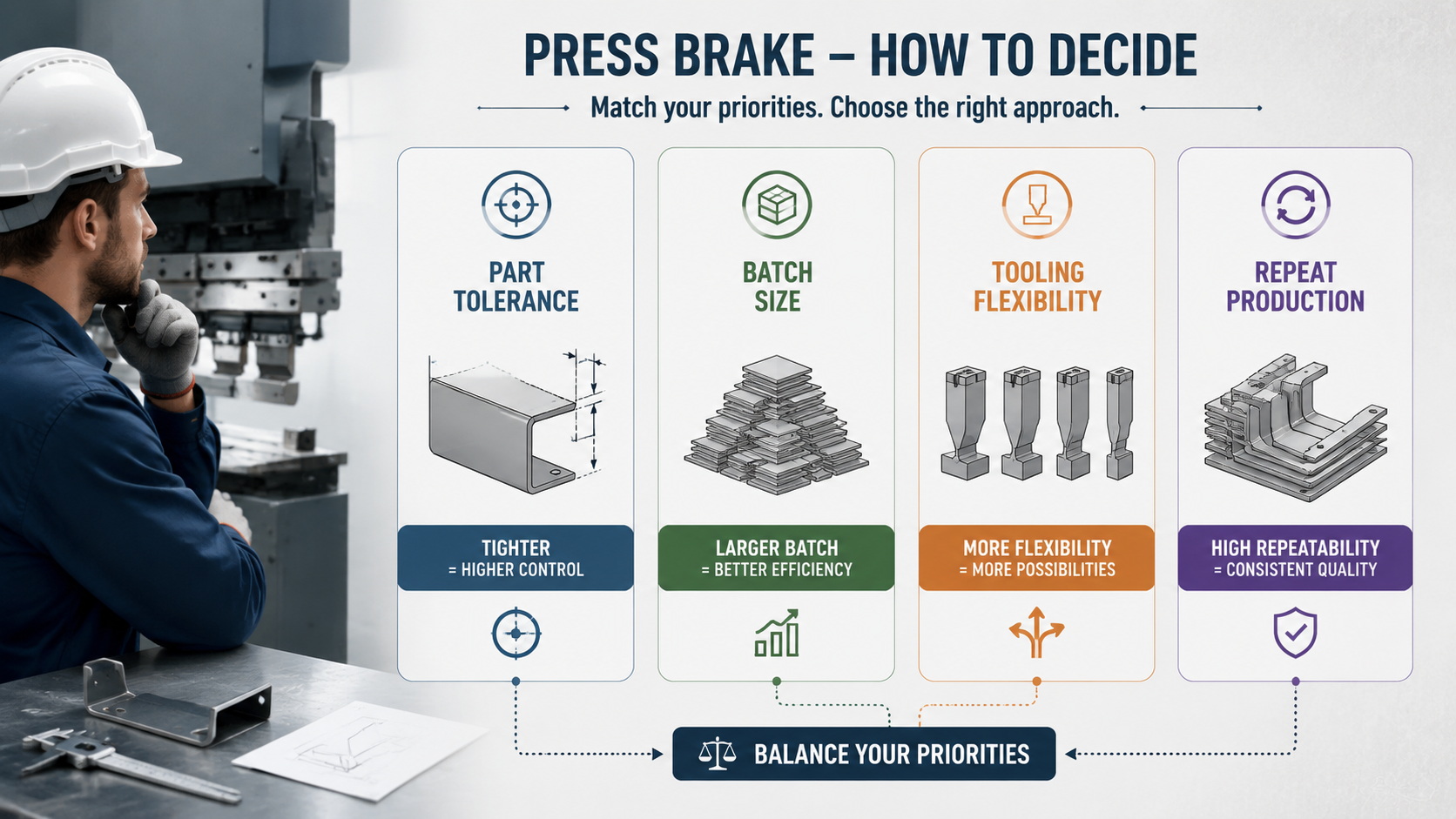
Choosing between air bending and bottoming should begin with the part drawing and production goal. The right method is not always the one that looks strongest on paper. It is the one that matches the full production requirement.
A practical selection process can follow these steps:
1. Review the part tolerance and angle requirement.
2. Check the material type, thickness, and batch consistency.
3. Estimate the required tonnage and confirm machine capacity.
4. Decide how often the part will repeat.
5. Determine whether one tooling setup must support multiple bend angles.
6. Choose air bending for flexibility or bottoming for stronger consistency.
This process helps manufacturers avoid underpowered setups, unnecessary tooling changes, and rework caused by springback errors.
In real production, the difference between these two methods is not only technical. It is also operational. A shop that bends many different products every day often gains more from air bending because of faster setup and easier adjustment. A shop that repeats the same part in volume often benefits more from bottoming because of stable angle results.
Material selection also matters. Soft materials, hard materials, thick plates, and thin sheets all behave differently under load. A method that works well on one job may not be ideal on the next. That is why many manufacturers test both the material and the tooling before moving into full production.
Machine condition is another critical factor. Press brake accuracy depends on ram control, crowning, backgauge positioning, and overall mechanical stability. Even the best bending method cannot compensate for poor maintenance or inaccurate setup.
For CNC press brake manufacturers and sheet metal processors, the goal is not only to bend parts. The goal is to build a process that can support production stability, quality control, and cost efficiency at the same time. In OEM and ODM projects especially, this means balancing flexibility with consistency.
Air bending fits well into modern high-mix production because it supports changing demand and shorter lead times. Bottoming fits well into repeat production because it helps lock in more stable geometry. Many factories use both methods depending on product type, customer requirement, and target output.
This is why press brake selection should always be connected to the actual production model. A machine, tooling package, and bending method should be chosen as part of one system rather than as separate decisions.
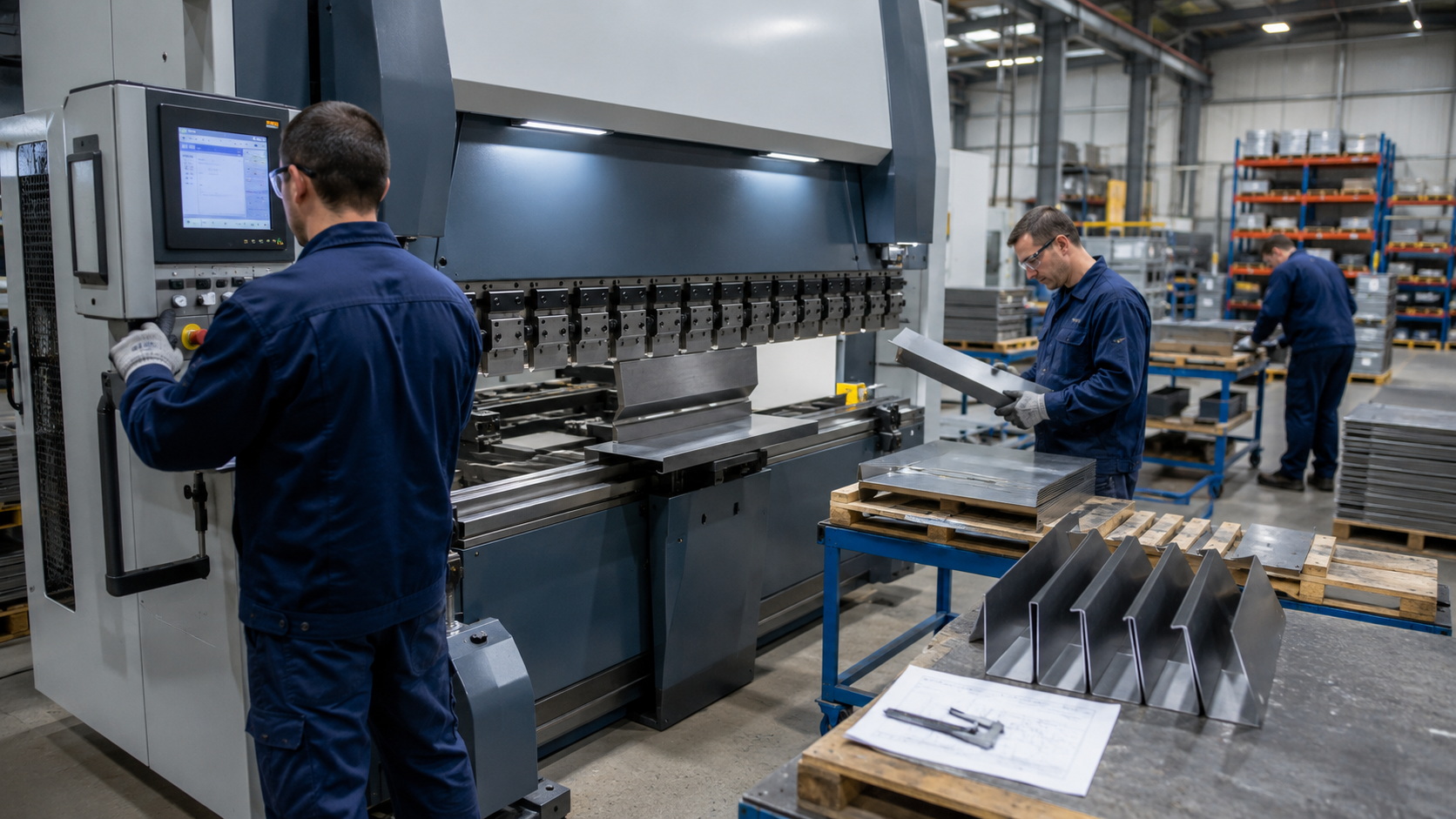
Air bending and bottoming are both valuable press brake techniques, but they are built for different priorities. Air bending is usually better for flexibility, faster setup, and lower tooling cost. Bottoming is usually better for angle consistency, reduced springback, and repeated production stability.
For manufacturers, the best approach is to match the method to the application. When the product mix is broad and changeovers are frequent, air bending often delivers the best overall efficiency. When the part is standardized and repeatability matters most, bottoming can provide better control.
In sheet metal fabrication, the right forming method is not the one with the most force. It is the one that produces the right part with the least waste, the best consistency, and the most reliable workflow.
Air bending forms the sheet without fully seating it into the die, while bottoming presses the material much deeper into the die for a tighter form.
Bottoming usually produces more stable angles, but air bending can also achieve high accuracy when the machine, tooling, and material are properly controlled.
Yes. Air bending generally requires less tonnage than bottoming, which makes it easier on the machine and tooling.
Springback changes the final bend angle after forming. It is one of the main factors that determines whether a part meets its drawing requirement.
Air bending is usually better for custom production because it allows faster setup, easier angle adjustment, and greater flexibility.
Bottoming is often better for repeat production because it provides stronger consistency and more stable angle results.
1. RMT – “Air Bending Vs. Bottom Bending.” https://www.rmtus.com/air-bending-vs-bottom-bending
2. AHY CNC – “Air Bending & Bottom Bending For Pressbrake.” https://www.ahycncs.net/news/air-bending-bottom-bending-for-pressbrake-61205819.html
3. Harsle – “3 Types of Bending Basic knowledge.” https://www.harsle.com/3-types-of-bending-basic-knowledge/
4. The Fabricator – “Press brake bending: A deep dive into springback.” https://www.thefabricator.com/thefabricator/article/bending/press-brake-bending-a-deep-dive-into-springback
5. The Fabricator – “Four steps to calculate press brake tonnage limits.” https://www.thefabricator.com/thefabricator/article/bending/four-steps-to-calculate-press-brake-tonnage-limits
6. CNDY Press – “China CNC Press Brake, Bending Machine, Laser Cutter Manufacturer & Supplier.” https://www.cndypress.com/
7. CNDY Press – “CNC Press Brake Sheet Metal Bending: How Modern OEM/ODM Factories Improve Precision And Efficiency.” https://www.cndypress.com/cnc-press-brake-sheet-metal-bending-how-modern-oem-odm-factories-improve-precision-and-efficiency.html


