


Views: 222 Author: CNDY-Press Publish Time: 2026-06-20 Origin: Site


Content Menu
● What Is Sheet Metal Bending?
● Core Types of Sheet Metal Bending
>> Air Bending
>> Coining
>> Other Common Bending Techniques
● How CNC Press Brakes Enable Accurate Bending
● K-Factor, Bend Allowance, and Why They Matter
● Understanding and Controlling Springback
● Choosing the Right Bending Method for Your Project
● Practical Design Tips for CNC Press Brake Bending
● Case Insight: From Prototype to Stable Production
● How CNDY-Press Supports OEM & ODM Bending Projects
● When to Upgrade or Re-Evaluate Your Bending Setup
● Call to Action: Turn Your Drawings into Bend-Ready Parts
● FAQ
Sheet metal bending is one of the most critical steps in transforming flat metal into real-world products, and CNC press brakes are the workhorses that make precise, repeatable bends possible for modern fabrication shops. From my experience working with OEM/ODM customers in industries like construction machinery, electrical enclosures, and automotive components, the biggest performance gains rarely come from "buying a bigger machine"—they come from choosing the right bending method, understanding the limits of the material, and designing parts that are friendly to CNC press brake production. [komaspec]
Below is a deeply restructured and expanded guide on types of sheet metal bending and how CNC press brakes such as those from CNDY-Press can help you achieve accurate, cost-effective results.
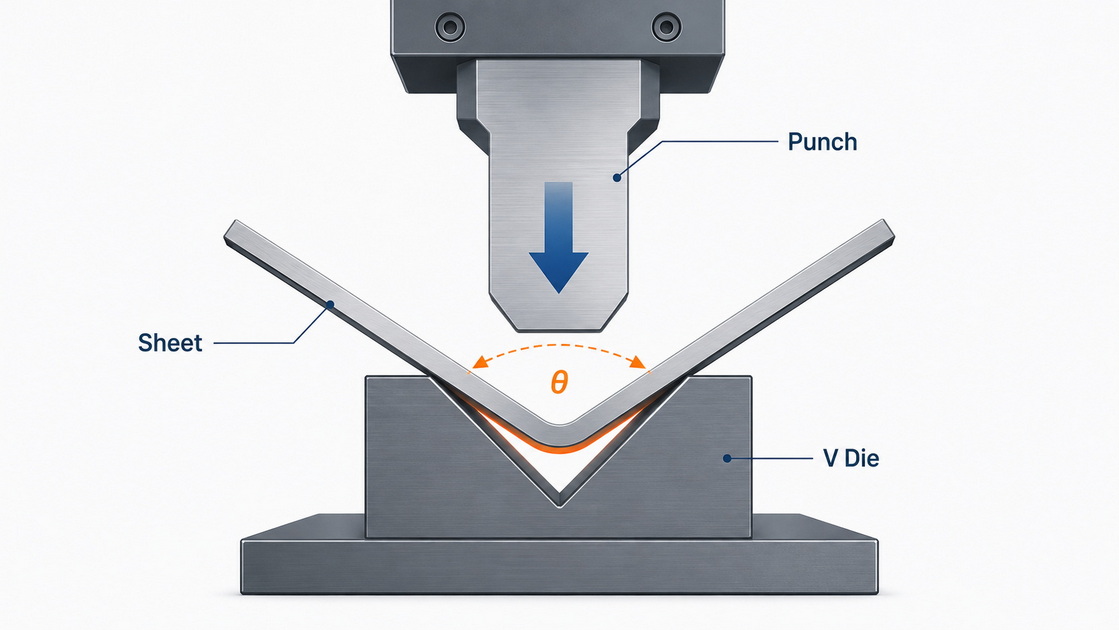
Sheet metal bending is a forming process where a flat sheet is plastically deformed along a straight axis to create angles, channels, or complex profiles without removing material. In practice, this means you take a cut blank and use tools (punch and die) on a press brake to create the desired bend angle and radius. [xometry]
For B2B buyers and engineers, bending is the bridge between laser-cut or punched blanks and functional products like cabinets, brackets, machine frames, and housings. In most fabrication workflows, bending quality directly affects downstream assembly, welding, and even field performance. [komaspec]
In industrial practice, most sheet metal bending on CNC press brakes can be grouped into a few fundamental methods: air bending, bottom bending, coining, and several specialized techniques for large or complex parts. [en.wikipedia])
In air bending, the sheet only touches three points: the punch tip and the two shoulders of the V-die; it never fully seats at the bottom of the die. The bend angle is controlled primarily by how deep the punch penetrates into the die opening rather than by the exact angle of the die itself. [wisecutlaser]
Key characteristics of air bending: [cnhawe]
- Requires lower tonnage than bottoming or coining.
- One die can produce several different angles by adjusting penetration depth.
- Higher springback compared with coining, especially in high-strength steels.
- Ideal for flexible production and mixed-angle jobs.
From a manufacturer's perspective, modern CNC press brakes are typically optimized around air bending because it balances tooling flexibility, speed, and energy consumption. In our own projects for export customers, we often standardize air bending for small to medium batches to minimize setup time and tooling cost, then switch to more force-intensive methods only when tolerances demand it. [wisecutlaser]
Bottom bending—often called bottoming—pushes the sheet almost fully into the die so the inside of the bend conforms closely to the die angle. This is sometimes described as "seating the material in the die." [xometry]
Key characteristics of bottom bending: [cnhawe]
- Requires 4–5× the tonnage of air bending for the same material and die opening.
- Angle is largely defined by the die angle itself, resulting in better repeatability.
- Springback is reduced compared with air bending, though not eliminated.
- Best suited for repeat production where angle consistency is crucial.
In real-world OEM work, bottoming is common in control cabinets, elevator panels, and appliance housings where long, visible bends must align perfectly with door gaps or mating parts. For these jobs, our engineers at CNDY-Press typically recommend precision-ground tooling and a CNC crowning system to compensate for deflection across the machine length. [komaspec]
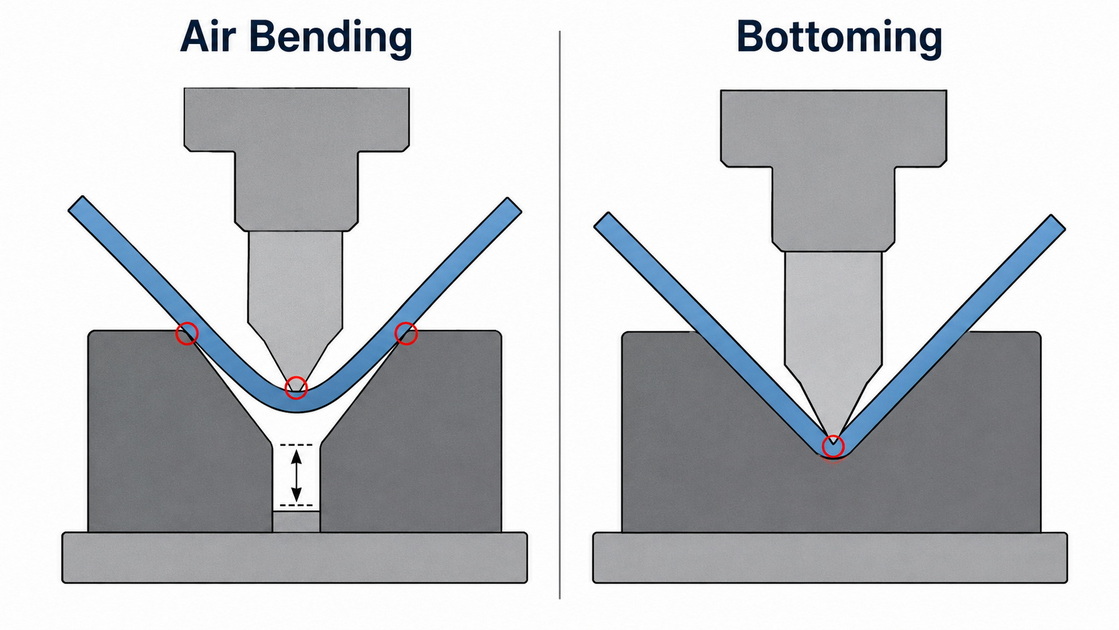
Coining uses very high force so that the punch effectively "stamps" the bend angle and radius into the material, compressing the metal fibers at the bend. The sheet is fully forced into the die and often slightly penetrated by the punch tip. [xometry]
Key characteristics of coining: [wisecutlaser]
- Requires 5–10× the tonnage of air bending, depending on material and thickness.
- Produces very tight tolerances and minimal springback.
- Generates more tool wear and energy consumption.
- Typically reserved for high-precision, smaller parts or specialized materials.
We see coining used in applications like small brackets for automotive electronics or precision components in medical equipment, where even a 0.5° deviation in angle can cause assembly issues. For these parts, our CNC press brake customers often combine coining with offline programming and angle measurement systems to keep scrap rates near zero. [komaspec]
Beyond the main three methods, several additional techniques are frequently used in sheet metal fabrication. [lyah-machining]
- Folding / Panel bending: The sheet is clamped while a folding beam swings up to create the angle, ideal for large panels and thin materials where surface finish is critical. [xometry]
- Roll bending: Uses multiple rollers to create large-radius curves, common in ducts, enclosures, and structural covers. [komaspec]
- U-bending and channel bending: Essentially V-bends combined or repeated to form channels or closed profiles, often performed on CNC press brakes with sequential bends. [youtube]
These methods are typically chosen when part size, radius, or geometry make standard V-die bending inefficient or impossible.
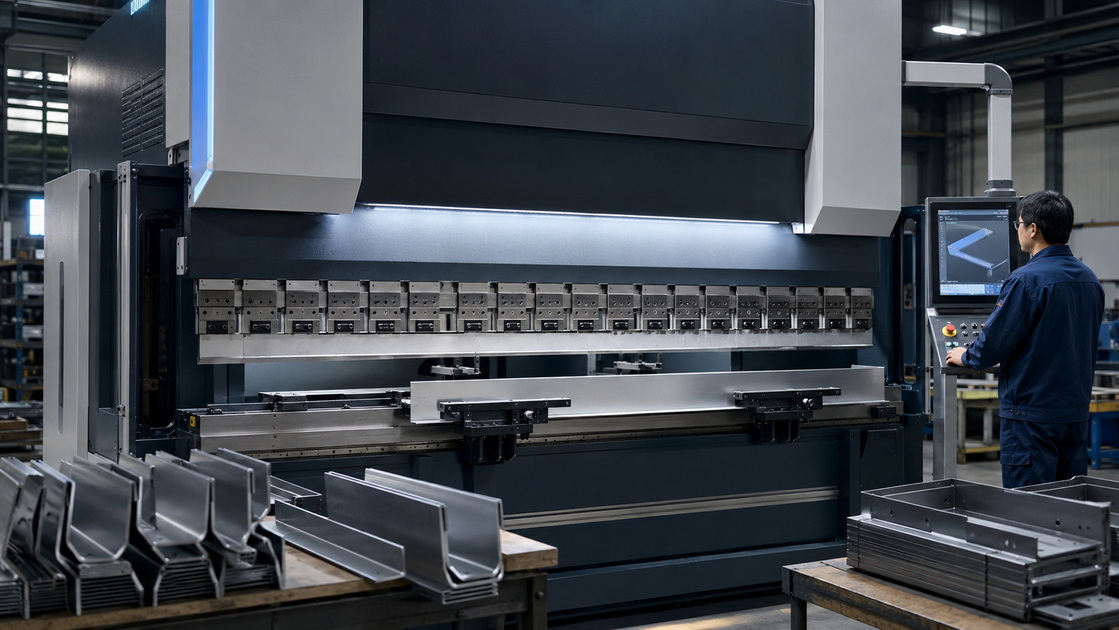
Modern CNC press brakes combine mechanical precision with digital control to achieve repeatable bending quality across thousands of parts. For manufacturers like CNDY-Press, this is where we can bring tangible value to buyers beyond simply supplying a "machine." [afmeurope.co]
Typical capabilities involved in CNC bending include: [durmapress]
- Multi-axis backgauge systems for accurate positioning of the sheet.
- CNC-controlled ram depth for precise angle control in air bending.
- Automatic crowning to compensate for deflection over long bends.
- Programmable bending sequences to minimize re-clamping and collisions.
- Optional angle measurement systems for closed-loop control.
In customer projects, we often start from real parts and drawings, evaluate material and thickness, and then recommend not only the right press brake capacity but also the optimized bending method and tooling setup. This "process-first" approach typically saves more cost than oversizing the machine.
Whenever you bend sheet metal, the outer fibers stretch and the inner fibers compress, while somewhere in between lies the neutral axis. The K-factor is a geometric ratio that describes where this neutral axis sits within the thickness of the material, and it directly affects how much material is "consumed" by the bend. [en.wikipedia])
In simplified terms:
- K-factor is the ratio between the distance from the inside of the bend to the neutral axis and the total thickness of the sheet. [sendcutsend]
- Once you know K-factor, you can calculate bend allowance—the arc length of the neutral axis in the bend—and bend deduction, which lets you determine the correct flat length before bending. [en.wikipedia])
Why this matters for engineers and buyers: [sendcutsend]
- Incorrect flat patterns lead to parts that are either too long or too short.
- Different bending methods (air, bottoming, coining) can yield different K-factors.
- Suppliers and customers need to agree on design assumptions to avoid disputes during inspection.
In our experience, the most efficient approach is to standardize K-factors and bend tables per material and thickness, then validate them with trial bends and measurement. Once this is done, both design engineers and press brake programmers can work from the same data.
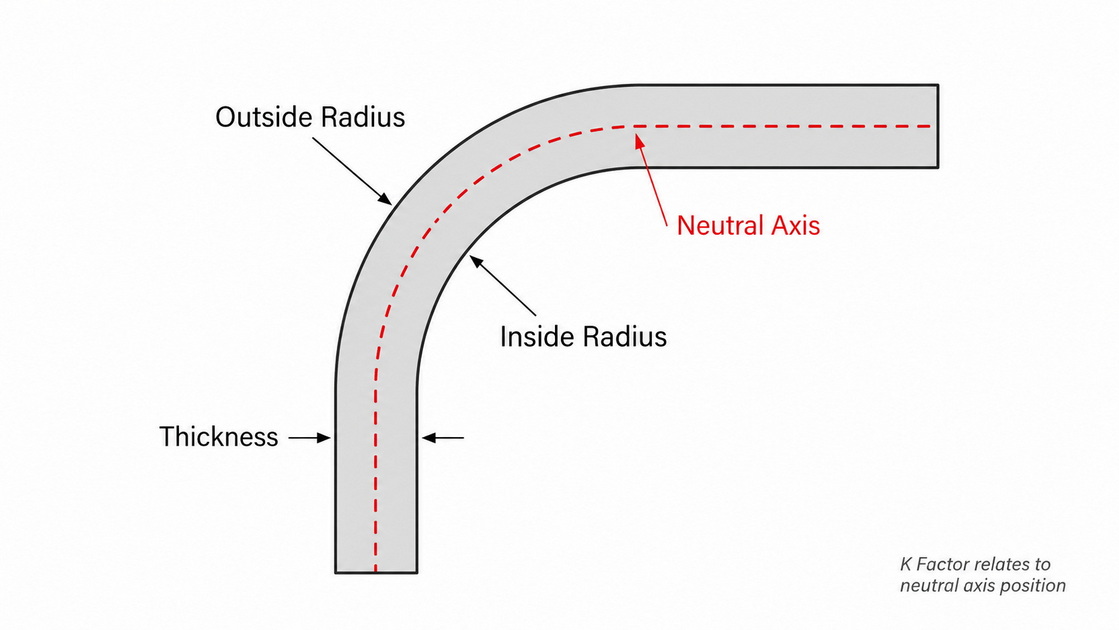
Springback is the elastic recovery that occurs after the load is removed: the bend angle "opens up" slightly, and the radius becomes larger than under load. Its magnitude depends on factors like material strength, thickness, bend radius, and the chosen bending method. [sheetmetal]
Key factors influencing springback: [sheetmetal]
- Material: High-strength steels and certain stainless grades show more springback.
- Bend radius and thickness: Larger radii and thinner materials generally produce more noticeable springback.
- Bending method: Air bending shows more springback; coining shows the least.
In industrial practice, we typically control springback using a combination of: [durmapress]
- Overbending (programming a slightly smaller angle than desired).
- Tool selection (using smaller V-openings or different punch radii).
- Higher-force methods (bottoming or coining when required).
- Closed-loop angle measurement on high-end CNC press brakes.
For long-term customers, we often maintain a springback database tied to specific material batches and suppliers, which helps reduce trial-and-error when switching coils or sheet suppliers.
From a buyer's perspective, the main question is rarely "What is air bending?" but rather "Which bending method is best for my part and budget?" To answer that, we look at dimensions, tolerances, material, and quantity. [wisecutlaser]
Below is a simplified decision table our engineering team often uses when we review OEM/ODM drawings with clients:
| Scenario | Recommended method | Rationale |
|---|---|---|
| Multiple angles, small to medium batches | Air bending | Flexible, lower tonnage, fewer tool changes. (xometry) |
| High-volume production with tight but not extreme angle tolerances | Bottom bending | Better repeatability, manageable tonnage. (xometry) |
| Critical angles with very low tolerance (e.g., ±0.2°) | Coining | Minimal springback, high precision. (xometry) |
| Large panels with cosmetic surfaces | Folding / panel bending | Minimal marking, ideal for enclosures. (komaspec) |
| Large-radius curves | Roll bending | Consistent radii and smoother curves. (komaspec) |
In OEM and ODM projects, we typically document this choice in the process routing, so it's clear whether the part relies on air bending (with its inherent springback) or on a more force-intensive method.
From working with global B2B buyers, we see recurring design issues that can be solved early at the CAD stage. Below are practical tips that make life easier for both designers and press brake operators: [gushwork]
1. Standardize bend radii and V-die openings
Use a single "family" of radii and matching dies across your part range whenever possible. This simplifies tooling and reduces mistakes. [xometry]
2. Respect minimum bend radius and flange length
Very sharp bends or very short flanges can cause cracking or require special tooling. Check with your supplier for minimums per material. [sendcutsend]
3. Align bends with grain direction when possible
Bending parallel vs. perpendicular to rolling direction affects cracking risk and springback. For critical parts, discuss this with your fabricator. [komaspec]
4. Include bend reliefs where needed
When two bends are close, small relief cuts help avoid tearing and distortion at corners. [xometry]
5. Provide clear tolerances and reference surfaces
Overly tight tolerances across the entire part drive cost without always adding value. Specify where tight control truly matters—such as mating interfaces, door gaps, or mounting holes. [nopio]
In our OEM/ODM conversations, we've seen projects reduce total part cost by 5–15% simply by revising bend radii, flange lengths, and tolerance schemes to match practical realities on CNC press brakes. [gushwork]
Consider a typical scenario from our customer base: a European equipment maker needs a new control cabinet with a mix of long bends and stiffening flanges. Their first prototype uses small radii and randomly varied angles.
What we often do in such a case is: [gushwork]
1. Review the CAD and identify problematic bends (too small radius, too short flange, conflicting angles).
2. Propose standard radii and a consistent V-die set that works across all panels.
3. Choose air bending for non-critical flanges and bottoming for visible front edges.
4. Calibrate K-factors and springback values on sample parts, then update the bend tables.
5. Lock in a stable CNC program for repeat orders.
Once this loop is closed, the buyer can confidently place recurring OEM orders, knowing that parts from different batches, or even different machines, will fit together on their assembly line.
As a manufacturer specializing in CNC press brakes and integrated sheet metal processing solutions, our role goes beyond delivering equipment—we collaborate with buyers to optimize both design and process for their bending operations. [danetsoft]
Typical ways we support OEM/ODM customers include: [danetsoft]
- Process consulting: Helping you choose bending methods, tooling, and K-factors for your core product families.
- Custom configurations: Matching machine tonnage, working length, and backgauge configuration to your parts and material mix.
- Automation integration: Adding front supports, sheet followers, or robot interfaces for high-volume production.
- Training and documentation: Providing operators with practical guides and bend charts so they can achieve stable quality faster.
For buyers, this means you're not just buying a single press brake—you're gaining an end-to-end bending capability that can scale from prototypes to high-volume production.
Even mature fabrication plants often carry hidden inefficiencies in their bending processes. Based on industry benchmarks and our own customer feedback, you may want to re-evaluate your setup if: [quickcreator]
- Operators frequently manually adjust angles or rework parts after bending.
- You see inconsistent results when switching materials or thicknesses.
- Tooling changes and setups consume more time than the actual bending.
- You plan to introduce new materials (e.g., high-strength steels) without updating tonnage or tooling.
In these cases, revisiting your choice of bending method, tooling, CNC programs, and even machine configuration can yield tangible gains in throughput and quality. [quickcreator]
If you're designing or sourcing sheet metal parts and want to ensure they bend correctly the first time, this is the right moment to involve a bending specialist. Our engineering team at CNDY-Press can review your drawings, recommend optimal bending methods, and propose CNC press brake configurations tailored to your product mix.
Whether you need a single CNC press brake, a full sheet-metal processing line, or long-term OEM/ODM production support, you can share your drawings and requirements with us so we can help you move from concept to stable mass production more quickly and reliably.
1. What is the difference between air bending and bottom bending?
Air bending leaves a gap between the sheet and the die bottom, so the angle is controlled by ram depth; bottom bending seats the sheet into the die angle, which improves repeatability but requires more tonnage. [cnhawe]
2. When should I choose coining instead of air bending?
Coining is recommended when you need very tight angle tolerances, minimal springback, or when the part's function depends on precise fit, but it requires significantly higher press brake capacity and robust tooling. [cnhawe]
3. How does K-factor affect my flat pattern?
K-factor determines how much material is consumed in the bend area, which directly influences bend allowance and bend deduction; incorrect values lead to flat patterns that produce parts too long or too short after bending. [en.wikipedia])
4. Why do my parts show different angles with the same program?
Variations in material thickness, mechanical properties, grain direction, tooling wear, and even machine deflection can all change the effective angle, especially in air bending; using crowning, angle measurement, and standardized materials helps stabilize results. [durmapress]
5. What information should I share with a press brake supplier or OEM partner?
Provide material type and thickness ranges, maximum part length, required tolerances, typical annual volumes, and sample drawings, so your supplier can recommend suitable tonnage, bending methods, tooling, and automation options. [nopio]
1. Komaspec. "An Engineers' Guide to Sheet Metal Bending." (2025).
https://www.komaspec.com/about-us/blog/guide-to-sheet-metal-bending/ [komaspec]
2. Xometry. "Sheet Metal Bending: The Basics." (2020).
https://www.xometry.com/resources/machining/the-basics-of-bending-sheet-metal/ [xometry]
3. Wikipedia. "Bending (metalworking)."
https://en.wikipedia.org/wiki/Bending_(metalworking) [en.wikipedia])
4. Wikipedia. "K-factor (sheet metal)."
https://en.wikipedia.org/wiki/K-factor_(sheet_metal) [en.wikipedia])
5. SendCutSend. "What Is K Factor in Sheet Metal Bending? The Ultimate Guide." (2023).
https://sendcutsend.com/blog/what-is-k-factor-in-sheet-metal-bending-terminology/ [sendcutsend]
6. Accuracy Laser and Fabrication. "Air Bending vs. Bottom Bending: Choosing the Right Method for CNC Press Brakes."
https://accuracylaser.com/air-bending-v-bottom-bending/ [accuracylaser]
7. HAWE. "How to Calculate Press Brake Tonnage." (2026).
https://www.cnhawe.com/how-to-calculate-press-brake-tonnage/ [cnhawe]
8. Sheetmetal.me. "Spring Back."
https://sheetmetal.me/tooling-terminology/spring-back/ [sheetmetal]
9. Gushwork. "Industrial SEO: Grow Revenue Using Only 8 Steps." (2026).
https://www.gushwork.ai/blog/seo-industrial-companies [gushwork]
10. Decoding. "SEO for Manufacturers: Complete Guide to Ranking in 2026." (2026).
https://trydecoding.com/blog/seo-for-manufacturers/ [trydecoding]
11. Nopio. "Manufacturing SEO: Guide to Getting Found by B2B Buyers." (2026).
https://www.nopio.com/blog/manufacturing-seo/ [nopio]
12. Vicla. "Types of Sheet Metal Bending."
https://www.vicla.eu/en/blog/types-of-sheet-metal-bending [quickcreator]


