


Views: 230 Author: CNDY-Press Publish Time: 2026-07-26 Origin: Site


Content Menu
● What Is a Plate Rolling Machine?
● How CNC Plate Rolling Machines Work
● Three-Roll and Four-Roll Plate Rolls
● Main Industrial Applications
● How to Choose the Right Machine
● Common Problems in Plate Rolling
● Practical Tips for Better Results
● Why Customized Equipment Matters
>> 1. What is a CNC plate rolling machine used for?
>> 2. What materials can be rolled?
>> 3. What is the difference between a three-roll and four-roll machine?
>> 4. Why is pre-bending important?
>> 5. How do I choose the right plate rolling machine?
A CNC plate rolling machine is one of the most important forming tools in modern metal fabrication. It helps manufacturers convert flat plate into cylinders, cones, and curved components with consistency, accuracy, and better production efficiency.
For companies working in shipbuilding, wind tower manufacturing, pressure vessels, heavy steel structures, and industrial equipment, plate rolling is not just a forming step. It is a core process that affects product quality, delivery speed, and overall manufacturing cost. As production requirements become more demanding, many buyers now look for machine solutions that offer stronger control, easier operation, and better repeatability.
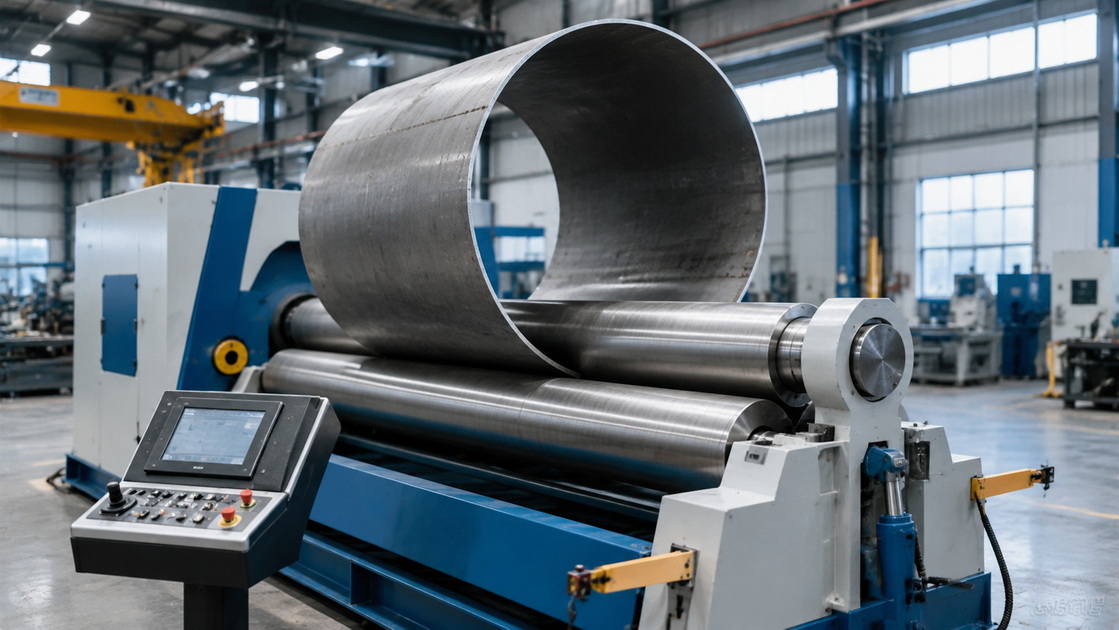
A plate rolling machine is used to bend flat metal plate into curved shapes through a controlled rolling process. The machine applies pressure through a set of rollers, gradually forming the material into the required radius.
These machines are widely used because they can produce smooth and uniform curves while maintaining the structural integrity of the plate. Compared with manual methods, plate rolls deliver better repeatability and are much more suitable for industrial production.
A CNC plate rolling machine uses programmed controls to improve precision and reduce operator dependence. Instead of relying only on manual adjustment, the operator sets the required parameters, and the machine helps guide the rolling process more accurately.
The basic workflow usually includes the following steps:
1. Set the target radius and plate thickness.
2. Align the plate with the rollers.
3. Perform pre-bending on the edges.
4. Roll the plate through controlled passes.
5. Check the final shape and adjust if necessary.
This process makes the machine suitable for repeat orders and complex production runs. It is especially helpful when manufacturers need consistent output across multiple batches.
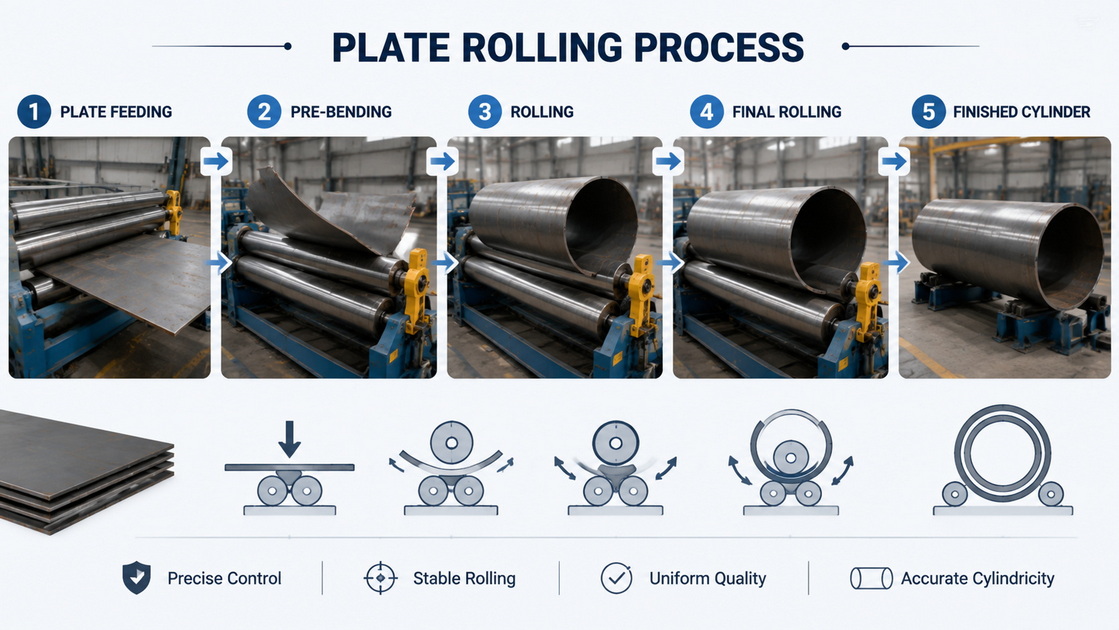
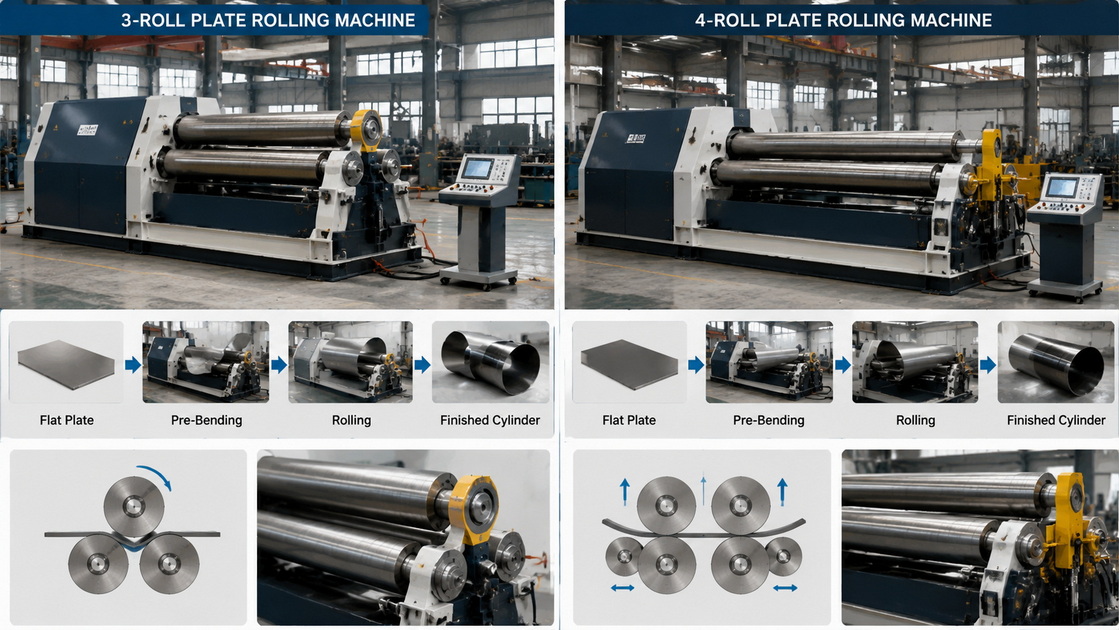
Plate rolling machines are commonly divided into three-roll and four-roll types. Each design has its own strengths, and the right choice depends on production goals.
| Machine Type | Main Advantage | Best Use |
|---|---|---|
| Three-roll plate roll | Strong forming ability and simple structure | General rolling and heavy fabrication |
| Four-roll plate roll | Easier pre-bending and better handling efficiency | High-volume production and repeated jobs |
Three-roll machines are often chosen for their robust performance and compact design. Four-roll machines are usually preferred when easier operation and faster setup are more important.
Pre-bending is one of the most important stages in plate rolling. It means bending the plate edges before the full rolling process begins, which helps reduce flat ends and improves the final shape.
When pre-bending is done correctly, manufacturers can reduce waste, shorten finishing time, and achieve better seam fit-up during welding. This is especially valuable in projects where precision and material efficiency matter.
Common benefits of pre-bending include:
- Less scrap material.
- Better edge quality.
- Reduced trimming work.
- Improved final roundness.
- Cleaner welding preparation.
For high-volume industrial production, strong pre-bending control can make a noticeable difference in both quality and cost.
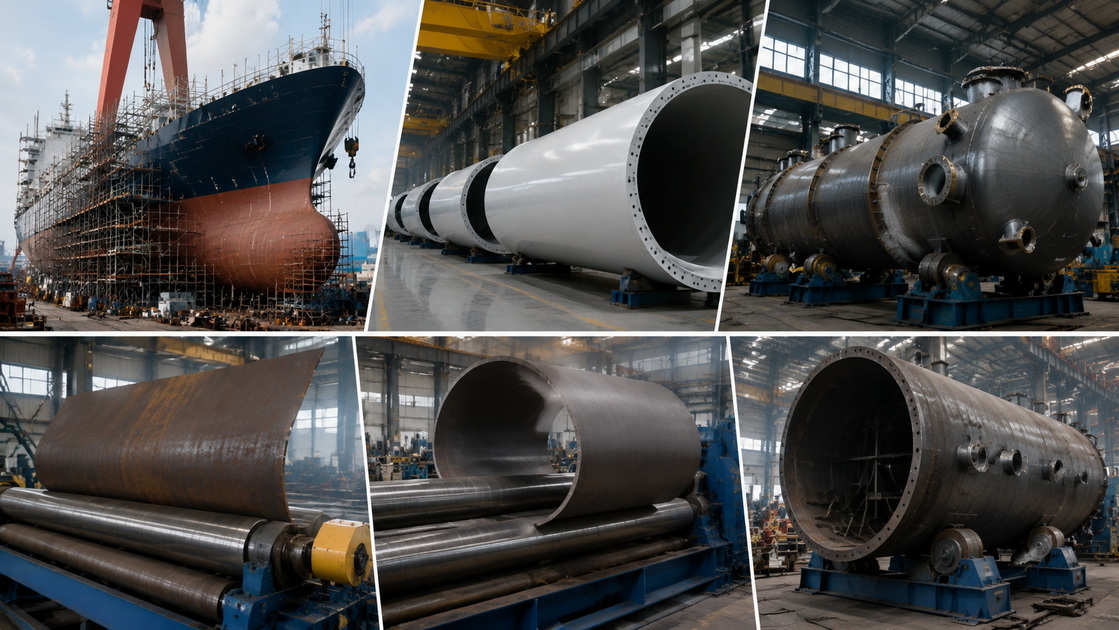
Plate rolling machines are used across a wide range of industries that require curved metal parts. Their ability to create large-diameter and custom-shaped components makes them essential in heavy fabrication.
Common applications include:
- Shipbuilding, including hull sections and curved structural parts.
- Wind tower production, including cylindrical and conical shells.
- Pressure vessels and storage tanks.
- Steel structures and construction components.
- Industrial equipment and process systems.
- Ducts, silos, and large metal enclosures.
These industries depend on reliable forming performance because the final shape must meet strict engineering requirements. In many cases, the quality of the rolling process affects downstream assembly, welding, and long-term product performance.
Selecting the right plate rolling machine requires more than checking the machine size or price. The machine should match the actual production needs of the factory.
Important factors to consider include:
- Maximum plate thickness.
- Working width.
- Required rolling diameter.
- Material type, such as carbon steel, stainless steel, or aluminum.
- Expected daily production volume.
- Level of automation.
- Operator experience.
- Maintenance and spare parts support.
For OEM and ODM projects, customization is often the most practical approach. A tailored machine can better match production targets, local standards, and customer-specific requirements.
Even a well-designed machine can produce poor results if the setup is not correct. In many cases, problems come from operator error, incorrect settings, or material mismatch.
Common issues include:
- Uneven curvature.
- Flat ends that are too large.
- Springback after rolling.
- Misalignment during feeding.
- Surface marks or edge deformation.
These issues can usually be reduced through careful setup, proper training, and regular machine inspection. The operator should always verify the first sample before full production begins.
To achieve more stable rolling quality, manufacturers should pay attention to both machine setup and daily operation.
Useful practices include:
- Calibrate the rollers before production.
- Match the pressure settings to the plate thickness.
- Keep the plate aligned during feeding.
- Use pre-bending to reduce waste.
- Inspect the first finished part before continuing.
- Maintain the rollers and mechanical components regularly.
These simple steps can improve consistency and reduce costly rework. For factories handling export orders or repeat production, small process improvements often lead to significant operational gains.
Many industrial buyers need more than a standard machine. They need a solution that fits specific materials, product sizes, output goals, and factory workflows.
Customized plate rolling equipment can offer several advantages:
- Better fit for special plate dimensions.
- Improved efficiency for repeated production.
- More suitable control systems for operator needs.
- Greater compatibility with surrounding fabrication lines.
- Easier adaptation for different project types.
This is especially important for manufacturers serving international customers or producing a wide range of metal parts. A customized machine can help support both flexibility and long-term production stability.
A CNC plate rolling machine is a key asset for manufacturers that need accurate, repeatable, and efficient metal forming. From pre-bending to final shaping, each step influences product quality and production performance. By choosing the right machine type, understanding the rolling process, and matching the equipment to real production needs, manufacturers can improve both output quality and operational efficiency.
For businesses involved in OEM or ODM manufacturing, the best results often come from a solution designed around actual working conditions, target materials, and output expectations. A well-matched plate rolling machine is not just a piece of equipment—it is part of the foundation of a reliable production system.
A CNC plate rolling machine is used to bend flat metal plate into cylinders, cones, and other curved shapes for industrial fabrication.
Common materials include carbon steel, stainless steel, aluminum, and other metal plates, depending on the machine's capacity and configuration.
A three-roll machine is known for strong forming ability, while a four-roll machine usually offers easier pre-bending and simpler handling.
Pre-bending reduces flat ends, improves final shape quality, and helps save material and finishing time.
You should consider plate thickness, working width, material type, target diameter, production volume, and service support.
1. Moore Machine Tools – “Everything You Need to Know About The Plate Roll” – A comprehensive guide covering what plate rolls are, how they operate, the mechanics of metal plate bending/rolling, and the step-by-step process including setting bending force, placing the metal plate, and pre-bending. https://mooremt.com/everything-about-plate-roll/
2. WebFX – “SEO for Machinery Manufacturers: 5 Proven Lead Strategies” – A guide on how machinery manufacturers can use SEO to drive more qualified leads, improve online visibility, and reach prospects searching for industrial equipment. https://www.webfx.com/blog/manufacturing/machinery-seo-guide/
3. Custom Market Insights – “Plate Rolling Machine Market Size $638.37 Mn By 2034” – Market research press release projecting the global plate rolling machine market to grow from USD 447.9 million in 2025 to USD 638.37 million by 2034 at a CAGR of 5.1%, driven by infrastructure development, construction growth, and technological advancements such as CNC and IoT integration. https://www.custommarketinsights.com/press-releases/plate-rolling-machine-market-size/
4. Zion Market Research – “Plate Rolling Machine Market Size, Share, Growth Report” – Market report analyzing the global plate rolling machine market, valued at USD 477.91 million in 2024 and projected to reach USD 795.69 million by 2034 at a CAGR of 5.23%, with segmentation by machine type (3-roller, 4-roller), capacity, mode of operation, and end-user industries. https://www.zionmarketresearch.com/report/plate-rolling-machine-market
5. IndexBox – “Plate Rolling Machine Market in the European Union” – Market analysis report covering the European Union plate rolling machine market from 2026 to 2035, with key findings including a projected CAGR of 3.5–5.5%, heavy-duty 4-roll machines dominating revenue, imports from China and Turkey accounting for 30–40% of unit volume, and offshore wind expansion driving specialized demand. https://www.indexbox.io/store/european-union-plate-rolling-machine-market-analysis-forecast-size-trends-and-insights/
6. BendMak USA – “Plate Rolling: What is Pre-Bending and Why Is It So Important?” – An article explaining the concept of pre-bending in plate rolling, its importance in the metal forming process, and why it is a critical step for achieving accurate bends. https://www.bendmakusa.com/blog/plate-rolling-pre-bending
7. Himalaya Machine – “The Role of Plate-Bending Machines in Wind Turbine Manufacturing” – An article discussing how plate-bending machines are used to form cylindrical and conical tower sections for wind turbines, the manufacturing process, and the importance of precision in producing components for the renewable energy sector. https://www.himalayamachine.com/post/what-is-the-role-of-plate-bending-machines-in-wind-turbine-manufacturing
8. APEC USA – “5 Tips to Optimize Your Custom Metal Fabrication Design” – A guide offering five practical tips for optimizing custom metal fabrication designs: clarifying design specifications, simplifying and editing drawings, collaborating with fabricators, considering metal alloy options, and understanding the forces the component will face. https://www.apecusa.com/blog/5-tips-to-optimize-your-custom-metal-fabrication-design/
9. TMachineTools – “The important role of plate rolling machines” – An article highlighting the growing demand for plate rolling machines across industries such as aerospace, shipbuilding, automotive, energy, and pressure vessel manufacturing, and the increasing requirements for accuracy, automation, and efficiency in metal forming equipment. https://www.tmachinetools.com/news_Detail_1/4.html


