


Views: 203 Author: CNDY-Press Publish Time: 2026-08-19 Origin: Site


Content Menu
● Why Press Brake Tonnage Is Not the Only Selection Factor
● 80 Ton vs 200 Ton Press Brake: Main Differences
● When an 80 Ton CNC Press Brake Is the Right Choice
>> Benefits of an 80-Ton Press Brake
● When a 200 Ton CNC Press Brake Is Worth Considering
>> Benefits of a 200-Ton Press Brake
● How to Calculate Press Brake Tonnage for Your Parts
>> Step 1: Define the Material
>> Step 2: Confirm the Real Bend Length
>> Step 3: Select the Bending Method and Tooling
>> Step 4: Add a Practical Capacity Margin
>> Step 5: Verify Machine and Tooling Limits
● How Thickness and Bend Length Affect Capacity
● Features That Influence Bending Quality and Productivity
● Installation and Workshop Planning
>> Workshop Planning Checklist
>> 1. Can an 80-ton press brake bend 3 mm steel?
>> 2. Is a 200-ton press brake more accurate than an 80-ton machine?
>> 3. What is the difference between press brake tonnage and bending length?
>> 4. Why is capacity reserve important when selecting a press brake?
>> 5. Do stainless steel and aluminum require the same tonnage as mild steel?
Choosing between an 80 ton CNC press brake and a 200 ton press brake machine is not simply a matter of purchasing more force. The right machine depends on the material you bend, sheet thickness, tensile strength, bend length, tooling, part geometry, production volume, and workshop conditions.
For light-to-medium sheet-metal work, an 80-ton press brake can be a practical and efficient solution. For longer, thicker, or more complex components, a 200-ton CNC press brake offers greater working capacity, rigidity, and production flexibility. The best choice should be based on your real parts, not tonnage alone.
Key point: Choose press brake capacity according to your most demanding recurring bending job, then confirm machine length, tooling capacity, open height, stroke, and loading limits before finalizing the equipment configuration.
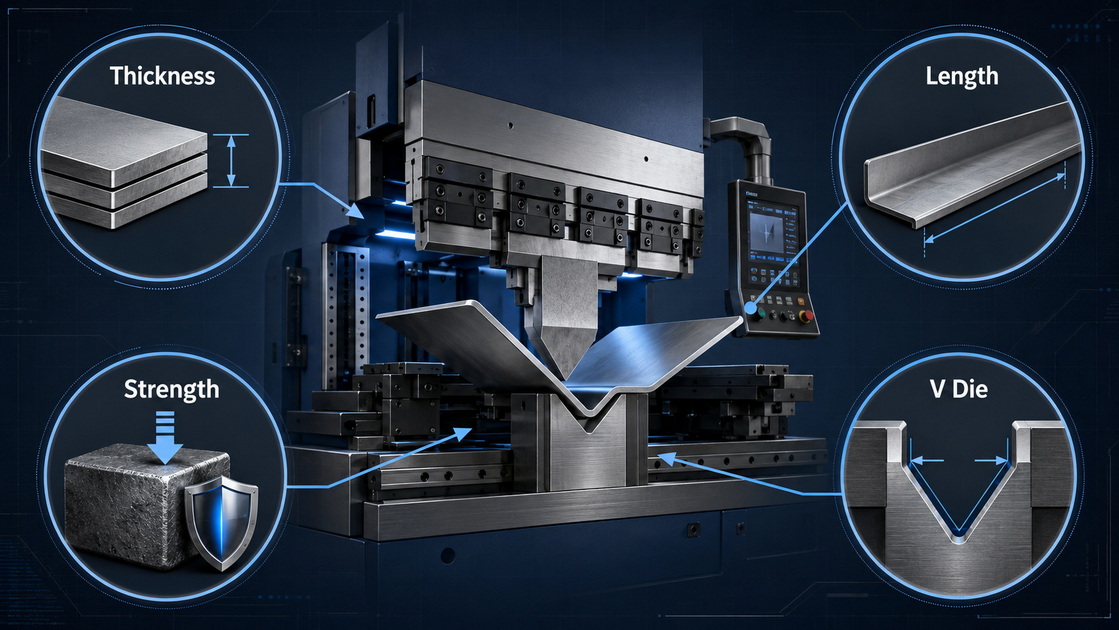
Press brake tonnage refers to the maximum bending force a machine can generate under specified working conditions. However, it does not directly define the maximum material thickness a machine can process.
Actual bending force is influenced by several variables:
- Material type and tensile strength
- Material thickness
- Bend length
- V-die opening
- Bending method
- Punch and die configuration
- Tooling condition
- Centered or off-center loading
In air bending, which is commonly used in modern sheet-metal production, required bending force increases rapidly as material thickness rises. Thickness has a particularly strong effect because it is squared in standard bending-force calculations.
Where:
F = bending force in kN
RmR_mRm = material tensile strength in MPa
SSS = material thickness in mm
LLL = bend length in mm
VVV = V-die opening in mm
This means a modest increase in sheet thickness can create a much larger tonnage requirement. A machine that bends a short 3 mm steel component comfortably may not have sufficient capacity to bend the same material across a much longer length.
For this reason, the right question is not simply, "Can this press brake bend 3 mm steel?" The more useful question is: "Can this machine repeatedly bend our specific material, thickness, length, angle, and profile with the required accuracy?"
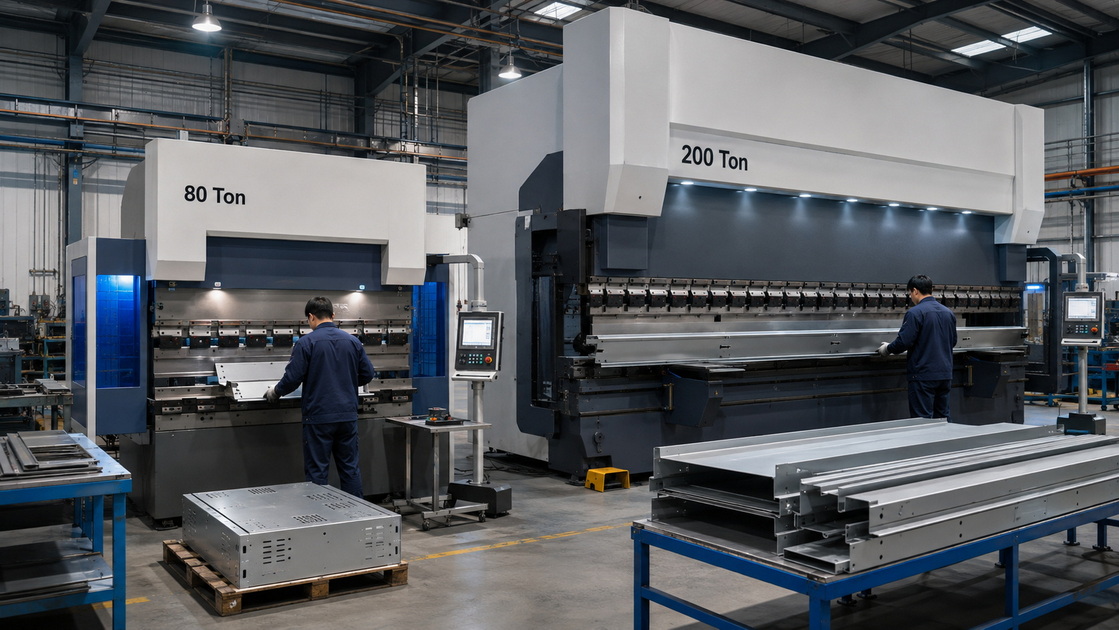
An 80-ton and a 200-ton CNC press brake differ in more than rated force. Their working length, ram stroke, daylight, machine weight, electrical requirements, and backgauge capability can all affect daily production.
| Specification | 80 Ton CNC Press Brake | 200 Ton CNC Press Brake | Production Impact |
|---|---|---|---|
| Nominal bending force | 800 kN | 2,000 kN | A 200-ton machine delivers 2.5 times more rated bending force |
| Typical bending length | 2,500–3,200 mm | 3,200–6,000 mm | A longer bed supports larger panels and longer bends |
| Column distance | 1,990–3,200 mm | 2,480–4,900 mm | Wider clearance improves handling of broad workpieces |
| Throat depth | Around 300 mm | Around 320 mm | Throat depth affects access for edge and return-flange bends |
| Ram stroke | Around 100 mm | Up to 200 mm | Greater stroke supports deeper profiles and complex tooling |
| Maximum open height | 320–350 mm | Up to 460 mm | More daylight provides clearance for tall tooling and formed parts |
| Backgauge options | 2–4 axes | 3–6 axes | More axes improve flexibility for complex profiles |
| Main motor power | Around 7.5 kW | Around 18.5 kW | Higher machine capacity requires more installed power |
| Typical machine weight | Around 5–7 tonnes | Around 10–19 tonnes | Installation and floor planning become more demanding |
The specifications above should be used as a general guide. Final machine parameters may differ according to bending length, CNC controller, hydraulic system, tooling arrangement, backgauge configuration, safety equipment, and optional automation.
An 80-ton CNC press brake is often suitable for fabricators producing smaller components, shorter bends, and thinner material. It can provide reliable performance for workshops that need accurate CNC bending while keeping investment, floor space, and energy use under control.
Typical applications include:
- Electrical enclosures and cabinet parts
- Control-box panels
- HVAC fittings and light duct components
- Brackets, mounting plates, and small frames
- Furniture panels and metal accessories
- Appliance components
- Light-gauge stainless-steel parts
- Aluminum sheet-metal products
- Small OEM metal assemblies
- Lower initial equipment cost
- Reduced workshop footprint
- Lower electrical power requirement
- Easier handling of small and medium-size workpieces
- Efficient production for repetitive light-to-medium bending
- Lower operating costs when heavy-duty capacity is not required
An 80-ton machine is a strong option when most parts are relatively short and material thickness remains within a light-to-medium range. It is especially effective for manufacturers producing consistent batches of enclosures, brackets, panels, and similar formed parts.
However, the machine should not be selected only according to average daily work. It must also handle the most demanding part that will be produced repeatedly. Selecting too little capacity may restrict future business opportunities and limit the types of projects a workshop can accept.
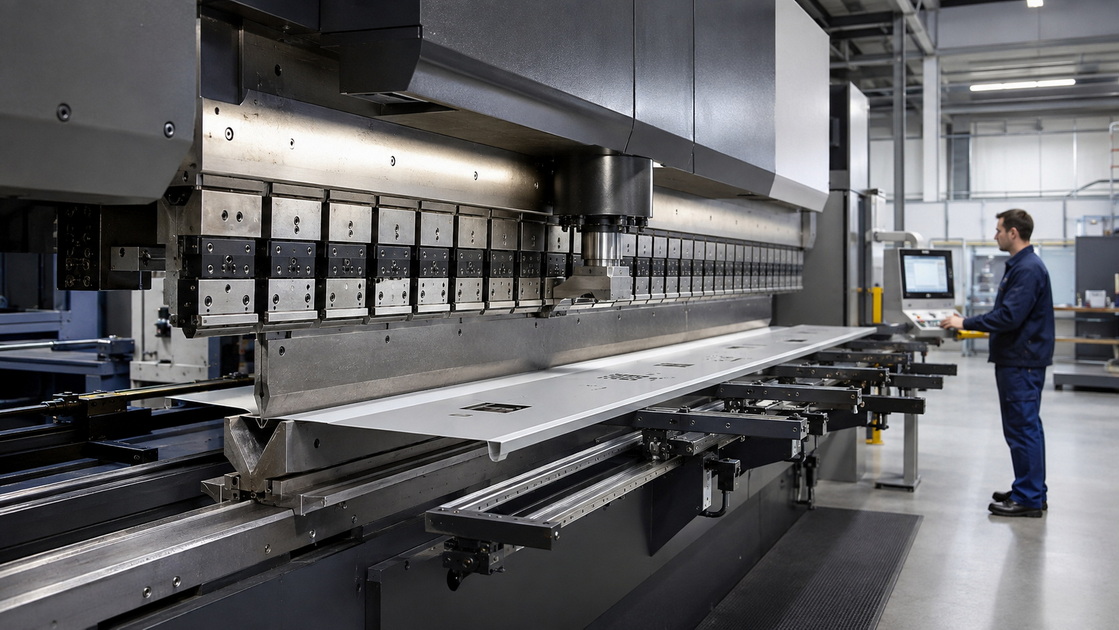
A 200-ton CNC press brake is designed for operations that process longer sheets, thicker materials, heavier components, or complex multi-bend structures. Its advantage is not only higher bending force. It also provides a larger working envelope and greater flexibility for future projects.
Common applications include:
- Large electrical cabinets and switchgear enclosures
- Long panels for industrial equipment
- Truck, trailer, and transportation components
- Agricultural machinery parts
- Construction-equipment components
- Heavy-duty steel brackets and frames
- Large HVAC and ventilation components
- Long channels, trays, and structural profiles
- Stainless-steel industrial panels
- OEM components requiring multiple bends and tight consistency
- Higher bending capacity for more demanding materials and profiles
- Longer working length for large sheet-metal components
- Greater ram stroke for deep or complicated formed parts
- Larger open height for tall tooling and return flanges
- More backgauge configuration options
- Improved flexibility for mixed production requirements
- Capacity reserve for future heavy-duty projects
A 200-ton press brake can eliminate the need to divide long components into separate sections. This can reduce welding work, simplify assembly, improve appearance, and help maintain dimensional consistency.
For example, a long cabinet panel made from a single bent sheet may look cleaner and require less downstream fabrication than a design made from two smaller sections joined by welding. In high-volume production, this can reduce handling time and improve workflow.
The trade-off is that a 200-ton machine normally requires more floor space, a stronger installation plan, higher lifting capacity, and more electrical power. It is most valuable when the production mix truly requires its force and working dimensions.
The best way to choose between an 80-ton and 200-ton press brake is to review actual part drawings and production requirements. Instead of relying on a single material example, collect data from the parts that represent your current and future workload.
Record the following details for every representative part:
- Material type
- Material grade
- Tensile strength
- Sheet thickness
- Surface finish
- Whether the material is carbon steel, stainless steel, aluminum, galvanized steel, or high-strength steel
Different materials require different bending force. Stainless steel generally needs more bending force than mild steel at the same thickness and bend length. Aluminum may require less force, depending on its alloy and temper.
Use the actual bend length, not necessarily the total blank size. A wide sheet with a short bend may require much less force than a long continuous bend across the entire part.
Longer bends increase required force directly. If bend length doubles while all other factors remain the same, the required bending force will approximately double.
Air bending, bottoming, and coining require different levels of force.
- Air bending uses lower force and offers flexible angle control.
- Bottoming requires more force but can improve angle consistency.
- Coining requires significantly higher force and is generally used for specialized applications.
The V-die opening also changes the bending requirement. A smaller V-opening typically requires more force, while a larger opening may reduce force but alter the inside bend radius.
A commonly used air-bending starting point is a V-die opening around eight times the material thickness. This should be treated as a starting guide only. Final tooling should be selected according to material properties, desired inside radius, cosmetic requirements, bend geometry, and manufacturer recommendations.
A press brake should not be selected only at the calculated force requirement. A reasonable capacity margin allows for changes in material properties, tooling choices, production variation, and future product development.
Capacity margin is important for:
- Material-thickness variation
- Higher-strength material batches
- Changes in bend length
- New customer requirements
- Tooling limitations
- Repeat production stability
- Future business expansion
The objective is not to purchase the highest tonnage available. The objective is to choose a machine that can produce target parts safely, consistently, and efficiently over its working life.
Before finalizing a press brake configuration, confirm more than the total rated tonnage.
Important checks include:
- Overall machine bending force
- Maximum bending length
- Permitted concentrated load
- Centerline load limit
- Off-center loading limit
- Punch and die tonnage rating
- Ram stroke
- Open height
- Throat depth
- Backgauge travel
- Crowning system availability
A press brake may have enough total rated force for a job while still being unsuitable for a short, highly concentrated bend. Concentrated loading can place excessive force in a small section of the ram and bed. This is why machine loading limits and tooling data must be reviewed together.
Consider two parts made from the same carbon steel using the same bending method and tooling.
- Part A has a 3 mm thickness and a 1,000 mm bend length.
- Part B has a 3 mm thickness and a 2,000 mm bend length.
Part B will require approximately twice the bending force because its bend length is twice as long.
Now consider a third part:
- Part C has a 6 mm thickness and a 1,000 mm bend length.
Although Part C has the same bend length as Part A, its material thickness is doubled. Because thickness has a squared effect in the bending-force formula, the required force can increase approximately four times under comparable conditions.
This is why selecting press brake capacity based only on a material thickness statement can lead to the wrong equipment choice. Bend length, material strength, die opening, and bending method must always be considered together.
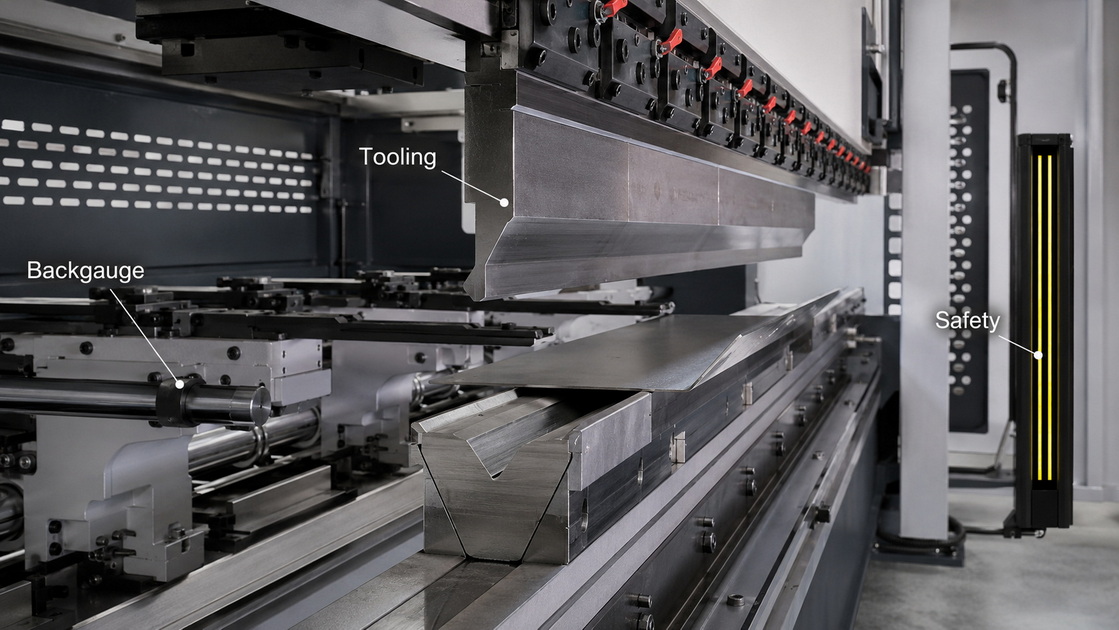
Press brake performance depends on the complete machine configuration. Rated tonnage is important, but it cannot compensate for unsuitable tooling, an inadequate backgauge, inconsistent programming, or poor material handling.
A reliable CNC controller helps operators program bending sequences, manage tooling data, calculate bend allowances, and repeat established programs. This is especially valuable for OEM and ODM work, where part changes, mixed orders, and precise dimensional requirements are common.
A suitable controller can help reduce setup time, minimize trial bending, and improve consistency between operators and shifts.
The backgauge positions the workpiece for accurate bend locations. A simple X-axis backgauge may be sufficient for standard brackets and straightforward panels.
More complex parts may benefit from additional axes, such as:
- X axis for backgauge depth
- R axis for vertical movement
- Z1 and Z2 axes for finger spacing
- X5 or X6 configurations for advanced part positioning
Additional axes are useful when producing tapered components, offset bends, complex boxes, angled profiles, and multiple part sizes. The correct configuration should match actual product requirements rather than adding unnecessary complexity.
Long workpieces can create deflection in the ram and bed during bending. This may cause the bend angle in the middle of a long part to differ from the angle near its ends.
A crowning system helps compensate for this deflection. It can improve angle consistency across long bends and is particularly valuable for large panels, longer bending lengths, and demanding tolerance requirements.
Tooling affects bend radius, flange clearance, surface marking, bending quality, and production reliability. A well-matched tool set helps produce stable results and reduces unnecessary rework.
When selecting tooling, consider:
- Required inside bend radius
- Material thickness and strength
- Flange dimensions
- Surface-protection requirements
- Tooling load rating
- Part complexity
- Production volume
- Changeover frequency
A press brake should be planned as part of a complete manufacturing workflow. This is particularly important for 200-ton models, which may require more space, stronger floor support, and larger material-handling equipment.
- Machine footprint: Allow clearance for operation, tooling changes, maintenance, and material movement.
- Floor capacity: Confirm that the floor can support machine weight and operating loads.
- Electrical supply: Verify voltage, frequency, phase, available power, and protection requirements.
- Material handling: Plan for forklifts, cranes, sheet lifters, roller supports, or manual handling aids.
- Workpiece flow: Map material movement from unloading through bending, welding, finishing, inspection, and packing.
- Maintenance access: Keep service areas accessible for hydraulic, electrical, and mechanical maintenance.
- Operator space: Provide safe and efficient working positions around the machine.
- Safety layout: Include protective devices, emergency stops, controlled access areas, and clear traffic routes.
The larger machine is not always the best investment if the workshop cannot support efficient loading, unloading, maintenance, or material flow. A well-configured 80-ton press brake can outperform an oversized machine when it is better matched to the actual production environment.
An 80-ton CNC press brake is generally suitable for light-to-medium sheet-metal work, shorter bend lengths, compact parts, and production environments where space and operating efficiency are important.
A 200-ton CNC press brake is generally more suitable for long panels, thicker materials, complex formed components, heavy-duty fabrication, and operations that need more capacity reserve for future projects.
The correct machine should be chosen after reviewing real drawings, material details, maximum bend lengths, production quantities, tooling requirements, tolerance expectations, and workshop conditions. A machine that is properly matched to the work will improve bending consistency, reduce setup challenges, support safer operation, and create a more stable production process.
For customized manufacturing projects, CNDY-Press can assess the full production requirement and develop a suitable CNC press brake configuration based on the required tonnage, bending length, CNC system, backgauge axes, tooling arrangement, safety options, and automation requirements.
It may be able to bend 3 mm steel, but the answer depends on bend length, material tensile strength, die opening, tooling, and bending method. A short bend may require much less force than a long continuous bend. Always calculate the required force using actual production conditions.
Not automatically. Accuracy depends on CNC programming, machine condition, backgauge repeatability, crowning, tooling quality, material consistency, and operator setup. A properly configured 80-ton press brake can achieve excellent accuracy within its intended operating range.
Tonnage refers to the bending force a press brake can generate. Bending length refers to the maximum length of material the machine can form in one setup. Both must be suitable for the workpiece. High tonnage does not help if the machine bed is too short for the required part length.
Capacity reserve helps accommodate material variation, tooling changes, new product requirements, and production fluctuations. It also supports more stable long-term use by preventing the machine from operating continuously at the edge of its rated capability.
No. Different materials have different tensile strengths and forming characteristics. Stainless steel generally requires more force than mild steel for the same thickness and bend length. Aluminum may require less force depending on the alloy and temper. Material-specific data should always be used.
1. MYT CNC. "[80 Ton vs 200 Ton Press Brake Machine]." Machine configuration and specification comparison for 80-ton and 200-ton CNC press brakes.
2. Durma Press. "[Press Brake Tonnage Chart: Formula, Calculator & Bending Force]." Information on bending-force concepts, tonnage charts, and calculation variables.
3. Rucheng Machinery. "[Press Brake Force Calculation: Tonnage Formula and Chart]." Information on air-bending force calculations, material properties, and tonnage planning.
4. Canadian Metalworking. "[Bending Basics: Why Tonnage Matters]." Guidance on tonnage calculations, concentrated loading, and machine load limits.
5. The Fabricator. "[An Overview of Press Brake Safeguarding]." Information on press brake safeguarding and operational safety considerations.
6. ISHN. "[How to Safeguard Press Brake to Prevent Operator Injuries]." Guidance on machine guarding and safe press brake operation.
7. Productivity Inc. "[Tonnage / Bend Force Calculator]." A reference tool for estimating bending force based on material, thickness, bend length, and tooling conditions.


