


Views: 242 Author: CNDY-Press Publish Time: 2026-10-29 Origin: Site


Content Menu
● What Makes a Press Brake Servo-Electric?
>> Servo-Electric Is Not the Same as Servo-Hydraulic
>> Does "All-Electric" Mean Completely Oil-Free?
● How Does a Servo-Electric Press Brake Work?
>> 1. The Operator Loads the Bending Program
>> 2. The Backgauge Positions the Workpiece
>> 3. The Servo Drive Moves the Ram
>> 4. The Punch Forms the Sheet
>> 5. The Ram Retracts and the Part Is Repositioned
● Screw Drive vs Belt Drive: Which Is Better?
● Servo-Electric vs Hydraulic vs Hybrid Press Brakes
● What Benefits Can Buyers Realistically Expect?
>> Lower Main-Drive Standby Demand
>> Reduced Hydraulic Maintenance
>> Responsive Motion and Compact Production
>> Reduced Exposure to Hydraulic Temperature Variation
● Application Limits: Do Not Buy Around a Universal Thickness Rule
● Three Practical Checks That Improve the Buying Decision
>> 1. Measure Energy per Accepted Part
>> 2. Separate Motion Accuracy From Part Accuracy
>> 3. Test Changeovers, Not Just Continuous Production
● Comparing Unequal Quotation Packages
● How CNDY-Press Can Support Your Evaluation
● FAQ
>> 1. Is a servo-electric press brake maintenance-free?
>> 2. Can an electric press brake bend stainless steel?
>> 3. Does electric drive guarantee better bend angles?
>> 4. Is a hybrid press brake the same as an electric press brake?
>> 5. Can servo-electric equipment handle high-tonnage applications?
A servo-electric press brake is a CNC sheet metal bending machine that uses electric servo motors and a mechanical transmission to move the ram, rather than hydraulic cylinders as its main bending drive.
For manufacturers producing brackets, electrical enclosure components, precision covers, and other formed parts, this technology can offer responsive motion, reduced hydraulic maintenance, and efficient operation. However, these advantages depend on the machine design, production schedule, tooling, and application.
My starting point when evaluating a servo-electric press brake is verification. A machine should be selected around the parts it must produce—not around claims that electric drive automatically guarantees perfect accuracy or the lowest operating cost.
This guide explains how an electric press brake works, how it differs from hydraulic and hybrid machines, and what buyers should test before investing.
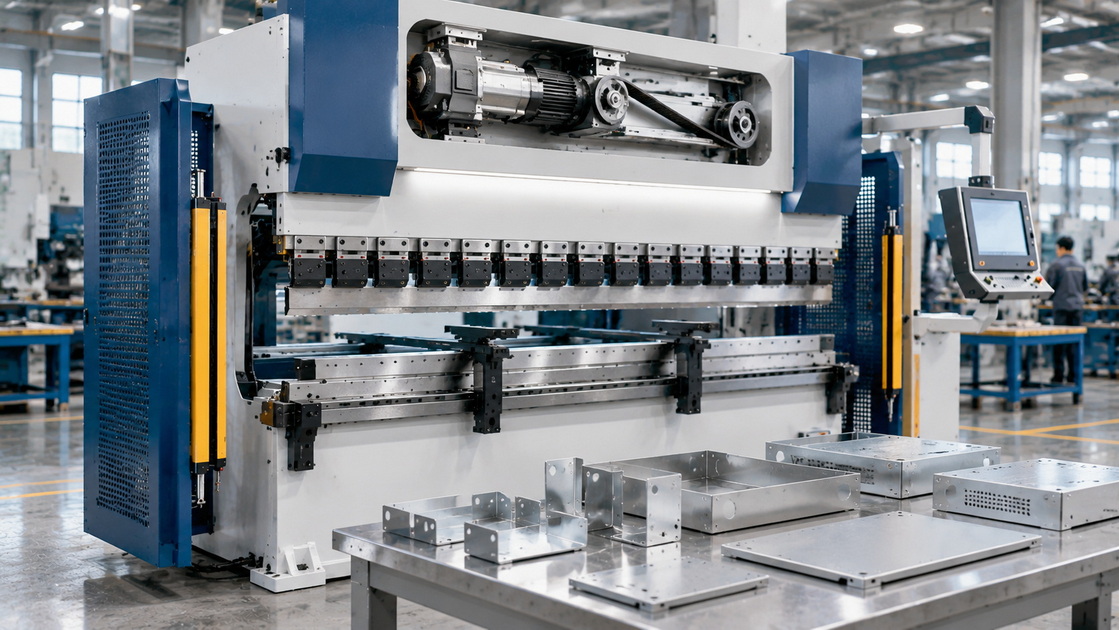
The defining feature is its main bending-drive architecture.
A servo motor produces controlled rotary motion. A mechanical transmission converts that motion into the linear force required to move the ram and form sheet metal between a punch and die.
Common arrangements include:
- Screw-driven mechanisms.
- Belt-and-pulley systems.
- Other manufacturer-specific electromechanical designs.
The CNC coordinates ram movement, backgauge positioning, and the programmed bending sequence.
A servo-hydraulic or hybrid press brake uses servo-controlled hydraulic power to operate cylinders. It still contains hydraulic components.
A servo-electric press brake uses an electromechanical main drive.
Both can provide controlled motion and reduced standby losses compared with some conventional machines. The presence of a servo motor alone does not establish which technology a quotation describes.
Ask for a drive-system diagram and a clear list of hydraulic circuits.
Not necessarily.
The main bending drive may be hydraulic-free while optional clamping or auxiliary equipment uses hydraulics. Mechanical components may also require lubrication.
Therefore, distinguish between:
- A hydraulic-free main drive.
- A machine without any hydraulic subsystem.
- Equipment approved for a specific cleanliness environment.
These are different purchasing requirements.
The program defines the part sequence, tooling, backgauge positions, and ram movements.
Depending on the controller and installed options, programming may include graphical simulation, collision checking, or offline preparation.
Controller capability should not be confused with installed machine capability. Confirm which functions are supplied and enabled.
The operator or automation system places the sheet against the gauge fingers.
The X-axis establishes gauging depth. Additional movements, such as programmable R height or lateral finger positioning, can help accommodate different part geometries.
Reliable contact matters. A sophisticated drive cannot compensate for a workpiece positioned against an unsuitable reference.
The motor, drive electronics, transmission, and feedback system coordinate the ram's approach and bending movement.
The machine transitions from approach motion into the controlled forming stage according to its design and safety system.
Avoid treating advertised approach speed as a production-rate guarantee. Actual output also depends on handling, gauging, tool changes, and safe operating conditions.
In air bending, the punch pushes the workpiece into the die opening without fully forcing it against the die profile.
The resulting angle depends on penetration, material properties, thickness, tooling, and springback.
Servo control provides precise motion control, but it does not make these variables disappear.
The machine opens to the programmed position, allowing the next bend or part removal.
For small components, efficient opening and short handling distances can be valuable. For larger parts, operator assistance and material support may dominate cycle time.
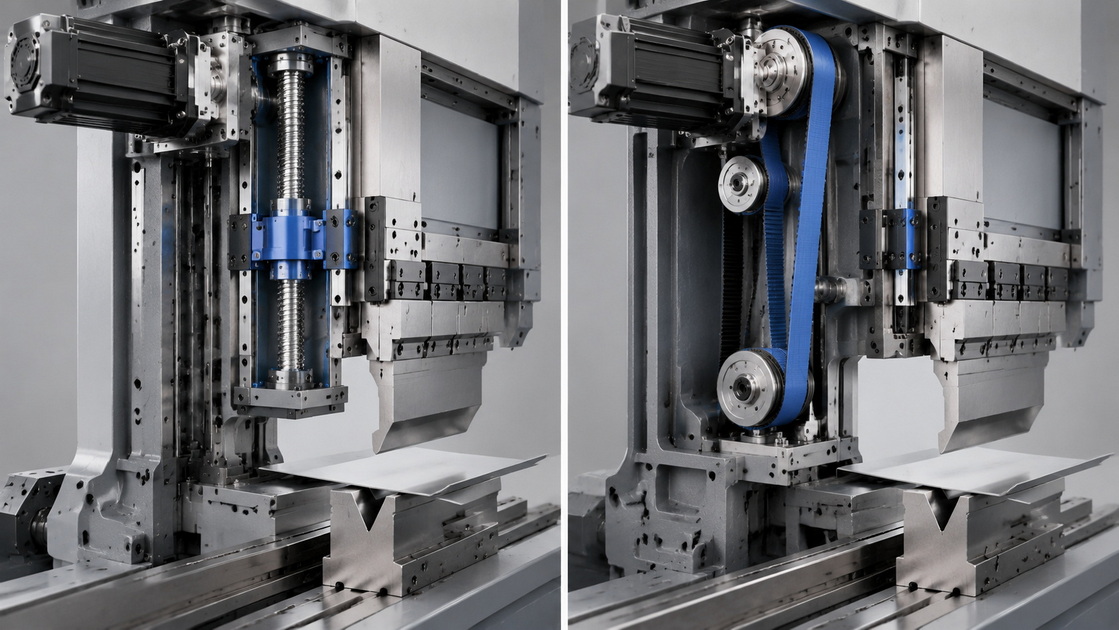
Neither mechanism should be declared universally superior.
| Design consideration | Screw-driven arrangement | Belt-and-pulley arrangement |
|---|---|---|
| Force transmission | Through a screw-and-nut mechanism | Through belts and pulley arrangements |
| Important inspection points | Lubrication, alignment, load rating, wear | Belt condition, tracking, tension, pulley condition |
| Load distribution | Depends on actuator layout and frame design | Depends on the distribution of drive points |
| Maintenance planning | Follow specified lubrication and inspection intervals | Follow specified inspection and adjustment procedures |
| Purchasing priority | Proven performance under the intended load cycle | Proven performance under the intended load cycle |
A useful supplier discussion should address permissible loading, service intervals, replacement costs, and local support.
A screw-driven machine is not automatically more rigid as a complete system. Likewise, a belt-driven machine is not automatically less accurate. Frame construction, feedback, tooling, and load distribution all contribute.
| Factor | Servo-electric | Conventional hydraulic | Servo-hydraulic or hybrid |
|---|---|---|---|
| Main bending drive | Electromechanical | Hydraulic cylinders | Hydraulic cylinders with demand-responsive drive arrangements |
| Hydraulic oil in main drive | Not required | Required | Required |
| Standby energy | Main-drive demand can be low; auxiliaries still consume power | Depends on pump and control design | Can be reduced through on-demand operation |
| Maintenance focus | Transmission, guides, lubrication, drives, safety systems | Oil, filtration, seals, valves, guides, safety systems | Hydraulic and electrical systems |
| Application fit | Determined by force, geometry, duty, and handling needs | Determined by the same requirements | Determined by the same requirements |
| Main comparison risk | Assuming electric means maintenance-free | Comparing against an outdated baseline | Mistaking hybrid for hydraulic-free |
Modern hydraulic equipment can also use on-demand drives. A fair comparison therefore names the actual machines and operating conditions rather than treating every hydraulic press brake as continuously pumping at full demand.
An electric drive can avoid the continuously running hydraulic-pump arrangement found on some conventional machines.
However, the complete machine still has electrical loads. Controls, cooling equipment, lighting, and auxiliaries may remain active.
The useful question is not whether the machine "uses power only when bending." It is how much energy the complete system consumes while producing an agreed quantity of acceptable parts.
Removing the main hydraulic circuit eliminates its oil changes, filtration tasks, and associated leak points.
Maintenance does not disappear. Mechanical transmissions, lubrication systems, guides, electrical cabinets, cooling equipment, and safeguards still require attention.
Request a maintenance schedule before ordering, including expected consumables and specialist service requirements.
Servo-electric machines can be well suited to rapid, repetitive production of appropriately sized parts.
For example, TRUMPF positions its TruBend Series 7000 around small-part bending, ergonomics, and direct-drive productivity.
The important relationship is between machine motion and the overall process. Faster ram travel creates limited benefit if operators spend most of the cycle supporting or repositioning the sheet.
Without a hydraulic main drive, oil viscosity is no longer a variable in that drive system.
That does not make the machine thermally invariant. Mechanical structures, motors, tooling, and the production environment can still experience temperature changes.
Claims of identical first-bend and end-of-shift performance should be demonstrated rather than assumed.
Statements such as "electric press brakes are only for material below 6 mm" are too broad to guide procurement.
Bending requirements depend on:
- Material strength.
- Thickness.
- Bend length.
- Die opening.
- Required radius.
- Forming method.
- Tool load limits.
- Machine geometry.
Commercial electric equipment also extends beyond compact, low-force machines. SafanDarley publishes a fully electric 300-ton model, illustrating why buyers should check current product specifications instead of relying on a fixed technology boundary.
Nevertheless, a model's availability does not establish suitability for every heavy-duty application. Confirm allowable loading, duty conditions, and tooling restrictions.
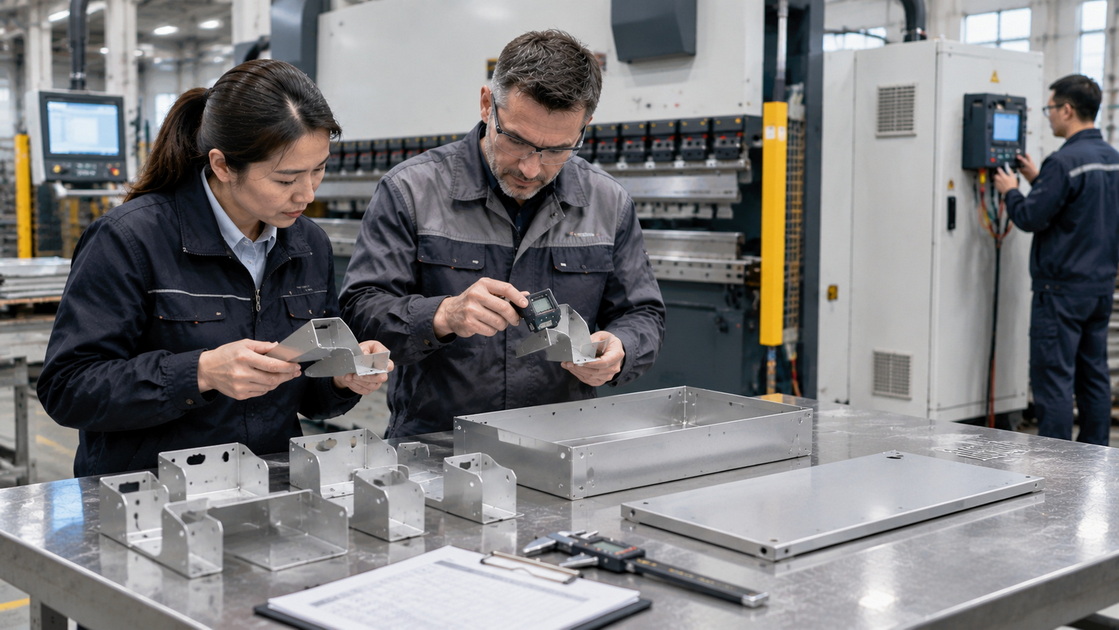
Request an energy trial using representative production.
Measure:
Energy per accepted part=Total measured energy/Accepted finished parts
Include the complete machine and agreed auxiliaries.
Record material, tooling, batch size, setup, idle time, reject quantity, and cycle conditions. If two machines produce different part mixes, their energy figures are not directly comparable.
Manufacturer claims of savings "up to" a percentage should be treated as configuration-dependent claims, not universal forecasts.
Ask suppliers to distinguish:
- Ram positioning repeatability.
- Backgauge positioning performance.
- Finished bend-angle tolerance.
- Completed-part dimensional tolerance.
- Assembly fit.
A small positioning figure does not directly translate into an identical angular tolerance on every material.
For variable materials or demanding tolerances, discuss whether angle measurement or process compensation is required.
A demonstration may show a fast sequence after extensive setup.
For high-mix manufacturing, also measure:
1. Loading the next program.
2. Changing tooling.
3. Adjusting supports.
4. Producing the first acceptable component.
5. Restarting after an interruption.
This reveals whether the proposed machine improves the whole workflow rather than only the bending stroke.
Two machines with the same nominal force and bending length may include very different production capabilities.
Check whether each quotation includes:
- Equivalent tooling.
- Crowning or relevant compensation.
- Comparable backgauge movements.
- Angle measurement.
- Safety equipment.
- Front supports.
- Offline software.
- Installation and training.
- Spare parts and warranty support.
For OEM and ODM projects, also freeze approved component substitutions and documentation responsibilities.
A lower machine price can become a higher installed cost if essential functions appear later as options.
CNDY-Press develops and manufactures sheet-metal processing equipment and offers OEM, ODM, and customer-specific production services.
For a servo-electric project, begin by asking the engineering team to confirm the available architecture and its suitability for your application. Do not assume that general customization capability establishes every possible electric-drive configuration.
Provide representative drawings, material grades, thicknesses, batch sizes, tolerances, available utilities, and destination requirements.
Request a written proposal covering the drive system, tooling, backgauge, safety equipment, maintenance, and acceptance criteria.
A servo-electric press brake can be a strong option when its motion characteristics, maintenance profile, and production capabilities match the work.
It is not automatically more accurate, faster, or cheaper for every application.
No. It removes main-drive hydraulic maintenance but still needs inspection, lubrication, cleaning, and servicing appropriate to its mechanical and electrical systems.
Yes, within its specified capabilities. Selection must consider material strength, bend length, thickness, tooling, radius, and surface requirements—not material name alone.
No. Material variation, tooling, setup, springback, measurement, and compensation remain important. Validate finished parts under agreed conditions.
No. A hybrid generally retains hydraulic force generation. Confirm the architecture rather than relying on product naming.
Some commercial models do. Published fully electric equipment reaches 300 tons, but each application still requires a machine-specific engineering review.
1. [CNHAWE — What Is a Servo-Electric Press Brake and How Does It Work?]. Original article used as a topic and technical-claim starting point. Its absolute statements about thermal stability, oil-free operation, transmission superiority, and universal efficiency were not adopted as established facts. No user comments were included in the retrieved page content or supplied separately. [cnhawe]
2. [SafanDarley — Simple by Design: Three Benefits of the E-Brake]. Manufacturer information on pulley-drive architecture and preventive maintenance. [safandarley]
3. [SafanDarley — E-Brake 160T–200T Ultra Technical Brochure]. Drive construction and manufacturer-qualified energy-saving claims; not an independent cross-brand test. [us.safandarley]
4. [SafanDarley — E-Brake 300T Ultra Dual Drive]. Evidence of a commercially published fully electric 300-ton configuration. [safandarley]
5. [TRUMPF — TruBend Series 7000]. Manufacturer information on direct-drive small-part bending, ergonomics, and angle measurement. [trumpf]
6. [TRUMPF — TruBend Series 5000]. Evidence that modern hydraulic press brakes can use on-demand servo drives. [trumpf]
7. [Westway Machinery — SafanDarley E-Brake Application Discussion]. Distributor account illustrating that hydraulic clamping may coexist with an electric main drive. [westwaymachinery]
8. [CNDY-Press — About Us]. Company background and stated OEM, ODM, and customized manufacturing services. [cndypress]


