


Views: 280 Author: CNDY-Press Publish Time: 2026-10-27 Origin: Site


Content Menu
● How Does a Hybrid Servo Press Brake Work?
● Hybrid Servo vs Conventional Hydraulic vs All-Electric Press Brakes
● Key Features to Evaluate on a Hybrid Servo CNC Press Brake
>> Demand-Responsive Pump Control
>> Closed-Loop Machine Control
>> Configured Backgauge Functions
>> Integrated Safety Functions
● How Much Energy Can a Hybrid Servo Press Brake Save?
>> Why the Production Schedule Matters
>> Use Energy per Accepted Part
● A Practical Energy Verification Protocol
● Does Hybrid Servo Technology Improve Bending Accuracy?
>> Separate Three Performance Claims
● Why Higher Approach Speed Does Not Guarantee Higher Output
● Noise, Oil Volume, and Thermal Behavior
● Hybrid Does Not Mean Maintenance-Free
>> Ask About Diagnostic Support
● Safeguarding Must Match the Complete Machine
● Comparing Different Machine Packages
● How CNDY-Press Can Support a Custom Project
>> 1. Is a hybrid servo press brake fully electric?
>> 2. Will it always reduce electricity costs by the advertised percentage?
>> 3. Does servo control guarantee accurate bend angles?
>> 4. Does a hybrid machine still need hydraulic maintenance?
>> 5. What should a factory acceptance test include?
A hybrid servo press brake combines servo-controlled electric drive technology with hydraulic force generation. Instead of operating the hydraulic pump at one continuous speed, the system adjusts pump operation to match the machine's movement and pressure requirements.
For sheet metal manufacturers, the potential benefits include lower energy consumption, reduced idle noise, and more demand-responsive operation. However, those benefits depend on the drive architecture, machine configuration, workload, and comparison baseline.
This guide explains how hybrid servo press brakes work, what their advantages actually mean, and how buyers can evaluate a proposed machine before investing.
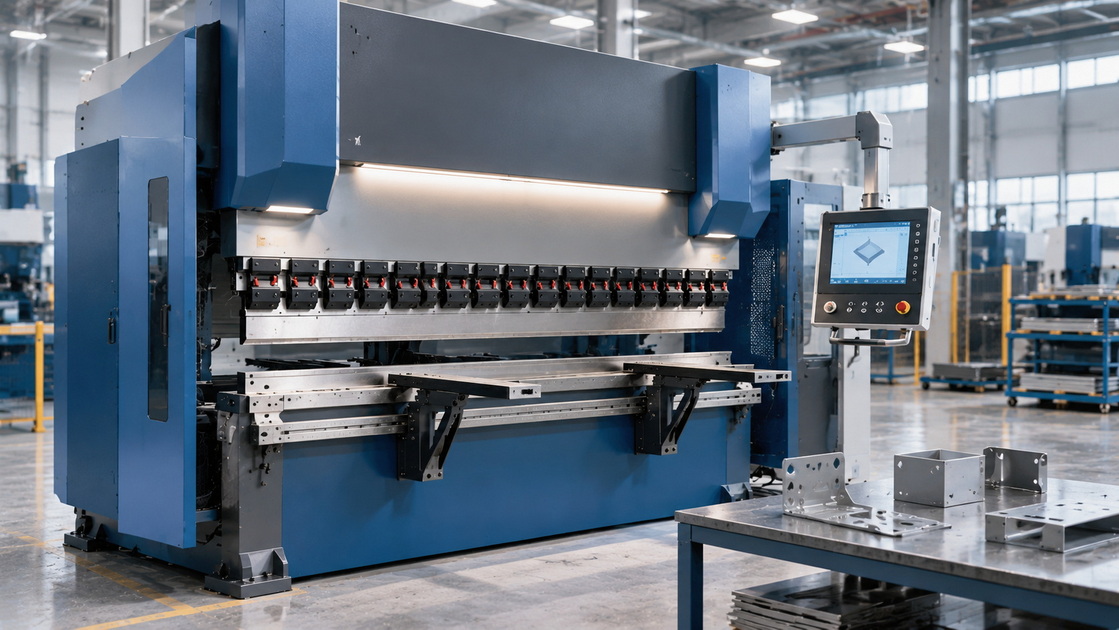
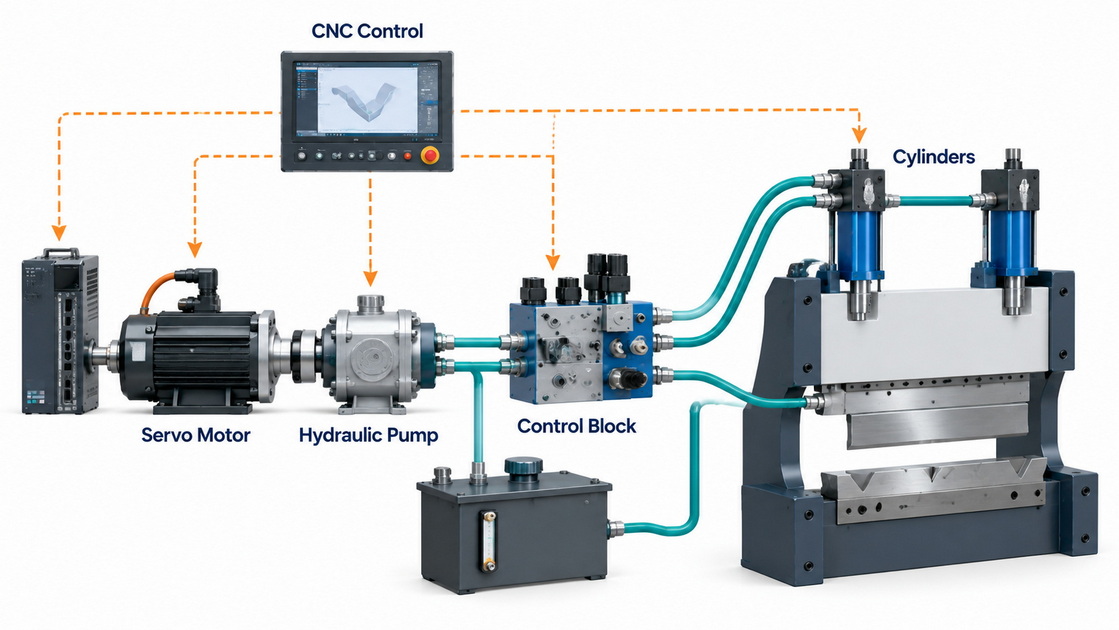
In a typical servo-pump arrangement, an electric servo motor drives a hydraulic pump. The pump supplies the hydraulic system that moves the ram and generates bending force.
The control system coordinates motor operation with machine requirements. Pump output can therefore change between approach, bending, return, and waiting periods.
This differs from older constant-speed arrangements, where the pump continues operating even when the production process requires little useful hydraulic output.
Depending on the design, the system may include:
- Servo motors and drives.
- Hydraulic pumps.
- Hydraulic cylinders.
- Position and pressure feedback.
- Hydraulic valves and safety functions.
- A CNC controller.
- Oil filtration and temperature-management components.
Not every hybrid machine uses the same circuit. Ask the supplier for a functional description of the proposed architecture rather than assuming that the word "hybrid" defines one standard design.
These terms describe different aspects of machine construction.
A hybrid servo press brake still uses hydraulics. It should not be confused with an all-electric machine that generates ram movement through an electromechanical arrangement.
Likewise, conventional hydraulic press brakes vary considerably. Comparing a modern hybrid machine with an unspecified "hydraulic machine" creates an unreliable benchmark.
| Comparison area | Conventional hydraulic | Hybrid servo-hydraulic | All-electric |
|---|---|---|---|
| Ram force generation | Hydraulic | Hydraulic | Electromechanical |
| Drive arrangement | Depends on pump and control design | Servo-controlled hydraulic drive | Electric drive with mechanical transmission |
| Hydraulic oil | Required | Required; quantity varies | Ram drive does not require a hydraulic circuit |
| Energy comparison | Establish a measured baseline | Evaluate against that baseline | Evaluate against the same production task |
| Maintenance focus | Hydraulic and mechanical systems | Hydraulic, electrical, and mechanical systems | Electrical and mechanical systems |
| Selection priority | Application and installed capability | Workload and drive integration | Application and machine design |
The label is a starting point, not a performance guarantee.
A useful specification separates drive technology from the rest of the machine.
Servo operation allows pump output to respond to actual demand. This is the primary technical basis for potential energy savings.
HAWE describes servo-driven press-brake systems that dynamically adjust delivery volume and pressure. Its product range also illustrates that different hydraulic control architectures exist within modern press-brake applications.
Position feedback and coordinated control help the machine execute programmed movements.
However, ram-position feedback is not the same as measuring the finished bend angle. Buyers should confirm whether the quotation includes angle measurement, compensation, or only position control.
The backgauge positions the workpiece for successive bends. Its usefulness depends on the geometry of the parts and the movements available.
Request an explanation of each quoted axis and demonstrate it on representative components. More axes do not automatically improve every production task.
Hydraulic holding, stopping behavior, and monitored machine functions need to work as a coordinated system.
HAWE identifies reliable beam holding and monitoring among the requirements of modern press-brake control. These functions still require appropriate integration into the complete machine.
There is no universal percentage.
The source article reports energy reductions for its own product offering. Separately, HAWE states that its ePRAX drives can achieve savings of up to 80% compared with conventional press controls.
These figures use different product descriptions and comparison conditions. They should not be combined into a general industry promise.
A machine that spends substantial time waiting between operations has a different energy profile from one running repetitive bends continuously.
The result also depends on auxiliary equipment, oil-temperature control, standby settings, part handling, and the selected baseline.
The purchasing priority is measurement: compare the energy required to produce acceptable parts under matched conditions.
A practical metric is:
Record the measurement boundary. A main-drive reading is different from a whole-machine reading that includes controls, cooling, and other equipment.
Also record production time, rejected parts, and idle periods. An energy comparison without output data can be misleading.
Ask competing suppliers to follow the same documented trial:
1. Use the same part drawings and material specifications.
2. Identify the tooling and bending method.
3. Produce an agreed batch size.
4. Include a defined waiting period.
5. Measure electricity at the agreed boundary.
6. Inspect the finished parts.
7. Report total energy and accepted output.
Specify whether setup and warm-up are included.
This is a proposed purchasing protocol, not a standardized certification test. Its value comes from transparency and consistent conditions.
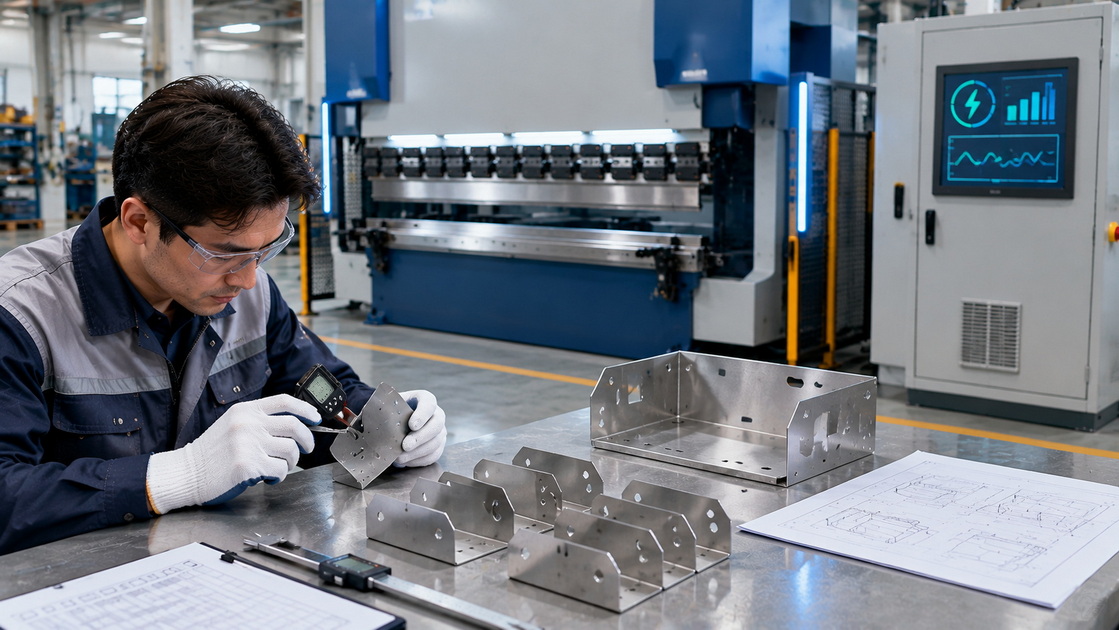
It can support controlled machine movement, but it does not independently determine finished-part accuracy.
A bend also depends on material thickness, mechanical properties, tooling, workpiece positioning, machine deflection, and setup.
Consequently, a claim about pressure stability or ram repeatability should not be presented as an equivalent bend-angle guarantee.
| Claimed capability | What it describes | What buyers should request |
|---|---|---|
| Ram positioning | Controlled machine movement | Test conditions and repeatability data |
| Backgauge positioning | Workpiece reference location | Relevant positioning demonstration |
| Finished-part accuracy | Actual component dimensions and angles | Representative production samples |
The original article cites pressure fluctuation of no more than 0.5%. Without a defined measurement method and application conditions, that figure should remain a supplier-specific claim rather than a universal hybrid-machine specification.
Approach speed describes only part of the cycle.
Actual throughput also includes gauging, handling, controlled bending, return, inspection, and tool changes.
The original article reports approach speeds of 260–280 mm/s for certain configurations. Those values do not establish production output for an unrelated machine or component.
For a multi-bend enclosure, request measured times for:
- Setup and programming.
- First-piece approval.
- Loading and orientation.
- Bending and repositioning.
- Unloading.
- Inspection and rework.
A small improvement in ram movement may have little effect if manual handling dominates the job.
Conversely, a well-integrated workflow may improve output without relying on headline speed alone.
Demand-responsive operation can reduce unnecessary pump running. This creates a basis for quieter waiting periods and lower energy losses.
However, "quiet" should be evaluated under specified conditions. Ask where sound is measured and whether the machine is idle, approaching, or bending.
Oil volume also depends on architecture. HAWE states that its speed-controlled ePRAX modular system can significantly reduce the required tank volume. That is not evidence that every hybrid design has the same oil requirement.
Request the actual reservoir capacity, operating-temperature limits, cooling arrangement, and maintenance instructions for the quoted machine.
A hybrid servo press brake retains hydraulic components while adding electronic drive and control requirements.
Its maintenance plan should address:
- Hydraulic oil condition.
- Filtration.
- Seals and connections.
- Pump and motor condition.
- Electrical cooling and cleanliness.
- Position-feedback systems.
- Mechanical lubrication.
- Safety-function inspection.
Do not assume that reduced idle operation automatically establishes a particular maintenance interval.
Before purchase, confirm who can troubleshoot the machine, which diagnostic tools are required, and how replacement components will be supplied.
Also clarify software backups, parameter retention, remote-support arrangements, and access to service documentation.
These questions can matter more to production continuity than a general promise of "low maintenance."
Servo drive technology does not remove crushing hazards at the tools.
OSHA states that power press brakes must be effectively safeguarded under its general machine-guarding requirements. Its guidance also explains that a foot control does not itself separate the operator's hands from the point of operation.
Require a qualified assessment of the machine, tooling, workpieces, and operating methods.
The quotation should identify the proposed safeguards and responsibilities for installation, validation, training, and maintenance. Do not accept speed or productivity improvements that depend on bypassing protective functions.
A hybrid quotation may include a better controller, additional backgauge movements, different tooling, or angle measurement that the conventional quotation excludes.
If that package performs better, the drive technology alone may not explain the difference.
Build a matched comparison covering:
- Force and working length.
- Opening and stroke.
- Tooling.
- Backgauge configuration.
- Compensation features.
- Angle measurement.
- Safety equipment.
- Software.
- Installation and training.
Then identify which advantages arise from the drive and which come from the wider specification.
This prevents an attractive label from obscuring the actual purchasing decision.
CNDY-Press describes its business as the development, manufacture, sales, and servicing of CNC press brakes and related sheet metal processing equipment.
According to the supplied company background, it undertakes OEM and ODM projects and supports customized production.
No. It combines electric servo control with hydraulic force generation. An all-electric press brake uses a different ram-drive arrangement.
No. Results depend on the baseline machine, workload, waiting time, and measurement boundary. Request a matched trial rather than relying on a maximum claim.
No. Controlled movement is only one contributor. Require finished-part testing with representative material, tooling, and geometry.
Yes. Confirm oil, filtration, seals, connections, and other maintenance requirements in the machine documentation.
Include representative parts, repeated production, dimensional inspection, agreed energy measurements, safety-function checks, and a review of documentation and training.
1. [CNHAWE — What Is a Hybrid Servo Press Brake? Features & Advantages]. December 5, 2025. Original article supplied for restructuring. Its product performance figures are treated as supplier-specific claims.
2. [HAWE Hydraulik — Energy-Efficient Controls for Press Brakes: The Right Solution for Every Demand]. October 10, 2022. Supports servo-pump operation, conditional energy-saving claims, and architecture-specific oil-volume reductions.
3. [HAWE Hydraulik — Electronics, Hydraulic and System Solutions for Press Brakes]. Supports the discussion of drive architectures, beam holding, monitoring, and machine integration.
4. [OSHA — Power Press Brake Used as a Mechanical Power Press]. Regulatory interpretation supporting the discussion of general machine-guarding obligations. This historical interpretation is not a complete current compliance checklist.
5. [OSHA — Machine Guarding: Foot Control]. Supports the limitation of foot controls as a protective measure.


