


Views: 210 Author: CNDY-Press Publish Time: 2026-07-11 Origin: Site


Content Menu
● Why Stainless Steel And Aluminum Need Different Press Brake Settings
● Key Material Properties: Stainless Steel vs. Aluminum
>> Mechanical Behavior And Tonnage Requirements
>> Springback And Minimum Bend Radius
● Core Press Brake Parameters You Must Adjust
>> 3. Punch Radius And Tool Material
>> 4. Bend Angle And Overbend Programming
● Practical Comparison Table: Stainless vs. Aluminum Bending
● Step By Step: Adjusting Your Press Brake From Stainless To Aluminum
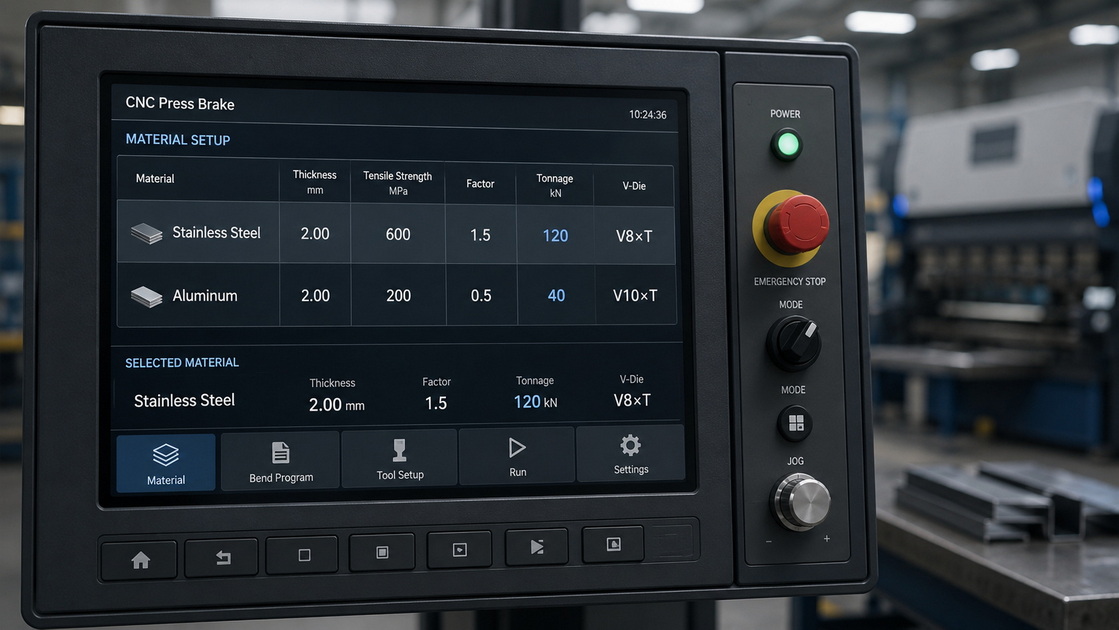
>> Step 1 – Update Material Library And Tonnage Limits
>> Step 2 – Change V-Die And Punch
>> Step 3 – Adjust Ram Speed And Dwell
>> Step 4 – Recalibrate Springback And Overbend
>> Step 5 – Document And Standardize
● Common Mistakes When Switching Between Materials
● Call To Action: Optimize Your Press Brake Programs With The Right Partner
● FAQ
Stainless steel and aluminum may look similar on a drawing, but they behave very differently once they hit your CNC press brake, and your bending settings need to reflect that. In this guide, I'll compare stainless steel vs. aluminum bending from a practical, shop-floor perspective and show how to adjust your press brake settings to achieve repeatable, safe, and economical results. [prima-press]
Both materials fall under "sheet metal," yet their mechanical properties, surface behavior, and springback demand distinct setups on a press brake. Treating aluminum like stainless (or vice versa) is a fast way to burn tonnage capacity, scrap parts, or mark surfaces. [makerverse]
From a CNC press brake manufacturer's standpoint, we see three critical differences:
- Strength and stiffness: Stainless steel typically requires more bending force than mild steel, while aluminum needs significantly less. [shop.adhmt]
- Springback: Aluminum often shows higher springback ratios, especially in harder alloys, demanding more overbending. [xometry]
- Surface sensitivity: Stainless shows marking quickly; aluminum is even more sensitive, especially decorative or anodized surfaces. [jsragos]
Understanding these differences is the foundation for safe press brake programming and long tool life.
Press brake capacity charts are usually based on mild steel as the reference. Other materials are adjusted with material factors. [prima-press]
- Stainless steel (e.g., 304): Often needs about 1.5× the force of mild steel at the same thickness. [shop.adhmt]
- Aluminum (common alloys): Often needs 40–60% of mild steel's force, depending on alloy and temper. [jsragos]
A typical guideline:
- If mild steel needs 25 tons/m for a given setup, stainless may require ~37–40 tons/m, while aluminum may need ~12–15 tons/m. [prima-press]
This has direct implications for machine sizing, die selection, and safety margins.
Springback depends on the relationship between yield strength and elastic modulus. [xometry]
- Stainless steel: High strength but also relatively stiff, with noticeable springback, especially in high-strength grades.
- Aluminum: Often shows even more springback relative to its stiffness, particularly in hard tempers like 6061-T6. [xometry]
General recommendations:
- Aim for a minimum inside bend radius ≥ material thickness for both stainless and aluminum to avoid cracking and distortion. [xometry]
- For hard aluminum alloys and tougher stainless, using 2–3× thickness as radius can significantly reduce cracking and tooling stress. [xometry]
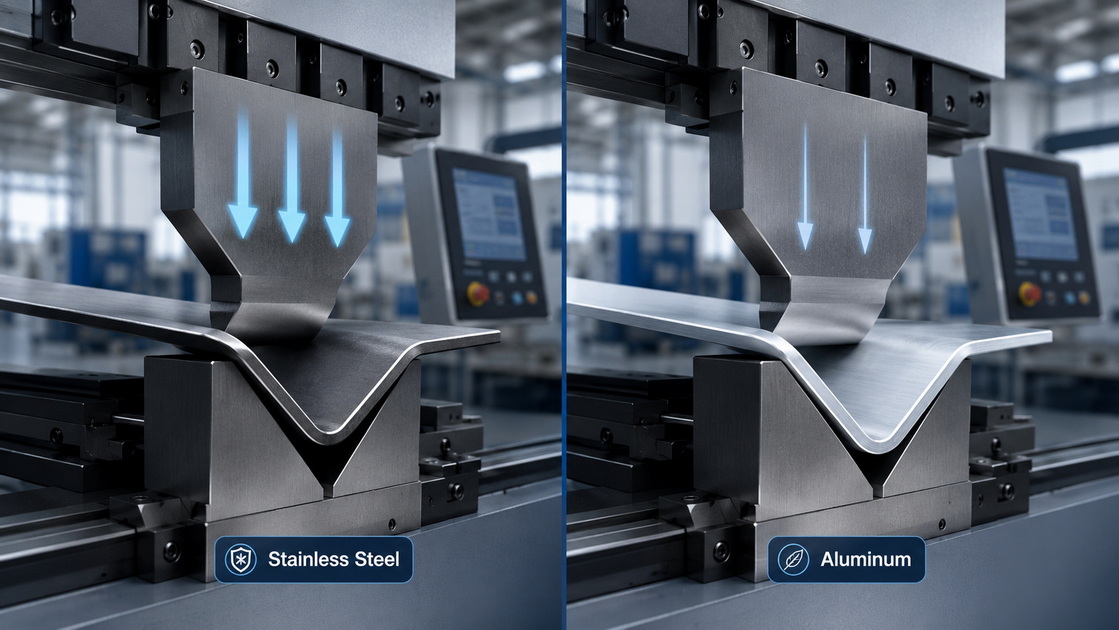
Press brake bending quality depends on a set of interrelated parameters. When switching between stainless steel and aluminum, you must review at least these four: tonnage, V-die opening, punch radius, and angle/programming. [accurl]
A common formula for required bending force incorporates length, thickness, material factor, and die opening. In practice: [prima-press]
- Use the material factor from your machine documentation or tonnage chart.
- Add a 20–30% safety margin to account for variation in yield strength and plate flatness. [prima-press]
For aluminum:
- Reduce tonnage setpoints to roughly 40–60% of the mild steel baseline, to avoid overloading and unnecessary tool wear. [jsragos]
For stainless:
- Increase tonnage and ensure the machine capacity is not exceeded, especially for longer bends and narrow dies. [shop.adhmt]
A widely used rule is: V-die opening ≈ 8× material thickness for standard air bending. Adjustments: [jsragos]
- For aluminum, using larger V-dies (10–12× thickness) can reduce marking and risk of cracking. [jsragos]
- For stainless steel, staying closer to 8× thickness often balances tonnage and bend quality. [shop.adhmt]
Example guideline for aluminum:
- 1–2 mm: 10–12× thickness
- 3–5 mm: 8–10× thickness
- 6 mm+: 10–12× thickness [jsragos]
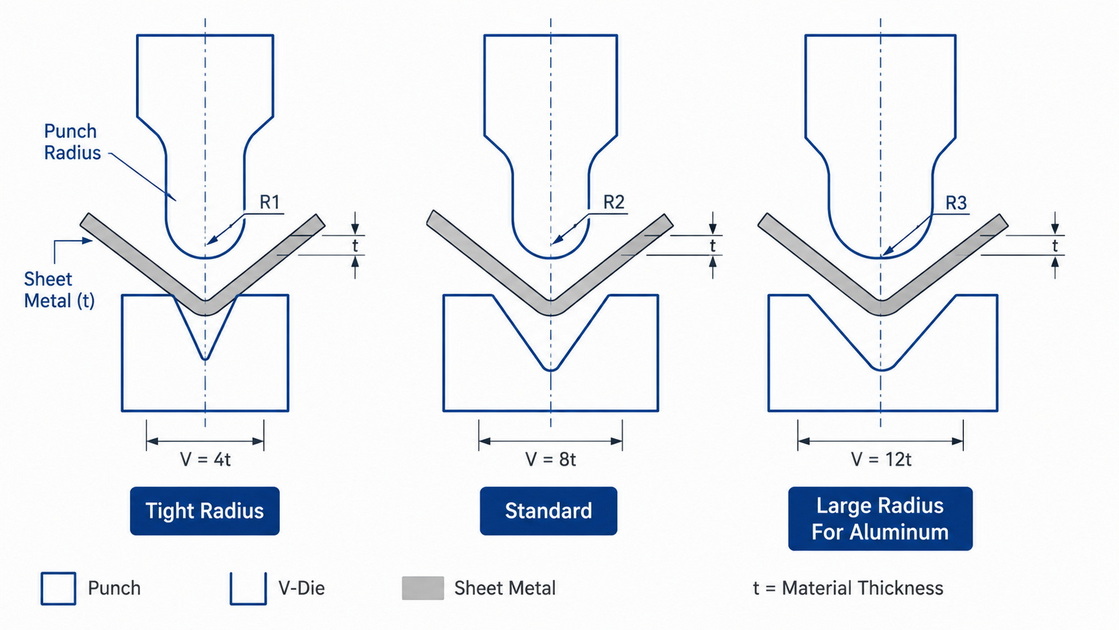
To control cracking and surface finish:
- Use a punch radius at least equal to sheet thickness for both stainless and aluminum. [makerverse]
- For hard aluminum alloys, consider 2–3× thickness punch radius. [xometry]
- Consider polished or coated tools when bending decorative stainless or aluminum to minimize marking. [makerverse]
Because stainless and aluminum spring back differently, angle programming and overbend values must be material-specific.
- For stainless steel, expect moderate springback; overbend by a few degrees, validated by test bends.
- For aluminum, overbend more; some alloys demand significantly higher overbend to hit the target angle. [xometry]
Advanced CNC press brakes typically allow material-specific correction tables. Once dialed in, operators can switch recipes quickly when changing from stainless to aluminum runs.
| Parameter | Stainless Steel Bending | Aluminum Bending |
|---|---|---|
| Required tonnage | ~1.5× mild steel (shop.adhmt) | ~40–60% of mild steel (jsragos) |
| Typical V-die opening | ~8× thickness (prima-press) | 8–12× thickness (jsragos) |
| Springback | Moderate to high | Often higher, especially hard alloys (xometry) |
| Recommended punch radius | ≥ thickness; more for high-strength grades (makerverse) | ≥ thickness, 2–3× for 6061-T6 (xometry) |
| Surface marking risk | High without proper tooling | Very high on decorative surfaces (jsragos) |
| Tooling wear | Higher (harder, abrasive) | Lower but sensitive to galling |
| Typical applications | Food equipment, chemical, architectural, structural | Enclosures, panels, automotive, lightweight structures |
Drawing on typical OEM projects we see at CNDY-Press, here is a simple, repeatable workflow when switching from stainless steel jobs to aluminum jobs on the same CNC press brake.
- Select or create a material entry for aluminum in the CNC control.
- Set material factor and maximum tonnage per meter based on your machine's charts. [accurl]
- Reduce tonnage limits to avoid over-driving aluminum and damaging tooling. [jsragos]
- Switch to larger V-dies for aluminum, especially above 3 mm thickness.
- Mount a punch with a larger radius if you were using a tight radius for stainless. [makerverse]
- Use clean, smooth tools to prevent galling and surface scratching.
- For aluminum, adopt a three-stage speed profile:
1. Slow approach before contact (soft touch).
2. Controlled pressing speed.
3. Smooth return stroke. [jsragos]
- Add a short dwell (0.2–0.5 s) at bottom dead center to allow stress relaxation and improve angle repeatability. [jsragos]
- Perform test bends and measure actual angle vs. programmed angle.
- Adjust overbend values until parts consistently reach target angles.
- Save these corrections as material-specific compensation curves in the controller. [accurl]
- Record tool configurations, V-die sizes, punch radii, and program parameters for each material and thickness range.
- Train operators to always select the correct material program rather than manually changing isolated parameters.
From shop audits and after-sales support, we repeatedly see a few mistakes:
- Using the same V-die for everything: This leads to over-tonnage on stainless or excessive marking and cracking on aluminum. [prima-press]
- Ignoring grain direction: Bending parallel to the grain increases crack risk, especially in aluminum; always bend across the grain when possible. [xometry]
- Skipping test bends: Jumping straight into production without verifying angles on the first piece often results in batch scrap.
A subtle but important insider point: operators sometimes "compensate" for wrong tooling with extra tonnage. This may "work" short-term but dramatically increases stress on both machine and tools. If you regularly need "more force than expected," revisit your die opening and punch radius first, not just tonnage.

Whether you run a job shop or an OEM line, your profitability depends on consistent, predictable bending of both stainless steel and aluminum. Getting there is as much about press brake settings and tooling as it is about the machine itself. [accurl]
As a manufacturer of CNC press brakes and complete sheet metal processing solutions, CNDY-Press works with customers to:
- Configure machines, tooling, and control parameters for their mix of stainless and aluminum jobs.
- Provide OEM and ODM customization, including tailored tonnage charts, material libraries, and language-localized interfaces.
- Support on-site and remote training, helping operators standardize best practices and avoid costly mistakes.
If you are planning to upgrade your press brake fleet or standardize bending programs for multiple materials, consider sharing your part drawings and current settings with our engineering team to discuss practical improvements and custom configurations.
1. How much more force does stainless steel need compared to aluminum on a press brake?
At the same thickness, 304 stainless typically needs around 50% more force than mild steel, while aluminum may need roughly 40–60% of mild steel's force, meaning stainless can require two to three times more force than aluminum in similar conditions. [shop.adhmt]
2. Can I use the same V-die for both stainless and aluminum?
You can in theory, but it is not ideal. Stainless often uses an 8× thickness V-die, while aluminum benefits from wider openings (10–12× thickness) to reduce marking and cracking risk. [prima-press]
3. Why does aluminum show more springback than stainless steel in some cases?
Aluminum often has a higher ratio of yield strength to elastic modulus, which leads to higher elastic recovery after unloading, especially in hard tempers like 6061-T6. [xometry]
4. How should I set dwell time for aluminum vs. stainless?
Aluminum benefits from a short dwell (0.2–0.5 s) at the bottom of the stroke to stabilize plastic deformation and improve angle repeatability; stainless may require less dwell, but both materials can benefit from controlled timing in high precision work. [accurl]
5. What's the minimum bend radius I should use for stainless and aluminum?
A safe general rule is inside radius ≥ material thickness for both materials, increasing to 2–3× thickness for high-strength stainless or hard aluminum alloys to reduce cracking and residual stress. [xometry]
1. Prima Press – "Comprehensive Guide to Press Brake Metal Thickness."
https://www.prima-press.com/comprehensive-guide-to-press-brake-metal-thickness/ [prima-press]
2. ADH Machine Tool – "The Ultimate Guide to Press Brake Metal Thickness."
https://shop.adhmt.com/press-brake-metal-thickness-guidelines/ [shop.adhmt]
3. JSRAGOS – "Best Press Brake Settings for Aluminum Sheet Bending."
https://www.jsragos.com/aluminum-bending-settings/ [jsragos]
4. Xometry – "Sheet Metal Bending Design Tips."
https://xometry.pro/en/articles/sheet-metal-bending-design-tips/ [xometry]
5. MakerVerse – "Bending Basics for Sheet Metal Fabrication."
https://www.makerverse.com/resources/sheet-metal/bending-basics-for-sheet-metal-fabrication/ [makerverse]
6. Rucheng Machinery – "How to Set Up a Press Brake: Tooling, Back Gauge & First Piece."
https://ruchengmachinery.com/blogs/press-brake-setup-guide.html [ruchengmachinery]
7. ACCURL – "Press Brake Parameters: Bending, Tonnage, Tooling and More."
https://www.accurl.com/blog/press-brake-parameters/ [accurl]
8. Xometry – "Sheet Metal Bending: The Basics."
https://www.xometry.com/resources/machining/the-basics-of-bending-sheet-metal/ [xometry]
9. Practical Machinist – "Bending Aluminum Sheet Metal on Manual Finger Brake."
https://www.practicalmachinist.com/forum/threads/bending-aluminum-sheet-metal-on-manual-finger-brake.296715/ [practicalmachinist]
10. Reddit r/metalworking – "Bending Brake Advice."
https://www.reddit.com/r/metalworking/comments/1o3s794/bending_brake_advice/ [reddit]


