


Views: 255 Author: CNDY-Press Publish Time: 2026-07-15 Origin: Site


Content Menu
● Step 1: Match Press Brake Capacity To Your Parts And Processes
>> Bending Length And Part Strategy
>> Tonnage: Calculating Bending Force With A Safety Margin
>> Clearance, Stroke Length And Material Thickness
● Step 2: Choose The Right Press Brake Technology For Your Shop
>> From Mechanical To CNC And Hybrid Systems
>> Operator Skill Level And Training
● Step 3: Optimize Tooling, Locks And Automatic Tool Change
>> Locks, Intermediates And Tooling Systems
>> Automatic Tool Change And CAD/CAM Integration
● Step 4: Configure Back Gauge And Supports For Complex Bends
>> Back Gauge Axes And Independent Towers
>> Front Supports, References And Bending Followers
● Step 5: Use Intelligent Crowning And Angle Control For Precision
>> Active Crowning And Structural Deformation
>> Optical And Probe Angle Control Systems
● Step 6: Consider Energy Saving Systems And Hybrid Architectures
● Optional Accessories That Make Daily Work Safer And Faster
● Where Configurable CNC Press Brakes From CNDY‑Press Fit In
Choosing and configuring a CNC press brake is one of the most consequential decisions in any sheet‑metal shop. The machine you select—and how you set it up—will determine not only bending accuracy, but also operator safety, cycle times, and long‑term profitability across OEM and ODM projects. [thefabricator]
In this guide, I will walk through how experienced fabricators size, equip, and configure a press brake for real‑world production: from bending length and tonnage calculation to crowning, angle control, and energy‑efficient hybrid systems. I'll also touch on how integrated equipment manufacturers such as CNDY‑Press, specialized in CNC press brakes and turnkey sheet‑metal lines, approach configuration for custom and high‑mix environments. [ruchengmachinery]

Before you look at any control screen or accessory catalog, you need to match the press brake's core capacity to the parts you actually bend. [popai-global]
The first question a seasoned engineer asks is not "Which brand?" but "How long is the part and how do we plan to bend it?" [thefabricator]
Key considerations:
- Maximum part length – The nominal bending length must cover your longest parts plus a margin for station setups. [popai-global]
- Station bending vs single‑station bending – If you plan to bend complex parts in multiple stations along the bed, a longer press brake enables multi‑station tooling without constant re‑setup. [canadianmetalworking]
Vicla's example is simple and practical: for a sheet of 1100 × 700 mm, a 2000 mm press brake allows multi‑station bending and future flexibility. In my own projects, I routinely overspec length by 20–30% when the shop's mix includes both short brackets and medium panels; the extra length pays off quickly in reduced setup time and fewer tooling changes. [canadianmetalworking]
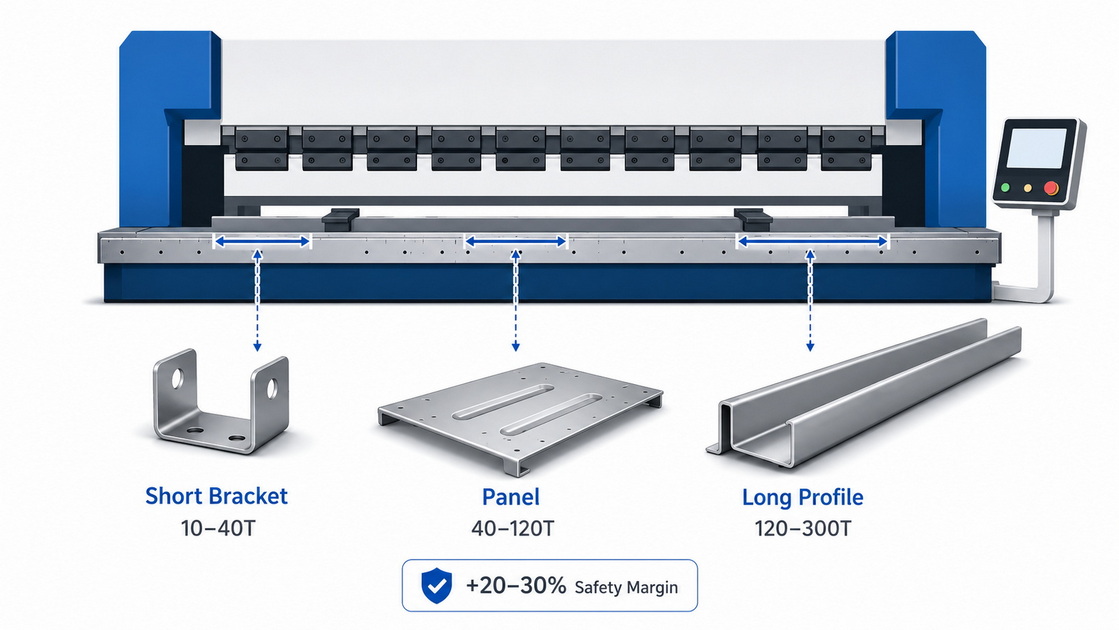
Tonnage is the bending force the machine can apply, and it must be calculated for the specific material, thickness and die opening you intend to use. [accurl]
Modern practice combines:
- A proven tonnage formula or an online tonnage calculator. [accurl]
- A 20–30% oversizing margin to account for variability in material properties and avoid operating at the absolute limit of the machine. [popai-global]
Typical tonnage calculation follows:
- Determine tonnage per unit length based on material and thickness. [accurl]
- Multiply by the bending length to get total required tonnage. [accurl]
An important expert caveat—highlighted in Vicla's guidance—is not confusing total force for a specific part with tons per meter for a given thickness and die combination; mixing these values is one of the most common misjudgments in shop planning. [thefabricator]
Beyond tonnage and length, clearance and stroke length determine whether you can actually remove the bent part and accommodate deep boxes or tall flanges. [popai-global]
- Clearance is the front opening of the press brake, impacting how easily parts can be inserted and removed. [popai-global]
- A larger stroke length allows deeper intermediates and easier extraction of complex bent parts. [popai-global]
Material thickness and type are equally critical: a ductile material like aluminum will bend with less force and different springback characteristics than stainless or high‑strength steel. As Vicla notes, understanding material behavior is essential for choosing both the press brake and the correct bending parameters. [thefabricator]
Once the capacity envelope is clear, you can evaluate press brake technologies—mechanical, hydraulic, servo, hybrid, and CNC—against your production mix and operator skills. [adhmt]
Vicla's overview of machine types reflects the diversity on the market: [thefabricator]
- Mechanical press brakes – Basic, affordable, but less precise and harder to control in modern high‑tolerance work. [popai-global]
- Hydraulic press brakes – The current workhorse, balancing power, precision and versatility with hydraulic rams. [popai-global]
- Pneumatic press brakes – Quieter, faster for light‑duty work but limited in force. [popai-global]
- Servo and CNC press brakes – High precision machines driven by servo motors and numerical control, suitable for complex and high‑volume bending. [ruchengmachinery]
- Hybrid press brakes – Combine hydraulic power with electric motor precision, ideal when both high force and fine control are required. [adhmt]
For OEM and ODM production, CNC press brakes and modern hybrid systems are typically preferred because they support repeatable setups, offline programming, and integration with CAD/CAM workflows. Manufacturers like CNDY‑Press and Vicla increasingly supply such machines with advanced controls, automatic tool changers and angle measurement systems as standard or optional features. [ruchengmachinery]
Advanced features only add value if your team can use them. Vicla explicitly warns that complex press brakes require skilled operators, and that training time and maintenance must be weighed against added capabilities. [pressbrakeguide]
From experience, I recommend:
- Documented training plans for new CNC press brake installations. [adhmt]
- Clear separation of roles: programming specialists, setup technicians, and operators. [canadianmetalworking]
- Use of simulation and test bends to build confidence before full production. [ruchengmachinery]
Configuring a CNC press brake is not only about the machine; it's also about how quickly and accurately you can change tooling and set up jobs. [thefabricator]
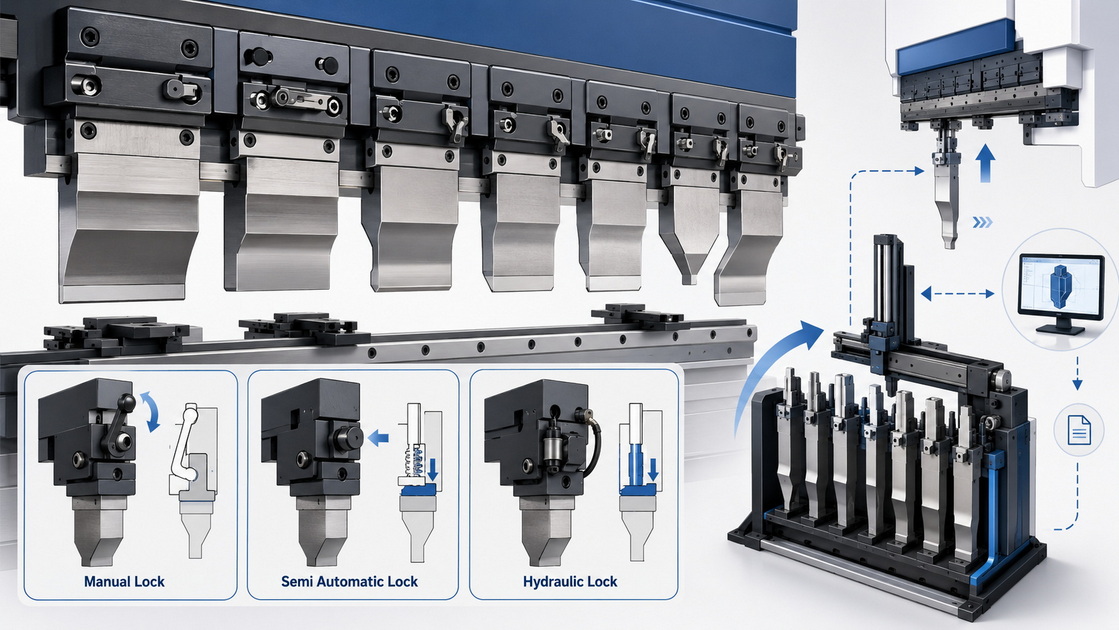
Intermediates are adaptors installed between the beam and punches to allow deep box structures and flexible tool positioning. Tool locking systems include: [popai-global]
- Manual locks
- Semi‑automatic locks
- Pneumatic blocks
- Hydraulic locks
The choice of locking system has a direct impact on setup time and ergonomic safety. Semi‑automatic locks, with rapid front locking/unlocking, significantly speed up re‑equipment compared with fully manual systems. Hydraulic and pneumatic locks, in turn, enable safe, automated alignment and fastening for high‑mix shops. [thefabricator]
A distinctive strength of modern CNC press brakes is automatic tool change, supported by dedicated tool warehouses and CNC integration. [adhmt]
Vicla illustrates such a system for hybrid press brakes:
- Automatic equipping of upper and lower tools, including wider V‑dies and special rod‑holding tooling. [popai-global]
- Tool rotation by 180° and multi‑station equipping without manual intervention. [popai-global]
- Setup times reduced by four to five times compared with manual tooling. [popai-global]
In advanced implementations, CAD/CAM systems process 3D part files, generate optimal bending cycles, and send programs to the machine, which then configures tooling automatically and logs all data back to a central system for Industry 4.0 analysis. This workflow is particularly valuable for manufacturers like CNDY‑Press whose customers operate in high‑mix, low‑volume environments and need to minimize non‑productive time. [thefabricator]
Back gauge systems, references and sheet supports determine how reliably you can position parts for repeat bends. [ruchengmachinery]
The back gauge is a motorized structure that moves along:
- Axis X – depth of the machine (front‑to‑back positioning). [popai-global]
- Axis R – vertical lifting of the gauge fingers. [popai-global]
Vicla uses independent tower gauges equipped with LED visual stops; when the LED lights, the sheet has reached the reference. In more accessorized versions, towers may be: [popai-global]
- Motorized (axes Z1–Z2) along the length of the bed. [popai-global]
- Independent (axes X2–X3) for complex part geometries. [popai-global]
- Anthropomorphic (axes R1–R2) for varied height and movement patterns. [popai-global]
Thin sheets benefit from front supports and carefully designed references. [ruchengmachinery]
Vicla notes:
- Pneumatic front references with Teflon coating to prevent marks on material, controlled by CNC along the Z axis. [popai-global]
- Front sheet supports on linear guides with adjustable height, lateral sliding and rotation, featuring quick clamp/release systems. [popai-global]
Metal sheet bending followers can lift weights up to 380 kg, reducing operator risk and improving part quality by preventing counter‑bend effects; these can be moved between machines for flexible use. Such accessories, when correctly configured, are essential in safety‑critical OEM work and heavy‑gauge bending. [pressbrakeguide]
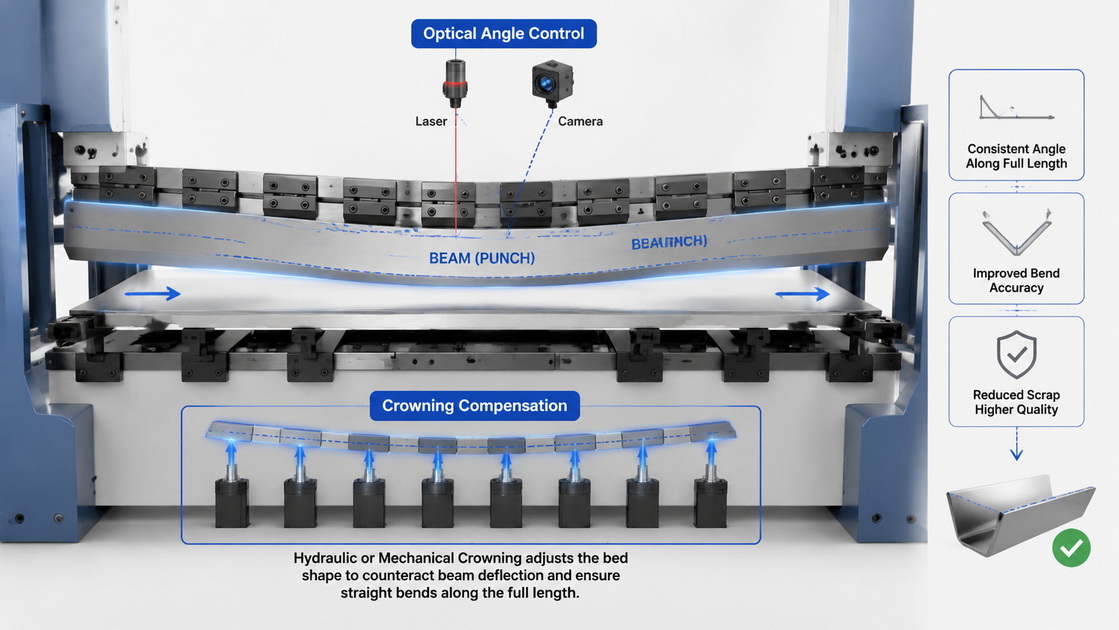
Longer press brakes face greater structural deformation under load, making crowning and angle control systems vital for high‑accuracy bending. [adhmt]
Traditional crowning systems relied on manual shims or pre‑set mechanical/hydraulic compensation based on theoretical calculations. Vicla's Clever Crowning system goes further: [popai-global]
- Sensors in the beams measure deformation in real time. [popai-global]
- CNC interpolates pressure data from cylinders and dynamically adjusts crowning to compensate. [popai-global]
This addresses not only the familiar beam crowning (bending of the beam pushed by side cylinders) but also the less known "yawn" effect—the tendency of frames to open in the throat zone under high load. In practice, active crowning systems significantly reduce angle variation across long parts and cut down on manual correction. [canadianmetalworking]
Angle control technologies include both probe‑based and optical systems. [adhmt]
Vicla's analysis points out limitations of tool‑inserted probes:
- Difficult installation and reliance on special punches and dies. [popai-global]
- Limited versatility when tools are changed. [popai-global]
- Fragility due to small mechanical elements exposed to dust, impacts and wear. [popai-global]
Optical angle control (O.A.C.) systems instead use laser beams and cameras to measure bending angles:
- A laser projects onto the sheet surface.
- Cameras detect elastic recovery during deformation.
- CNC sets corrections automatically to achieve desired angles. [popai-global]
The IRIS PLUS system is cited as a sophisticated solution that measures angles during bending from a safe distance, avoiding interference between parts and sensors. Accuracy is high—fractions of a degree—provided emitter and receiver remain within a certain distance and optical noise is controlled. [adhmt]
Critically, angle control systems deliver maximum value when integrated tightly with the CNC and robust machine mechanics, allowing self‑learning of elastic recovery for specific material batches. This reduces manual measurement, boosts productivity and stabilizes quality over time. [canadianmetalworking]
Energy cost and machine wear are now central considerations in press brake configuration. [yanglipress]
Vicla's hybrid concept emphasizes that simply adding an inverter does not make a machine truly hybrid; instead, intelligent hydraulic architectures are required: [popai-global]
- Standard hybrid – Dual hydraulic circuits with independent tanks, motors, pumps and inverters, allowing optimized control per cylinder and reduced wear. [popai-global]
- Hybrid Plus – Brushless motors for each cylinder with high forces and speeds, using compact direct‑drive motor‑pump units and reduced piping. [popai-global]
These systems concentrate efficiency on the active side of the machine, automatically balancing working pressure based on the part being bent. Practical benefits include lower energy consumption, less heat in hydraulic circuits, and extended component life—important for shops running multiple shifts. [yanglipress]
Beyond core configuration, a number of optional accessories directly improve safety, ergonomics and uptime. [pressbrakeguide]
Key examples from Vicla's lineup: [popai-global]
- Bending flattening table – Integrated in the die holder to perform flat hem bends without dedicated dies, useful in shops with frequent hems. [popai-global]
- Side parking – Extended linear guides to park sheet supports when not in use, keeping the workspace clear. [popai-global]
- Wireless 2‑pedal foot switch – Solar‑powered for extended autonomy, eliminating cables and using ultrasonic sensors to transmit data wirelessly. [popai-global]
- Tool locator with LEDs – Visual indication of correct locking position and active tool location, reducing operator guesswork and speeding setup. [popai-global]
From a UX standpoint on the shop floor, these small innovations compound to reduce cognitive load and physical strain on operators. [pressbrakeguide]
Manufacturers such as CNDY‑Press operate at the intersection of design, manufacturing and integration for CNC press brakes and sheet‑metal processing lines, often serving customers with diverse OEM and ODM projects. [ruchengmachinery]
In typical practice, such companies:
- Help customers map required bending length, tonnage and stroke against part families and future product plans. [thefabricator]
- Configure back gauge axes, crowning, angle control and tool locking systems to match the shop's mix and desired setup speed. [canadianmetalworking]
- Integrate CNC controls with CAD/CAM and, where appropriate, automatic tool change and Industry 4.0 data flows. [adhmt]
For buyers, working with a press‑brake manufacturer that understands both mechanical design and digital workflows simplifies the journey from machine purchase to stable, repeatable production. [ruchengmachinery]
1. How much extra tonnage should I plan beyond my calculated requirement?
Most experts, including Vicla, recommend oversizing press brake capacity by 20–30% to account for batch‑to‑batch material variation and to avoid operating at the machine's maximum limit. [accurl]
2. Do I really need optical angle control, or are probes enough?
Probes can work in stable, low‑mix environments but suffer from installation complexity and fragility. Optical systems like IRIS PLUS offer higher versatility, real‑time measurement and less interference with tooling, making them better suited to modern mixed‑material shops. [adhmt]
3. How do hybrid press brakes reduce energy consumption?
Hybrid architectures use dedicated hydraulic circuits and, in some models, brushless motors with direct‑drive pumps to apply power only where needed, minimizing idle energy use and heat generation. [yanglipress]
4. What is the role of CAD/CAM in press brake configuration?
CAD/CAM systems convert 3D part files into bending sequences, select tooling, and send programs and setup data to the CNC, enabling automatic tool change and consistent execution across jobs. [canadianmetalworking]
5. How should I organize tooling to reduce setup time?
Industry guidance suggests grouping tools either by material thickness or job type and applying 5S principles at the press brake. Combined with semi‑automatic or hydraulic locks, this significantly cuts setup and search time. [thefabricator]
1. Vicla. "How do I choose a press brake?" (Optionals And Accessories On Press Brakes). Available at: [popai-global]
2. Press Brake Guide. "Press Brake Setup Guide for Beginners". Available at: [pressbrakeguide]
3. Rucheng Machinery. "How to Set Up a Press Brake: Tooling, Back Gauge & First Bends". Available at: [ruchengmachinery]
4. Rucheng Machinery. "How to Operate a CNC Press Brake: Step‑by‑Step Guide (2026)". Available at: [ruchengmachinery]
5. The Fabricator. "Using Proper Press Brake Setup Procedures". Available at: [thefabricator]
6. Canadian Metalworking. "4 Steps to Better Press Brake Management". Available at: [canadianmetalworking]
7. ACCURL. "Press Brake Parameters: Bending, Tonnage Tooling and More". Available at: [accurl]
8. ADH Machine Tool. "Press Brake Tips and Tricks: Disciplined Setups for Accurate Bending". Available at: [adhmt]
9. YangLi Group. "6 Essential Tips for Improving Press Brake Setup Time". Available at: [yanglipress]


