


Views: 246 Author: CNDY-Press Publish Time: 2026-07-14 Origin: Site


Content Menu
● How backgauges influence production lead time
>> What a manual backgauge actually means in practice
>> What a CNC controlled backgauge changes
● Manual vs. CNC backgauge – core differences at a glance
● The production lead time equation
>> Cycle time and motion efficiency
● Impact on quality, scrap, and rework
>> Manual backgauge: quality is only as good as your best operator
>> CNC backgauge: digital repeatability
● Operator skill, ergonomics, and labor utilization
>> Manual systems: locking expertise into the machine
>> CNC systems: upskilling the whole team
● When a manual backgauge still makes sense
● When a CNC controlled backgauge is the clear winner
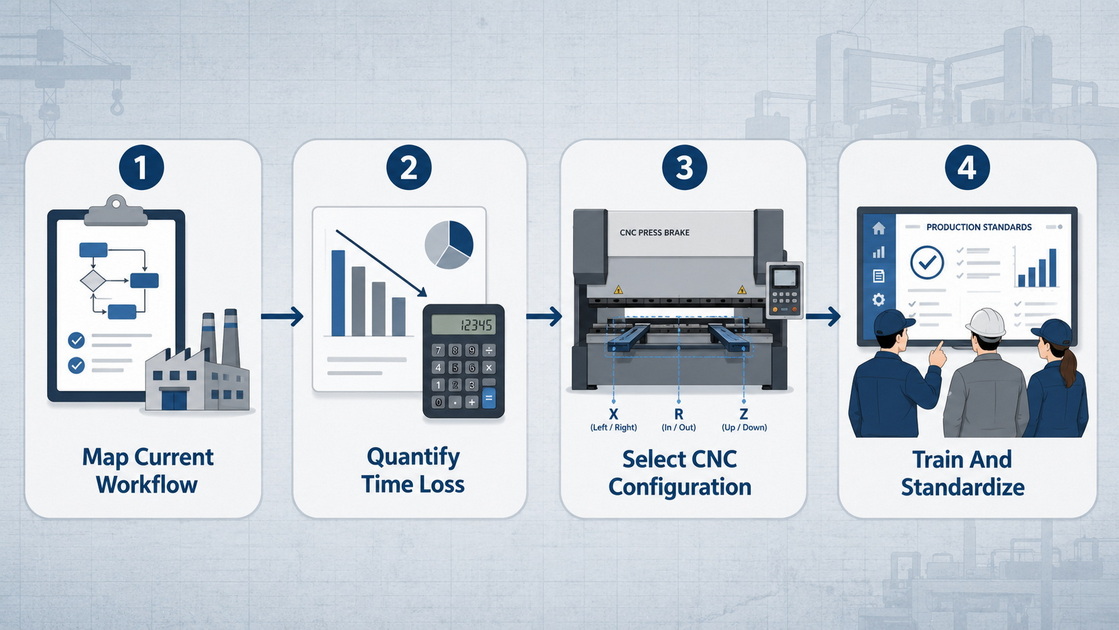
● Practical implementation roadmap – moving from manual to CNC backgauging
>> Step 1 – Map your current bending workflow
>> Step 3 – Choose the right CNC backgauge configuration
>> Step 4 – Train and standardize
● How OEM CNC press brake manufacturers like CNDY‑Press can help
● FAQ
Manual backgauges can work for simple, low‑volume bending, but a CNC controlled backgauge almost always wins when your priority is shorter, more predictable production lead times and stable quality. [canadianmetalworking]
In modern sheet metal fabrication, backgauging is no longer just an accessory on the press brake; it is the bottleneck or accelerator for your entire bending workflow. As an OEM manufacturer of CNC press brakes and complete sheet metal lines, CNDY‑Press sees the same pattern repeatedly when we audit customer shops: manual backgauges tie up experienced operators, while CNC controlled backgauges unlock faster setups, shorter queues, and much more consistent throughput. [cndypress]
From my perspective as a bending process engineer turned consultant, the real question for any production manager is not "Which backgauge is cheaper?" but "How many minutes per shift am I losing every time we re‑set a manual gauge, and what does that do to our promised lead times?"

A manual backgauge typically uses mechanical stops or hand‑wheel adjustments with analog scales. The operator measures, moves the gauge fingers by hand, then runs a test bend and fine‑tunes until the flange length is within tolerance. [canadianmetalworking]
In daily production, that translates into:
- Frequent manual measuring and re‑measuring
- Trial bends for each new part or batch
- Heavy reliance on the most experienced operator's "feel"
- Longer changeovers between jobs, especially in high‑mix environments [canadianmetalworking]
For simple parts and long runs, this can be acceptable, but as part variety increases, manual backgauge adjustments become a major drag on throughput.
A CNC controlled backgauge ties the gauge axes (X, R, sometimes Z1/Z2 and X1/X2) directly into the press brake's controller. Instead of hand‑adjusting, the operator loads or recalls a program, and the backgauge automatically moves to each position for every bend step. [weiyamt]
This delivers:
- Digital positioning with servo drives and encoders
- Fast, repeatable re‑positioning across multiple bends
- Stored programs for recurring parts, cutting setup time dramatically
- Lower dependence on operator "memory" and physical templates [lzkcnc]
Independent tests and vendor case studies often show setup time reductions of 30–40% and noticeable improvements in overall machine utilization after upgrading to CNC backgauges. [alpha-cnc]
| Aspect | Manual Backgauge | CNC Controlled Backgauge |
|---|---|---|
| Positioning method | Hand‑wheel, manual stops, visual scales (canadianmetalworking) | Servo or motorized axes via CNC controller (cnhawe) |
| Setup time per new part | High, depends on operator measuring and test bends (canadianmetalworking) | Low, program recall and automatic positioning (lzkcnc) |
| Repeatability | Operator‑dependent, more variation | High repeatability (often ≤ ±0.02–0.05 mm) (cnhawe) |
| Suitable batch profile | Simple parts, long runs, low mix | High mix, short runs, complex multi‑bend parts (weiyamt) |
| Impact on lead time | Longer, less predictable | Shorter, more stable and plannable (weiyamt) |
| Training demands | Requires highly skilled operators | Easier for mid‑skill operators to achieve quality (weiyamt) |
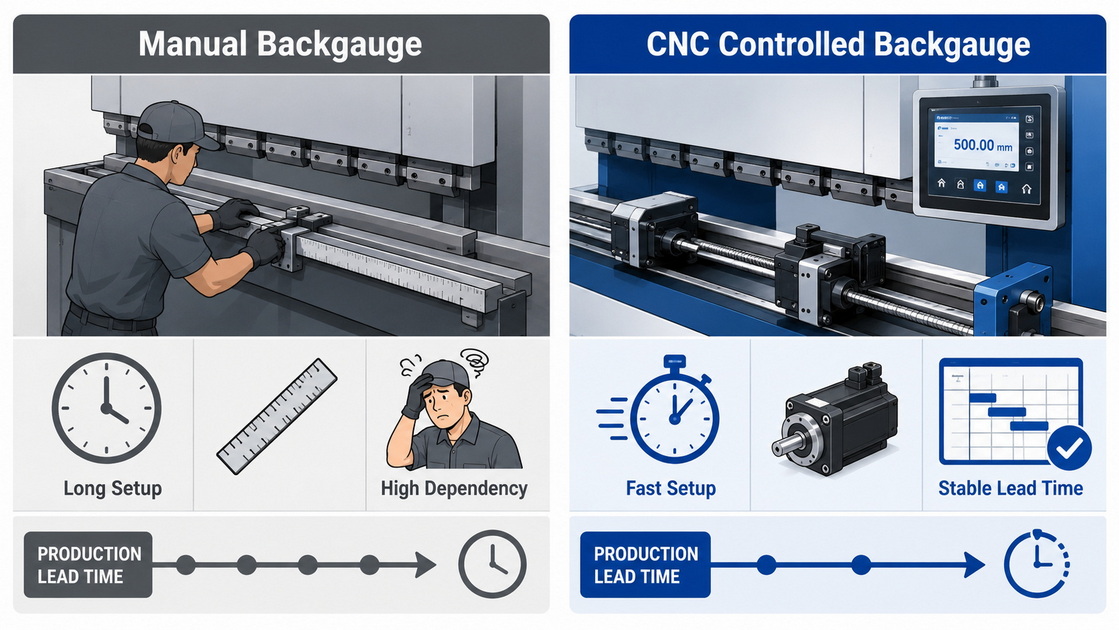
From a practical plant‑floor perspective, production lead time for bending is driven by four main components:
1. Setup time per job – positioning gauge, tooling, first‑article checks
2. Cycle time per part – bending movement plus repositioning time
3. Changeover frequency – how often you switch between parts or batches
4. Rework and scrap – extra time due to bad bends and adjustments [adhmt]
A CNC controlled backgauge impacts all four.
In a manual backgauge environment, every new part requires manual repositioning and verification. In contrast, with a CNC backgauge you: [canadianmetalworking]
- Recall an existing program or load a new one from CAD/CAM
- Let the CNC automatically move to each bend position
- Run a first article mainly to confirm material variability, not gauge positioning [weiyamt]
On high‑mix, low‑volume production, this can cut setup time by 30–50% per job according to multiple press brake technology reports. When you have 20–50 changeovers per shift, the saved minutes accumulate into hours and days shaved off real lead times. [adhmt]
Manual backgauges usually require the operator to:
- Step away from the foot pedal
- Move the sheet against the stop
- Visually confirm position
- Sometimes re‑measure with a tape or gauge [canadianmetalworking]
CNC systems:
- Position the backgauge fingers at high speed between bends
- Allow multi‑step programs to run with minimal operator repositioning
- Synchronize with ram movement to optimize cycle time [alpha-cnc]
The net effect is faster part flow and more parts per hour at similar or better quality.
With manual backgauging, dimensional accuracy and flange length consistency depend heavily on:
- Operator experience
- Fatigue and concentration over long shifts
- How carefully each stop is set and locked [canadianmetalworking]
This often leads to:
- Higher scrap rates, especially for tight‑tolerance parts
- More rework, adding hidden hours to lead time
- Difficulty maintaining consistent quality across shifts
Modern CNC backgauges use servo motors, ball screws and linear guides to achieve high repeatability (often down to ±0.02–0.05 mm on the X axis). Combined with angle compensation, material libraries and automatic crowning on advanced CNC press brakes, this allows: [cnhawe]
- Stable bending dimensions across large batches
- Lower scrap and rework
- Easier quality planning and documentation [cnhawe]
From a lead‑time point of view, less rework means fewer surprises and more confidence in promised delivery dates.
Manual backgauge setups force your best operators to spend precious time on:
- Measuring distances
- Adjusting mechanical stops
- Running trial parts and making corrections
This means highly paid, highly skilled staff are under‑utilized, acting as gauges rather than process controllers.
A CNC backgauge lets you:
- Encode best practices into programs rather than individuals
- Allow mid‑skill operators to run complex parts accurately
- Reassign senior operators to higher‑value tasks like process optimization and training [weiyamt]
In practice, this often reduces scheduling stress and contributes indirectly to shorter and more reliable production lead times because you are less constrained by "only one person can run that job".
From an expert's perspective, manual backgauges are not obsolete; they are just niche tools now.
A manual backgauge can still be appropriate if:
- You run very simple geometries with long, repeat runs
- Part tolerances are relatively loose
- You have low changeover frequency and long batches
- Budget constraints are strict and labor cost is low
In these scenarios, the incremental lead‑time improvement from CNC may not justify the investment immediately. But as soon as you move toward high‑mix production, frequent engineering changes, or tighter delivery commitments, manual backgauges become a constraint rather than an asset. [raymaxmachine]
CNC backgauges provide a strong ROI in environments with:
- High product mix and frequent short runs
- Demanding customers requiring tight delivery schedules
- Limited availability of very experienced press brake operators
- Integration needs with upstream CAD/CAM and ERP systems [adhmt]
Industry guides on NC vs. CNC press brakes consistently show that for high‑mix fabrication, CNC machines outperform older configurations on setup time, scrap, and long‑term cost per part. [raymaxmachine]
- Identify the number of changeovers per shift
- Log average setup time for each batch on manual backgauges
- Track scrap/rework percentages and re‑bend time
Use this simple calculation:
1. Extra setup time per job (manual vs. CNC)
2. Multiply by average jobs per day and working days per year
3. Convert hours into cost and capacity (how many extra orders you could ship)
Many fabricators discover that time saved per year not only covers the CNC investment but also frees capacity for new business. [adhmt]
- For standard parts: X and R axes
- For complex parts: add Z1/Z2, X1/X2, possibly delta X
- Ensure controller memory, material libraries, and offline programming support [cnhawe]
- Create standard setup procedures and naming conventions for programs
- Train operators on reading digital bend sequences
- Regularly review and optimize bending programs based on production feedback [weiyamt]
As an OEM with a focus on CNC press brakes, fiber laser cutting machines and integrated sheet metal lines, CNDY‑Press designs backgauge systems and control solutions for both new installations and upgrades. [cndypress]
From working with OEM and ODM clients in different regions, we see three recurring needs:
- Balanced configurations: Choosing the right number of backgauge axes so you don't over‑ or under‑spec the machine
- Application‑specific software: Bending databases and programs tuned for local standards and typical parts
- Flexible customisation: Machine frame size, backgauge travel, safety devices and HMI language tailored to the customer's own brand and market [cndypress]
This is where a flexible OEM like CNDY‑Press can align machine design with your exact product mix and target lead times instead of forcing you into a one‑size‑fits‑all configuration.
1. Can I retrofit a CNC controlled backgauge onto an existing manual press brake?
In many cases, yes; retrofit kits can add CNC control to the backgauge, though mechanical condition and control architecture of the original machine are key limiting factors. [cnhawe]
2. How much can a CNC backgauge reduce setup time?
Industry case studies commonly report 30–40% reductions in setup time and significant improvements in machine utilization after implementing CNC backgauges. [lzkcnc]
3. Does a CNC backgauge always require high‑end multi‑axis configurations?
Not necessarily; for many shops an X R configuration is a strong starting point, adding Z1/Z2 or X1/X2 only when your parts demand more complex positioning. [alpha-cnc]
4. How does a CNC backgauge interact with offline programming?
Offline programming generates bend sequences and backgauge positions that can be loaded directly into the CNC controller, further reducing on‑machine setup time and programming errors. [weiyamt]
5. What is the biggest hidden cost of staying with manual backgauges?
The largest hidden cost is usually lost capacity and extended lead times caused by long changeovers, operator dependency and rework, which reduce the number of sellable parts you can ship per week. [adhmt]
1. Canadian Metalworking. "Press Brake Backgauging." Available at: [canadianmetalworking]
2. ADH Machine Tool. "NC Press Brake vs CNC Press Brake: True Cost, Setup Time, and Long-Term ROI." 2026. Available at: [adhmt]
3. CNDY‑Press. "China CNC Press Brake, Bending Machine, Laser Cutter Manufacturer & Supplier." 2026. Available at: [cndypress]
4. WEIYA Machine. "Press Brake Backgauge Systems – Precision Bending and CNC Integration Explained." 2025. Available at: [weiyamt]
5. RAYMAX. "New Trends in Press Brake Design and Functionality." 2025. Available at: [raymaxmachine]
6. CNDY‑Press. "Best CNC Press Brake Manufacturers in 2026 – An Expert Buyer's Guide for OEM & ODM Projects." Available at: [cndypress]
7. HAWE CNC. "CNC Press Brake Back Gauge Features That Make Bending Easier." 2025. Available at: [cnhawe]
8. ADH Machine Tool. "Mastering the Press Brake Backgauge: Eliminating Setup Errors." 2026. Available at: [adhmt]
9. Alpha CNC. "Hydraulic Press Brake Backgauge System – Precision Control for High Accuracy Bending." 2026. Available at: [alpha-cnc]
10. LZK CNC. "How Does the Backgauge System in a Hydraulic CNC Press Brake Improve Bending Precision?" 2025. Available at: [lzkcnc]


