


Views: 239 Author: CNDY-Press Publish Time: 2026-10-26 Origin: Site


Content Menu
● Small Press Brake vs Large Press Brake at a Glance
● 1. Separate Machine Size From Production Capacity
>> A Large Machine Is Not Automatically Faster
>> A Small Machine Is Not Necessarily Low Volume
● 2. Define the Part Envelope Before Comparing Machines
>> Bending Length Is Only One Dimension
>> Avoid Buying Around a Vague Future Requirement
● 3. Match Tonnage to the Actual Bending Operation
>> Do Not Compare Thickness Ratings Without Their Assumptions
>> More Machine Force Does Not Remove Tooling Limits
● 4. Convert Production Volume Into Required Hours
● 5.High Volume Does Not Necessarily Require a Large Press Brake
>> What Could Change the Decision?
● 6. Setup Time Can Matter More Than Machine Size
>> Evaluate Setup Improvements First
● 7. One Large Press Brake vs Two Smaller Machines
● 8. Automation Should Follow Part Suitability
● 9. Compare Cost per Accepted Part
>> Do Not Assume Energy Use From Size Alone
>> Use a Like-for-Like Comparison
● Buying Capacity for the Wrong Bottleneck
● A Practical Supplier Trial and Acceptance Plan
● How CNDY-Press Can Support Machine Selection
● FAQ
>> 1. How Many Parts per Day Can a Small Press Brake Produce?
>> 2. Can a Large Press Brake Bend Small Parts Accurately?
>> 3. Should We Add a Fixed Tonnage Margin?
>> 4. When Are Two Smaller Machines Better Than One Large Machine?
>> 5. What Evidence Should Support a Productivity Guarantee?
Choosing a small press brake vs large press brake is not simply a matter of matching a higher production volume with a bigger machine. Machine size determines which parts you can bend. Production capacity depends on how efficiently the complete bending process operates.
A compact CNC press brake may be an excellent choice for thousands of small brackets. A large press brake may be necessary for a relatively small order of long panels. Neither case is unusual.
My starting point is throughput: how many acceptable parts can the proposed production system deliver within the available time?
This guide explains how to evaluate machine dimensions, bending force, setup time, handling, and investment cost before committing to a press brake.
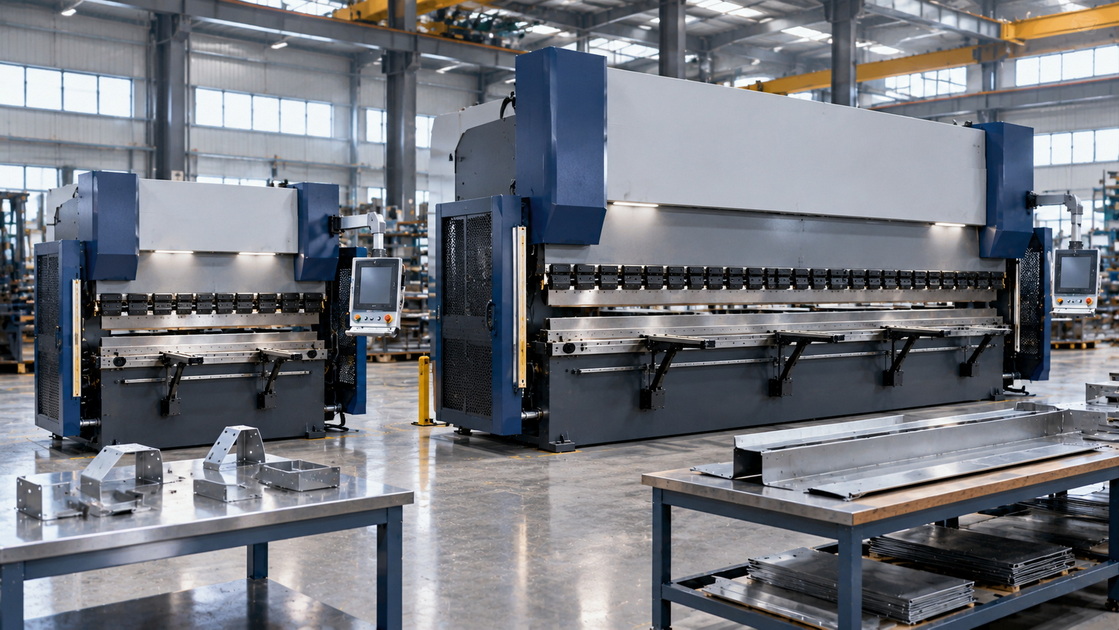
"Small" and "large" are relative descriptions, not standardized capacity classes. Compare actual specifications rather than relying on the product label.
| Selection Factor | Small Press Brake | Large Press Brake |
|---|---|---|
| Typical application | Compact components and shorter bends | Longer parts, heavier work, or larger working envelopes |
| Production advantage | Can support efficient small-part handling | Accommodates work beyond a compact machine’s geometry |
| Main limitation | Force, bending length, and available clearance | Space, handling requirements, and potentially higher ownership cost |
| High-volume potential | Strong when cycle and setup suit the part | Strong when the product and workflow justify the equipment |
| Automation | Possible with suitable parts and equipment | Possible with suitable handling and integration |
| Main purchasing risk | Underestimating future part requirements | Paying for capacity that does not improve output |
The objective is not to purchase the largest machine affordable. It is to purchase the production capability the business can use.
Press brake selection involves two different questions:
1. Can the machine produce the required part?
2. Can the production system produce enough of those parts?
The first question concerns force, geometry, tooling, and accuracy. The second concerns time, staffing, availability, and process organization.
A larger bed or higher tonnage does not independently reduce setup, loading, repositioning, inspection, or unloading time.
For small components, a compact machine may offer favorable handling and ergonomics. For large components, the limiting factor may be sheet support or manipulation rather than ram movement.
Commercial compact bending systems can support manual production and automation.
Their suitability depends on the actual parts, gripper access, tooling, cycle sequence, and replenishment requirements—not simply their footprint.
Start with representative drawings and a realistic future product list.
Record:
- Material grade and tensile-strength range.
- Thickness.
- Longest bend.
- Largest blank dimensions.
- Finished part geometry.
- Required radius and flange dimensions.
- Dimensional and angular tolerances.
- Surface-marking restrictions.
A part can fit along the bed and still be impossible to complete.
Check daylight, stroke, throat depth, distance between uprights, backgauge travel, and tooling height.
Review the complete bend sequence. Previously formed flanges may collide with tooling or machine structures during later operations.
"Something larger may arrive next year" is not an adequate specification.
Identify likely future parts, expected demand, and the cost of alternative production arrangements. Otherwise, a hypothetical order can drive an oversized investment.
Required bending force depends on material strength, thickness, bend length, die opening, and forming method.
Air bending, bottoming, and coining should not be treated as interchangeable calculations.
A supplier's statement that a machine bends a certain thickness is incomplete without the material, length, tooling, and method.
Request a calculation for the actual part and confirm it against machine and tooling limits.
Also distinguish metric tonnes-force from US short tons when comparing quotations.
A short tool segment can reach its permitted loading before the machine reaches its total capacity.
Check the punch, die, holders, and permitted concentrated or off-center machine loading. Ask the supplier to document the limiting component.
This is particularly important when bending short, thick brackets on a much larger press brake.
Monthly part quantities alone can conceal workload.
A component with six bends and several repositioning steps may consume more machine time than a simpler component produced in greater quantities.
Use:
Required time=Setup time+Production time+Other planned activities
A useful production-time estimate is:
Production time=Required good quantity×Measured time per good part
If the measured time excludes scrap, rework, or interruptions, account for those separately.
Include:
- Loading.
- Positioning.
- Bending.
- Reorienting the part.
- Unloading.
- Routine checks.
Do not substitute maximum ram speed for demonstrated part-cycle time.
Machine motion is only one portion of the process.
Consider an illustrative order for 3,000 small brackets per week.
Assume a representative trial establishes a 30-second cycle per completed part, including routine handling but excluding batch setup.
Production requires 25 hours.
If the schedule includes ten setups lasting 15 minutes each, setup adds 2.5 hours. Total planned demand is therefore 27.5 hours before any additional allowance.
Suppose the shop independently establishes 32 usable hours per week for this work after accounting for other commitments.
The workload may fit a compact machine—provided that force, geometry, quality, and staffing requirements are satisfied.
A larger machine would not automatically improve the result.
The conclusion changes if:
- Actual cycles are slower than the trial.
- Changeovers are more frequent.
- Material presentation creates delays.
- Inspection requires additional machine occupancy.
- Demand variability consumes the remaining capacity.
These figures are hypothetical planning inputs, not supplier performance claims.
For high-mix production, frequent changeovers can dominate the schedule.
Consider 20 batches requiring 20 minutes of setup each. That represents 6 hours and 40 minutes of setup time.
Reducing each setup to 10 minutes saves 3 hours and 20 minutes without changing bending speed.
Potential improvements include:
- Quick-change tooling and clamping.
- Offline programming.
- Standardized tool layouts.
- Stored setup information.
- Better material staging.
- First-piece inspection planning.
TRUMPF and Bystronic both discuss setup reduction and tooling changes as important productivity opportunities.
However, advertised productivity improvements should not be applied to a project without a representative trial.
Grouping jobs by tooling can reduce changeovers.
Balance that benefit against delivery dates, work-in-progress, and scheduling flexibility. A long production batch is not automatically efficient if it delays urgent orders.
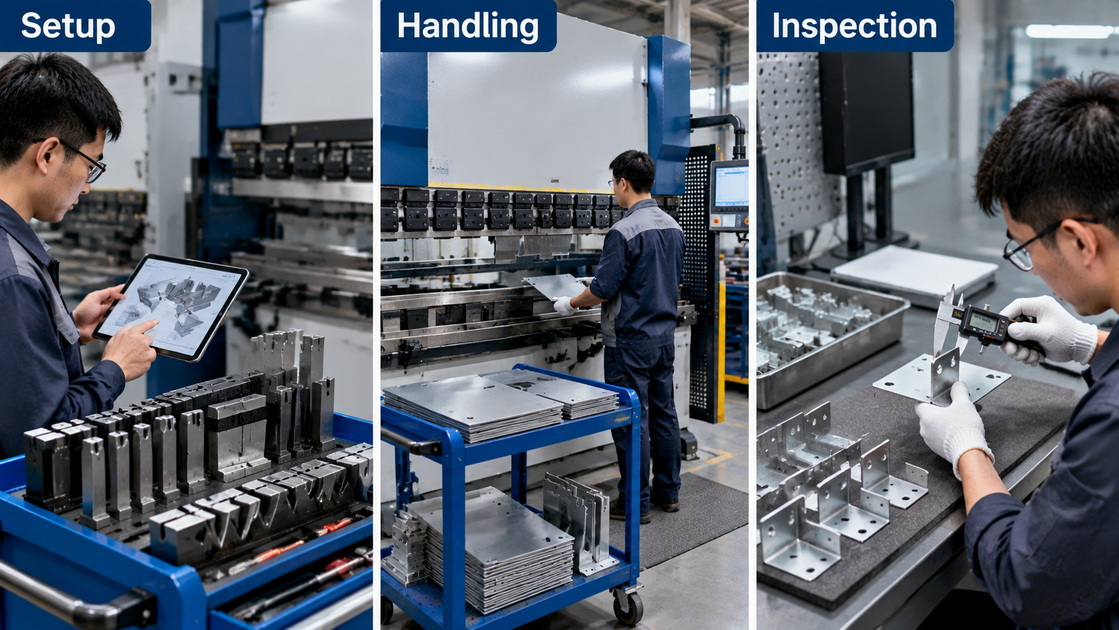
Two smaller machines can sometimes support parallel work, separate product families, and reduce competition for a shared resource.
One large machine may be preferable when the product mix requires its working envelope or when duplicating supporting resources would be inefficient.
| Decision Area | One Larger Machine | Two Smaller Machines |
|---|---|---|
| Long-part capability | Potentially available | Not automatically equivalent |
| Parallel production | One primary resource | Possible with appropriate staffing |
| Maintenance interruption | Can affect the shared resource | Some work may continue elsewhere |
| Supporting resources | Concentrated | May require duplicated tooling and utilities |
| Scheduling | Centralized | Can separate product families |
| Floor planning | One larger installation | Two working and safety zones |
Two independent machines are not a substitute for an engineered tandem press brake.
Also verify whether the business has enough operators, tooling, and upstream supply to benefit from parallel capacity.
Automation is not reserved exclusively for very large batches.
Modern systems can support smaller series, but economic performance depends on programming, changeovers, gripper compatibility, and material handling.
Before selecting an automated cell, request a review of:
1. Part geometry and gripping surfaces.
2. Loading and unloading.
3. Regripping requirements.
4. Tool changes.
5. Inspection strategy.
6. Recovery from interruptions.
7. Expected unattended operation.
A larger press brake with an unsuitable handling system can be less productive than a smaller, well-matched cell.
Purchase price is only one ownership cost.
Include installation, tooling, safeguarding, utilities, service, training, labor, and any required lifting or handling equipment.
Drive technology, hydraulic operation, idle time, duty cycle, and actual workload influence energy use.
Request energy information under defined conditions. A smaller machine is not automatically more economical for every job, and a large machine is not necessarily inefficient whenever it is idle.
Compare candidate machines using the same:
- Part.
- Material.
- Tooling requirements.
- Quality criteria.
- Shift pattern.
- Labor assumptions.
- Cost period.
Then assess cost per accepted part, rather than cost per nominal ton of machine capacity.
A faster press brake cannot solve every production delay.
If blanks arrive late, operators wait for drawings, or inspection stops the process, additional bending capacity may remain unused.
Map the current workflow before purchasing.
Record waiting, setup, handling, processing, and rework separately. The investment should address the constraint that actually limits delivery.
This is often a more valuable exercise than comparing catalog bending speeds.
Ask shortlisted suppliers to process representative easy, difficult, and high-volume parts.
Agree on:
- Material and tooling.
- Setup starting condition.
- Cycle-time boundaries.
- Number of repeated parts.
- Measurement method.
- Permitted adjustment.
- Acceptance tolerances.
- Safety verification.
Evaluate finished-part consistency, not only controller positioning specifications.
For long parts, review deflection compensation and angle consistency across the bend. For small parts, assess handling and safe access.
Separate factory acceptance from installation and site acceptance responsibilities.
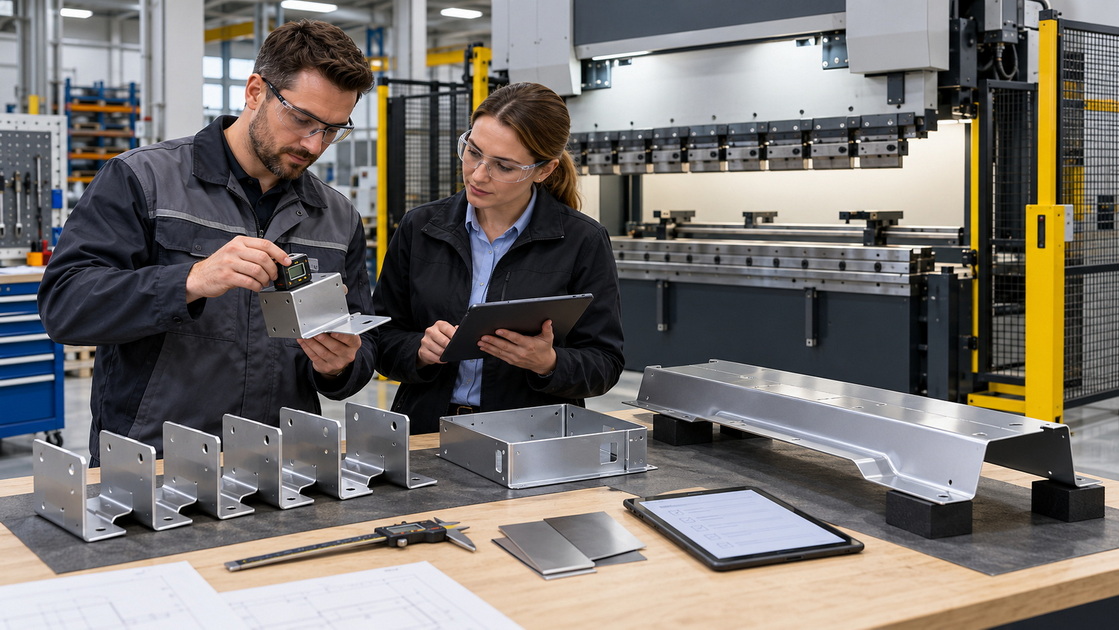
CNDY-Press states that it develops, manufactures, sells, and services sheet-metal processing equipment, including CNC press brakes.
Its published company information also describes OEM, ODM, and customized manufacturing services.
For a meaningful proposal, provide:
- Representative drawings.
- Weekly quantities and batch sizes.
- Material specifications.
- Existing cycle and setup data.
- Available floor space.
- Destination electrical requirements.
- Automation and branding requirements.
Request a comparison of technically suitable configurations—not simply a recommendation for the highest-capacity machine.
Confirm feasible customization, tooling, testing, service scope, and delivery milestones in writing.
Choose a small press brake when it meets the part envelope and delivers the required output efficiently.
Choose a large press brake when force, working dimensions, handling, or the verified product mix requires it.
For production growth, investigate setup reduction, parallel resources, staffing, and automation before assuming that larger equipment is the answer.
There is no universal figure. Output depends on bend count, handling, setup, inspection, staffing, and machine availability. Establish capacity through representative time studies.
Potentially, yes. Confirm tooling suitability, machine loading limits, part access, and the complete process. Large dimensions alone do not establish accuracy or efficiency.
Do not apply an arbitrary percentage without engineering review. Confirm material variation, the calculation method, tooling limits, and manufacturer operating restrictions.
When parallel demand, product separation, and staffing justify them. They are unsuitable substitutes if essential parts exceed their working envelopes.
Require defined parts, materials, tooling, setup conditions, cycle boundaries, quality criteria, and acceptance procedures. A maximum speed specification is not a part-output guarantee.
1. [Bystronic — Finding Press Brake Capacity]. Discusses setup reduction, quick-change tooling, automation, and extending production availability. [bystronic]
2. [Bystronic — Understanding Modern Press Brakes]. Explains tooling setup, drive systems, and the relevance of dynamic performance to small parts. Historical speed examples were not adopted as current universal benchmarks. [bystronic]
3. [TRUMPF — Press Brakes]. Describes small-part ergonomics and automatic tooling setup. [trumpf]
4. [TRUMPF — Bending Machines]. Discusses manual and automated production, including smaller series and changing parts. [trumpf]
5. [Bystronic — Press Brake Essentials]. Addresses bend-sequence clearance and deflection compensation. [bystronic]
6. [WILA — Tool Shape]. Explains the relationship between tooling geometry, bending freedom, and load capacity. [wilatooling]
7. [Bystronic — Press Brake Solutions]. Illustrates the distinction between bending length, force, compact configurations, and broader machine ranges. [bystronic]
8. [CNDY-Press — About Us]. Company equipment portfolio and OEM, ODM, and customized manufacturing positioning. [cndypress]


