


Views: 270 Author: CNDY-Press Publish Time: 2026-07-17 Origin: Site


Content Menu
● Understanding Press Brake Bending And Panel Folding
>> What Is Press Brake Bending?
>> What Is Panel Folding (Panel Bending)?
● Where Each Process Works Best For Large, Thin Sheets
>> Strengths Of Press Brake Bending On Large, Thin Panels
>> Strengths Of Panel Folding On Large, Thin Panels
● Press Brake Bending vs. Panel Folding
● Choosing For Large, Thin Sheets
● Large Door Panels For Enclosures
● Practical Setup Tips For Large Thin Sheets On Press Brakes
● How A CNC Press Brake Manufacturer Fits Into This Picture
Large, thin sheet metal panels are notoriously difficult to form consistently, and the choice between press brake bending and panel folding directly affects quality, cycle time, and operator safety. In my experience working with fabricators that run both CNC press brakes and automatic panel benders, the best results come from matching the process to the part: press brakes for flexibility and thickness range, panel folding for thin, large panels and box-type components. [fabricatingandmetalworking]
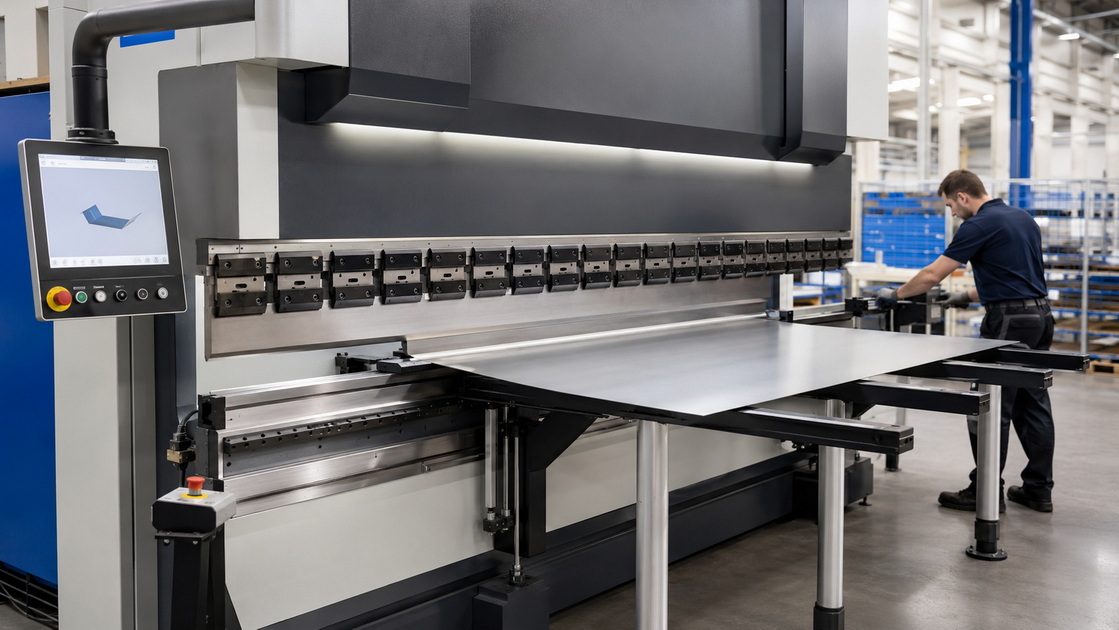
Press brake bending uses a punch and die set to deform the sheet along a straight line, driven by a hydraulic, mechanical or servo ram. [openpr]
- The sheet rests on the die.
- The punch descends, creating a bend by forcing the sheet into the die opening.
- Common modes include air bending, bottoming and coining, each with different tonnage and springback behavior. [openpr]
Because press brakes can take many tools and handle a wide thickness range, they are the backbone of general-purpose metal fabrication worldwide. [durmapress]
Panel folding, often performed by a panel bender, clamps the sheet and uses moving blades or beams to wrap the material around a clamping edge rather than pressing it into a die. [archivemarketresearch]
- The blank is clamped by blank holders.
- Folding blades move up or down to create positive or negative bends along the panel edges.
- Many panel benders automatically reposition the part, bending multiple edges without manual flipping. [fabricatingandmetalworking]
Panel folding is particularly suited to large, thin sheet panels, cabinets, enclosures and boxes where edge flanges must be formed repeatedly with minimal operator handling. [adhmt]

For large, thin sheets (for example 1.0–3.0 mm steel panels), press brakes provide broad flexibility but demand careful handling. [fabricatingandmetalworking]
Key strengths:
- Wide thickness range: From thin gauge up to heavy plate in the same machine. [openpr]
- Custom tooling: Special punches and dies for non-standard radii, hems and offsets. [durmapress]
- Single-piece versatility: Handles low-volume, varied geometry parts with relative ease.
Limitations for large, thin sheets:
- Large blanks often require two operators or cranes, increasing labor and risk. [archivemarketresearch]
- Panel sag and deflection can introduce angle variation and cosmetic defects.
- Frequent tool changes and manual bending sequences reduce throughput unless heavily automated. [archivemarketresearch]
Industry case studies show that panel benders are particularly effective for large thin panels and box-type parts. [fsmdirect]
Advantages:
- Minimal material handling: Large blanks are loaded once; the machine manipulates the part for multiple bends. [fabricatingandmetalworking]
- Single-operator workflow: Even big panels can be formed by one operator with reduced physical strain. [archivemarketresearch]
- High repeatability: Consistent bend angles and flange lengths due to controlled clamping and folding motion. [fsmdirect]
Panel benders also excel at producing boxes, doors and lids in roughly half the time a press brake needs due to reduced setups and automated sequences. They are generally optimized for thin to medium-thin gauges, making them ideal for high-volume, large-panel production in cabinets, HVAC, enclosures and architectural panels. [adhmt]

The table below consolidates typical differences when dealing specifically with large, thin sheet metal panels. [durmapress]
| Dimension | Press Brake Bending | Panel Folding (Panel Bender) |
|---|---|---|
| Bending method | Punch‑and‑die deformation along a line (openpr) | Folding blades wrap sheet around clamped edge (archivemarketresearch) |
| Handling of large thin panels | Often needs two operators or lifting aids; part manipulation during sequence (archivemarketresearch) | Single loading, minimal manual handling, machine repositions for multiple bends (archivemarketresearch) |
| Thickness range | Thin gauge up to heavy plate; very versatile (openpr) | Typically thin to mid‑thin gauges (about 0.5–2 mm steel, model‑dependent) (openpr) |
| Box and enclosure production | Possible but operator‑intensive with multiple setups and flips (archivemarketresearch) | Very fast for boxes/lids; entire sides bent quickly, high repeatability (archivemarketresearch) |
| Tooling | Multiple punch/die sets, higher setup and changeover time (openpr) | Mostly standard blades and clamps; minimal tooling changes (archivemarketresearch) |
| Operator skill dependency | High; angle consistency depends strongly on operator and tooling choice (openpr) | Lower; CNC program and servo systems drive repeatability (archivemarketresearch) |
| Accuracy on large parts | Good with skilled operators, but panel deflection can affect large thin sheets (archivemarketresearch) | Strong accuracy and repeatability on large panels; reduced deflection issues (fsmdirect) |
| Automation readiness | Can be integrated into cells, but requires more peripheral handling (mac-tech) | Commonly delivered as highly automated systems with loaders, conveyors and robots (adhmt) |
Based on audits of fabricators and published industry analysis, a simple decision framework helps clarify whether press brake bending or panel folding is better for large, thin sheets in your plant. [mac-tech]
1. Part Mix And Geometry
- Many large panels, doors, enclosures and boxes → favor panel folding.
- Mixed heavy plate and complex profiles → press brakes stay essential.
2. Thickness And Material
- Mostly thin sheets (0.8–2.0 mm steel or aluminum) → panel benders deliver speed and consistency. [adhmt]
- Significant volume in 4–10 mm plate → press brakes with suitable tonnage are required.
3. Volume And Changeover Frequency
- High-mix, frequent job changes with repeatable panel families → panel benders reduce setups and labor. [mac-tech]
- Low-volume, highly customized parts → press brakes offer more flexible tooling and sequences.
4. Labor Profile And Skill Availability
- Limited access to highly experienced press brake operators → automated folding reduces dependency on individual skills. [mac-tech]
- Strong existing operator base and custom bending jobs → press brakes remain core.
5. Automation And Line Layout
- Goals of lights-out or semi-automatic production with laser cutting, stacking and bending → panel benders integrate easily into automated cells. [adhmt]
- Incremental modernization without major layout changes → upgrading CNC press brakes is often the first step.
Industry reports highlight that large panels for cabinets and doors often run significantly faster on panel benders than on press brakes. [fsmdirect]
Typical scenario:
- Material: 1.2 mm coated steel.
- Part: enclosure doors with flanges on all four sides.
- Press brake: requires operator support for long blanks, multiple tool changes and manual flips.
- Panel bender: loads blank once, clamps and folds all edges with automatic repositioning, delivering consistent angle and flange length.
For this part family, panel folding reduces operator fatigue and frees skilled staff to focus on more complex press brake work, while scrap and rework drop thanks to repeatable folding sequences. Shops still use CNC press brakes for thicker reinforcement brackets and frames, leading to a complementary machine mix rather than a full replacement. [estesdm]
Even when panel benders are not available, large, thin panels can be run more consistently on CNC press brakes by following a disciplined approach. [openpr]
1. Control Deflection And Support
Use additional sheet supports, front supports or helpers to minimize panel sag between backgauge and tooling. Sag directly affects angle consistency in thin sheets. [fabricatingandmetalworking]
2. Optimize Tooling For Thin Gauge
Choose air bending with appropriately sized V-dies to reduce tonnage and avoid marking, while leaving room to compensate springback through ram depth adjustments. [durmapress]
3. Standardize Programs And Angle Checks
Create CNC programs with documented bend sequences, backgauge positions and angle correction data, and implement regular angle checks across the panel length. [openpr]
4. Train Operators On Large Panel Safety
Thin, large sheets can create pinch points and awkward handling positions; standard operating procedures and safety training reduce risk. [archivemarketresearch]
These practices narrow the gap between press brake bending and panel folding on large thin panels where panel benders are not yet deployed.
As a manufacturer dedicated to CNC press brakes and complete sheet metal processing lines, a company such as CNDY‑Press typically helps customers in three main ways: [openpr]
- Configured press brakes: Providing machines sized for expected thickness ranges, panel sizes and tonnage requirements, including CNC controls tailored to high-mix bending.
- Tooling and application support: Advising on punch/die selection, bend sequences and safety, especially for large thin panels and box components. [durmapress]
- OEM and ODM integration: Designing custom bending cells, backgauges, sheet supports and peripheral equipment to match the customer's specific part mix and automation roadmap.
In many projects, the most effective strategy is not simply choosing press brake bending or panel folding, but engineering a combined forming solution where CNC press brakes handle thick and complex parts, and automated folding equipment (whether panel benders or bespoke folding modules) focus on repeatable, large thin panels.
1. Is panel folding always better than press brake bending for large, thin sheets?
No. Panel folding often provides faster, more repeatable results for large thin panels and box-type parts, but press brakes remain superior for thicker materials, deep channels, and highly customized profiles. [fabricatingandmetalworking]
2. What sheet thickness range typically favors panel folding?
Many panel benders are optimized for thin to mid-thin gauges, commonly around 0.5–2.0 mm steel depending on model and material. Above that, press brakes with suitable tonnage are generally preferred. [adhmt]
3. Can one operator manage large thin panels safely on a press brake?
Yes, but it requires appropriate supports, carefully designed handling procedures and often lifting aids. Panel benders reduce manual handling and thus lower physical strain and safety risks. [archivemarketresearch]
4. How does automation change the ROI between press brakes and panel benders?
In high-mix environments with many cabinet and panel SKUs, automated panel benders can significantly improve throughput and reduce labor costs. For plants focused on structural parts and heavy plate, automated press brake cells may yield better ROI. [mac-tech]
5. Should a factory aiming at thin sheet enclosures invest only in panel benders?
Most mature sheet metal plants use both: panel benders for high-volume thin panels and boxes, and CNC press brakes for thicker reinforcements, brackets, frames and special profiles. The optimal mix depends on the part portfolio and growth plans. [estesdm]
1. Fabricating & Metalworking. "Panel Benders vs. Press Brakes — Bending vs. Folding: Does your shop have the right machine for the job?"[archivemarketresearch]
2. DurmaPress. "Press Brake vs Panel Bender: What's the Difference?" [openpr]
3. ADH Machine Tool. "Press Brake vs Panel Bender: Key Differences That Dictate Shop Strategy." [adhmt]
4. ADH Machine Tool. "Panel Bender vs. Press Brake: Choosing the Right Sheet Metal Strategy." [adhmt]
5. Mac-Tech. "Panel Benders vs. Press Brakes: Speed, Precision, Quality." [mac-tech]
6. Mac-Tech. "Panel Benders vs Press Brakes ROI in High Mix." [mac-tech]
7. Estes Design & Manufacturing. "Panel Benders vs. Press Brakes – Which is Better and Why?" [estesdm]
8. ADH Machine Tool. "Press Brake vs. Folding Machine: Why the 'Versatile' Brake Still Matters." [adhmt]


