


Views: 239 Author: CNDY-Press Publish Time: 2026-09-16 Origin: Site


Content Menu
● What Is a Mechanical Press Brake?
>> How Mechanical Press Brakes Deliver Force
>> Main Advantages of Mechanical Press Brakes
>> Main Limitations of Mechanical Press Brakes
● What Is a Hydraulic Press Brake?
>> Why Hydraulic Force Control Matters
>> Main Advantages of Hydraulic Press Brakes
>> Main Limitations of Hydraulic Press Brakes
● Mechanical vs Hydraulic Press Brake: Full Comparison
● The Core Difference: Speed Versus Flexibility
● Precision, Repeatability, and Bend Quality
>> Why CNC Hydraulic Press Brakes Improve Process Control
>> Do Not Specify a Press Brake by Tonnage Alone
● Bending Force: A Practical Selection Framework
>> Why Material Changes Matter
● The Non-Negotiable Decision Factor
>> Important Safety Considerations
>> Mechanical Versus Hydraulic Safety in Practice
● Maintenance and Total Cost of Ownership
>> Mechanical Press Brake Maintenance Priorities
>> Hydraulic Press Brake Maintenance Priorities
>> Total-Cost Question to Ask Before Buying
● Which Press Brake Is Best for Your Application?
● CNDY-Press Recommendation for OEM and ODM Buyers
● FAQ
>> 1. Is a hydraulic press brake more accurate than a mechanical press brake?
>> 2. Are mechanical press brakes faster than hydraulic press brakes?
>> 3. Can a hydraulic press brake bend stainless steel?
>> 4. How do I calculate the required press brake tonnage?
>> 5. Is a mechanical press brake safer than a hydraulic press brake?
Choosing between a mechanical press brake and a hydraulic press brake is not simply a question of machine price or maximum tonnage. The right solution depends on the material, bend complexity, batch size, tolerance requirements, operator-safety strategy, tooling, and future production plans.
From our perspective as a manufacturer of CNC press brakes and complete sheet-metal fabrication equipment, CNDY-Press sees one recurring pattern in OEM and ODM projects: a mechanical press brake can still be productive for highly repetitive, simple bending, but a hydraulic press brake is usually the more adaptable choice for modern fabrication shops that process varied materials, thicknesses, and part geometries.
This guide compares mechanical and hydraulic press brakes in practical terms, including working principles, force delivery, precision, operating cost, safety, maintenance, and purchasing criteria. It is designed to help production managers, fabricators, distributors, and OEM buyers select the metal bending machine that matches their actual workflow—not just the specifications on a quotation sheet.
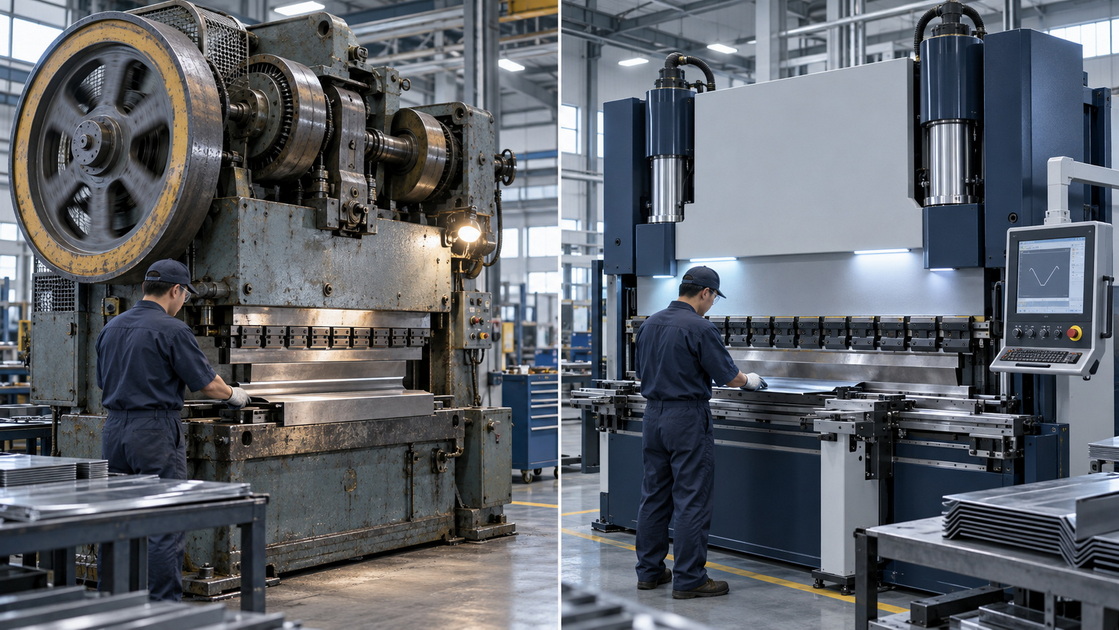
A mechanical press brake uses stored kinetic energy to move its ram. Its core drive system generally includes an electric motor, flywheel, clutch, crankshaft or eccentric mechanism, gears, and connecting components.
The motor continuously rotates the flywheel. When the operator initiates a bending cycle, the clutch engages and transfers the flywheel's stored rotational energy to the crankshaft. The crankshaft then drives the ram downward, forcing the sheet metal into the punch and die.
Mechanical press brakes are historically important in sheet-metal manufacturing because they can achieve fast, repetitive strokes. They are often associated with standardized components, thin sheet material, shallow bends, and long production runs where the same operation is repeated many times.
However, their mechanical motion also creates important limitations. The stroke is primarily determined by the machine's mechanical design, and the ram cannot be controlled with the same flexibility as a hydraulic system. Once the cycle is initiated, stopping or reversing the motion may be more difficult, depending on the clutch, brake system, controls, and safeguarding configuration.
A mechanical press brake does not provide maximum force uniformly across the entire ram stroke. Its usable forming force is generally greatest near the bottom dead center of the stroke.
This characteristic matters because not all bending operations occur at the same depth or require the same force profile. For simple, repeatable bending at a stable ram position, a mechanical press brake can be effective. But for deep forming, varying bend depths, material changes, or complex jobs, limited stroke flexibility may reduce process control.
- Fast cycle speeds for repetitive light- to medium-duty bending operations
- Simple mechanical architecture in many conventional designs
- Often suitable for high-volume production of standardized parts
- Potentially lower initial investment for used or basic equipment
- Effective for operations with fixed tooling and consistent workpieces
- Familiar technology for workshops with experienced mechanical-press operators
- Limited stroke, pressure, and speed adjustability
- Peak force is concentrated near the bottom of the stroke
- Less suitable for frequent product changeovers
- Lower flexibility for complex bending sequences
- Mechanical wear can affect consistency over time
- Safety control requires especially careful attention because of stored rotational energy and continuous mechanical movement
- Less aligned with the flexible, programmable production requirements of many current OEM and custom-metal-fabrication projects
A hydraulic press brake uses pressurized hydraulic oil and cylinders to drive the ram. Instead of relying primarily on a flywheel and crankshaft, the machine uses a hydraulic pump, valves, cylinders, controls, and often a CNC system to regulate ram movement.
When the bending cycle begins, hydraulic oil is directed into the cylinders. The cylinders apply controlled force to the ram, which moves the punch into the workpiece and lower die. The system can regulate pressure, ram speed, working stroke, return stroke, dwell time, and—in many CNC hydraulic press brakes—multiple bending parameters for different jobs.
Modern hydraulic press brakes are commonly equipped with CNC controllers, synchronized cylinders, backgauges, crowning systems, safety protection, and programmable tooling libraries. These functions make them well suited to batch production, custom fabrication, prototyping, and OEM/ODM manufacturing where part designs change frequently.
The major advantage of a hydraulic press brake is controllable force throughout the working stroke. The operator or CNC program can set and adjust the bending parameters based on the material and part requirements.
That does not mean every hydraulic machine produces identical results automatically. Accurate bending still depends on machine rigidity, cylinder synchronization, tooling condition, material consistency, crowning, backgauge accuracy, programming, and operator setup. But hydraulic control gives the manufacturer more practical ways to manage those variables.
For example, an operator can set different approach, bending, and return speeds. The machine can slow down near the bending point for improved control, then return efficiently after the bend. This is particularly useful when working with stainless steel, aluminum, galvanized sheet, thicker plate, or components with several bend angles.
- Adjustable ram pressure, speed, and stroke
- Stronger flexibility for different materials and thicknesses
- Better fit for CNC control and multi-step bending programs
- Suitable for complex bends, deeper forming, and varied parts
- Ability to stop, hold, or reverse ram motion under controlled conditions
- Easier integration with CNC backgauges, crowning, laser guarding, and automation
- Better long-term fit for custom OEM/ODM production
- More practical for fabricators expanding into diversified, higher-value work
- Higher initial investment than basic mechanical machines
- Hydraulic systems require disciplined inspection and maintenance
- Oil cleanliness, seals, hoses, valves, and temperature management affect performance
- Cycle speed may be lower than a specialized mechanical press for extremely simple, repetitive jobs
- Operators need training in CNC programming, tooling selection, pressure settings, and safe setup procedures
The table below provides a practical comparison for buyers evaluating a mechanical press brake vs hydraulic press brake investment.
| Comparison Factor | Mechanical Press Brake | Hydraulic Press Brake | Best Fit |
|---|---|---|---|
| Drive system | Flywheel, clutch, crankshaft, gears, and mechanical linkage | Hydraulic pump, valves, cylinders, and electronic or CNC controls | Depends on production needs |
| Force delivery | Highest useful force is typically near bottom dead center | Controlled force can be applied through the working stroke | Hydraulic for varied work |
| Stroke adjustment | Usually limited by mechanical design | Highly adjustable through controls and programming | Hydraulic |
| Ram speed | Often very fast for repetitive cycles | Variable; can combine rapid approach with controlled bending speed | Mechanical for simple speed; hydraulic for control |
| Precision potential | Good for stable, repetitive operations | High potential with CNC synchronization, backgauge, crowning, and process control | Hydraulic for complex parts |
| Changeover flexibility | Lower, especially for varied bend depths and products | Higher, with programmable settings and CNC recipes | Hydraulic |
| Heavy-material capability | More limited by force curve and machine design | More suitable for thicker and higher-strength materials when properly specified | Hydraulic |
| Complex bend sequences | Less convenient | Well suited to multi-bend, multi-angle, and custom parts | Hydraulic |
| Initial purchase cost | Often lower for basic or older equipment | Typically higher, especially with CNC and safety options | Mechanical for tight upfront budgets |
| Maintenance focus | Clutch, brake, flywheel, bearings, gears, crankshaft, mechanical linkage | Hydraulic oil, filters, seals, hoses, valves, cylinders, electronics | Depends on service capability |
| Energy use | Flywheel may rotate continuously during operation | Can deliver power on demand, depending on hydraulic architecture | Evaluate actual duty cycle |
| Safety integration | Requires robust guarding and clutch/brake control | Often easier to combine with CNC controls and modern safeguarding | Hydraulic, but both need safeguarding |
| Best application | High-volume, repetitive, simple thin-sheet parts | Mixed production, custom fabrication, precision parts, OEM/ODM work | Hydraulic for most modern shops |
The simplest way to understand the decision is this:
- A mechanical press brake prioritizes repetitive cycle speed.
- A hydraulic press brake prioritizes controlled force and production flexibility.
For a factory producing one basic bracket in very large quantities, using consistent thin material and the same tooling every day, the speed advantage of a mechanical press brake may be attractive.
For a manufacturer processing multiple product types, mixed sheet thicknesses, custom drawings, changing angles, and short-to-medium batch sizes, a hydraulic press brake usually creates more value. Its flexible stroke, programmable controls, and adjustable pressure help reduce setup restrictions.
This distinction becomes especially important in contract manufacturing. An OEM customer may begin with a small batch of cabinet panels, later request a stainless-steel version, revise hole positions, add return flanges, or require tighter angle consistency. A hydraulic CNC press brake gives the manufacturer more room to respond without changing the entire production method.
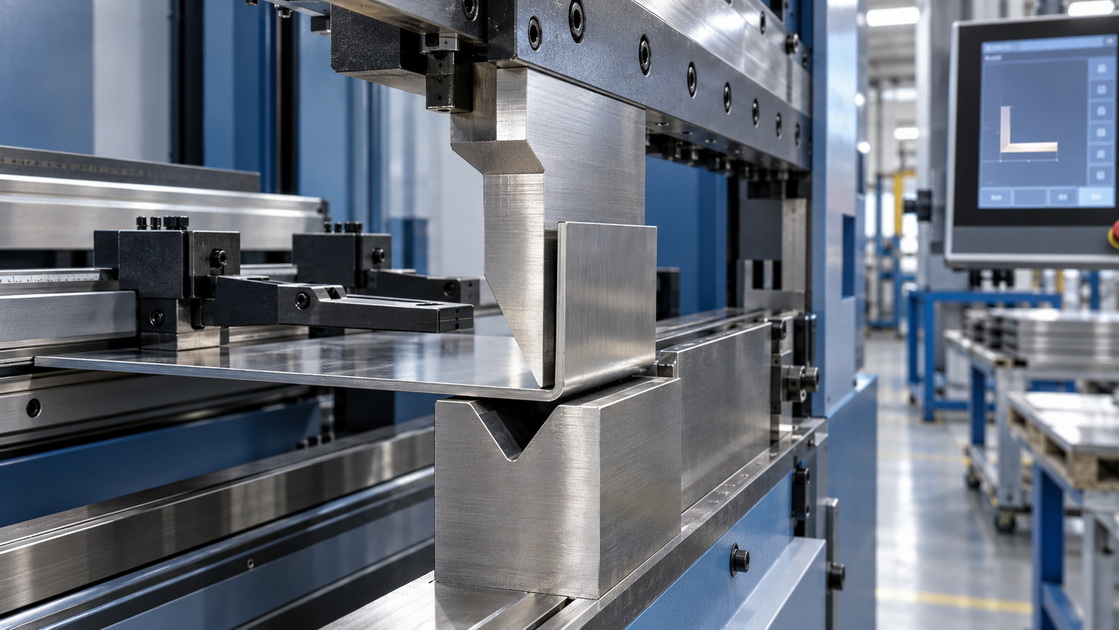
A common purchasing mistake is to assume that machine tonnage alone determines finished-part quality. Tonnage is important, but it is only one part of the bending equation.
In practical production, bend accuracy depends on several interacting factors:
- Material thickness variation
- Tensile strength and yield behavior
- Grain direction
- Springback
- Punch radius and V-die opening
- Tooling wear
- Ram parallelism and synchronization
- Backgauge positioning
- Crowning compensation
- Operator setup and program verification
For air bending, the die opening has a major impact on forming force. The Fabricator notes that tonnage charts are based on particular die-width-to-material-thickness ratios, and using a substantially different die opening can make a chart-based tonnage estimate inaccurate. It also explains that the required force changes with tensile strength, sheet thickness, bend length, friction, die radius, and grain direction.
A CNC hydraulic press brake can improve repeatability because it allows the user to store, recall, and adjust bending programs. Depending on the configuration, operators may program:
- Backgauge positions
- Bend angles
- Ram depth
- Pressure or tonnage limits
- Dwell time
- Bend sequence
- Tooling data
- Crowning compensation
- Part quantity and production order
For a custom metal-fabrication business, this reduces dependence on manual trial-and-error setup. It does not eliminate the need for first-piece inspection, but it can make repeat jobs more consistent and faster to restart.
When reviewing customer RFQs, CNDY-Press recommends treating press brake tonnage as a starting point—not the final specification.
A 100-ton press brake is not automatically suitable for every part that appears to need "less than 100 tons." The buyer must also evaluate:
1. Bending length and whether the load is centered or off-center
2. Material tensile strength, especially for stainless steel and high-strength steel
3. Sheet thickness tolerance across the material batch
4. V-die opening and punch radius
5. Bending method, such as air bending, bottoming, or coining
6. Tooling load rating
7. Daylight, throat depth, stroke, and open height
8. Future product requirements, not only today's part drawing
Industry guidance emphasizes that bending-force calculations are estimates and that a machine's rated capacity should exceed the application's calculated bending force. Exceeding machine or tooling capacity can damage equipment and create serious operator risk.
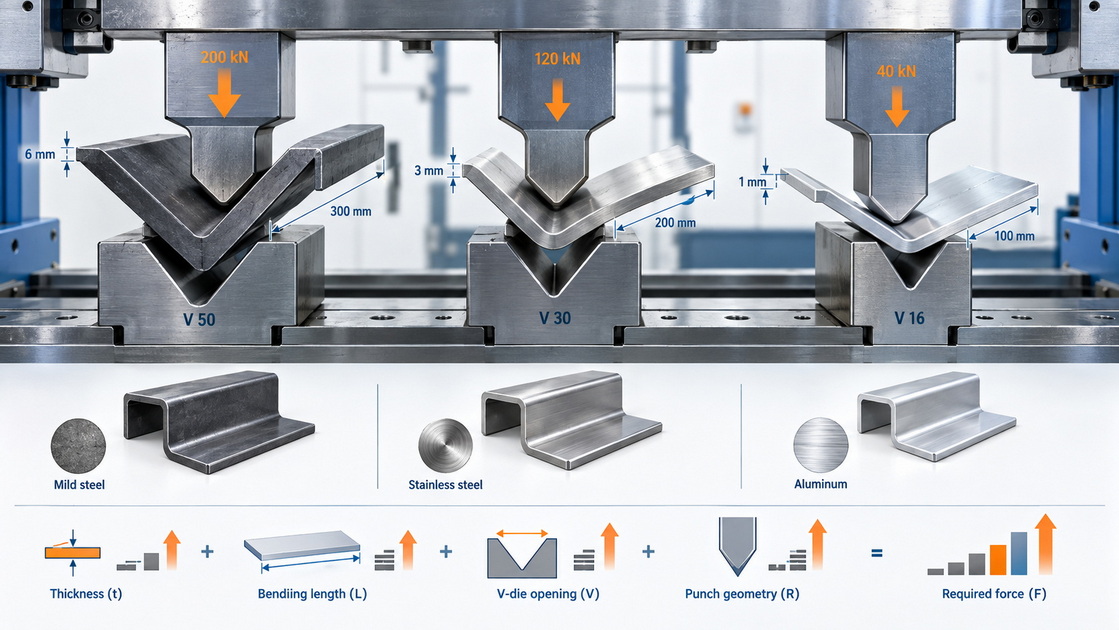
The force required for bending increases sharply as material thickness increases. In simplified air-bending calculations, force is also affected by bend length, tensile strength, and V-die opening.
A commonly cited engineering-style relationship can be expressed as:
Bending Force∝Material Tensile Strength×Thickness2×Bend Length/V-Die Opening
The key practical lesson is that thickness has a squared effect. If the sheet thickness doubles, the required bending force does not merely double—it can increase much more significantly, depending on material and tooling conditions.
Imagine a shop bends a mild-steel enclosure panel successfully using an existing tooling setup. The same customer later requests a similar part in 304 stainless steel.
The part may look nearly identical on the drawing, but the required force can rise because stainless steel generally has a higher tensile-strength ratio than mild steel. The Fabricator provides an example tensile ratio of approximately 1.246 for 304 stainless compared with a 60,000 PSI A36 steel baseline.
This is why a reliable press brake supplier should ask for more than length and thickness. Buyers should be prepared to provide:
- Material grade
- Material thickness
- Bend length
- Required angle
- Internal bend radius
- Bending method
- Number of bends
- Production volume
- Part drawing in PDF, DWG, or STEP format
- Special surface-protection requirements
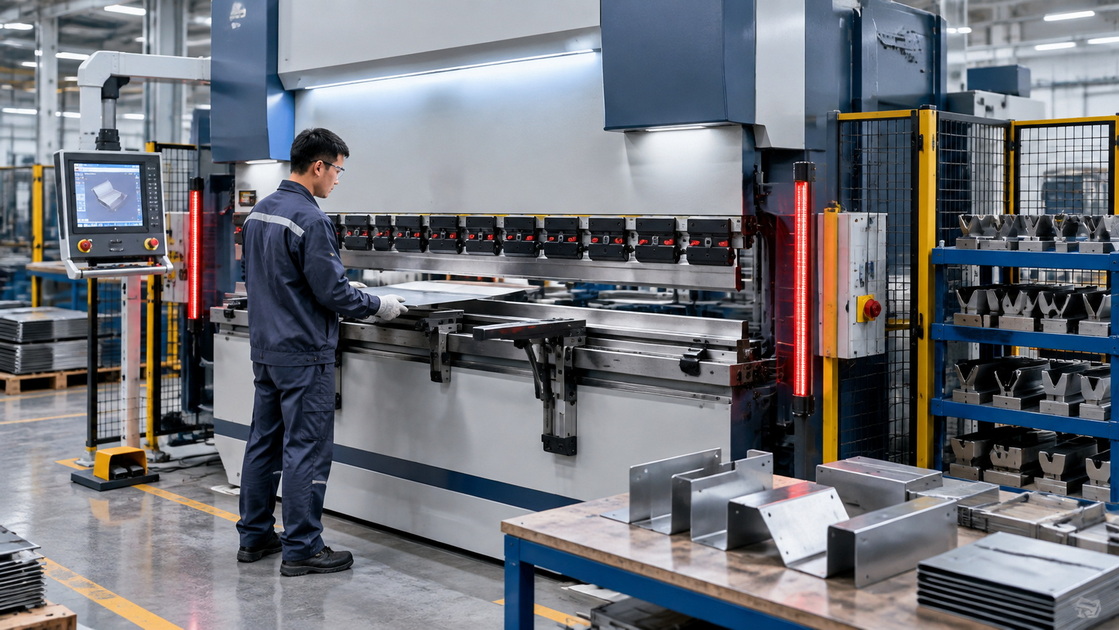
Neither a mechanical press brake nor a hydraulic press brake is "safe by default." Safe operation depends on risk assessment, proper machine design, reliable safeguards, correct installation, training, inspection, tooling condition, and disciplined operating procedures.
OSHA identifies several categories of powered press brakes, including part-revolution mechanical presses, hydraulic presses, hydra-mechanical presses, and mechanical-friction-clutch presses.
For U.S. workplaces, OSHA states that safeguarding for both mechanical and hydraulic power press brakes is addressed under 29 CFR 1910.212, which requires one or more guarding methods to protect operators and other employees from hazards such as the point of operation, ingoing nip points, rotating parts, flying chips, and sparks.
- Use appropriate point-of-operation safeguarding
- Verify emergency-stop functions regularly
- Apply lockout/tagout procedures before maintenance or tooling changes
- Inspect punches, dies, clamps, hydraulic hoses, and guards
- Keep operators and helpers away from hazardous zones
- Use trained personnel only
- Confirm safeguarding is suitable for the specific tooling and application
- Do not bypass light curtains, laser protection, interlocks, or safety controls
- Follow local regulations and the machine manufacturer's operating manual
OSHA also notes that electronic safety devices can be used as guarding methods when they effectively and reliably prevent personnel from entering the danger zone during the operating cycle. However, OSHA does not endorse individual products, and the safeguarding solution must work reliably with the specific machine and application.
Hydraulic press brakes often provide more controllable ram movement. Operators can generally regulate approach speed, working speed, return, pressure, and ram position. This can support safer setup and production practices when combined with properly engineered safeguarding.
Mechanical press brakes may involve stored flywheel energy and mechanical clutch/brake systems. Therefore, inspection, clutch/brake condition, anti-repeat performance, stopping capability, and guarding are especially important.
The correct conclusion is not that one drive type removes risk. Rather, the buyer should select a machine with a safety strategy appropriate to its use case, operator behavior, tooling, part geometry, and applicable regulations.
The purchase price of a press brake is visible. The total cost of ownership is less visible, but often more important.
A lower-cost mechanical press brake may appear attractive if a workshop only considers the initial capital expense. However, a buyer should also estimate labor, setup time, scrap, downtime, spare parts, training, electricity consumption, maintenance capability, and future production flexibility.
Mechanical press brakes require attention to components such as:
- Flywheel and drive belts
- Clutch and brake assemblies
- Crankshaft or eccentric mechanism
- Bearings and bushings
- Gears and lubrication points
- Mechanical ram guides
- Linkage alignment
- Electrical controls and foot switches
The condition of these parts can directly affect machine safety, stroke consistency, and production reliability.
Hydraulic press brake maintenance typically focuses on:
- Hydraulic oil cleanliness and replacement intervals
- Filters
- Hoses and fittings
- Cylinder seals
- Hydraulic valves
- Pump performance
- Oil temperature
- Ram synchronization
- Electrical connections
- CNC controller backups
- Backgauge drive mechanisms
- Tool clamping systems
Hydraulic maintenance is not inherently difficult, but it must be systematic. Contaminated oil, leaking seals, worn valves, or poorly adjusted synchronization can reduce bending accuracy and increase downtime.
Instead of asking only, "Which press brake is cheaper?" ask:
"Which machine will produce our required parts at the lowest reliable cost per acceptable bend over the next five to ten years?"
For a business handling diversified OEM and ODM orders, the answer is often a CNC hydraulic press brake because its flexibility can reduce changeover time, expand the range of jobs accepted, and improve repeatability for returning orders.
The following decision guide can help narrow the choice.
| Your Production Situation | Recommended Choice | Reason |
|---|---|---|
| High-volume production of one simple thin-sheet part | Mechanical press brake may be suitable | Fast repetitive cycle capability can be valuable |
| Frequent changes between products, materials, or bend angles | Hydraulic press brake | Adjustable stroke, speed, pressure, and CNC program control |
| Custom OEM/ODM sheet-metal fabrication | CNC hydraulic press brake | Strong flexibility for evolving drawings and mixed production |
| Thick steel, stainless steel, or high-strength materials | Hydraulic press brake with correctly calculated tonnage | Better force control and suitability for demanding work |
| Multi-bend enclosure panels, electrical cabinets, doors, or frames | CNC hydraulic press brake | Backgauge programming and repeatable bend sequences |
| Low initial budget and simple work | Used or basic mechanical press brake may be considered | Only after a full safety and condition assessment |
| Growth plan involving automation or digital production management | CNC hydraulic press brake | Easier integration with modern controls, tooling, and automation |
For most current sheet-metal fabrication projects, a hydraulic CNC press brake is the more suitable investment. It offers the process control, programmability, adaptability, and production range needed for modern metalworking.
Mechanical press brakes remain relevant in specific situations. They can be efficient for straightforward, high-volume operations involving stable material and tooling conditions. But they are generally less flexible when a factory must process multiple part designs, different thicknesses, stainless steel, aluminum, complex bends, or customer-specific OEM/ODM requirements.
At CNDY-Press, we recommend selecting a press brake based on the entire application—not only tonnage. Our engineering team can evaluate your drawings, material data, bend lengths, thickness range, tooling requirements, production volume, and automation goals to recommend a suitable CNC hydraulic press brake configuration.
Whether you need a standard machine or a customized bending solution, the right equipment should help you produce more accurate parts, reduce setup risk, improve throughput, and support future business growth.
In most mixed-production environments, a CNC hydraulic press brake offers greater potential for repeatable accuracy because it can control ram position, pressure, speed, backgauge movement, and crowning settings. However, final bend accuracy still depends on material variation, tooling, machine condition, programming, and first-piece inspection.
Mechanical press brakes can be faster for highly repetitive, simple cycles because of their flywheel-driven mechanism. Hydraulic press brakes may have lower maximum cycle speed in some cases, but their variable speed control and faster setup for changing jobs can create higher overall productivity for diverse production.
Yes. Hydraulic press brakes are widely used for stainless steel, provided the machine tonnage, tooling, V-die opening, punch radius, bending length, and material tensile strength are correctly evaluated. Stainless steel commonly requires more bending force than comparable mild steel.
Tonnage calculations typically account for material tensile strength, sheet thickness, bend length, V-die opening, punch and die geometry, and bending method. Because real-world conditions vary, use a trusted tonnage chart or engineering calculation and maintain a capacity margin. Never exceed the rated capacity of the machine or tooling.
Neither machine type is automatically safer. Both require correct guarding, operating procedures, training, maintenance, and hazard control. Hydraulic machines can provide more controllable motion, but safeguarding must be designed for the specific machine, tooling, and operation. OSHA requires suitable machine guarding for both mechanical and hydraulic power press brakes.
1. Occupational Safety and Health Administration (OSHA). "[Machine Guarding: Presses—Powered Press Brakes]." Identifies the major categories of powered press brakes, including mechanical and hydraulic types. [osha]
2. Occupational Safety and Health Administration (OSHA). "[Use of Laser Guarding Systems with Hydraulic Press Brakes]." Explains safeguarding expectations under 29 CFR 1910.212 and the conditions under which electronic safety devices may be considered. [osha]
3. Benson, Steve. "[Taking a Deep Dive into Press Brake Tonnage, Part I: Improving Formulas]." "The Fabricator". Discusses air-bending force, die-opening ratios, tensile-strength ratios, friction, grain direction, and capacity margins. [thefabricator]
4. Occupational Safety and Health Administration (OSHA). "[Mechanical Power Presses—29 CFR 1910.217]." Provides U.S. regulatory context for mechanical power press safety requirements. [osha]
5. The Fabricator. "[An Overview of Press Brake Safeguarding]." Discusses key press-brake safety frameworks, including OSHA requirements and ANSI B11.3. [thefabricator]
6. Conic. "[Preparation for Bending: Tonnage Calculation]." Provides a technical overview of factors used in V-bending tonnage calculations. [conic.co]


