


Views: 278 Author: CNDY-Press Publish Time: 2026-09-19 Origin: Site


Content Menu
● Press Brake vs Finger Brake: Quick Comparison
>> Where Finger Brakes Work Well
>> How a CNC Press Brake Works
● The Core Technical Differences
>> Bending Force and Material Capacity
>> Part Geometry and Tooling Flexibility
● Press Brake vs Finger Brake Applications
>> Best Applications for Finger Brakes
>> Best Applications for CNC Press Brakes
● A Realistic Selection Framework
>> Choose a CNC Press Brake When
● The Overlooked Issue: Springback and Material Variability
>> Practical Process-Control Steps
● Expert Buyer's Checklist for CNC Press Brakes
>> Minimum Information to Send a Manufacturer
>> Key Machine Specifications to Compare
● How CNDY-Press Supports Customized Bending Projects
>> 1. Is a finger brake the same as a box-and-pan brake?
>> 2. Can a finger brake replace a press brake?
>> 3. How much press-brake tonnage do I need?
>> 4. Is air bending more common than bottom bending?
>> 5. What safety equipment should a CNC press brake have?
A press brake and a finger brake both bend sheet metal, but they solve different manufacturing problems. A finger brake is a practical, low-complexity tool for thin sheet, short runs, prototypes, boxes, trays, and simple enclosures. A CNC press brake is an industrial bending system designed for controlled force, repeatability, complex tooling, long bend lengths, and scalable production.
For buyers of sheet metal fabrication equipment, the decision should not be based on machine price alone. Material type, thickness, bend length, part geometry, tolerance, batch size, operator skill, safety requirements, tooling strategy, and future production plans all matter. At CNDY-Press, we manufacture CNC press brakes and complete sheet metal processing equipment, with OEM, ODM, and customized production support for customers with specific manufacturing requirements.
Quick recommendation: Choose a finger brake when your work is light-gauge, low-volume, and focused on simple boxes or trays. Choose a CNC press brake when repeatability, capacity, production speed, tooling flexibility, and controlled bending accuracy are business-critical.
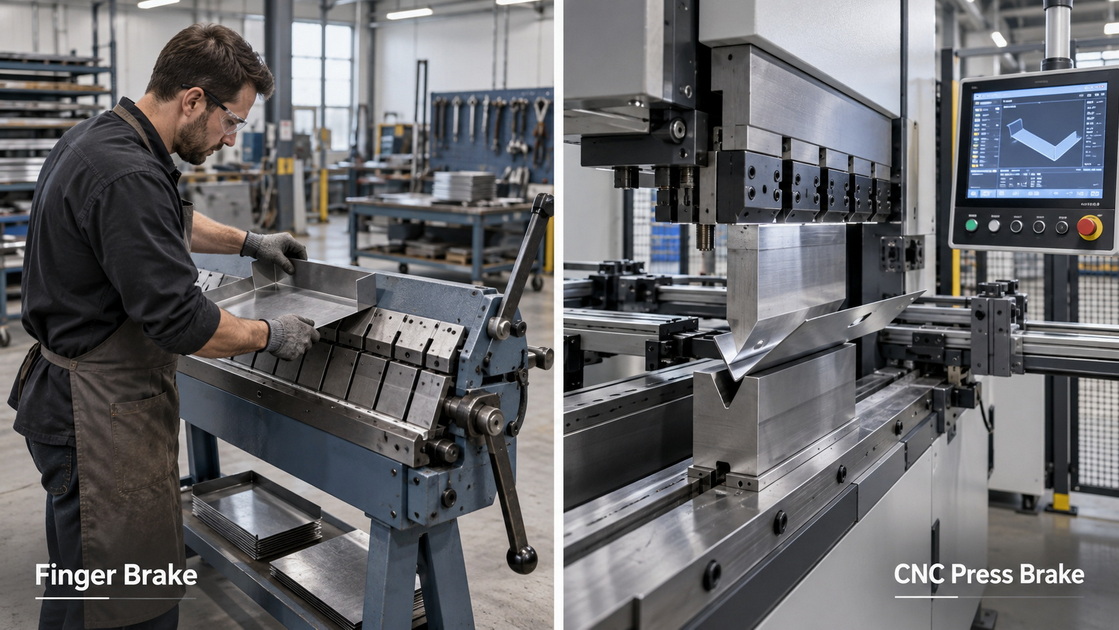
| Factor | Finger Brake | CNC Press Brake |
|---|---|---|
| Common names | Finger brake, box-and-pan brake, leaf brake | Hydraulic press brake, servo press brake, CNC press brake |
| Working principle | Sheet is clamped and a bending leaf is lifted manually | Punch drives sheet into or over a die using controlled ram force |
| Power source | Usually manual | Hydraulic, electric servo, hybrid, or mechanical system |
| Best material range | Thin-gauge sheet metal | Thin sheet through heavy plate, depending on tonnage and tooling |
| Typical part types | Boxes, trays, pans, light enclosures, HVAC details | Brackets, channels, cabinets, panels, frames, structural parts, complex formed components |
| Accuracy | Operator-dependent | High repeatability with CNC control, calibrated tooling, and backgauges |
| Production speed | Suitable for prototypes and small batches | Suitable for repeat production and high-volume manufacturing |
| Tooling flexibility | Removable fingers and clamping leaf | Wide range of punches, dies, hemming tools, gooseneck tools, radius tools, and special tooling |
| Setup complexity | Low | Moderate to high, depending on part complexity |
| Floor space | Small | Larger; requires machine, tooling storage, material handling, and safety clearance |
| Initial investment | Lower | Higher |
| Best buyer profile | Hobby shops, repair teams, HVAC work, prototype benches | Fabricators, OEMs, contract manufacturers, metalwork factories, production lines |
The original comparison correctly identifies the broad difference between the two machines: finger brakes are light-duty and manually operated, while press brakes provide more force, precision, and industrial flexibility. The more important procurement question is whether your parts, material, tolerance, and production schedule justify the additional capability of a CNC press brake.
A finger brake is a manually operated sheet metal bending machine. It uses a clamping bar and a hinged bending leaf. The operator places a sheet under the clamping bar, secures it, and lifts the leaf to form the bend.
It is also called a:
- Box-and-pan brake
- Leaf brake
- Sheet metal finger brake
- Manual bending brake
The term "finger" refers to the removable, segmented clamping fingers. These fingers can be rearranged to allow bends around previously formed flanges. That makes the machine especially useful for making boxes, pans, trays, shallow enclosures, and ductwork sections.
1. The operator marks or aligns the bend line.
2. The sheet is placed under the segmented clamping fingers.
3. The clamping bar holds the sheet in position.
4. The operator lifts the bending leaf.
5. The sheet bends around the clamping edge.
6. The part is removed or repositioned for the next bend.
The process is direct and inexpensive. It also relies heavily on operator setup, hand force, material consistency, and careful alignment.
Finger brakes are a good fit for:
- Light-gauge mild steel
- Aluminum sheet
- Copper sheet
- Galvanized steel
- HVAC ductwork
- Electrical boxes
- Small control-panel enclosures
- Prototype trays
- Repair parts
- Small custom fabrication jobs
A finger brake is particularly useful where the part needs multiple return flanges or enclosed sides that would interfere with a continuous straight clamping bar.
A finger brake has mechanical and commercial limits:
- Limited bending force
- Limited sheet width
- Limited material thickness
- Higher dependence on operator technique
- Lower repeatability across large batches
- Limited ability to form complex profiles
- Slower output for production orders
- More manual handling and fatigue
A manual brake may be economical for a few parts. It becomes less economical when the same part must be produced hundreds or thousands of times with consistent angles, flange lengths, and cosmetic quality.
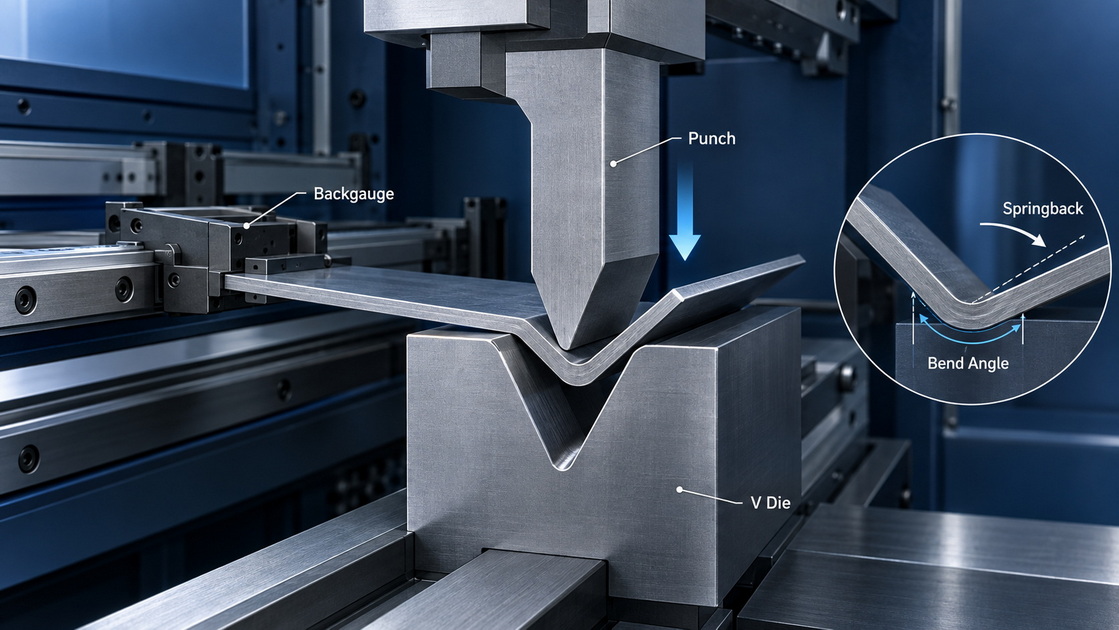
A CNC press brake is a machine that bends sheet metal by applying controlled force through a punch and die. The workpiece is positioned against a backgauge, and the ram moves the punch downward into a V-die or other lower-tool configuration.
Modern press brakes can use:
- Hydraulic drive systems
- Electric servo drive systems
- Hybrid servo-hydraulic systems
- CNC control systems
- Multi-axis backgauges
- Automatic crowning
- Laser or contact angle-measurement systems
- Offline programming software
- Robotic loading and bending cells
1. The operator or programmer selects a bend program.
2. The CNC positions the backgauge to the required flange dimension.
3. The operator places the sheet against the backgauge.
4. The ram lowers the punch into the selected die.
5. The machine controls depth, angle, and sometimes crowning compensation.
6. The workpiece is repositioned for the next bend.
7. The CNC repeats programmed sequences for consistent production.
A press brake can perform air bending, bottom bending, coining, hemming, radius bending, offset bending, and other forming operations depending on tooling and machine capacity.
TRUMPF explains that in air bending, the punch presses the workpiece into the die without forcing it against the die walls, while bottom bending presses the workpiece completely into the die with no clearance between punch, material, and die.
CNC control improves consistency by managing:
- Ram depth
- Bend sequence
- Backgauge position
- Material-dependent corrections
- Tooling data
- Bend-angle compensation
- Multiple-axis movement
- Repeat programs for future orders
This does not mean every part is automatically accurate. Material thickness variation, tensile-strength variation, grain direction, tool wear, incorrect die selection, and springback still affect results. But a well-configured CNC press brake gives manufacturers a much better platform for repeatable production than a manual finger brake.
The biggest difference is available force.
A finger brake applies force through manual leverage. Its practical capacity is therefore limited to relatively thin, light sheets. A press brake applies controlled tonnage through a hydraulic or electric drive system, allowing it to bend much thicker materials and longer parts.
Press brake tonnage depends on:
- Material tensile strength
- Material thickness
- Bend length
- V-die opening
- Bend method
- Punch radius
- Grain direction
- Tooling condition
- Required safety margin
For air bending, a common starting point is a V-die opening near eight times material thickness for mild steel, but this is only a starting guideline. The actual tooling and tonnage must be confirmed with a reliable bending chart, supplier recommendation, calculation, and test bend. One industry reference gives approximately 50 metric tons per meter for air bending 6 mm mild steel with a V opening near 48–50 mm; stainless steel requires a higher force factor, while aluminum typically needs less.
Important: Never choose a press brake only by total tonnage. The machine must also have the correct bending length, frame rigidity, throat depth, daylight, stroke, open height, backgauge travel, tooling compatibility, and safety system.
Finger-brake accuracy depends on:
- Operator alignment
- Manual clamping consistency
- Bend-mark accuracy
- Material springback
- Leaf position
- Sheet positioning
- Operator force and technique
A CNC press brake improves repeatability through programmed backgauge positions and ram-depth control. It is more appropriate for:
- Consistent flange lengths
- Tight bend-angle tolerances
- Multi-bend parts
- Repeat orders
- Interchangeable assemblies
- High-volume production
- Automated downstream welding or assembly
For example, a production enclosure with eight bends, multiple return flanges, and a ±0.5 mm flange requirement is normally a press-brake application. A simple aluminum tray with four shallow bends may be better suited to a finger brake if volumes are low.
Finger brakes are excellent at certain geometries, especially shallow boxes and pans. Their segmented fingers allow a formed sidewall to pass around the clamping area during subsequent bends.
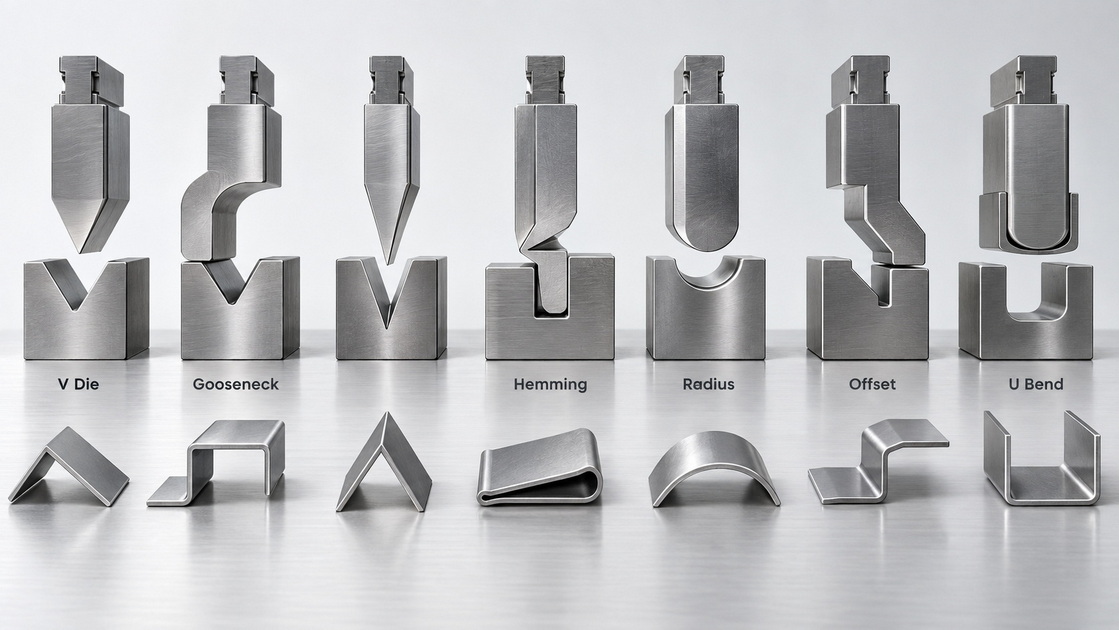
However, press brakes provide a much wider tooling ecosystem:
| Tooling Type | Typical Use |
|---|---|
| Standard punch and V-die | General air bending |
| Gooseneck punch | Avoids collision with return flanges |
| Acute punch and die | Sharp-angle or acute bends |
| Hemming tools | Flattened hems and safety edges |
| Radius tools | Larger inside bend radii |
| Offset tools | Z bends and joggles |
| U-bending tools | Channels and U-shaped profiles |
| Custom tooling | Product-specific shapes and high-volume repeat work |
A press brake is more flexible overall, but finger brakes retain an advantage for certain manual box-forming tasks where removable fingers simplify the sequence.
The lower purchase price of a finger brake can be misleading if the application requires repeated production.
Consider the total cost per part:
Cost Per Part=(Machine Cost + Tooling Cost + Setup Cost + Labor Cost + Scrap Cost + Maintenance Cost)/Total Good Parts Produced
For low quantities, the finger brake often wins because setup is quick and capital cost is low. For repeat production, a CNC press brake can reduce labor time, improve first-pass yield, and improve bend consistency.
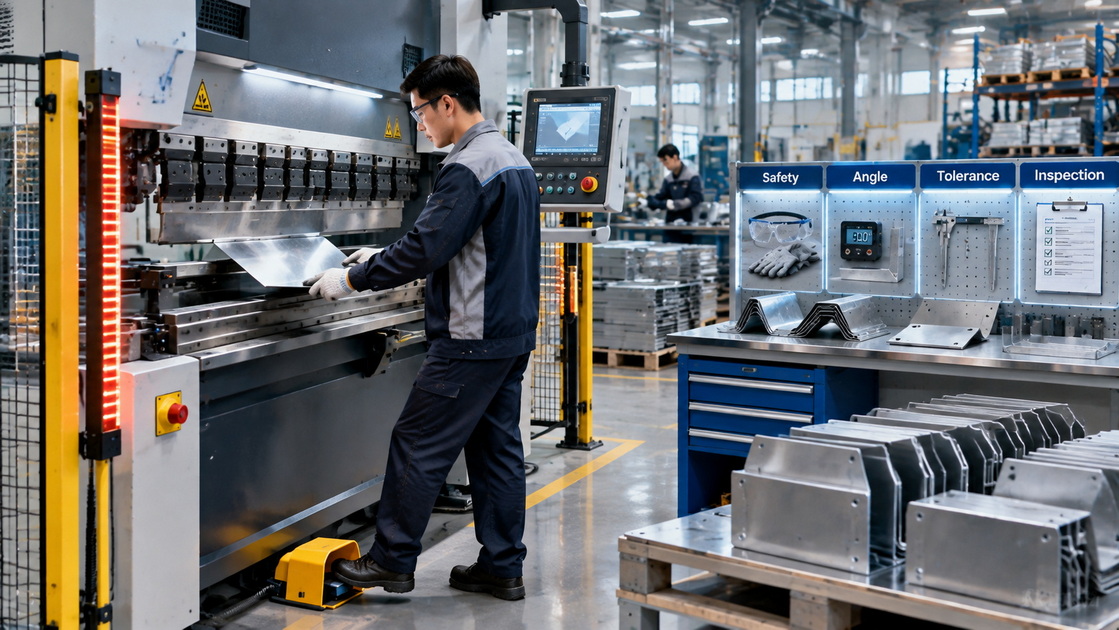
Both machine types create pinch-point hazards. A press brake adds powered motion, higher force, and greater risk of severe injury if operated without appropriate guarding, training, tooling procedures, and work practices.
OSHA requires employers to provide guarding methods that prevent operators and other employees from entering the danger zone during a machine's operating cycle. Examples include barrier guards, two-hand controls, and electronic safety devices.
For CNC press brakes, safeguarding may include:
- Laser safety systems
- Light curtains
- Two-hand controls
- Safety mats
- Foot-pedal control with appropriate protection
- Side and rear guarding
- Safe-distance procedures
- Emergency-stop systems
- Operator training
- Lockout/tagout for maintenance
- Tooling-change procedures
- Daily safety checks
Safety systems must be selected based on the machine, tooling, part geometry, operator access, and applicable local regulations. Buyers should not treat safety equipment as an optional accessory.
| Application | Why a Finger Brake Fits |
|---|---|
| Small electrical boxes | Removable fingers help form multiple sides |
| HVAC duct components | Light sheet and simple flanges suit manual forming |
| Aluminum trays | Low-volume, simple bends |
| Prototype enclosures | Fast adjustment without complex CNC programming |
| Repair-shop work | Low investment and flexible manual operation |
| Custom pans and covers | Segmented fingers handle boxed shapes |
| Application | Why a CNC Press Brake Fits |
|---|---|
| Electrical cabinets | Repeatable multi-bend forming and accurate flange positions |
| Machine guards | Longer bends, heavier material, consistent safety-related parts |
| Automotive brackets | High volume and repeatable geometry |
| Elevator panels | Cosmetic quality and consistent angles |
| Construction equipment parts | Thick material and high tonnage requirements |
| Server cabinets | Multiple bends, tight tolerances, repeat production |
| Industrial enclosures | Tooling flexibility and scalable production |
| Stainless steel channels | Controlled bending and springback compensation |
Choose a finger brake if most of the following are true:
- You mainly form thin sheet metal.
- Your parts are short and light.
- Your production volume is low.
- You make boxes, trays, pans, or simple enclosures.
- Operators need quick manual adjustments.
- Capital budget and floor space are limited.
- Tolerance requirements are moderate.
- You do not require CNC programming, high-speed output, or automated material handling.
Choose a CNC press brake if most of the following are true:
- You bend medium-thickness or thick metal.
- Your parts have long bend lengths.
- You require reliable flange dimensions and bend angles.
- You produce repeat batches or high volumes.
- You need many tooling options.
- You manufacture cabinets, machine parts, structural components, or precision enclosures.
- You want to reduce manual variability.
- You need a platform that can scale with future orders.
- You plan to integrate offline programming, robotic handling, or production data tracking.
One of the most common mistakes in bending-equipment purchasing is assuming that a machine alone determines bend accuracy. In reality, springback is a material behavior.
After the bending force is removed, the material elastically recovers and opens slightly. The amount of springback depends on:
- Material grade
- Tensile strength
- Thickness
- Inside bend radius
- Grain direction
- Tooling geometry
- Bend method
- Lubrication and surface condition
- Batch-to-batch material variation
A CNC press brake can compensate for springback through controlled ram depth, bend-angle correction, crowning, and in some systems real-time angle measurement. But it cannot eliminate the need for correct tooling and process validation.
1. Confirm the actual material grade and thickness.
2. Use a suitable punch radius and V-die opening.
3. Make test bends from the production material batch.
4. Measure the angle and flange length.
5. Adjust ram depth or bend allowance values.
6. Validate first-off parts before full production.
7. Record the proven program, tooling, and material information for repeat orders.
Before purchasing a CNC press brake, collect real part data rather than only asking for a "100-ton" or "160-ton" machine.
- Material type and grade
- Maximum and minimum sheet thickness
- Maximum bend length
- Typical bend length
- Part drawings or DXF files
- Required bend angles and tolerances
- Number of bends per part
- Annual and daily production volumes
- Largest finished part dimensions
- Tooling requirements
- Available floor space
- Power supply
- Required safety standard
- Need for robotic loading or tandem operation
- Target delivery date and destination country
| Specification | Why It Matters |
|---|---|
| Nominal tonnage | Determines maximum bending-force capacity |
| Bending length | Must exceed the longest required bend |
| Distance between frames | Limits usable bending length between side frames |
| Throat depth | Important for deep-box or large-panel clearance |
| Ram stroke | Affects tooling clearance and forming range |
| Open height / daylight | Important for tall tooling and deep profiles |
| Backgauge axes | Supports complex flange positions and sequences |
| Crowning system | Helps maintain angle consistency across long bends |
| Controller | Affects programming, visualization, networking, and usability |
| Tool-clamping system | Influences setup time and tooling compatibility |
| Safety system | Protects operators and supports regulatory compliance |
| Service support | Determines uptime, spare-parts access, and long-term ownership cost |
CNDY-Press focuses on the R&D, manufacturing, sales, and service of CNC press brakes and complete sheet metal processing equipment. For OEM, ODM, and customized manufacturing projects, the most productive discussion begins with the customer's actual parts and process requirements.
A custom press-brake project may involve:
- Tonnage and bending-length selection
- Hydraulic, servo-hydraulic, or electric-drive configuration
- CNC controller selection
- Backgauge-axis configuration
- Crowning system selection
- Tool-clamping options
- Front-sheet support arms
- Safety protection configuration
- Tooling recommendations
- Special throat depth, stroke, or open height
- Tandem press-brake systems
- Automation interfaces
- Custom color, branding, and export packaging
In most metalworking contexts, yes. A finger brake is commonly called a box-and-pan brake because its removable fingers allow the operator to make boxes, pans, trays, and other parts with multiple bent sides.
No, not for most industrial production. A finger brake can handle certain light-gauge, low-volume box and tray work very effectively. It cannot replace the tonnage, length capacity, CNC repeatability, tooling range, and production efficiency of a press brake.
Tonnage depends on material type, tensile strength, thickness, bend length, die opening, and bend method. Use a manufacturer-approved tonnage chart, calculate conservatively, and validate with test bends. Do not select a machine based only on a general "tons per meter" estimate because tooling and material variables can change the result substantially.
Air bending is widely used because one punch-and-die combination can produce multiple bend angles by changing ram depth. Bottom bending presses the sheet fully into the die and can improve angle control in some applications, but it generally requires more force. TRUMPF distinguishes air bending from bottom bending based on whether the material contacts the die walls during the bend.
The correct safety package depends on applicable regulations, machine design, tooling, and workpiece geometry. Common elements include point-of-operation safeguarding, laser systems or light curtains, two-hand controls where suitable, side and rear guards, emergency stops, safe foot controls, training, and lockout/tagout procedures. OSHA requires machine guarding that prevents workers from entering danger zones during machine operation.
1. PrimaPress. "[Press Brake vs Finger Brake: Key Differences]." Original article reviewed and expanded for this guide; source for basic finger-brake and press-brake definitions, mechanisms, applications, and introductory comparison. [prima-press]
2. TRUMPF. "[Bending]." Source explaining the distinction between air bending and bottom bending. [trumpf]
3. Occupational Safety and Health Administration. "[General Requirements for All Machines, as Applied to Power Press Brakes]." Source for machine-guarding requirements and examples of barrier, two-hand, and electronic safeguarding methods. [osha]
4. The Fabricator. "[An Overview of Press Brake Safeguarding]." Industry reference on press-brake safeguarding, light curtains, stopping time, safety distance, and training considerations. [thefabricator]
5. AMADA. "[Combination of Dies and Punches]." Technical tooling catalogue containing air-bending-force chart information for mild steel and press-brake tooling materials. [amada]
6. JSTMT. "[Press Brake Tonnage Chart: Tons Per Meter for Air Bending]." Reference for an example air-bending tonnage calculation framework, V-die starting guidelines, material adjustment factors, and safety-margin considerations. [jstmt]


