


Views: 222 Author: CNDY-Press Publish Time: 2026-05-14 Origin: Site


When I sit down with new customers in sheet metal fabrication, the first question is rarely "Which laser brand should I buy?" but "What materials can I reliably cut, and where are the risks?" Over the past decade working with fiber laser cutting machines, I have seen projects succeed or fail not because of laser power, but because of material selection, cutting parameters and safety awareness. [remcortechnology]
This guide gives you a practical, engineer‑level view of laser cutting materials: which metals and non‑metals work best, which should be avoided, and how to match them with fiber laser, CO2 laser and diode laser systems. It builds on the original Accurl article and adds updated 2025–2026 insights from real production floors. [accurl]
From a manufacturer's perspective, I have learned that the same laser can look excellent or terrible depending on the material you feed it. The right pairing of material and laser type gives you: [evanstd]
- Higher cutting speed and cleaner edges
- Lower burrs and secondary finishing
- More predictable costs per part
- Longer optics and nozzle life thanks to fewer reflections and less slag [wisecutlaser]
Conversely, the wrong material—especially PVC or unknown plastic mixes—can destroy optics, corrode the machine and put operators at risk due to toxic fumes. That is why every serious fiber laser buyer should treat a "laser cutting materials list" as part of their core process documentation, not just marketing. [accurl]
Professional shops typically deal with four broad material families: [evanstd]
- Metals – carbon steel, stainless steel, aluminum, copper, brass, galvanized steel, titanium, nickel alloys and precious metals
- Non‑metals – wood, acrylic, engineering plastics, foam, paper and cardboard, textiles, leather and rubber
- Specialty materials – glass, ceramics, stone, anodized aluminum and laser laminates
- Materials to avoid – PVC, ABS, HDPE, fiberglass and any halogen‑containing or unknown‑coating substrates
Each category behaves differently under fiber, CO2 and diode lasers, and your cut quality, speed and operating cost depend on understanding those differences. [fwincnc]
Stainless steel is one of the most laser‑friendly metals: it offers excellent corrosion resistance, good strength and typically very clean edge quality. [fabworks]
- Typical thickness range (fiber laser): up to 20–30 mm with high‑power sources (10–30 kW), thinner on mid‑power machines [wisecutlaser]
- Edge quality: smooth, low oxidation when using nitrogen as assist gas
- Typical applications: food processing equipment, medical devices, architectural elements, decorative panels [fabworks]
From experience, stainless is often where buyers underestimate gas cost. Nitrogen cutting gives beautiful, oxide‑free edges but with higher gas consumption; planning gas supply is essential for high‑volume stainless parts. [evanstd]
Mild steel is the workhorse material for sheet metal shops. [accurl]
- Advantages: low material cost, easy to cut with oxygen assist, high structural strength
- Edge quality: good, but oxide layer forms with oxygen assist; that can affect downstream welding or painting
- Typical applications: structural parts, frames, brackets, agricultural and construction machinery components [accurl]
Industry data shows that with optimized oxidation melting cutting, slit widths down to about 0.1 mm are achievable, provided the machine has sufficient power and well‑tuned parameters. [evanstd]
Aluminum is prized for its high strength‑to‑weight ratio and corrosion resistance, especially in aerospace, automotive and high‑end equipment. [fabworks]
- Challenges: high reflectivity and thermal conductivity; requires stable high‑power fiber lasers and careful parameter tuning
- Assist gas: usually nitrogen or air to avoid oxidation and discoloration
- Applications: vehicle body parts, machine covers, transport components, decorative and architectural elements [wisecutlaser]
In practice, many shops underestimate how much heat conduction affects small features in thick aluminum: inner contours can overburn if speed and focus are not adjusted for contour density. [wisecutlaser]
Copper and brass are valuable for electrical and decorative applications, but their high reflectivity makes them challenging without the right fiber laser configuration. [remcortechnology]
- Copper: superior electrical and thermal conductivity; used for busbars, heat exchangers, high‑end decorative pieces [accurl]
- Brass: good conductivity and attractive golden finish; used in plaques, decorative hardware and some electronic components [accurl]
Modern high‑power fiber lasers with anti‑reflection protection can cut these metals reliably, but parameter windows are narrow, making strong OEM application support important.
- Galvanized steel: steel with zinc coating; popular in HVAC, outdoor structures and automotive parts due to corrosion resistance. [accurl]
- Titanium: exceptional strength‑to‑weight ratio and biocompatibility; used in aerospace and medical implants. [accurl]
- Nickel alloys: withstand very high temperatures, essential in turbines, engines and chemical plants. [evanstd]
These materials often require careful gas selection and heat management to avoid coating damage or micro‑cracks, which is where experienced OEMs and parameter libraries add real value.
While fiber lasers dominate metal cutting, non‑metals remain the territory of CO2 and, to a lesser degree, diode lasers. [fwincnc]
Wood and engineered boards cut beautifully with CO2 lasers, producing clean edges and intricate patterns. [accurl]
- Use cases: furniture components, architectural models, signage, interior decoration
- Key parameters: moderate power, higher speed and good smoke extraction to avoid charring
Fiber lasers are generally not used for wood due to wavelength and absorption characteristics. [fwincnc]
Acrylic is one of the most visually impressive CO2 laser materials, with polished edges straight off the machine. [accurl]
- Use cases: illuminated signage, display stands, protective covers, branding elements
- Benefits: glass‑like appearance without brittleness and safer handling in public spaces [accurl]
Accurl's overview correctly highlights that plastics such as POM, ABS and polycarbonate behave very differently under the laser: [accurl]
- POM (Delrin): excellent for precise, wear‑resistant components, but must be cut with correct extraction due to fumes. [accurl]
- ABS and polycarbonate: technically possible, but often problematic—edge discoloration, melt, toxic fumes and poor quality above 1 mm thickness. [accurl]
- Foams, paper, cardboard, textiles and leather: widely used for packaging, fashion, signage and models, but require low power and high speed plus good ventilation to avoid burning. [accurl]
From an industrial standpoint, many shops treat plastics and foams as "laser‑engraving" rather than "laser‑cutting" materials, restricting cutting to very controlled applications because of fumes.
One of the most valuable contributions of the Accurl article is the clear list of forbidden materials. In my own work with fiber laser users, I insist on a written "do‑not‑cut" list, prominently displayed near the machine. [accurl]
Key materials to avoid include: [evanstd]
- PVC and vinyl – release chlorine gas, which is highly corrosive and toxic; can destroy optics and ventilation systems.
- ABS, HDPE and polypropylene foams – prone to melting, catching fire and emitting hazardous fumes.
- Fiberglass and epoxy composites – release dangerous fumes and particulates; can damage both operators and equipment.
- Thick polycarbonate (>1 mm) – tends to burn, discolor and generate heavy smoke; poor edges and severe fire risk. [accurl]
- Any halogen‑containing materials or unknown coatings – can emit corrosive gases; without full MSDS data, they should be treated as unsafe. [accurl]
- Expert tip: If the supplier cannot clearly provide a material specification and MSDS, it does not belong in a laser cutting cell. This rule alone has saved several of my customers from expensive downtime.

CO2 lasers are ideal for: [fwincnc]
- Wood and engineered boards
- Acrylic and many plastics
- Paper, cardboard and textiles
- Leather and rubber (within safety limits)
They struggle with thick metals but are excellent multi‑purpose machines for signage, packaging and custom fabrication.
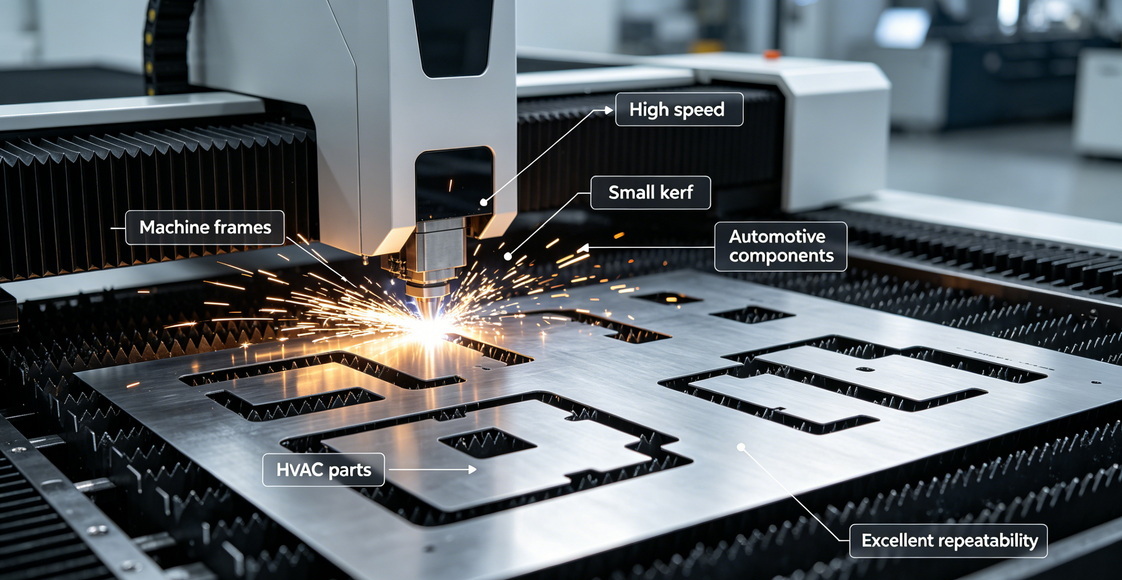
Fiber laser cutting machines—like those we build at CNDY‑Press—are designed primarily for metal materials. [remcortechnology]
- Best suited for carbon steel, stainless steel, aluminum alloys, brass, copper, titanium and nickel alloys [wisecutlaser]
- Offer very high cutting speeds, small kerf width and excellent repeatability
- Fully support modern high‑power laser sources (10–30 kW) for thick plate cutting
Fiber lasers are not the right tool for wood, acrylic or textiles; for those applications, a CO2 laser or combined equipment strategy is recommended. [fwincnc]
Diode lasers fill a niche for hobby and small‑scale work: [fwincnc]
- Good for thin wood, leather and some plastics
- Useful for engraving on various substrates
- Limited for industrial sheet metal due to lower power and beam quality
Serious OEM and ODM metal projects should look at fiber laser cutting machines as the main platform.

One gap in many online guides is a step‑by‑step workflow that procurement and engineering teams can use together. Here is a simplified process we apply in CNDY‑Press projects:
1. List your top 5–10 materials and max thicknesses (e.g., Q235 10 mm, SS304 8 mm, 6061 aluminum 6 mm).
2. Classify each material by laser family: metal → fiber laser; non‑metal → CO2 or alternative.
3. Define quality level per material: welding‑ready edges, paint‑ready, decorative finish or rough cut.
4. Rank monthly volume per material to estimate total cutting time and gas consumption. [fwincnc]
5. Choose machine power and table size based on the heaviest combination of thickness, quality and volume.
6. Build a "safe materials" and "forbidden materials" list and integrate it into your work instructions and training. [accurl]
Using this workflow, even new teams quickly understand why, for example, a 12 kW fiber laser is justified for mixed carbon steel and stainless plate work, but overkill for a shop focused on thin sheet and occasional cutting.

After supporting many OEM and ODM projects, there are patterns I see repeatedly:
- Most downtime issues are not caused by the laser source, but by material inconsistency. Variations in coating, flatness or thickness can force constant parameter tweaks.
- Clients who document materials and parameters per part number (instead of "remembering settings") achieve faster changeovers and fewer mistakes.
- Investing in proper fume extraction and filtration upfront pays off quickly, especially when cutting galvanized steel, aluminum or plastics. [evanstd]
- Material traceability (heat batch, supplier, coating) becomes important once you supply to automotive or aerospace; laser cut quality is only one part of their audit.
For a manufacturer like CNDY‑Press, this is why we combine machine delivery with process support—helping customers define their material strategy, not just machine specifications.
Ready to match your materials with the right fiber laser cutting machine?
- Share your material list, maximum thickness and production targets with our engineering team. We will propose a customized fiber laser solution, including recommended power, table size and cutting parameter ranges for your main metals, so you can go into production faster and with fewer risks.
1. Which materials are best suited for fiber laser cutting machines?
Fiber lasers excel at carbon steel, stainless steel, aluminum alloys, brass, copper, titanium and many nickel‑based alloys. They can also mark or engrave some coated non‑metals, but for bulk non‑metal cutting, CO2 lasers are usually better. [remcortechnology]
2. Why is PVC so dangerous to cut with a laser?
When PVC or vinyl is cut by a laser beam, it releases chlorine gas, which is toxic to operators and corrosive to the machine's internal components. This can rapidly damage optics, bearings and exhaust systems and is strictly prohibited in professional shops. [evanstd]
3. How do I decide the right laser power based on my materials?
Start from your thickest and hardest‑to‑cut material (often carbon steel or stainless), then consider required edge quality and productivity. High‑power fiber lasers (10–30 kW) are justified when you cut thick plate daily; for thin sheet or mixed work, mid‑power machines are more economical. [wisecutlaser]
4. Can one machine handle both metals and non‑metals effectively?
In practice, no single laser type is optimal for all materials. Fiber lasers are highly efficient on metals; CO2 lasers dominate non‑metals like wood and acrylic. Combined machine strategies or separate equipment are common in professional fabrication shops. [fwincnc]
5. What is the safest way to introduce a new material into production?
Always request material specifications and MSDS, verify it is not on your forbidden list, then run controlled cutting tests starting from conservative parameters. Monitor fume extraction, edge quality and flame behavior before releasing the material into full production. [evanstd]
1. Accurl. "Laser Cutting Materials: All Supported Materials and Ones that Should be Avoided." 2024.
[https://www.accurl.com/blog/laser-cutting-materials/] [accurl]
2. Remcor Technology. "The Ultimate Guide to Fiber Laser Cutting Machines – Everything You Need to Know in 2026." 2026.
[https://www.remcortechnology.com/the-ultimate-guide-to-fiber-laser-cutting-machines-everything-you-need-to-know-in-2026.html] [remcortechnology]
3. Wisecut Laser. "2026 Guide to the Best Fiber Laser Cutters for Sheet Metal Fabrication." 2026.
[https://www.wisecutlaser.com/news/2026-guide-to-the-best-fiber-laser-cutters-for-sheet-metal-fabrication/] [wisecutlaser]
4. FabWorks. "How to Pick the Best Material for your Laser Cut Project." 2024.
[https://www.fabworks.com/blog/best-metals-for-laser-cutting] [fabworks]
5. Evan's Technology. "What Materials Are Recommended for Laser Cutting?" 2024.
[https://evanstd.com/blog/what-materials-are-recommended-for-laser-cutting/] [evanstd]
6. FW Inc CNC. "How to Choose the Right Laser Cutting Machine: A Buyer's Guide for 2026." 2025.
[https://www.fwincnc.com/how-to-choose-the-right-laser-cutting-machine-a-buyers-guide-for-2026/] [fwincnc]


