


Views: 222 Author: CNDY-Press Publish Time: 2026-05-02 Origin: Site


In high‑mix, high‑precision sheet metal fabrication, laser cutting accuracy is often the difference between profitable production and costly rework. As manufacturers in automotive, aerospace, HVAC, and machinery tighten their tolerances, buyers expect repeatable precision from every batch, whether they order standard parts or fully customized OEM frames and enclosures. [accurl]
As a sheet metal equipment manufacturer focused on fiber laser cutting machines and turnkey metal fabrication lines, we see this demand every day in our OEM and ODM projects for global customers. In this guide, we step out of the purely theoretical and share what "accurate laser cutting" really means on the shop floor in 2026—backed by data, real tolerances, and practical best practices you can apply immediately. [omtech]
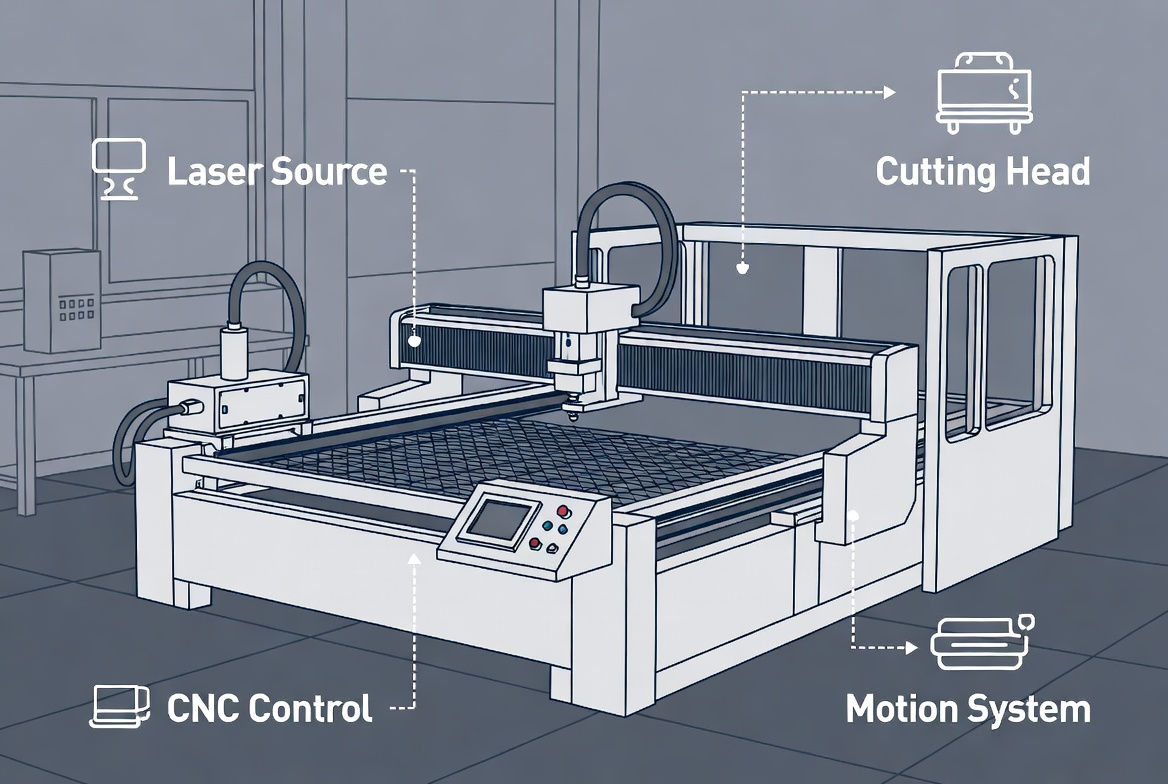
Laser cutting uses a highly focused beam of light to melt or vaporize material along a programmed cutting path. In modern metal fabrication, two technologies dominate: fiber laser and CO₂ laser, with fiber now clearly leading for most metal cutting applications. [fab-line]
Key points that make laser cutting inherently precise: [lasermaster.co]
- Very small spot size (often 10–20 microns) allows intricate geometries. [accurl]
- Narrow kerf, typically around 0.004–0.012 inches, minimizes material loss. [retero]
- CNC positioning systems with servo drives offer positioning accuracy down to ±0.002 inches in modern machines. [fab-line]
From a user's perspective, this translates into parts that drop from the machine ready for bending, welding, and assembly with minimal secondary processing. [metalcraftspinning]
When buyers ask "How accurate is laser cutting?" they're normally talking about dimensional tolerance and repeatability over the full production run. [lasermaster.co]
Typical benchmark figures you can expect from well‑configured laser cutting systems: [retero]
- Dimensional tolerance: usually around ±0.005 inches (≈ ±0.127 mm) for standard laser cutting applications. [accurl]
- Fine‑tolerance capability: high‑end systems and thin sheets can reach ±0.003 inches or better under optimized conditions. [retero]
- Kerf width: approximately 0.004–0.012 inches depending on lens, nozzle, and material thickness. [fab-line]
- Positioning tolerance: often in the region of ±0.002 inches for modern CNC motion systems. [lasermaster.co]
| Cutting method | Typical tolerance range | Edge quality / detail level |
|---|---|---|
| Fiber laser cutting | ±0.003–±0.005 in (thin sheet) retero | Very fine detail, minimal burrs lasermaster.co |
| CO₂ laser cutting | Around ±0.005 in accurl | Good detail, strong on non‑metals accurl |
| Plasma cutting | Around ±0.020 in or worse accurl | Rougher edge, larger kerf |
| Mechanical shearing | Good straight cuts, limited detail lasermaster.co | No complex internal features |
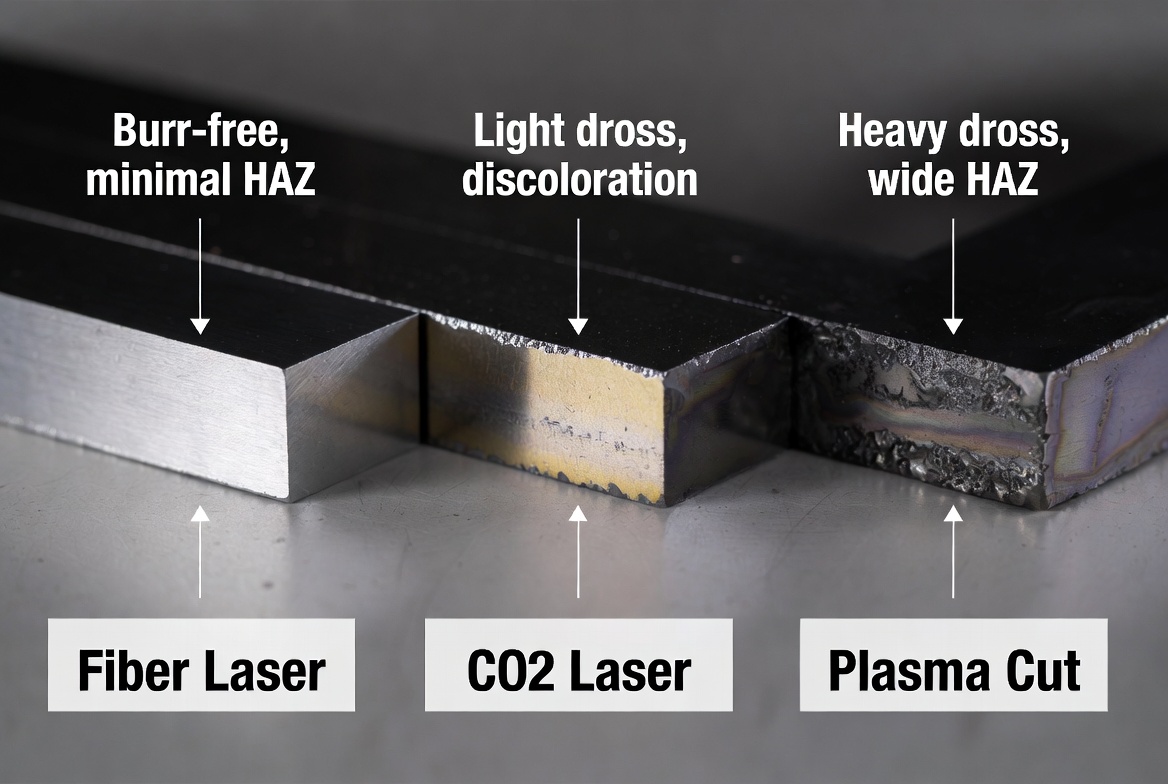
For buyers working with precision assemblies, fiber laser cutting is now the default choice because it combines tight tolerances with high speed and good edge quality, even on high‑strength steels and aluminum alloys. [yimingims]
Fiber laser cutters use solid‑state technology and fiber‑optic delivery to produce a small, highly stable beam ideal for metals. [hncnclaser]
- Typical tolerance: as tight as ±0.003 inches on thin metals with optimized setup. [retero]
- Best for: stainless steel, carbon steel, aluminum, copper, and brass. [yimingims]
- Key advantages: high cutting speed, low operating cost, excellent energy efficiency, and strong performance on reflective metals. [hncnclaser]
From our experience with high‑power fiber laser platforms, fiber becomes especially attractive when you need high‑volume, high‑precision production on material thicknesses from 0.5–25 mm. [hwleiclaser]
CO₂ lasers generate a beam in a gas mixture and deliver it via mirrors. [accurl]
- Typical tolerance: around ±0.005 inches for metals and non‑metals. [lasermaster.co]
- Best for: plastics, wood, acrylic, and mixed-material work. [lasermaster.co]
- Key advantages: very versatile across organic and non‑metallic materials. [accurl]
Crystal lasers use doped crystals to create a high‑intensity beam. [accurl]
- Typical tolerance: comparable to high‑end fiber systems, around ±0.004 inches. [retero]
- Best for: micro‑machining, medical devices, and fine electronic parts. [accurl]
For most sheet metal OEM projects, fiber laser cutting offers the best balance of precision, speed, and cost of ownership. [yimingims]
Even the most advanced machine will not achieve its potential accuracy without proper configuration and control. Based on industry data and daily production experience, these are the factors that matter most: [omtech]
1. Laser type and power – Higher power is essential for thick plate but can introduce more heat, so you must tune parameters to avoid excessive heat‑affected zones. [goldmarkpower]
2. Material thickness – Thin sheet (<1.5 mm) can achieve tolerances around ±0.01 mm, while 3.0 mm and above requires allowance for greater deviation. [retero]
3. Material type and purity – High‑purity steels and aluminum cut more cleanly; reflective materials like copper require specific strategies to maintain accuracy. [metalcraftspinning]
4. Cutting speed and acceleration – Very high speeds improve throughput but can cause slight dimensional drift if not matched with proper acceleration and corner strategies. [metalcraftspinning]
5. Focus position and spot size – Shorter focal length lenses provide smaller spots and finer detail but reduce depth of field, so they are best reserved for thin materials and fine features. [fab-line]
6. Machine stiffness and drive system – Rigid frames, precision linear guides, and high‑performance servo drives are essential to maintain positioning accuracy at high speed. [hncnclaser]
7. Environment and workholding – Sheet flatness, stable temperature, and good support grids reduce vibration and deflection during cutting. [omtech]
8. Operator skill and maintenance discipline – Experienced technicians know how to dial in parameters for each material and thickness, and regular maintenance prevents drift. [omtech]
Good part design is one of the most under‑used levers for improving cutting accuracy and reducing defects. Based on best practices and field experience, follow these guidelines: [metalcraftspinning]
- Avoid ultra‑sharp internal corners – Add small fillets to reduce overheating, burning, and micro‑cracks. [metalcraftspinning]
- Respect minimum hole and slot sizes – As a rule of thumb, keep hole diameter and slot width at least equal to material thickness. [accurl]
- Plan cut order – Cut internal features before outer contours to prevent part movement. [metalcraftspinning]
- Compensate kerf in CAD/CAM – Apply kerf compensation so finished dimensions match the design after material removal. [lasermaster.co]
These adjustments may only change a drawing by tenths of a millimeter, but they can dramatically improve consistency in mass production. [metalcraftspinning]
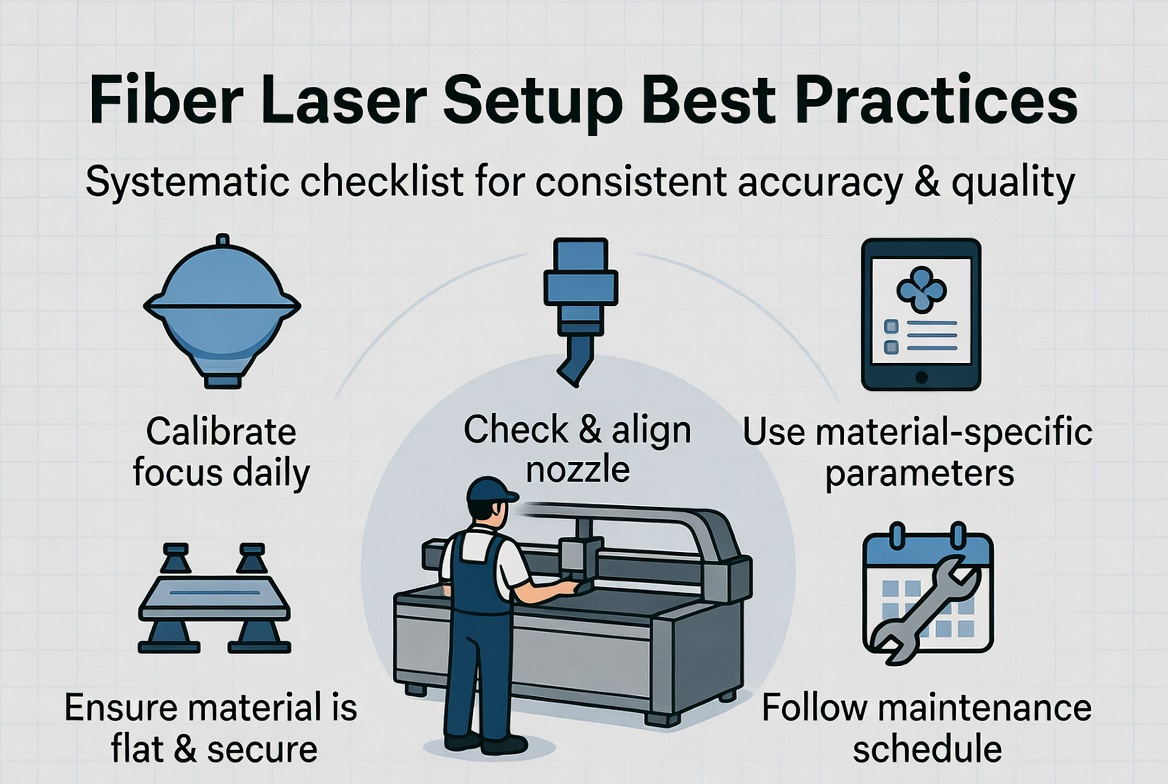
If you already operate laser cutting equipment, there are concrete actions your team can take this week to boost accuracy and repeatability. [goldmarkpower]
1. Calibrate focus and nozzle alignment
- Perform routine focus tests and nozzle centering checks to verify the beam is concentric and properly focused. [goldmarkpower]
2. Optimize cutting parameters by material
- Build and maintain parameter libraries for each thickness and material grade instead of reusing generic programs. [goldmarkpower]
3. Control material quality and flatness
- Specify flatness requirements to your steel supplier and store sheets properly to avoid warping. [metalcraftspinning]
4. Use appropriate assist gas and pressure
- Nitrogen for burr‑free stainless and aluminum; oxygen for thicker carbon steel where slight oxidation is acceptable. [goldmarkpower]
5. Implement scheduled maintenance
- Clean lenses and mirrors, check belts and bearings, and verify backlash in linear axes at defined intervals. [omtech]
From our OEM and ODM projects, we observe that shops that standardize these procedures can often tighten their effective tolerances by 20–30% without changing hardware. [omtech]
Accuracy is not a "set and forget" parameter—it drifts over time if you do not maintain the system. [omtech]
Critical maintenance activities that directly affect precision: [omtech]
- Beam alignment checks – Even a small misalignment reduces edge quality and changes kerf width.
- Lens and mirror cleaning – Contamination shifts the focal point and can create inconsistent cut edges.
- Axis calibration and backlash control – Regular calibration ensures the CNC coordinates match real‑world motion.
- Monitoring laser power output – Aging laser sources may deliver lower effective power than the set value, which changes cutting behavior.
By combining preventive maintenance with regular trial cuts and measurement, you can ensure that the tolerances you promise to customers remain valid over the full life of the machine. [omtech]
Accuracy is no longer only about optics and mechanics. In 2026, digital technologies are reshaping what laser cutting systems can deliver. [yimingims]
Notable trends that impact precision and consistency:
- AI‑powered nesting and cutting strategies – Intelligent software optimizes paths and corner behavior to reduce heat build‑up and dimensional distortion. [yimingims]
- IoT‑enabled monitoring – Real‑time data on temperature, vibrations, gas pressure, and power output helps detect deviations before they affect entire batches. [hncnclaser]
- Higher dynamic performance – Positioning speeds up to around 180 m/min and accelerations in the 3G range allow fast yet precise motion when paired with advanced control algorithms. [hncnclaser]
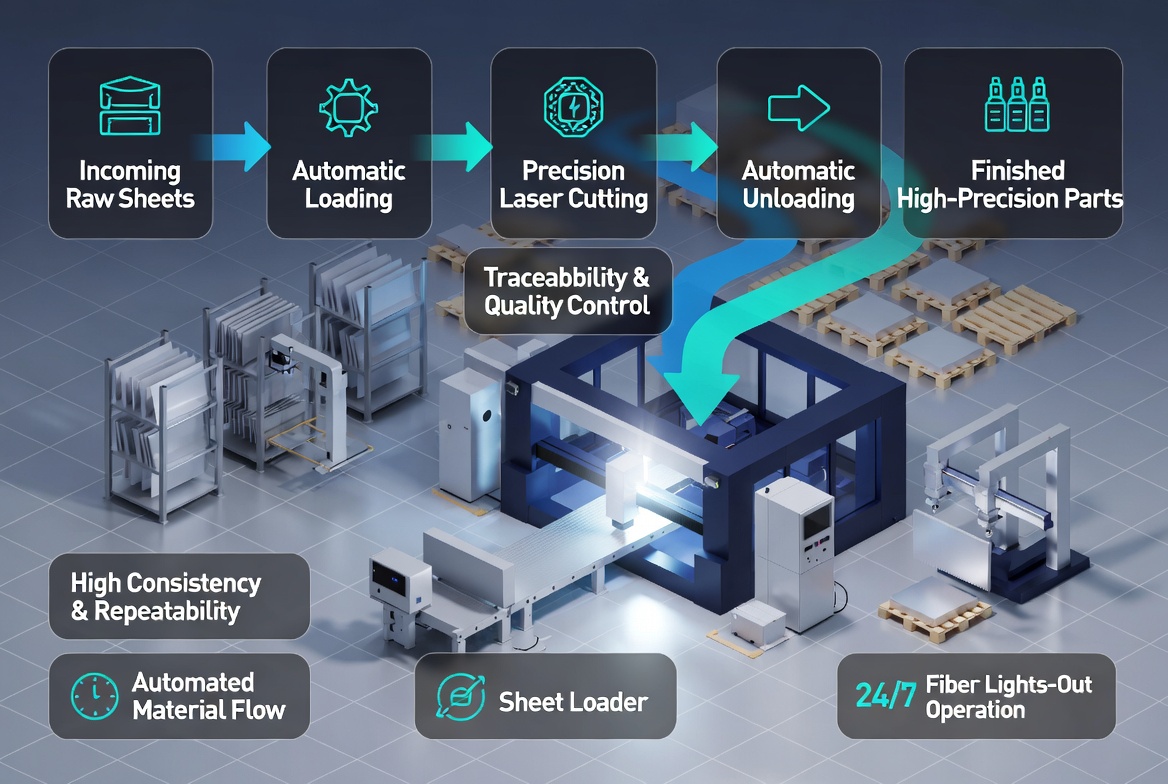
- Industry 4.0 integration – Laser cutting cells are increasingly connected with upstream design systems and downstream bending and welding robots for fully digital traceability of tolerances. [hwleiclaser]
Industry reports estimate that the global fiber laser cutting machines market is on track to reach around USD 8 billion by 2026, supported by double‑digit annual growth as manufacturers upgrade to more precise and automated systems. [yimingims]
For many buyers, the real challenge is not owning a laser cutting machine—it is consistently producing accurate parts without building a full in‑house engineering and process team. That is why OEM and ODM services for laser cutting equipment and turnkey lines have grown rapidly. [longxinlaser]
A robust OEM/ODM laser cutting partner typically provides: [longxinlaser]
- Custom machine design to match your exact material range, part sizes, and tolerance targets.
- Prototype validation so cutting parameters and tolerances are proven on your own parts before mass production.
- Brand customization of machine covers, software interface, and documentation to integrate into your product portfolio.
- Integrated automation including loading/unloading systems, warehouse racks, and conveyors for stable, repeatable handling. [lemon8-app]
By combining customized hardware with application engineering and process tuning, OEM/ODM solutions make it significantly easier for end users to achieve the promised tolerances in real‑world conditions. [longxinlaser]
From an engineer's perspective, the decision often comes down to material, thickness, and required tolerance. [lasermaster.co]
Choose fiber laser cutting when:
- You need tight tolerances (around ±0.005 inches or better) on metal parts. [retero]
- Your material mix includes stainless steel, carbon steel, aluminum, and copper alloys. [yimingims]
- You require high throughput with relatively low cost per part. [hncnclaser]
- You plan to integrate the cutting cell into a digital, automated production environment. [hwleiclaser]
If your portfolio includes large non‑metallic panels or specialized plastics, a separate CO₂ system may still be valuable—but for metal‑centric OEM fabrication, fiber is the logical first choice. [lasermaster.co]
If your projects demand consistent tolerances, clean edges, and reliable lead times, the right fiber laser cutting machine or turnkey OEM/ODM line will directly impact your competitiveness. [hncnclaser]
We support customers from initial part drawings through to full production, helping you: [longxinlaser]
- Select a suitable laser power, working area, and automation configuration.
- Validate target tolerances on real materials with test cuts.
- Customize machine design and branding for OEM/ODM projects.
Share your drawings, material specifications, and tolerance requirements, and our applications team will recommend a configuration—and test program—tailored to your production goals. [longxinlaser]
1. What tolerance can I realistically expect from fiber laser cutting on 3 mm stainless steel?
For 3 mm stainless steel on a high‑quality fiber laser system with optimized parameters, tolerances around ±0.005 inches are achievable in series production, with finer results possible on smaller, well‑supported parts. [retero]
2. Why are my laser‑cut parts slightly oversized compared with the CAD model?
This usually indicates that kerf compensation is not correctly applied in CAM, or parameters are not tuned for the specific material and thickness, causing variation in kerf width. [lasermaster.co]
3. Does higher laser power always improve accuracy?
No. Higher power helps with thicker materials and cutting speed, but if not properly tuned, it can create wider kerfs and larger heat‑affected zones that reduce dimensional accuracy. [goldmarkpower]
4. How often should I calibrate my laser cutting machine to maintain precision?
Most high‑duty shops perform basic alignment and calibration checks weekly, with more comprehensive inspections monthly or quarterly depending on utilization and quality requirements. [accurl]
5. Is laser cutting accurate enough for press‑fit or interference‑fit components?
For many press‑fit applications, especially in thin sheet assemblies, properly optimized fiber laser cutting can deliver the consistency needed, but you must validate fits through prototyping. [lasermaster.co]
1. ACCURL. "How Accurate is Laser Cutting: Standard Laser Cutting Tolerances." [accurl]
2. LaserMaster. "Laser Cutting Accuracy Explained | Precision & Tolerances." [lasermaster.co]
3. Retero. "Laser cutting tolerances & accuracy: What is really possible." [retero]
4. Fab‑Line. "The Ultimate Guide to Laser Cutting Accuracy." [fab-line]
5. OMTech. "How To Improve Laser Cutting Accuracy." [omtech]
6. Gold Mark Power. "What factors affect the accuracy of laser cutting and how can it be compensated?" [goldmarkpower]
7. Metal Craft Spinning. "Maximizing Precision in Laser Cutting: Tips and Best Practices." [metalcraftspinning]
8. Industry report. "2026 Top Fiber Laser Cutting Machine Trends and Innovations." [yimingims]
9. HN CNC Laser. "The Future of Laser Cutting: Trends to Watch in 2026." [hncnclaser]
10. Longxin. "OEM/ODM Services." [longxinlaser]
11. OEM laser cutting machine services overview. [lemon8-app]
12. IEME 2026 Review: "How Fiber Laser and Intelligent Manufacturing Are Reshaping the Future of Industry." [hwleiclaser]


