


Views: 233 Author: CNDY-Press Publish Time: 2026-10-25 Origin: Site


Content Menu
● What Makes a Press Brake Heavy-Duty?
● Heavy-Duty Press Brake vs Standard Press Brake: Key Differences
● Calculate Thick Plate Bending Requirements Before Choosing a Machine
>> Thickness Is Only One Force Driver
>> Use Actual Material Properties
>> Separate Air Bending From Bottoming and Coining
● The V-Die Trade-Off: Less Force Can Mean Different Parts
● When a Standard Press Brake Is the Right Choice
>> Occasional Thick Plate Jobs
>> Shorter Bends With Manageable Force
>> Mixed Production With Frequent Changeovers
● When a Heavy-Duty Press Brake Becomes the Better Investment
>> Thick Plate Is a Core Production Requirement
>> Parts Require Long Bends or Greater Working Space
● Why Tooling Can Be the Limiting Factor
● Crowning, Springback, and Material Direction
>> Crowning Addresses Deflection
>> Springback Requires Process Control
>> Grain Direction Affects Bendability
● Two Thick Plate Applications
>> Application A: Occasional Short Plate Brackets
>> Application B: Repeated Long High-Strength Plate Components
● Quoting Thickness Without Bend Length
● How to Validate a Press Brake Before Purchase
● Choose the Press Brake Around Your Production Needs
>> 1. Is There a Fixed Thickness That Requires a Heavy-Duty Press Brake?
>> 2. Can a Standard Press Brake Bend Thick Stainless Steel?
>> 3. Does Higher Tonnage Guarantee Better Bending Accuracy?
>> 4. Can a Wider V Die Avoid Buying a Larger Machine?
>> 5. Is a Heavy-Duty Machine Better for Every Factory?
A heavy-duty press brake is generally the stronger candidate for frequent, demanding thick plate bending. However, a standard press brake can be suitable when the required force, bend length, tooling load, working space, and production duty remain within its approved limits.
The heavy-duty press brake vs standard press brake decision therefore cannot be settled by plate thickness alone. A short bend in thick mild steel may require less total force than a much longer bend in thinner, stronger material.
My starting point when reviewing a machine proposal is the complete bending application—not the equipment label. The right investment delivers the required parts safely and consistently without paying for capacity that production rarely uses.
For CNDY-Press customers evaluating CNC press brakes, OEM projects, or customized equipment, that means comparing capability across the entire bending system.

"Heavy-duty" is a commercial description, not a universal specification with a fixed tonnage threshold.
Manufacturers may use it for machines designed around higher forming forces, longer bending lengths, demanding duty cycles, or large workpieces. Buyers should therefore ask what engineering features support the description.
Relevant evidence includes:
- Rated force and permitted loading conditions.
- Frame, ram, and bed design.
- Deflection compensation.
- Hydraulic and thermal capacity.
- Tooling and holder ratings.
- Workpiece handling provisions.
- Performance under representative production conditions.
A standard CNC press brake may already provide substantial force and advanced controls. Conversely, a machine advertised as heavy-duty may lack the working envelope or tooling required for your particular part.
| Selection Factor | Standard Press Brake | Heavy-Duty Press Brake |
|---|---|---|
| Typical production role | General fabrication within its rated envelope | Demanding plate work or larger forming applications |
| Forming capacity | Model-dependent | Often higher, but must be verified |
| Structural requirements | Designed for specified rated loads | May incorporate structures suited to greater loads |
| Working envelope | Varies by model | May offer greater clearance and handling options |
| Tooling | Selected for the application | Often requires high-load tooling and holders |
| Installation | Depends on machine size and design | May require more extensive foundations and access planning |
| Operating economics | Attractive when capacity matches the workload | Justified when additional capability improves production |
| Accuracy | Depends on the complete process | Not automatically better because the machine is larger |
The comparison is between configurations, not assumptions. Two machines with similar advertised tonnage can have different application limits.
For comparable air-bending conditions, required force is approximately proportional to:
This relationship explains why small specification changes can have large consequences.
With the same material, bend length, and die opening, increasing thickness from 10 mm to 12 mm raises the estimated force by approximately 44%.
If the die opening also changes, the force comparison changes. The relationship is a planning tool, not a substitute for the machine and tooling suppliers' approved calculations.
Do not size a machine using "steel" as the complete material description.
Identify the grade, thickness tolerance, tensile-strength range, and forming guidance. High-strength plate may demand substantially different force and bend-radius decisions from ordinary mild steel.
Provide material certificates where available. Ask the supplier which strength value and thickness it used in its calculation.
A force estimate for air bending does not apply automatically to bottoming or coining.
The forming method changes contact conditions and force requirements. Confirm the process before comparing machine quotations.
Also distinguish metric tonnes-force from U.S. short tons. Similar-looking numbers can represent different forces.
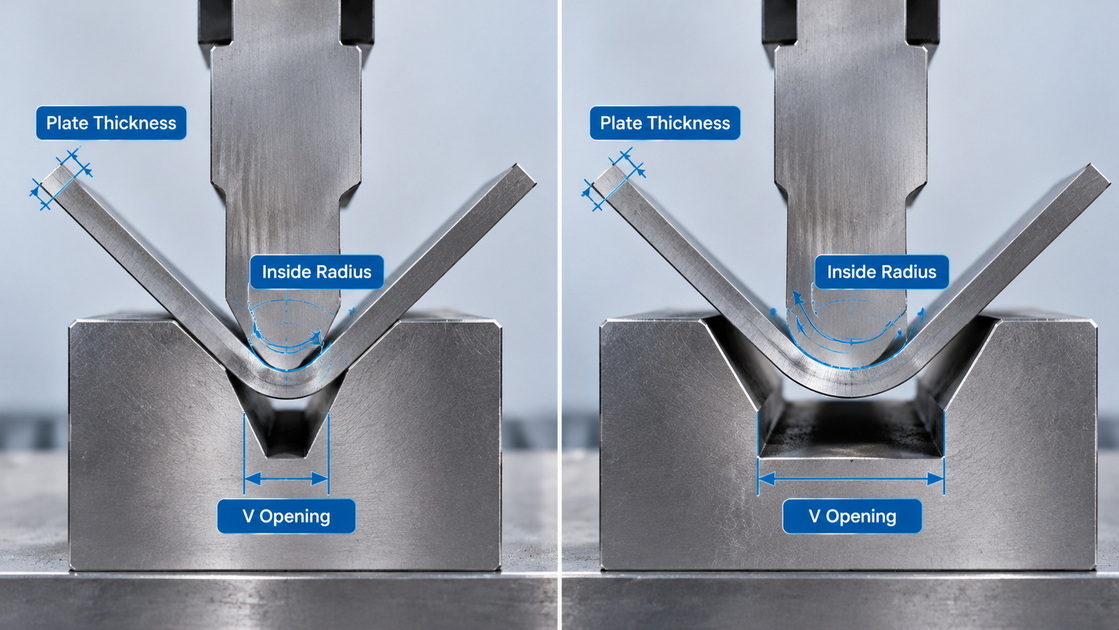
A wider V opening generally reduces air-bending force, but it also changes forming geometry.
Potential consequences include:
- A larger naturally formed inside radius.
- Different minimum flange requirements.
- Changed bend allowance.
- Different product contact and marking.
- Possible interference with adjacent features.
A wider die is therefore not a universal solution to insufficient machine capacity.
For thick plate work, the acceptable die opening must fit the drawing, material's bendability, and available tooling. Check the punch radius and die shoulder geometry as part of the same review.
A standard press brake can be a sound investment when thick plate work remains comfortably within its documented application limits.
If thick plate bending represents a small share of production, a general-purpose machine may provide sufficient flexibility.
The decision should still include suitable tooling, handling, and acceptance testing. Occasional use does not permit exceeding any rated limit.
Shortening the bend reduces total force under otherwise comparable conditions.
However, this does not automatically make the setup safe. The machine's concentrated-load limits and the tooling's load per unit length must also be respected.
For a shop handling varied parts, usable setup efficiency may matter more than maximum tonnage.
Evaluate tool changes, programming, backgauge access, operator handling, and service support. A correctly matched standard machine can be more economical than an oversized system that complicates routine work.
When demanding plate work is routine, select equipment around sustained production rather than an occasional demonstration.
Ask the manufacturer to define the proposed operating cycle, oil-temperature management, forming speed, and expected performance under repeated loading.
Long plate sections can combine high force requirements with significant deflection and handling demands.
Check usable bending length, distance between uprights, throat depth, stroke, daylight, and removal clearance.
A machine may have enough tonnage yet still be unable to complete the bend sequence or release the finished component.
Large plate parts can make positioning, supporting, and rotating the workpiece more time-consuming than the bending stroke itself.
Discuss suitable lifting arrangements, support systems, and coordinated handling equipment. Confirm their capacity and compatibility with the proposed process.
Buy the handling concept with the machine—not as an unresolved issue after installation.
The machine is only one element in the load path.
The punch, die, holders, adapters, and supporting interfaces must all be suitable for the intended force and loading conditions.
WILA explains tooling capacity using load per unit length and emphasizes evenly distributed loading. A short tool segment does not inherit the full capacity of a one-meter tool.
This matters when a powerful press brake forms a short part. Available machine force can exceed what the local tooling arrangement permits.
Request written confirmation covering:
1. Punch and die ratings.
2. Holder and adapter ratings.
3. Engaged tool length.
4. Permitted concentrated loading.
5. Any restrictions on off-center bending.
Do not treat excess machine tonnage as a reserve that can be applied indiscriminately.
Under load, the machine structure and tooling system can deflect. Crowning compensates for relevant deflection to help maintain a consistent angle along the bend.
Ask how the proposed system is set and verified for your application.
Crowning does not correct every source of error. Material variation, tooling condition, and workpiece positioning still matter.
After unloading, material partially recovers elastically. The required compensation depends on material properties and bending geometry.
Angle measurement and suitable control functions can help, but the acceptance test should demonstrate final results on representative parts.
Do not accept an unloaded positioning specification as proof of finished-part angular accuracy.
Rolling direction can influence cracking risk and the minimum suitable bend radius.
Check the plate producer's recommendations for the exact grade, thickness, and bend orientation. Avoid applying a universal radius rule to every thick plate material.
More machine force cannot make an unsuitable bend radius metallurgically acceptable.
Consider two illustrative purchasing briefs.
The buyer produces a limited number of short brackets alongside lighter fabrication work.
The material, die opening, and bend length produce a force requirement within the standard machine's approved capacity. Tooling, localized loading, clearance, and handling are also acceptable.
A standard CNC press brake may be the more rational choice.
The buyer regularly bends long components with demanding material properties and large workpiece dimensions.
Force, deflection, handling, and sustained operation become central requirements. A heavy-duty configuration may offer the appropriate production platform.
These are decision examples, not CNDY-Press project records. Both require application-specific engineering confirmation.
"Can this machine bend 20 mm steel?" is an incomplete purchasing question.
A useful capability statement must specify:
- Material grade and strength basis.
- Actual thickness.
- Bend length.
- Forming method.
- Die opening and tooling.
- Required radius and angle.
- Machine loading position.
Ask competing suppliers to quote the same part package. Otherwise, one may calculate a short mild-steel bend while another assumes full-length high-strength plate.
The resulting prices are not meaningfully comparable.
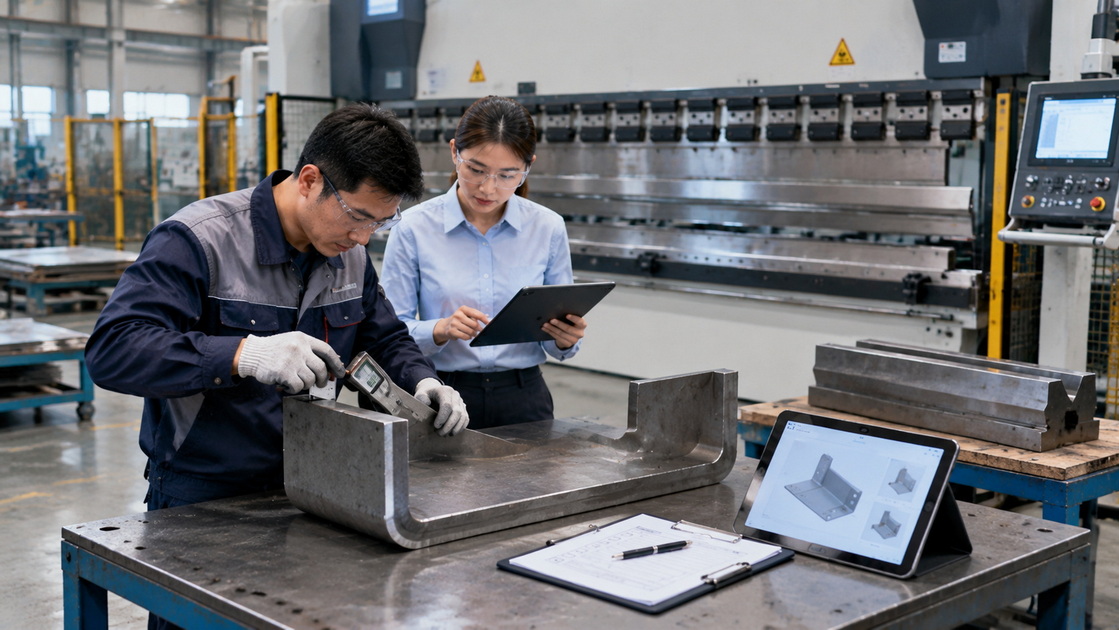
Use a structured acceptance process:
1. Submit representative drawings and material specifications.
2. Review force calculations and tooling compatibility.
3. Confirm working-envelope and bend-sequence clearance.
4. Agree on measurable dimensional and angular requirements.
5. Conduct a representative loaded trial.
6. Evaluate repeat production, handling, and setup time.
7. Document installation, training, service, and spare-parts arrangements.
For safety, include point-of-operation protection and the hazards created by moving plate. OSHA identifies additional risks where workpieces move upward or create trapping areas during bending.
Safeguarding must be assessed for the actual machine and task. Do not disable protective systems to make an unsuitable setup workable.
Choose a standard press brake when it meets the complete application reliably and economically. Consider a heavy-duty press brake when sustained force, long bends, large parts, or demanding handling justify the additional capability.
CNDY-Press develops and manufactures CNC press brakes and sheet-metal equipment, with OEM, ODM, and customized production services.
No. Thickness alone is insufficient. Material strength, bend length, die opening, tooling, and production requirements determine the appropriate configuration.
Potentially, provided the complete application stays within approved limits. Use the actual stainless grade and strength data rather than a generic material multiplier alone.
No. Accuracy depends on structural behavior, crowning, tooling, material consistency, positioning, and process control. Verify results on representative parts.
Sometimes it reduces force sufficiently, but it may change radius and flange requirements. Confirm drawing compliance and tooling suitability before adopting that approach.
No. Additional capability may bring higher purchasing, tooling, installation, and handling costs. Evaluate the production mix and total operating economics.
1. The Fabricator. "Press Brake Basics: Material, Die Width, and Bending Force," October 2026. Explains the relationship between thickness, tensile strength, die opening, bend length, and estimated forming force. [Read the technical explanation]. [thefabricator]
2. The Fabricator. "Taking a Deep Dive Into Press Brake Tonnage, Part I: Improving Formulas," November 2019. Supports adjusting force estimates for material strength and distinguishing calculation assumptions. [Read the article]. [thefabricator]
3. WILA. "Learn About WILA Tools and Load Capacity." Explains tooling load per unit length, evenly distributed loading, and the need to consider tools, holders, and machine limits together. [Read the tooling guidance]. [wilatooling]
4. The Fabricator. "The Rules of Press Brake Tool Selection," May 2019. Discusses die opening, radius, flange constraints, and risks associated with inappropriate tooling choices. [Read the selection guide]. [thefabricator]
5. Bystronic. "Press Brake Solutions." Describes differing machine sizes, force ranges, crowning, handling features, and application configurations. Used as an industry example, not evidence of CNDY-Press specifications. [Review the manufacturer information]. [bystronic]
6. The Fabricator. "Bending Basics: The Fundamentals of How to Bend Metal," January 2014. Explains plate-bending considerations including material direction, radius, and springback. Specific bend limits must come from the relevant material producer. [Read the technical article]. [thefabricator]
7. The Fabricator. "Bending Basics: The Hows and Whys of Springback and Springforward," July 2014. Supports the discussion of elastic recovery and process-dependent angle compensation. [Read the explanation]. [thefabricator]
8. Occupational Safety and Health Administration. "Machine Guarding eTool: Powered Press Brakes." Identifies point-of-operation and moving-workpiece hazards and outlines safeguarding considerations. [Read the official safety guidance]. [osha]


