


Views: 222 Author: CNDY-Press Publish Time: 2026-05-26 Origin: Site


Fiber laser cutting has become the default choice for industrial metal fabrication, while CO2 lasers now fill more specific niches where non‑metal materials or legacy setups are involved. For manufacturers evaluating a new machine above the USD 150,000 range, the key question is not "fiber or CO2?" but which fiber laser configuration best fits their materials, volumes and automation strategy. [vocal]
The original article rightly concludes that fiber lasers outperform CO2 lasers for most industrial metal cutting applications, especially in steel, stainless steel and aluminum. However, the market has moved even further toward fiber technology, with fiber lasers now dominating new laser cutting machine installations globally. [heatsign]
- Reports indicate that fiber lasers already account for around one‑third or more of the laser cutting machine segment, and their share continues to rise as older CO2 systems are retired. [fortunebusinessinsights]
- Industry statistics show thousands of manufacturers actively transitioning from CO2 to fiber, reflecting a structural shift rather than a temporary trend. [customcy]
From my experience working with OEM and ODM customers, most new projects involving industrial sheet and plate metal now specify fiber lasers from the feasibility study stage, with CO2 discussed only when non‑metallic materials (acrylic, wood, textiles) are critical to the business. [thunderlaser]
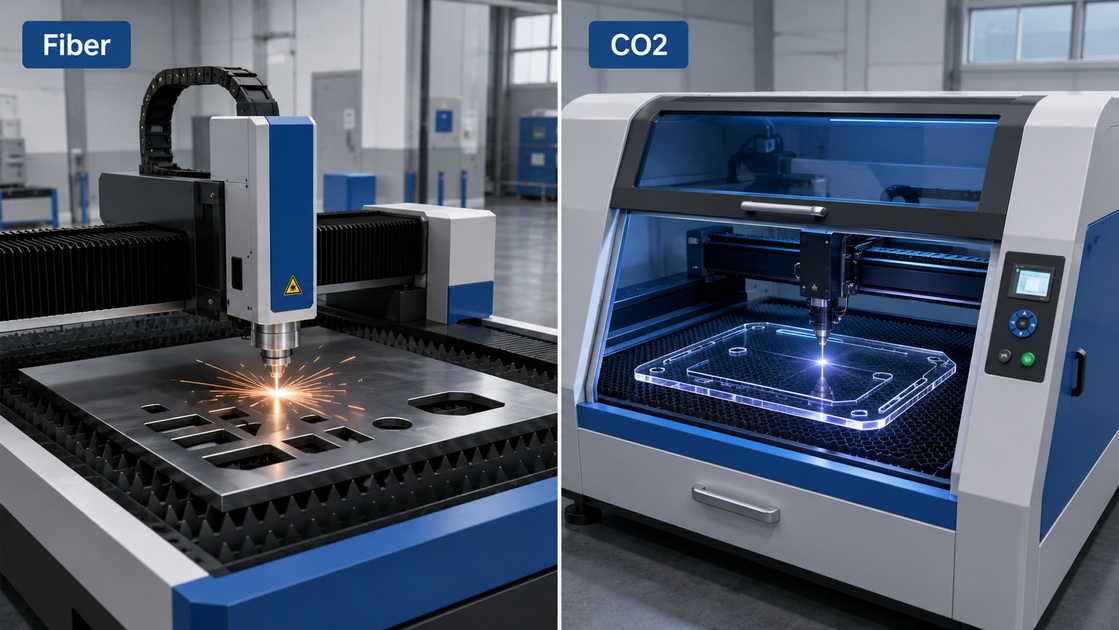
The source article clearly highlights that fiber lasers deliver much higher cutting speeds than CO2 machines on thin‑to‑medium gauge metals. This aligns with broader data: fiber lasers cut faster, especially on high‑volume production lots. [slmlaser]
- Fiber lasers achieve substantially higher feed rates on mild steel, stainless steel and aluminum in the 1–25 mm range, which covers most industrial sheet production. [prima-press]
- Faster cutting translates directly into more parts per hour, which is often the decisive KPI for production managers and CFOs. [hypertherm]
In practice, manufacturers that upgrade from CO2 to fiber often report:
- Shorter cycle times on repeat parts
- Ability to consolidate multiple jobs onto fewer machines
- Reduced need for overtime or additional shifts
The article notes that fiber lasers can reach 30–40% electrical efficiency, while CO2 lasers typically operate in the 10–15% range. Industry research confirms that fiber systems deliver more cutting power per unit of electricity, significantly reducing energy bills over time. [heatsign]
As a result:
- Energy savings accumulate over the 15–20 year lifetime of a fiber laser, yielding a lower cost per part even when purchase price is higher. [vocal]
- Lower energy waste also means less heat generation, which simplifies cooling and improves component longevity. [hypertherm]
CO2 lasers rely on gas‑filled resonators, mirrors and complex optical paths that need regular alignment and replacement. Fiber lasers, by contrast, use solid‑state sources with far fewer optical components, resulting in lower maintenance and more predictable uptime. [thunderlaser]
Key differences:
- Fiber lasers typically require less frequent intervention on optics, leading to more stable, repeatable performance. [hypertherm]
- CO2 systems often incur more unplanned downtime due to mirror contamination, gas issues and alignment drift, especially in high‑dust or high‑usage environments. [cmu]
From a production planning standpoint, fiber lasers make it easier to maintain consistent schedules and delivery commitments, which is critical for OEM contracts.
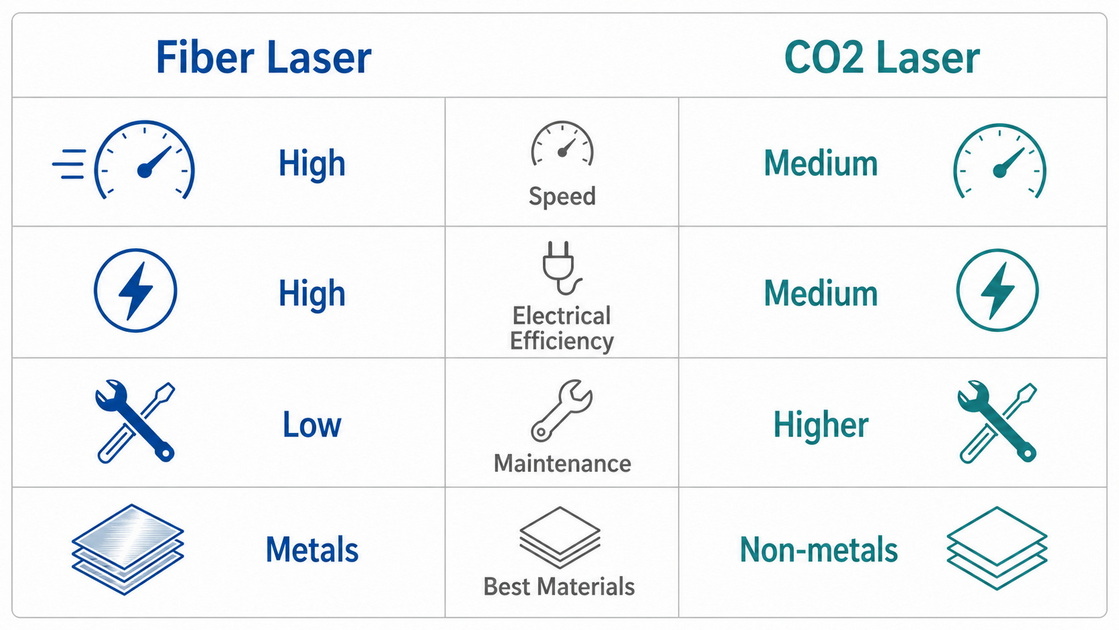
The existing article states that a high‑quality industrial fiber laser can last 15–20 years or more, with laser sources rated for 100,000+ operating hours. This aligns with broader industry expectations that solid‑state lasers outlast traditional CO2 resonators. [fortunebusinessinsights]
- Long service life supports multi‑year capital planning, especially for manufacturers balancing depreciation and productivity. [vocal]
- The extended life of the laser source, combined with lower maintenance, reinforces the case for fiber when calculating total cost of ownership. [slmlaser]
Beyond the article's explanation, current best practice is to model TCO across at least 7–10 years, including: [thunderlaser]
- Initial purchase price and financing
- Energy consumption (kWh per shift)
- Consumables and maintenance parts
- Labour hours for maintenance and supervision
- Downtime and opportunity cost
Multiple independent analyses show that fiber lasers typically win on TCO for industrial metal applications, even when the upfront price is higher than legacy CO2 machines. [fortunebusinessinsights]
The original content focuses on metal cutting, where fiber clearly leads, but it's important to note where CO2 still fits. [redsaillaser]
CO2 lasers can be a better fit when:
- Non‑metallic materials like wood, acrylic, leather, paper or textiles are the main focus. [redsaillaser]
- You run a mixed portfolio of organic and synthetic materials where CO2's wavelength offers cleaner cuts on non‑metals. [redsaillaser]
- Your existing workflows and tooling are optimised around legacy CO2 systems, and near‑term production doesn't justify a major upgrade.
However, for industrial metal fabrication, especially in sheet and plate steel, stainless and aluminium, CO2's advantages have largely been overtaken by fiber's performance and cost profile. [prima-press]
To strengthen E‑E‑A‑T, it helps to look at recent market data on laser cutting machines. [customcy]
- The global laser cutting machines market is projected to reach USD 8.01 billion around 2025, driven largely by demand for fiber‑based systems. [customcy]
- Analysts expect the fiber laser segment to hold around 29–30% share of the laser cutting market by 2026, with continuing growth toward 2034. [heatsign]
- One recent analysis notes that fiber lasers' combination of higher performance and lower power consumption allows businesses to reduce operational expenses significantly. [slmlaser]
In short: the market data reinforces what many production managers have already experienced—fiber lasers are no longer "new technology"; they are the mainstream standard for industrial metal cutting.
The source article already gives strong guidance, but buyers often ask for a simple, actionable checklist. [vocal]
Step 1: Define Your Materials and Thickness
- Mostly metals (steel, stainless, aluminium) → Fiber laser.
- Mostly non‑metals (acrylic, wood, textiles) → CO2 laser.
- Mixed portfolio → Consider separate machines or a hybrid strategy. [thunderlaser]
Step 2: Clarify Production Volume
- High‑volume, high‑mix production → Fiber lasers' speed and automation are critical. [slmlaser]
- Low‑volume, prototype or craft work → CO2 may still be viable if materials dictate. [thunderlaser]
Step 3: Evaluate Automation Needs
- If you plan for lights‑out production, automated loading/unloading or tower storage, fiber lasers' compact, stable beam makes integration easier. [hypertherm]
- CO2 systems can be automated, but typically with more complexity and space requirements. [hypertherm]
Step 4: Calculate TCO, Not Just Purchase Price
- Include energy, consumables, maintenance, and expected uptime in your ROI calculations. [vocal]
- Remember that fiber lasers often have longer service lives and higher resale value, which improves capital utilisation. [heatsign]
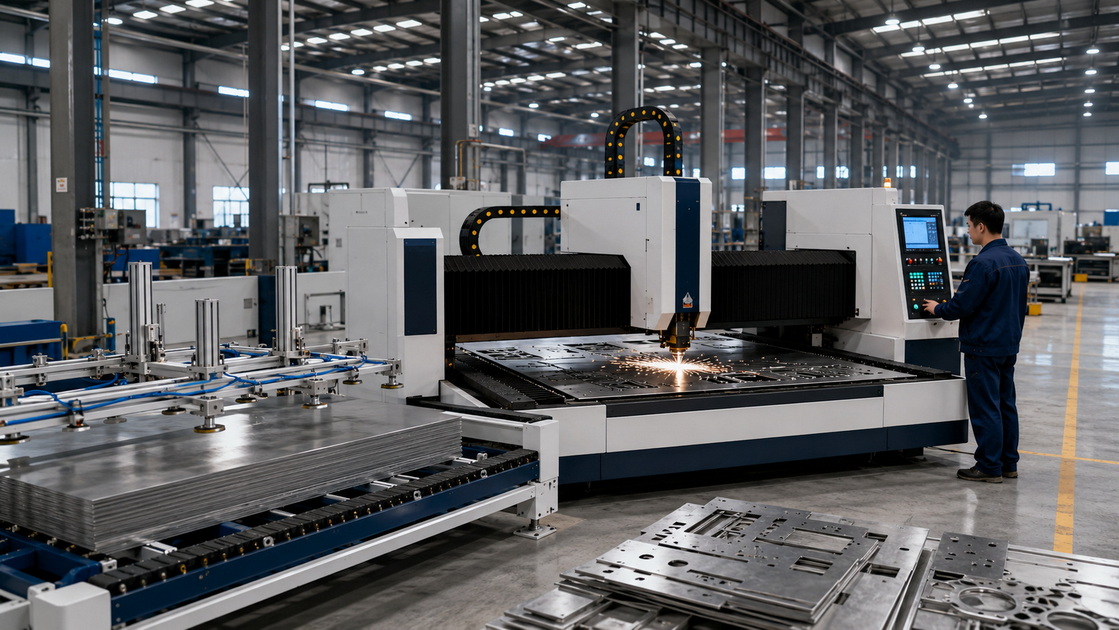
While we cannot share confidential customer names, a typical upgrade journey looks like this: [slmlaser]
- A mid‑sized fabricator running one or two CO2 lasers struggles with rising energy costs and frequent maintenance.
- After analysing throughput and energy usage, they install a single high‑power fiber laser with automation.
- Within 12–18 months, they retire one CO2 system and redirect labour to higher‑value tasks, as the fiber machine covers most daily production needs.
The result is often:
- Higher output from fewer machines
- Lower energy and maintenance costs
- More consistent quality, especially on thin‑to‑medium gauges
This type of transformation is now common in OEM and ODM environments where consistent, predictable output is essential.
| Factor | Fiber Laser | CO2 Laser |
|---|---|---|
| Main applications | Industrial metal cutting, high‑volume production | Non‑metals, legacy metal setups |
| Cutting speed (metals) | Very fast on thin–medium metals | Slower overall on metals |
| Electrical efficiency | Around 30–40% | Around 10–15% |
| Maintenance | Fewer optics, lower maintenance | Frequent mirror/gas maintenance |
| Automation compatibility | Excellent, compact and stable beam | More complex, larger footprint |
| Operating cost (metals) | Lower cost per part over lifetime | Higher long‑term operating cost |
| Service life | 15–20+ years with 100,000+ hour sources | Shorter resonator life |
| Ideal use cases | OEM production, sheet/plate steel fabrication | Acrylic, wood, textiles, legacy non‑metal cutting |
If you are currently evaluating CO2 vs. fiber laser for industrial metal cutting, the data and real‑world performance point strongly toward fiber laser systems as the strategic choice. The next step is to translate this insight into a concrete project plan: [fortunebusinessinsights]
- Define your material mix, thickness range and annual throughput.
- Decide how far you want to go with automation (manual load vs. tower systems vs. full lights‑out).
- Shortlist a small number of industrial‑grade fiber laser suppliers who can support OEM/ODM configurations and long‑term service.
As a manufacturer of fiber laser cutting machines and complete sheet‑metal processing solutions, CNDY‑Press can help you design and configure systems tailored to your OEM and ODM projects, from power selection and table size to automation and integration with your existing lines. [made-in-china]
1. Is there any situation where a CO2 laser is better than a fiber laser?
Yes. CO2 lasers still excel in non‑metal applications such as acrylic, wood, paper and textiles, where their wavelength interacts more favourably with organic materials, producing clean edges and minimal charring. [redsaillaser]
2. How do I know if my production volume justifies investing in a fiber laser?
If your line runs multiple shifts or you face recurring bottlenecks on metal cutting, a fiber laser's higher throughput and lower operating cost often justify the investment within a few years, especially when you include reduced maintenance and energy costs. [vocal]
3. What power level fiber laser should I choose?
Power selection depends on maximum thickness, typical thickness range and desired cutting speed; for many sheet‑metal operations, 3–12 kW covers most needs, while heavier plate operations may benefit from higher power levels. [prima-press]
4. Can I reuse my existing CO2 automation with a new fiber laser?
In some cases, yes, but many plants use an upgrade as an opportunity to modernise material handling, since fiber lasers' smaller footprints and stable beams make them easier to integrate with modern automation. [hypertherm]
5. How can I make sure my new fiber laser stays productive for 15–20 years?
Follow the manufacturer's preventive maintenance schedule, keep cooling and dust control systems in good order, and ensure regular software updates to the CNC and control systems; this preserves performance and extends useful life. [cmu]
1. Moore Machine Tools – "Which Is Better, CO2 or Fiber Laser?"
https://mooremt.com/co2-or-fiber-laser/ [hypertherm]
2. Customcy – "Laser Cutting Machines Statistics for 2026"
https://customcy.com/blog/laser-cutting-machines-stats/ [customcy]
3. Fortune Business Insights – "Laser Cutting Machines Market Size | Growth Report "
https://www.fortunebusinessinsights.com/laser-cutting-machines-market-102879 [fortunebusinessinsights]
4. HeatSign – "Fiber Laser Market Trends & Growth Projections"
https://www.heatsign.com/7-important-facts-on-fiber-laser-market-trends/ [heatsign]
5. Thunder Laser – "How to Choose a Suitable Laser Cutting Machine"
https://www.thunderlaser.com/how-to-choose-a-suitable-laser-cutting-machine [thunderlaser]
6. SLMLaser – "Top 10 Industrial Laser Cutting Machine Trends in 2026"
https://slmlaser.com/industrial-laser-cutting-machine/ [slmlaser]
7. Vocal Media – "How to Choose the Best Laser Cutting Machine for Your Business"
https://vocal.media/journal/how-to-choose-the-best-laser-cutting-machine-for-your-business [vocal]
8. PrimaPress – "Fiber Laser Cutting Machine Manufacturer"
https://www.prima-press.com/fiber-laser-cutter/ [prima-press]
9. RedSail Laser – "A Buyer's Guide to Choosing the Right Fabric Laser Cutting Machine"
https://www.redsaillaser.com/archives/4773.html [redsaillaser]
10. Made‑in‑China – Example OEM/ODM Fiber Laser Cutting Machines
https://www.made-in-china.com/price/prodetail_Laser-Cutting-Machine_cOmThbrEbyGF.html [made-in-china]


