


Views: 222 Author: CNDY-Press Publish Time: 2026-06-05 Origin: Site


Content Menu
● What Is a Bending Machine in Modern Sheet Metal Fabrication?
● Core Types of Bending Machines (With Real-World Use Cases)
>> 1. CNC Press Brakes (Sheet Metal Bending Workhorse)
>> 2. Roll Bending Machines (Plate Rolls)
>> 3. Tube and Pipe Bending Machines
>> 4. Section and Profile Bending Machines
● How CNC Press Brakes Actually Work (Expert-Level Overview)
>> Working Principle in Practice
>> Main Drive Types: Hydraulic, Electric, Hybrid
● CNC Press Brake vs. Other Bending Machines
● How to Choose the Right Bending Machine (Engineer's Checklist)
>> 1. Material Type, Thickness, and Width
>> 2. Bend Angle and Radius Requirements
>> 3. Precision, Repeatability, and Automation Level
>> 4. Production Volume and Mix
>> 5. Budget, Lifecycle Cost, and Energy Use
● Why Many OEMs Standardize on CNC Press Brakes
● Best Practices to Get the Most from a CNC Press Brake
● Why Partner With a Specialist Manufacturer for CNC Press Brakes and Bending Solutions
● Call to Action: Plan Your Next Bending Machine Upgrade
● FAQ
CNC press brakes sit at the heart of modern sheet metal fabrication, and choosing the right bending machine type will make or break your productivity, precision, and project profitability. As someone who has helped dozens of OEM and ODM customers upgrade from manual brakes to CNC press brakes, I see the same pattern: teams that truly understand bending machine types make better investment decisions, waste less material, and deliver more consistent parts. [alekvs]
In practical shop-floor terms, a bending machine is any machine that uses force and tooling to plastically deform metal along a straight or curved line to achieve a required angle, radius, or profile. It does this by pressing the workpiece between tools (punch and die, rolls, or form blocks), controlling the bend depth and position until the metal takes on its final shape. [en.wikipedia]
From an engineer's perspective, bending machines are a core part of the forming stage in the metal fabrication workflow, right after cutting and before welding, assembly, or surface treatment. In export-oriented factories and contract manufacturing lines, bending machines often run in multi-shift operation, so factors like repeatability, setup time, and automation level matter just as much as pure tonnage. [e-ci]
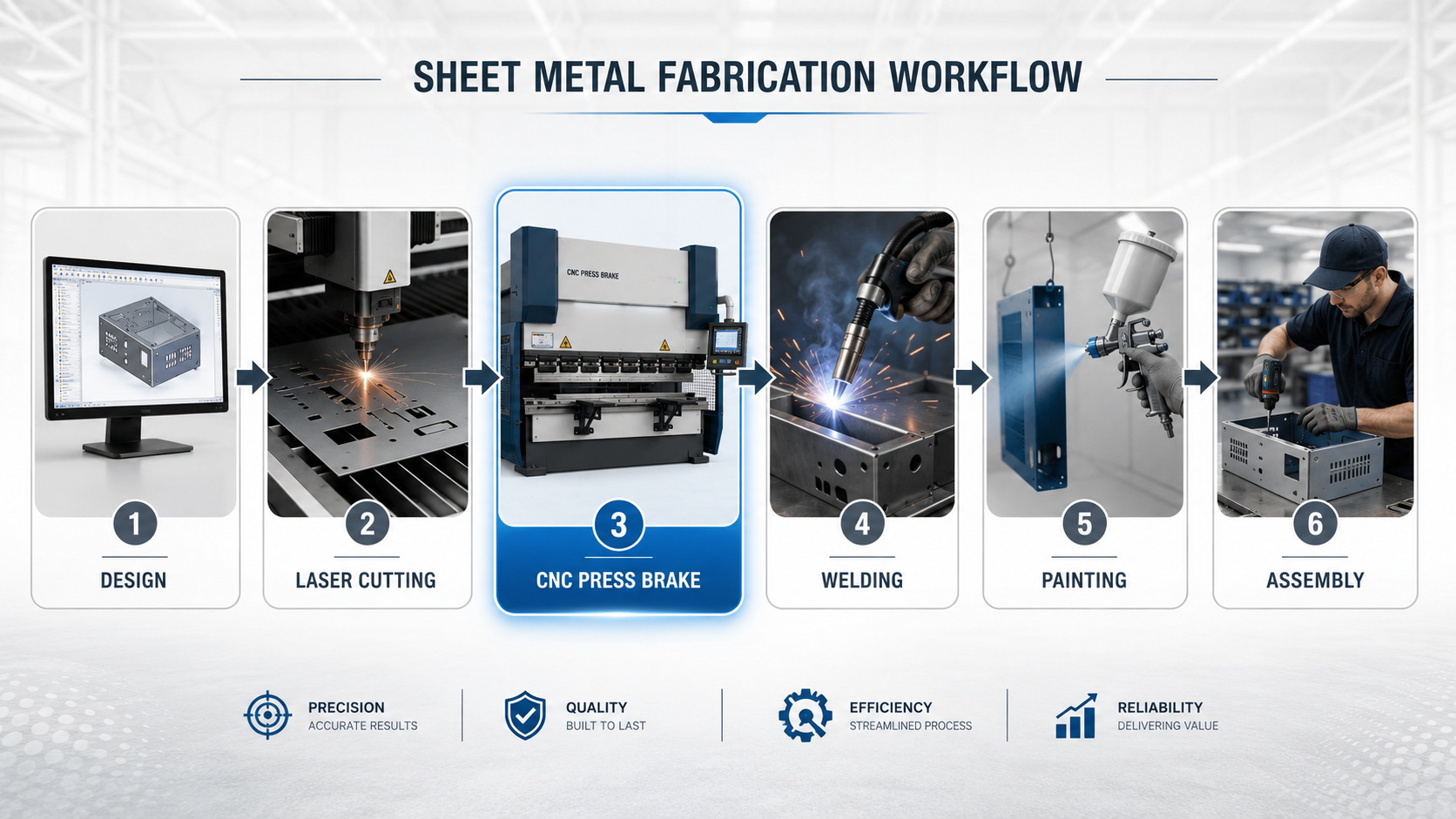
Below is a structured overview of the main bending machine types you'll encounter, and where each one makes the most sense in a real production environment. [fab-line]
A CNC press brake is a press that bends sheet metal by clamping the workpiece between a punch and die, with all key parameters (backgauge position, stroke, crowning, bend sequence) controlled by a CNC system. The operator inputs angle, material, thickness, and tooling data, and the machine automatically executes precise bends with high repeatability across large batches. [accurl]
Key advantages from the perspective of an OEM buyer:
- High precision and repeatability for complex multi-bend parts. [dimarmfg]
- Fast changeovers using CNC programs, ideal for high-mix, low-volume jobs. [alekvs]
- Compatibility with bending simulation, offline programming, and angle measurement systems. [accurl]
Typical applications include electrical enclosures, HVAC housings, cabinets, automotive brackets, agricultural machinery panels, and general sheet metal products. For many factories, the CNC press brake becomes the central forming asset around which upstream cutting and downstream welding are planned. [accurl]
Roll bending machines (plate rolls) use three or four powered rolls to form flat plate into cylindrical or conical shapes. As the sheet passes repeatedly between the rolls, the adjustable central roll induces curvature until the desired diameter is reached. [fab-line]
They are the preferred choice for:
- Large tanks, pressure vessels, and silos
- Shipbuilding and offshore structures
- Large-diameter ducts and structural pipes
Users value them for their ability to handle thick, wide plates with reasonably high productivity, where traditional press brake bending would require excessive tonnage or multiple hits. In many heavy-industry shops, a CNC press brake and a plate roll are installed side-by-side to cover both box-type and cylindrical work. [accurl]

Tube bending machines are dedicated to bending round, square, or rectangular tubes using methods like rotary draw bending, compression bending, and mandrel bending. They focus on maintaining inner diameter, minimizing wrinkling and ovality, and meeting tight positional tolerances along 3D tube paths. [fab-line]
These machines are critical in:
- Automotive exhaust systems, frames, and roll cages
- Aerospace tube assemblies
- Plumbing, HVAC, and hydraulic piping
In high-volume production, CNC tube benders with automatic loading and servo-controlled axes enable fully automated, multi-plane bends in a single cycle, significantly reducing labor per part. For a manufacturer that already owns CNC press brakes, adding tube bending capability is often the next logical expansion to cover more of the customer's BOM. [fab-line]
Section bending machines and profile bending machines handle structural shapes (I-beams, H-beams, channels, angles) and custom extrusions, forming them into arcs, rings, or curved profiles. They typically use a three-roll configuration, applying high bending forces for heavy sections while controlling distortion. [fab-line]
They are widely used for:
- Building and bridge structures
- Curved architectural elements and facades
- Industrial frames and machinery bases
Fabricators appreciate their durability and ability to process large sections that would be impractical on standard press brakes. When combined with CNC control, profile benders can deliver repeatable radii across long production runs, which is essential for export projects with strict inspection requirements. [e-ci]

Although the core principle is simple—pressing a punch into a die to bend metal—the actual performance of a CNC press brake depends on multiple subsystems working together. [en.wikipedia]
In a typical bending cycle:
1. The operator positions the sheet against the backgauge according to the CNC program. [alekvs]
2. The ram (top beam) descends, bringing the punch toward the V-die.
3. As force increases, the sheet undergoes plastic deformation along the bend line until the target angle is reached. [dimarmfg]
4. The CNC control compensates for material springback and any deflection in the frame using crowning systems and angle feedback. [dimarmfg]
Modern CNC press brakes often support bending modes like air bending, bottoming, and coining, with air bending being the most common for flexible angle control and reduced tonnage requirements. [krollit]
From an engineering and energy-efficiency standpoint, the drive system is a crucial differentiator. [e-ci]
- Hydraulic press brakes:
- High tonnage, robust, proven for thick materials and heavy-duty tasks. [e-ci]
- Well-suited to general fabrication and heavy industry applications.
- Electric / servo-electric press brakes:
- Use servo motors instead of hydraulic circuits, delivering high accuracy, fast speeds, and lower energy consumption. [accurl]
- Ideal for thin to medium sheet metal, precision components, and factories pursuing green manufacturing.
- Hybrid press brakes:
- Combine hydraulic power with electronic servo control to balance power and precision. [accurl]
As an OEM, we've seen many global customers move from fully hydraulic to CNC servo-electric or hybrid press brakes to reduce operating costs, improve angle consistency, and meet sustainability targets in their supply chain. [accurl]
For decision-makers comparing technologies, the table below summarizes when a CNC press brake is your best option versus alternative bending machines. [accurl]
| Machine type | Best for | Key strengths (expert view) |
|---|---|---|
| CNC press brake | Sheet metal, boxes, brackets | High precision, fast setup, flexible angles, excellent for OEM/ODM work. (alekvs) |
| Roll bending machine | Cylinders, cones, large plates | Handles thick/wide plate, ideal for tanks and vessels. (fab-line) |
| Tube bending machine | Tubes and pipes | Preserves cross-section, accurate 3D tube paths. (fab-line) |
| Section/profile bender | Beams, channels, angles, extrusions | High force, curves large structural sections. (fab-line) |
For most sheet metal fabrication businesses, the CNC press brake is the first and most important investment; other bending machines are added later based on product mix and industry focus. [alekvs]
When I review equipment specifications for customers, I recommend evaluating bending machines against five core dimensions. [fab-line]
Different machines and models are designed for specific material ranges and working lengths. [fab-line]
- Confirm maximum thickness and width for steel, stainless, and aluminum.
- Check required tonnage based on your thickest material and longest bend.
Choosing a machine that is undersized leads to poor angles, premature wear, and in worst cases, structural damage to the frame. [dimarmfg]
Your parts may demand tight radii, large radii, or a combination of both.
- Verify that available tooling (punch and V-die) covers your smallest and largest radius needs. [alekvs]
- Confirm the machine's ability to maintain angle accuracy across the full bending length.
In many CNC press brakes, advanced crowning and deflection compensation systems are essential to keep angles consistent from the center to the edges of long bends. [dimarmfg]
If you serve export OEMs or high-spec industries (aerospace, medical, rail), repeatability is non-negotiable. [e-ci]
Look for:
- CNC controls from reputable brands (e.g., Delem, ESA, Cybelec) with graphical programming. [alekvs]
- Servo backgauges with multi-axis control (X, R, Z) for complex bending sequences. [alekvs]
- Options like angle measurement systems and automatic tool clamping for reduced setup time. [alekvs]
These features directly reduce scrap rates and training time for new operators, which is especially valuable in factories facing labor shortages.
Your production pattern should heavily influence the machine choice.
- High-volume, low-mix: prioritize cycle time, automation, and robust hydraulics or hybrids. [e-ci]
- High-mix, low-volume or project-based: prioritize CNC flexibility, fast setup, and offline programming. [alekvs]
CNC press brakes with memory for hundreds of programs and tool libraries are ideal for contract manufacturers handling many small batches for different customers. [alekvs]
Beyond the purchase price, consider:
- Energy consumption (servo-electric machines can dramatically reduce power usage). [accurl]
- Expected maintenance intervals and availability of spare parts.
- Software and training costs for CNC systems.
For shops in regions with high energy prices, upgrading from purely hydraulic to servo-electric or hybrid press brakes can significantly reduce total cost of ownership over the machine's life. [accurl]

Consider a global OEM that produces sheet metal cabinets and control panels for automation equipment. Their challenges typically include frequent design changes, multiple variants per model, and tight assembly tolerances.
By shifting from manual brakes to CNC press brakes and standardizing bending programs:
- They cut average setup time per job from tens of minutes to just a few minutes.
- Angle deviations dropped, reducing rework in assembly and improving fit-up with laser-cut parts. [dimarmfg]
- Uniform quality across shifts made it easier to qualify the plant as a long-term strategic supplier for overseas customers.
This is exactly the pattern we see across many of our OEM and ODM partners: once bending is digitized and repeatable, the entire production flow becomes more predictable and scalable.
To maximize ROI from a CNC press brake purchase, we advise customers to treat it not just as a machine, but as part of a digital, data-driven process. [accurl]
- Standardize tooling and bending data
Build and maintain a central database of tools, materials, and angle corrections inside the CNC control to ensure consistency between operators and shifts. [alekvs]
- Invest in operator training
Skilled operators who understand material behavior, springback, and safety can unlock the full precision potential of the machine and reduce scrap. [dimarmfg]
- Integrate with upstream and downstream processes
Coordinate with laser cutting or punching to optimize nesting and bend allowances, and align bending with welding and assembly jigs to minimize cumulative tolerance stack-up. [accurl]
For manufacturers that frequently take on OEM and ODM projects, partnering with a supplier that focuses on CNC press brakes and complete sheet metal solutions offers several strategic benefits. [mfgempire]
- Application-driven configuration
A specialist can help you select the right combination of tonnage, working length, CNC system, backgauge axes, and tooling based on your actual part drawings and production goals. [lform]
- Long-term scalability
As your export business grows, you may need to add tandem press brakes, automation, or additional bending machines such as tube benders or profile benders; a focused manufacturer can design a growth roadmap that keeps your line interoperable. [accurl]
- Process support and after-sales service
Expert guidance on programming, tool selection, and maintenance helps ensure your bending performance remains stable, even as you introduce new products or materials. [lform]
If your goal is to deliver consistent, high-quality sheet metal parts to demanding international buyers, a dedicated CNC press brake partner becomes a key part of your competitive advantage.
If you are evaluating new bending equipment or upgrading from manual or conventional hydraulic brakes, now is the time to benchmark your options in terms of precision, energy efficiency, automation, and lifecycle cost. [accurl]
Share your current part drawings, material range, and target output with a specialized press brake manufacturer to receive a tailored configuration and bending process proposal aligned with your OEM or ODM strategy. [lform]
1. What is the main difference between a CNC press brake and a manual press brake?
A CNC press brake uses a computerized control system to manage backgauge positions, bending depth, sequences, and compensation automatically, while a manual press brake relies heavily on operator skill and manual adjustment, resulting in lower repeatability and longer setup times. [han-chine]
2. When should I choose a roll bending machine instead of a press brake?
If your primary products are large cylinders, cones, or curved shells (such as tanks and silos), a roll bending machine is more efficient and better suited to handling thick, wide plates than a press brake. [fab-line]
3. Are servo-electric press brakes powerful enough for industrial production?
Yes, modern servo-electric press brakes combine high positioning accuracy with competitive bending force for thin and medium sheet metal, while providing lower energy consumption and cleaner operation compared to traditional hydraulics. [accurl]
4. How do I estimate the required tonnage for my CNC press brake?
Required tonnage depends on material type, thickness, bend length, and V-die opening; manufacturers usually provide tonnage charts or calculators to help you match your parts to the correct machine capacity. [han-chine]
5. What kind of maintenance does a CNC press brake require?
Regular tasks include checking and replacing hydraulic oil (for hydraulic or hybrid machines), inspecting electrical components, lubricating moving parts, calibrating the backgauge, and verifying tooling condition to maintain long-term accuracy and safety. [e-ci]
1. Fab-Line Machinery. "What Is a Bending Machine? A Guide to Its Types & Uses." (2023). [fab-line]
2. Accurl. "Press Brake Bending: Basics, Types & Tips." (2023). [accurl]
3. Alekvs. "What Is a Press Brake? Types and Functions Explained." (2025). [alekvs]
4. ECI. "Understanding CNC Press Brakes: Hydraulic, Mechanical, Electric and Hybrid Differences." (2025). [e-ci]
5. Accurl. "How Does a Servo-Electric Press Brake Work?" (2022). [accurl]
6. Accurl. "What is an Electric Press Brake: Definition, Types, Applications ..." (2023). [accurl]
7. Dimar Manufacturing. "What Is A Press Brake And How Does It Work?" (2026). [dimarmfg]
8. Wikipedia. "Press brake." (accessed 2026). [https://en.wikipedia.org/wiki/Press_brake] [en.wikipedia]
9. Lform. "Guide to Dominate Search Rankings in Industrial Markets." (2025). [lform]


