


Views: 268 Author: CNDY-Press Publish Time: 2026-10-27 Origin: Site


Content Menu
● CNC Press Brake vs Sheet Metal Brake Machine at a Glance
● What Is a Conventional Sheet Metal Brake?
>> Why Manual Does Not Mean Imprecise
● Bending Capability: Compare Parts, Not Machine Labels
● Tonnage and Gauge Ratings Mean Different Things
>> Conventional Brake Capacity
● Accuracy and Repeatability: Understand the Difference
>> CNC Control Helps Organize Repeat Work
>> Compensation Is Not a Universal Cure
● Production Speed: Measure the Complete Job
>> Request a Timed Demonstration
● Tooling and Bend Sequence Can Decide the Purchase
● Operator Skills and Machine Safety
>> Evaluate Safeguarding With the Actual Application
● Purchase Price vs Total Ownership Cost
>> Build a Comparable Cost Model
● A Practical Acceptance-Test Plan
>> Test More Than One Easy Part
● How CNDY-Press Supports Equipment Selection
>> 1. Is a CNC press brake a sheet metal brake machine?
>> 2. Can a manual brake produce accurate parts?
>> 3. Does a CNC press brake automatically correct every bend?
>> 4. Is higher tonnage always better?
>> 5. Can one machine process mild steel, stainless steel, and aluminum?
The CNC press brake vs sheet metal brake machine comparison begins with an important distinction: these terms are not mutually exclusive. A CNC press brake is a type of sheet metal bending machine. However, buyers often use "sheet metal brake" to describe a manual leaf brake or box-and-pan brake.
The practical comparison is therefore between a computer-controlled punch-and-die machine and a conventional folding brake. They differ in how they form metal, position workpieces, handle complex parts, and support repeat production.
For purchasing managers, the right choice depends on the parts—not simply whether one machine has a more advanced controller.
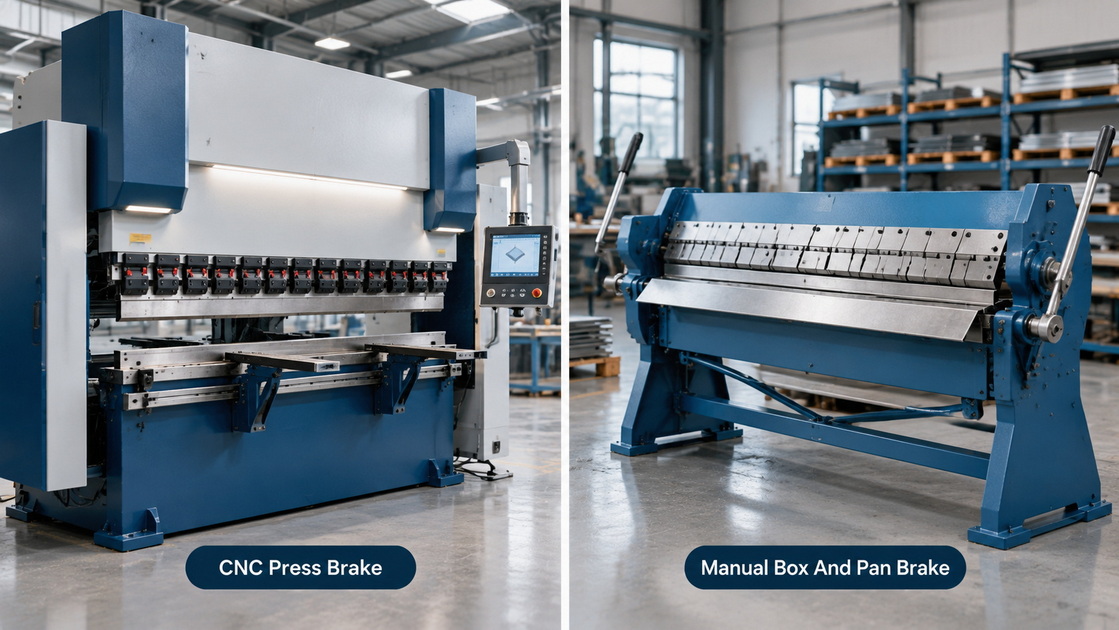
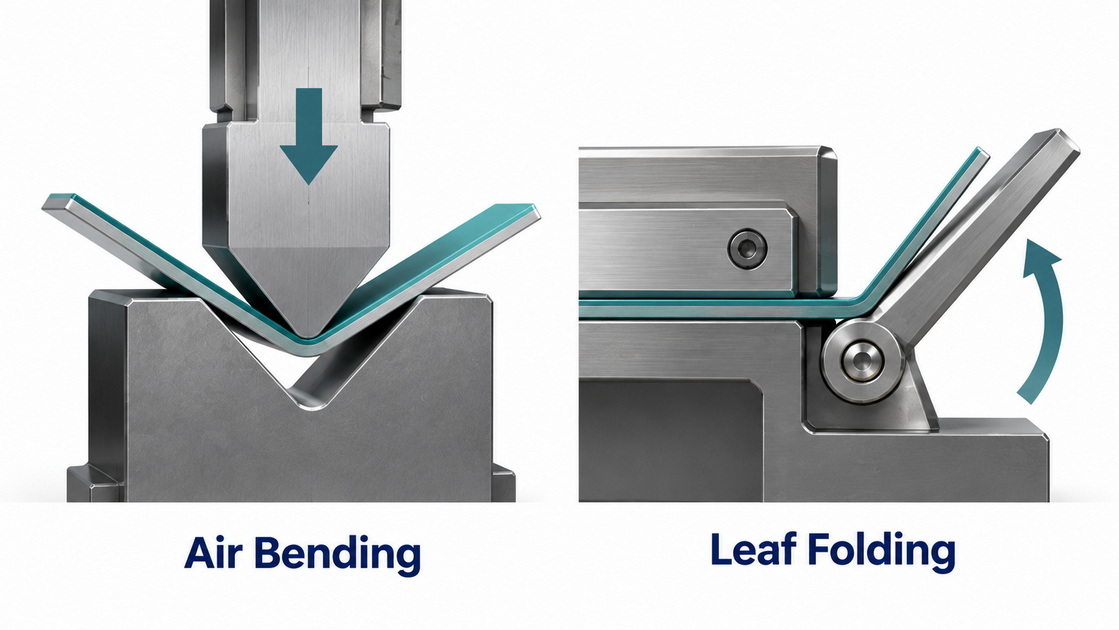
The key distinction is mechanism: how the machine applies force to create the bend.
A press brake uses a punch and die. A conventional leaf brake clamps the sheet and raises a bending leaf to fold the exposed material.
| Comparison point | CNC press brake | Conventional leaf or box-and-pan brake |
|---|---|---|
| Forming method | Punch presses material into a die | Clamped material is folded by a bending leaf |
| Control | Programmable machine functions | Manual adjustments and operator-controlled movement |
| Positioning | Configured backgauge and positioning systems | Stops, scales, and manual positioning |
| Tooling | Interchangeable punches and dies | Clamping tools, fingers, and bending components |
| Typical applications | Multi-bend parts, brackets, enclosures, repeat production | Straight folds, panels, trays, and suitable box shapes |
| Setup requirements | Tool selection, programming, positioning, and validation | Clamping, finger arrangement, stops, and manual adjustment |
| Main purchasing question | Does the configuration match the part family? | Does the rated capacity and geometry suit the work? |
This comparison does not cover every machine sold as a sheet metal brake. Powered folding machines can also have numerical control and sophisticated automation.
A CNC press brake forms sheet metal between an upper punch and a lower die. The controller manages specified movements and stores production programs.
In air bending, the punch pushes the sheet into the die opening without fully pressing it against the die walls. Punch penetration influences the resulting angle. Required travel and force depend on tooling, material, and part characteristics.
The configuration varies by machine.
A quotation should identify which functions are programmable, such as ram movement, backgauge positioning, bend sequencing, and compensation features.
Do not assume that "CNC" means automatic loading, automatic tool changes, or unattended production. Automated bending cells involve additional equipment and integration beyond the basic press brake.
For buyers, the controller specification should describe actual functions—not simply a brand name or screen size.
A conventional leaf brake clamps the workpiece along a bend line. The operator moves the bending leaf to form the exposed section.
A box-and-pan brake uses removable fingers to provide clearance for certain three-dimensional shapes.
Manufacturer examples show why capacity must be read carefully. Tennsmith lists different mild-steel capacities for the same machine depending on whether its bending bar or angle remains installed. Its published ratings also specify flange conditions.
Manual brakes can produce accurate work within their rated capabilities.
Some models include repeat-bend stops and adjustable clamping. However, maintaining dimensions across a job depends on setup, material consistency, positioning, and operator technique.
For a small workshop producing suitable parts, simplicity can be an advantage rather than a limitation.
A machine should be selected against representative drawings.
A CNC press brake may be appropriate for a family of brackets requiring several bends and controlled positioning. A leaf brake may be practical for straightforward panels or compatible trays.
Neither conclusion should be made from thickness alone.
Review:
- Bend length.
- Material grade and thickness.
- Required inside radius.
- Minimum flange length.
- Distance between bends.
- Return flanges.
- Part depth and clearance.
- Surface-marking restrictions.
A machine may have sufficient force yet lack the clearance needed for the final bend.
Similarly, a box-and-pan brake may form a shallow tray successfully but encounter limitations with a deeper or more enclosed design.
Press brake specifications commonly emphasize force and working length. Conventional brakes often list material-specific thickness or gauge ratings.
These measures cannot be compared directly.
Required force depends on the bending method, material properties, bend length, thickness, and tooling.
Air bending and bottom bending use different contact conditions. Bottom bending applies additional pressure after the sheet conforms to the tools, so the methods should not be treated as interchangeable.
Request a tooling-supported capacity assessment for the intended parts. Also verify the rated limits of punches, dies, holders, and other load-bearing components.
Read the full rating, including material type, bending length, minimum flange, and tooling arrangement.
For example, Tennsmith's bench-brake specifications distinguish models rated for 16-gauge mild steel from lighter models rated for 22-gauge material. These are model-specific ratings, not universal limits for manual brakes.
Never transfer a mild-steel rating directly to stainless steel or another material without manufacturer confirmation.
Accuracy concerns closeness to the specified result. Repeatability concerns consistency across repeated operations.
Neither is established by controller resolution alone.
A finished bend is influenced by material behavior, tooling, positioning, machine condition, and setup.
Stored programs and controlled positioning can reduce repeated manual adjustment.
However, the first approved part remains important. Recalling a program does not establish that a new material batch will behave identically.
The air-bending process itself depends on material and tooling characteristics, which must be considered when establishing the required punch movement.
Some press brakes include crowning to compensate for structural deflection along the bending length.
Trade coverage describes how material properties and bending force affect deflection and compensation requirements. Buyers should therefore ask how the proposed machine addresses long-part angle consistency rather than assuming that a compensation feature eliminates all variation.
Specify finished-part acceptance criteria and demonstrate them on representative samples.
Ram speed is only one part of production time.
A more useful comparison includes:
1. Drawing review.
2. Tool preparation.
3. Programming or manual setup.
4. First-piece inspection.
5. Loading and repositioning.
6. Bending.
7. Unloading and inspection.
8. Rework.
A manual brake may complete a simple one-off task without programming. A CNC press brake may offer advantages when the job involves repeated positioning and multiple bends.
For small batches with frequent changes, setup quality can matter more than the fastest advertised movement.
Provide the same drawing, material, quantity, and inspection requirements to each supplier.
Ask for measured setup time, total production time, acceptable output, and operator involvement.
Treat a demonstration as evidence for that tested part—not a blanket productivity guarantee.
One overlooked purchasing risk is selecting the machine before checking the full bend sequence.
A part may be feasible during the first operations but collide with the tooling or machine during the final bend.
Before ordering, request:
- Proposed tooling.
- Bend order.
- Clearance review.
- Part-support requirements.
- Required repositioning.
- Inspection points.
- Alternative arrangements for difficult features.
For a conventional brake, examine finger positions and clearance around previously formed flanges.
For a press brake, review tool profiles, machine opening, and access around the part.
Do not accept a flat-pattern demonstration as proof that the completed component can be formed.
CNC equipment changes the skill requirement; it does not remove it.
Operators still need to understand tooling, workpiece support, program verification, and abnormal conditions. Manual equipment also requires training and safe working practices.
OSHA identifies press-brake hazards associated with the point of operation, moving workpieces, and accidental cycling through controls such as foot pedals.
Require a qualified assessment of the proposed machine, tooling, workpiece, and operating method.
The purchasing review should cover appropriate guarding, safety functions, access control, training, and hazardous-energy procedures.
OSHA's machine-guarding guidance also emphasizes effective lockout/tagout arrangements when working on or around relevant equipment.
Never treat a controller upgrade as a substitute for a suitable safeguarding system.
A conventional brake often represents a simpler investment, but the lowest initial price is not necessarily the lowest cost per acceptable part.
A CNC press brake introduces a different cost structure, potentially including programming, software, tooling, service, and more complex infrastructure.
| Cost category | What to include |
|---|---|
| Acquisition | Machine, options, and required accessories |
| Tooling | Initial set and future replacements |
| Installation | Freight, handling, utilities, and commissioning |
| Labor | Setup, operation, inspection, and handling |
| Quality | Scrap, rework, and first-piece adjustment |
| Maintenance | Consumables, service, calibration, and downtime |
| Expansion | Additional tooling, software, or automation |
Compare the cost per acceptable part at realistic annual volumes.
Avoid a payback estimate that assumes every working hour becomes productive bending time.
The factory acceptance test should reflect the intended production mix.
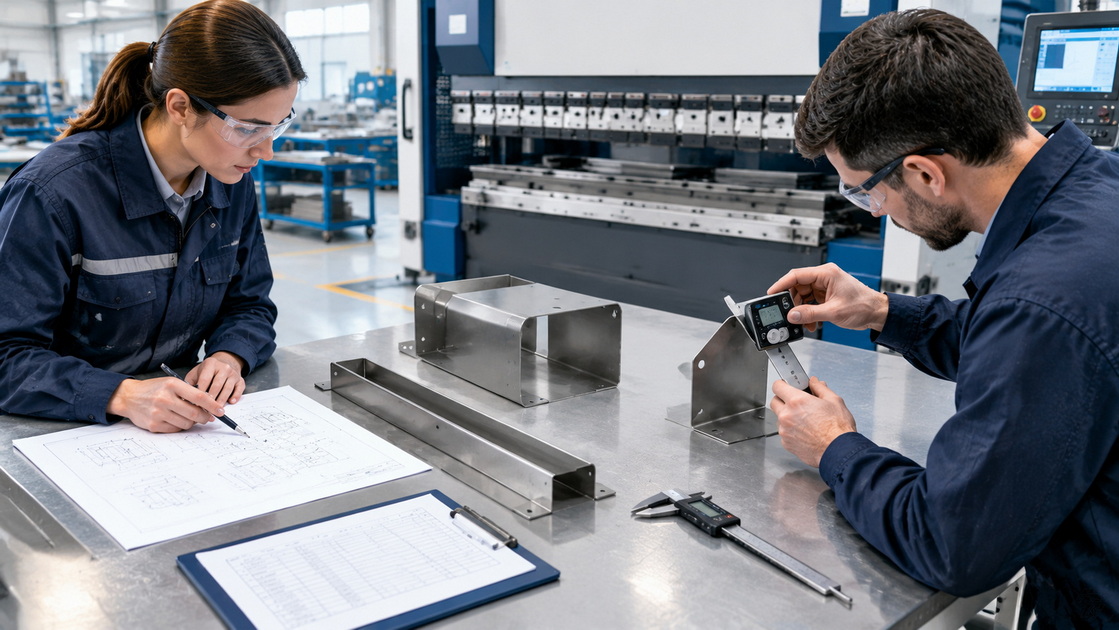
Include, where relevant:
- A long component.
- A multi-bend enclosure.
- A short-flange part.
- The thickest required material.
- A cosmetically sensitive component.
- A repeated batch.
Record the material grade, measured thickness, tooling, settings, operator involvement, and inspection method.
Define dimensional and angular tolerances, sample quantities, measurement locations, and treatment of rework.
A supplier's positioning specification is not the same as a guarantee for every finished part.
Also clarify installation checks, commissioning responsibilities, training, documentation, and service support before shipment.
CNDY-Press describes its business as the research, development, manufacture, sales, and servicing of CNC press brakes and related sheet metal processing equipment.
According to the supplied company background, it also undertakes OEM and ODM projects and offers customized production.
For a useful inquiry, submit representative drawings rather than requesting a machine by tonnage alone.
Include material grades, thickness range, longest bends, tolerances, expected quantities, available space, electrical requirements, and destination.
Yes. "Sheet metal brake" is a broad term. The comparison usually concerns a CNC punch-and-die machine versus a conventional leaf or box-and-pan brake.
Yes, within the machine's rated capacity and suitable geometry. Manufacturer examples include adjustable clamping and repeat-bend stops, but results still depend on setup and operation.
No. Available control and measurement functions vary. Ask which compensation or angle-measurement features are included and what finished-part performance will be demonstrated.
No. Force is only one requirement. Working length, tooling limits, clearance, minimum flanges, and the bend sequence must also match the application.
Possibly, but capacity and tooling must be checked for each material and part. Do not apply a published rating for one material automatically to another.
1. [TRUMPF — Bending]. Supports the descriptions of punch-and-die bending, air bending, bottom bending, and influencing process variables.
2. [TRUMPF — Bending Machines]. Supports the distinction between machine control and broader automated bending systems.
3. [Tennsmith — Connecticut Series Box and Pan Brakes]. Supports model-specific capacity conditions, clamping adjustment, repeat-bend stops, and box-forming specifications.
4. [Tennsmith — Bench Model Hand Brakes]. Supports examples of material-specific manual-brake ratings.
5. [MetalForming Magazine — Crowning Achievements Deliver Press Brake Accuracy and Process Efficiency]. Supports the discussion of force, deflection, and crowning.
6. [OSHA — Powered Press Brakes]. Authoritative guidance on press-brake hazards and safeguarding considerations.
7. [OSHA — Machine Guarding: Presses]. Supports the discussion of machine guarding and hazardous-energy control.


