


Views: 224 Author: CNDY-Press Publish Time: 2026-09-04 Origin: Site


Content Menu
● What Is a Hydraulic Press Brake?
● CNC Press Brake vs Hydraulic Press Brake at a Glance
● Bend Accuracy and Repeatability
>> Why Material Springback Matters
● Productivity: Setup Time Often Matters More Than Cycle Time
>> CNC Press Brake Productivity Advantages
>> Conventional Hydraulic Press Brake Advantages
● Cost Comparison: Initial Price vs Total Cost of Ownership
● Tonnage Selection: The Most Common Buyer Mistake
>> Expert Tip: Check Tonnage Per Meter
● When a CNC Press Brake Is the Better Choice
● When a Hydraulic Press Brake Is the Better Choice
● Safety and Compliance Should Influence Your Decision
● A Practical Selection Process for Buyers
>> 2. Identify Your Production Pattern
>> 3. Compare Complete Machine Configurations
>> 4. Request a Real Part Test
>> 5. Define Acceptance Criteria in Writing
● CNDY-Press Support for Customized Bending Projects
>> 1. Is a CNC press brake hydraulic?
>> 2. Is a CNC press brake more accurate than a hydraulic press brake?
>> 3. What tonnage press brake do I need for 3 mm steel?
>> 4. Can I bend stainless steel with a hydraulic press brake?
>> 5. Is a hydraulic press brake cheaper than a CNC press brake?
CNC press brakes and hydraulic press brakes are both essential machines for sheet metal fabrication, but they serve different production priorities. A CNC press brake is typically the stronger choice for repeatable, complex, high-mix production, while a conventional hydraulic press brake can be a practical option for simpler bending work, lower initial budgets, and operations led by experienced operators.
For buyers sourcing machinery for a new fabrication line, an upgrade project, or an OEM equipment program, the right question is not simply, "Which machine costs less?" The more valuable question is: Which press brake will produce the required part quality, at the required output, with the lowest operational risk over its working life?
At CNDY-Press, Maanshan Deyan Precision Machinery Technology Co., Ltd. works with global sheet metal fabricators, distributors, and OEM/ODM equipment partners. In practical machine-selection discussions, the decision often depends on part complexity, bending tolerance, material range, batch size, operator skill, safety needs, and future automation plans.
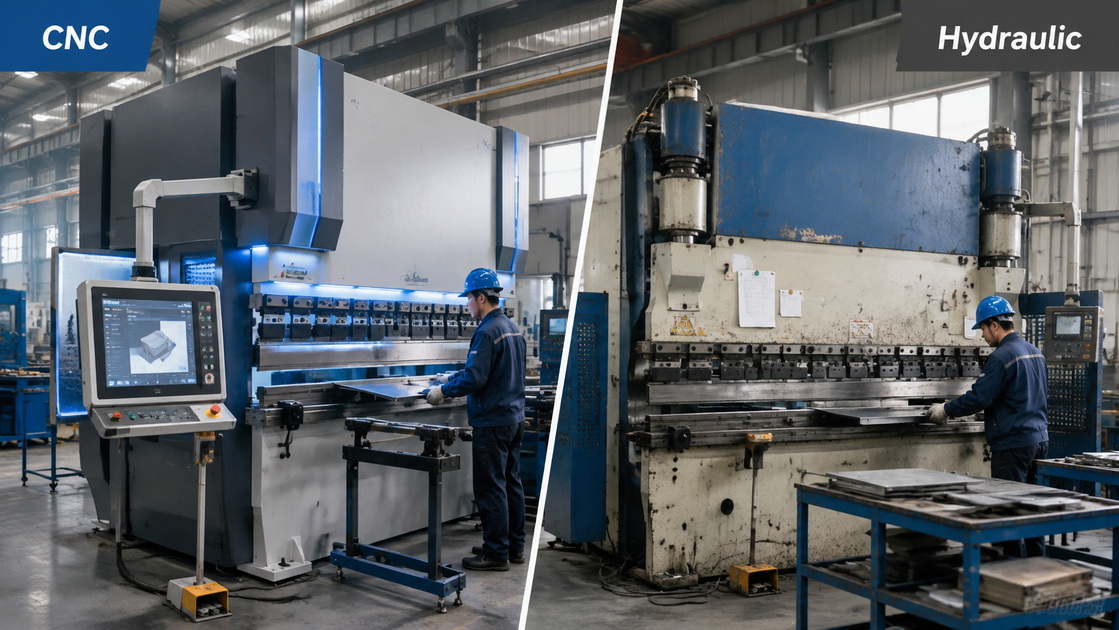
A CNC press brake is a sheet metal bending machine controlled by a computer numerical control system. It commonly uses hydraulic cylinders to move the ram, but its key difference is the digital control of the bending process.
The CNC controller can manage:
- Ram depth and stroke position
- Backgauge positioning
- Bend sequence
- Multiple-axis movement
- Crowning compensation
- Tool and die selection
- Angle correction
- Part-program storage
- Repeat production settings
Many CNC machines use electro-hydraulic synchronization. This means the left and right hydraulic cylinders can be controlled independently and precisely, helping the ram remain parallel during bending.
A typical CNC press brake may include X, R, Z1, and Z2 backgauge axes. Higher-specification machines may add X1, X2, R1, R2, or other axes for complicated workpieces and automated material handling.
The major advantage is consistency. Once a validated program is created, the machine can reproduce the same bending sequence across hundreds or thousands of parts with less dependence on one operator's manual judgment.
A hydraulic press brake uses hydraulic cylinders to drive the ram downward and form sheet metal with a punch and V-die. In the broadest sense, many CNC press brakes are also hydraulic machines because they use hydraulic power.
However, in everyday purchasing language, "hydraulic press brake" often refers to a more conventional machine with manual controls, a basic NC controller, a torsion-bar synchronization system, or limited programmable functions.
A conventional hydraulic press brake may be a suitable option for:
- Simple bends
- Low-volume production
- Repair and maintenance workshops
- Short-run fabrication
- Standard mild-steel components
- Operations with skilled manual operators
- Projects with limited capital budgets
These machines remain widely used because they are robust, familiar, and often less expensive at the time of purchase.
However, their performance depends more heavily on operator setup, material consistency, tooling selection, ram-depth adjustment, and manual compensation for springback.
Comparison Factor | CNC Press Brake | Conventional Hydraulic Press Brake |
Control system | Multi-axis computer numerical control | Manual control or basic NC control |
Ram synchronization | Electro-hydraulic proportional control | Often torsion bar or basic hydraulic synchronization |
Bending accuracy | High and repeatable | More dependent on operator skill |
Setup time | Faster for repeat jobs and complex parts | Longer for multi-step or changing jobs |
Complex part capability | Strong | Limited to moderate |
Backgauge control | Programmable multi-axis positioning | Manual or basic two-axis positioning |
Crowning | Often programmable hydraulic or mechanical crowning | May be manual, optional, or unavailable |
Operator dependence | Lower after programming | Higher |
Initial investment | Higher | Lower |
Maintenance complexity | Higher due to controls and electronics | Mechanically simpler |
Best production fit | Repeated, precise, high-mix production | Simple, low-volume, budget-focused fabrication |
The biggest difference is not hydraulic power. It is process control.
A CNC press brake automates key variables that a conventional hydraulic press brake often leaves to manual setup and operator experience.
Bend accuracy is often the deciding factor for buyers manufacturing cabinets, enclosures, electrical boxes, HVAC duct components, elevator parts, automotive components, stainless steel panels, and precision industrial assemblies.
A conventional hydraulic press brake can produce good parts in the hands of an experienced operator. However, accuracy may shift when:
- Material thickness changes
- Tensile strength varies between coils or batches
- Hydraulic oil temperature changes
- Tooling is replaced
- Another operator takes over the job
- The part includes multiple bends
- The bend length increases
- The workpiece requires tight tolerances
A CNC press brake reduces many of these risks by storing bend programs and controlling ram depth, backgauge positions, and bend sequence digitally.
Some current CNC comparison guides cite angle repeatability of approximately ±0.5 degrees or better for properly configured CNC equipment, while basic hydraulic-machine performance can depend much more on operator adjustment. Actual results always depend on the material, tooling, crowning, machine condition, and bending method.
After bending, metal naturally recovers slightly toward its original shape. This is called springback.
Springback is affected by:
- Material grade
- Material tensile strength
- Thickness
- Grain direction
- Bend radius
- V-die opening
- Punch geometry
- Bending method
- Material batch variation
A CNC press brake can store correction values and apply programmed ram-depth adjustments. For repeat production, this is a major advantage.
A conventional hydraulic press brake often requires the operator to test-bend, measure, adjust, and repeat. That process may be acceptable for a small job, but it can create hidden cost in a multi-shift production environment.
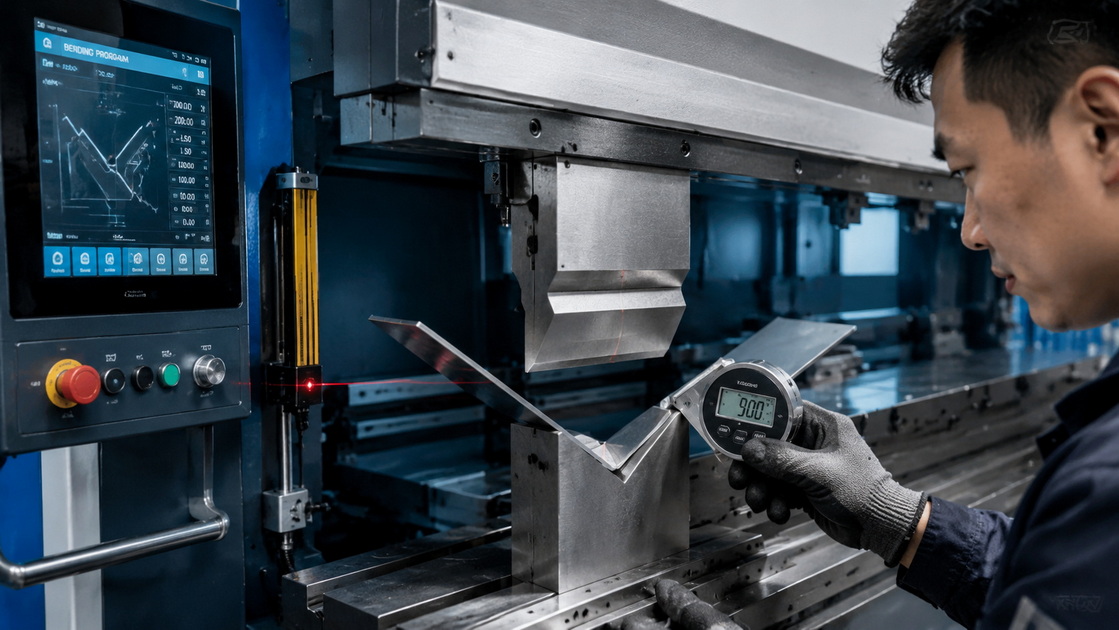
Many buyers focus only on ram speed. In reality, setup time often has a greater impact on press brake productivity than one or two seconds of bending speed.
A fabricator producing 5,000 identical brackets may prioritize cycle time. A job shop producing 30 different part numbers per day may gain more value from quick programming, repeatable setups, organized tooling, and reduced first-piece approval time.
The Fabricator reports that the average time in North America between completing the last part of one job and producing the first good part of the next can be approximately 30 minutes. This makes tooling management, setup discipline, and repeatable programming important operational priorities.
A CNC press brake can improve workflow through:
- Saved part programs
- Automatic backgauge movement
- Guided bend sequences
- Graphical programming
- Tool libraries
- Automatic crowning adjustment
- Reduced trial bends
- Fewer manual measurements
- More predictable first-piece approval
- Easier repeat orders
A hydraulic press brake can still be productive when:
- Parts are simple
- Bend quantities are low
- Workpieces are similar
- Operators are highly experienced
- Tooling changes are limited
- Accuracy requirements are moderate
- The workshop does not require complex bend sequencing
The right machine depends on production reality, not brochure speed.
A conventional hydraulic press brake usually has a lower purchase price. This is attractive for start-up workshops, repair businesses, and buyers with limited immediate capital.
However, a lower initial price does not always mean a lower long-term cost.
Cost Category | CNC Press Brake | Hydraulic Press Brake |
Initial machine investment | Higher | Lower |
Operator training | Programming training required | Strong manual skill required |
Setup labor | Often lower for repeat jobs | Often higher |
Scrap risk | Lower when programs are validated | Can be higher with manual adjustment |
Complex part handling | Better | More labor-intensive |
Maintenance | More electronics and sensors | Simpler control architecture |
Expansion to automation | Easier | More limited |
Long-term high-mix productivity | Usually stronger | Usually weaker |
A procurement decision should consider:
Total Cost of Ownership=Purchase Cost+Labor+Scrap+Tooling+Energy+Maintenance+Downtime
A CNC press brake may cost more at the beginning, but it can reduce setup labor and scrap during repeated or complex production.
A conventional hydraulic press brake may have a lower acquisition cost, but it may require more skilled labor and longer setup times as job complexity increases.
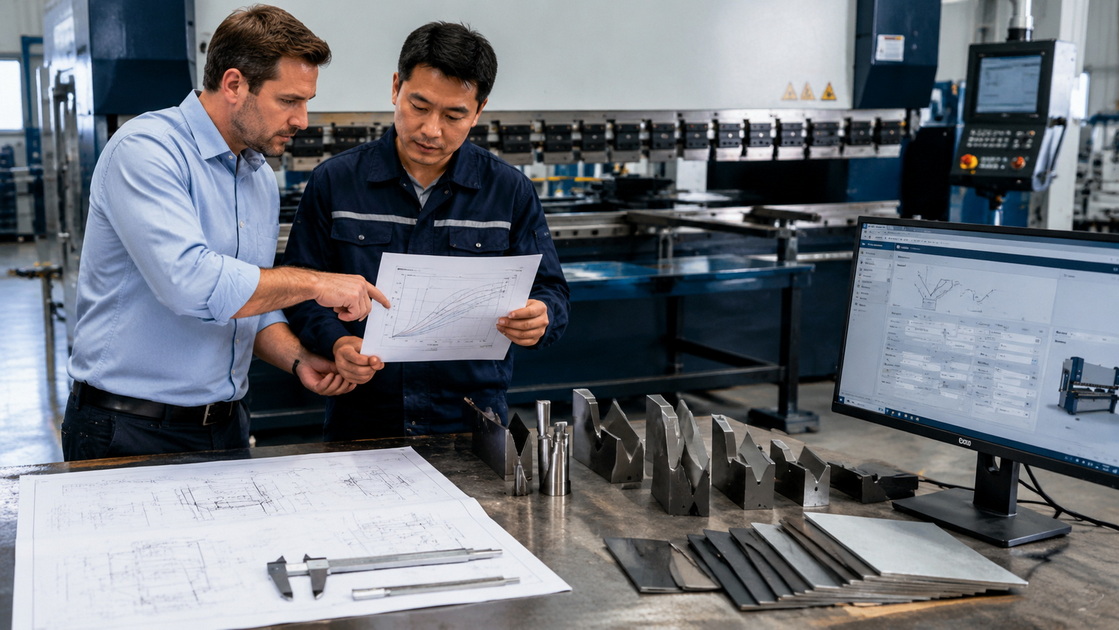
One of the most expensive mistakes in press brake sourcing is selecting equipment based only on maximum tonnage.
A 160-ton press brake is not automatically suitable for every job that appears to require 160 tons. Actual bending force depends on:
- Material thickness
- Material tensile strength
- Bending length
- V-die opening
- Punch radius
- Air bending, bottoming, or coining method
- Required bend angle
- Tooling load capacity
- Off-center loading condition
A commonly used engineering estimate for mild-steel air bending is:
P=650×S2×L/V×1000
Where:
- P = bending force in tons
- S = material thickness in millimeters
- L = bending length in millimeters
- V = V-die opening in millimeters
This calculation is only a starting point. It does not replace a machine manufacturer's verified bending-force chart or tooling-load review.
For stainless steel, the required bending force can be substantially higher than mild steel. One industry reference recommends multiplying the mild-steel estimate by approximately 1.5 for stainless steel, but buyers should always confirm the actual material grade and tensile strength with the equipment supplier.
Total tonnage is not enough.
A buyer must also confirm:
1. Maximum total machine tonnage
2. Maximum bending length
3. Permitted tonnage per meter
4. Tooling load rating
5. Off-center loading limits
6. Crowning capability
7. Actual workpiece position
A short, heavy bend in the center of the bed can create different stress conditions from a long bend distributed across the full working length.
Before finalizing a machine, provide the supplier with your actual drawings and ask for a documented bending-force calculation.
A CNC press brake is generally the better choice if your production requires precision, repeatability, complex geometry, or frequent job changes.
Choose a CNC press brake when you produce:
- Electrical cabinets
- Server racks
- Stainless steel enclosures
- Elevator panels
- HVAC components
- Automotive brackets
- Medical equipment housings
- Appliance panels
- Telecom cabinets
- Precision fabrication parts
- Multi-bend box sections
- Repeated OEM components
It is also the stronger option when your business expects to grow into:
- Automated bending cells
- Robotic loading
- Offline programming
- Barcode-based production
- Digital production tracking
- High-mix, low-volume manufacturing
- Multi-shift production
For OEM and ODM projects, CNC capability is especially valuable because customer drawings, special tooling, non-standard materials, and branding requirements often demand more controlled and repeatable processing.
A conventional hydraulic press brake can be the better option when the production requirement is straightforward and the buyer needs a durable, economical machine.
Choose a hydraulic press brake when you mainly produce:
- Simple brackets
- Basic channels
- Repair parts
- Light structural components
- Low-volume fabrication work
- Agricultural equipment parts
- General workshop components
- Standard mild-steel bends
- Occasional custom jobs
It may also fit buyers who:
- Have a limited startup budget
- Already employ highly skilled press brake operators
- Do not need multi-axis backgauge control
- Do not produce highly complex parts
- Do not require frequent product changeovers
- Prefer a simpler machine-control structure
A hydraulic press brake is not an inferior machine. It is simply a different production tool.
The problem occurs when a buyer uses a basic hydraulic machine for a production task that really requires CNC repeatability.
Press brakes create significant point-of-operation hazards. Buyers should evaluate safety systems at the same time as tonnage, controller, and price.
OSHA notes that powered press brakes include hydraulic press brakes and identifies guarding as a core safety requirement. Guarding may involve physical barriers, two-hand controls, electronic safety devices, laser systems, safe-distance procedures, and other methods appropriate to the task.
ISO 6909:2026 specifies safety requirements for press brakes, including hydraulic, hydraulic servo-drive, screw servo-drive, and belt-spring servo-drive machine types.
When comparing suppliers, ask for details about:
- Laser safety protection
- Light curtains
- Two-hand control systems
- Foot-pedal safety features
- Emergency-stop buttons
- Rear safety guards
- Side guarding
- Hydraulic overload protection
- Electrical safety documentation
- Risk-assessment documents
- CE documentation where required
- Operator manuals in the destination language
Do not treat safety equipment as a low-priority option. A low-cost machine without a properly defined safeguarding package can create operational, legal, and insurance problems after installation.
Use this five-step process before choosing between a CNC press brake and a hydraulic press brake.
Collect your top 20 to 50 production parts.
For each part, record:
- Material grade
- Thickness
- Maximum length
- Number of bends
- Tightest bend tolerance
- Production quantity
- Tooling requirement
- Required surface condition
This will show whether you need a simple bending machine or a programmable production platform.
Ask:
- Do we run the same part every day?
- Do we change jobs frequently?
- Do we need complex bend sequences?
- Do we make many small batches?
- Do we have highly skilled operators?
- Do we experience frequent setup errors?
- Do we need to reduce scrap?
- Do we plan to automate later?
If your workshop runs many changing part numbers, CNC programming usually creates measurable value.
Do not compare only "100T × 3200 mm" against "100T × 3200 mm."
Compare:
- Controller brand and model
- Number of controlled axes
- Backgauge design
- Crowning type
- Hydraulic components
- Electrical components
- Tooling system
- Safety protection
- Ram speed
- Open height
- Throat depth
- Warranty scope
- Spare-parts package
- Installation support
Ask the supplier to bend your most difficult representative part.
The test should use your:
- Actual material
- Maximum thickness
- Maximum bend length
- Critical bend angle
- Required tooling
- Most difficult bend sequence
This is more valuable than watching a supplier bend a short mild-steel sample part.
Your purchase contract should include:
- Machine model and serial number
- Technical configuration
- Approved drawings
- Material and component brands
- Accuracy requirements
- Factory acceptance-test procedure
- Safety configuration
- Delivery schedule
- Warranty terms
- Spare-parts list
- Installation and training support
- Final payment conditions
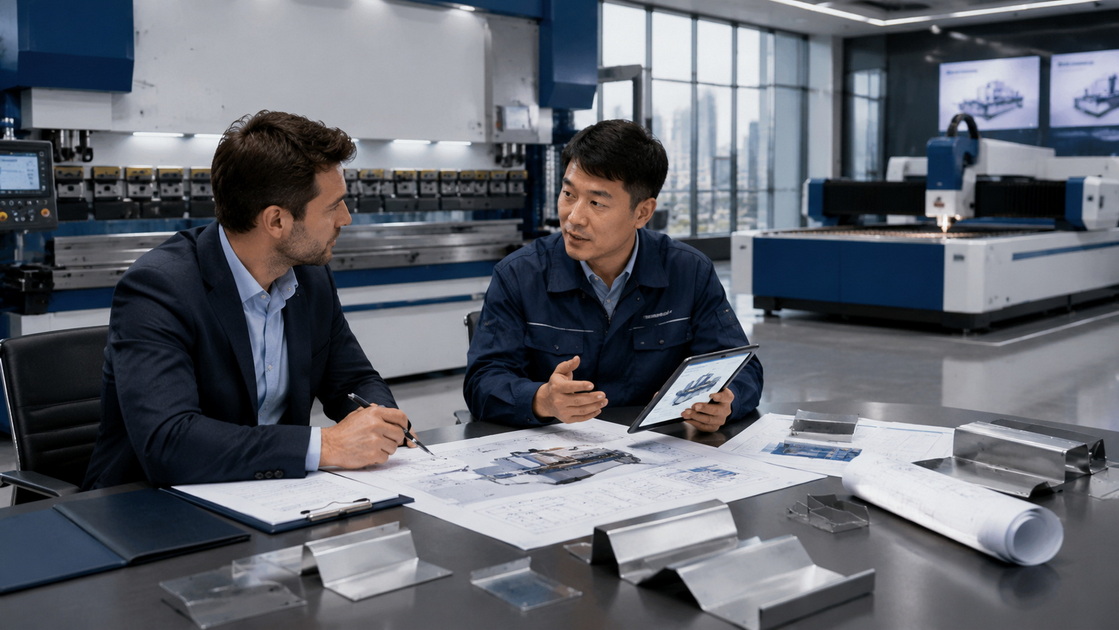
Maanshan Deyan Precision Machinery Technology Co., Ltd. provides CNC press brakes and related sheet metal fabrication equipment for buyers seeking standard machines, non-standard configurations, and integrated equipment solutions.
For distributors, OEM brands, and industrial fabricators, CNDY-Press can support discussions around:
- Customized bending length and tonnage
- CNC controller configuration
- Backgauge axis selection
- Tooling and clamping systems
- Hydraulic and electrical component options
- Branding and private-label requirements
- Machine color and logo customization
- Voltage and language localization
- Safety-package selection
- Matching laser-cutting, shearing, rolling, or grooving equipment
- Factory testing with customer drawings
The most reliable machine selection begins with your parts, not a standard catalog model.
Yes. Many CNC press brakes use hydraulic cylinders for ram movement. The term "CNC" refers to the computer-controlled system that manages ram position, backgauge axes, bend sequence, crowning, and other programmable functions.
In most repeat-production applications, yes. CNC control improves repeatability by managing ram depth and backgauge positioning digitally. Final accuracy still depends on material variation, tooling, machine calibration, crowning, and operator setup.
The correct tonnage depends on the bending length, material tensile strength, V-die opening, bending method, and required radius. A supplier should calculate the required force using your actual part drawing rather than giving a tonnage answer based on thickness alone.
Yes. However, stainless steel generally requires more bending force than mild steel of the same thickness and can show greater springback. Confirm the material grade, tensile strength, tooling selection, and required tonnage before purchase.
Usually, the initial purchase price is lower for a conventional hydraulic press brake. However, a CNC machine may reduce setup time, operator dependence, scrap, and long-term production cost for repeated or complex work.
1. [Allied Market Research — Press Brakes Market Size, Share, and Growth Forecast]
2. [OSHA — Powered Press Brakes Machine Guarding Guidance]
3. [OSHA — Guidelines for Point of Operation Guarding of Power Press Brakes]
4. [OSHA — Laser Guarding Systems With Hydraulic Press Brakes]
5. [ISO 6909:2026 — Machine Tools Safety Press Brakes]
6. [ISO 14955-4:2019 — Environmental Evaluation of Machine Tools]
7. [The Fabricator — Six Ways to Boost Press Brake Productivity]
8. [RMFG — Press Brake Tonnage Chart and Calculator]
9. [Punchtools — Press Brake Bending Force Chart]
10. [CNDY-Press — Company Profile and Sheet Metal Fabrication Equipment]


