


Views: 255 Author: CNDY-Press Publish Time: 2026-11-19 Origin: Site


Content Menu
● What Is the Difference Between an Automatic Press Brake and a CNC Press Brake?
● What Level of Press Brake Automation Does Your Factory Need?
>> Level 1: Operator-Fed CNC for Short Runs and Changing Part Mixes
>> Level 2: Targeted Automation for Setup and Quality Bottlenecks
>> Level 3: Robotic Bending for Repeatable Part Families
● How to Calculate Press Brake Automation Payback
● How to Specify and Acceptance-Test a CNC Press Brake
>> 1. Is every CNC press brake automatic?
>> 2. Does an automatic tool changer require a part-handling robot?
>> 3. Does more automation make a press brake more accurate?
>> 4. Can I add automation to a CNC press brake later?
>> 5. Is a robotic press brake suitable for low-volume production?
An automatic press brake and a CNC press brake are not necessarily different machines. CNC describes how the bending machine is controlled. Automatic describes which production tasks it performs without manual intervention. An operator-fed CNC machine can position its ram and backgauge automatically while an operator loads, turns, and removes every part. A robotic bending cell can use a CNC press brake to automate those handling steps as well. The right investment depends on what slows your factory down: programming, tooling changes, angle correction, or part handling.
At CNDY-Press, we develop and manufacture CNC press brakes and other sheet metal processing equipment, including custom configurations for OEM and ODM projects. Our starting point for a machine specification is a representative set of drawings and an honest look at the current bending process. A machine with more options is not necessarily the one that will ship more good parts.
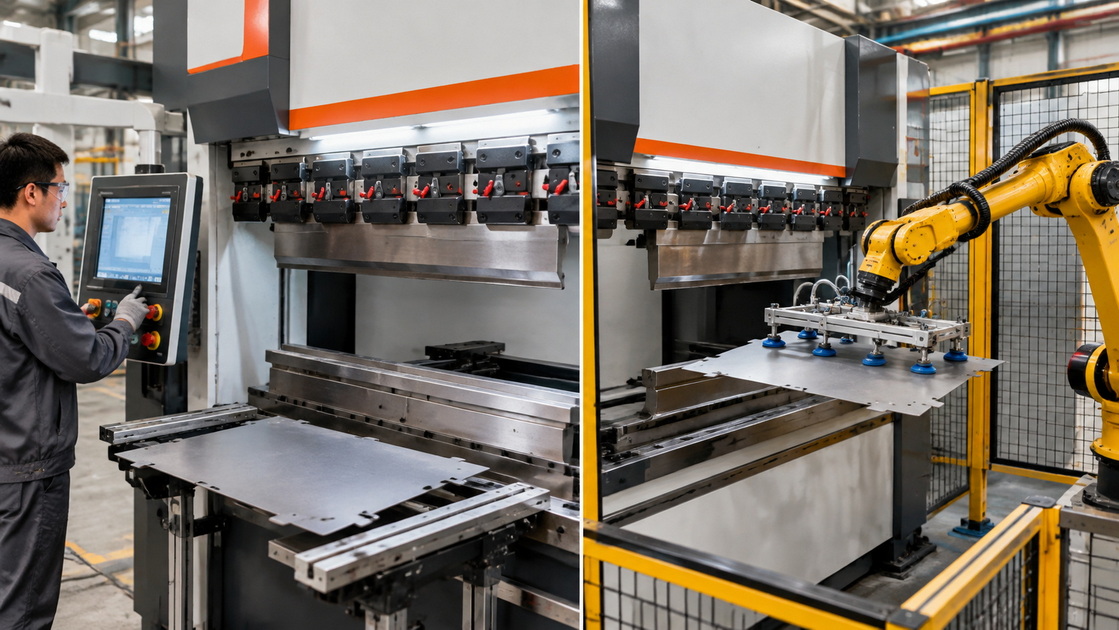
CNC stands for computer numerical control. A CNC press brake uses a programmed sequence to control the bending cycle and the machine axes included in its configuration. The backgauge positions the sheet relative to the tooling; the ram moves the punch during the bend. The controller can save job programs for repeat orders, but it cannot make a poorly located blank or an incorrect tool setup produce a good part.
"Automatic press brake" is a less precise buying term. One quotation may use it for a machine with programmable backgauge movement and automatic crowning. Another may include an automatic tool changer. A third may cover a guarded robotic cell that picks blanks, repositions them between bends, and stacks finished parts. Before comparing prices, ask each supplier to state which tasks are automatic, which are optional, and which still require an operator.
| Buying factor | Operator-fed CNC press brake | CNC press brake with targeted automation | Robotic bending cell |
|---|---|---|---|
| Part handling | Operator loads, repositions, and unloads parts | Usually operator-fed unless handling equipment is specified | Robot handles validated part families within the configured cell |
| Tool changes | Operator changes tooling | Automatic tool changer can be specified | May be automatic; confirm tooling and magazine coverage |
| Angle correction | Depends on the measurement and control package | In-process measurement and correction can be specified | Available on some cells; verify coverage on your parts |
| Best fit | Prototypes, short runs, and varied work | High-mix production with a measurable setup or quality bottleneck | Repeatable work with enough eligible volume to justify integration |
| Main buying risk | Underestimating setup time or operator workload | Paying for an option that does not address the bottleneck | Overestimating the share of work the cell can run without intervention |
Start here if batches are small, drawings change frequently, or the operator needs to handle many unusual parts. Specify the backgauge axes against your actual geometry. A simple flange may need little adjustment, while tapered or offset parts can require independently positioned gauge fingers. More axes are useful only when they help locate the part reliably.
Also check tonnage, usable bending length, tooling capacity, and clearance. A machine can have enough force and still be unable to complete a deep box if the formed flanges collide with the tooling or machine structure. Ask the supplier to demonstrate the full bend sequence, not just one straight bend.
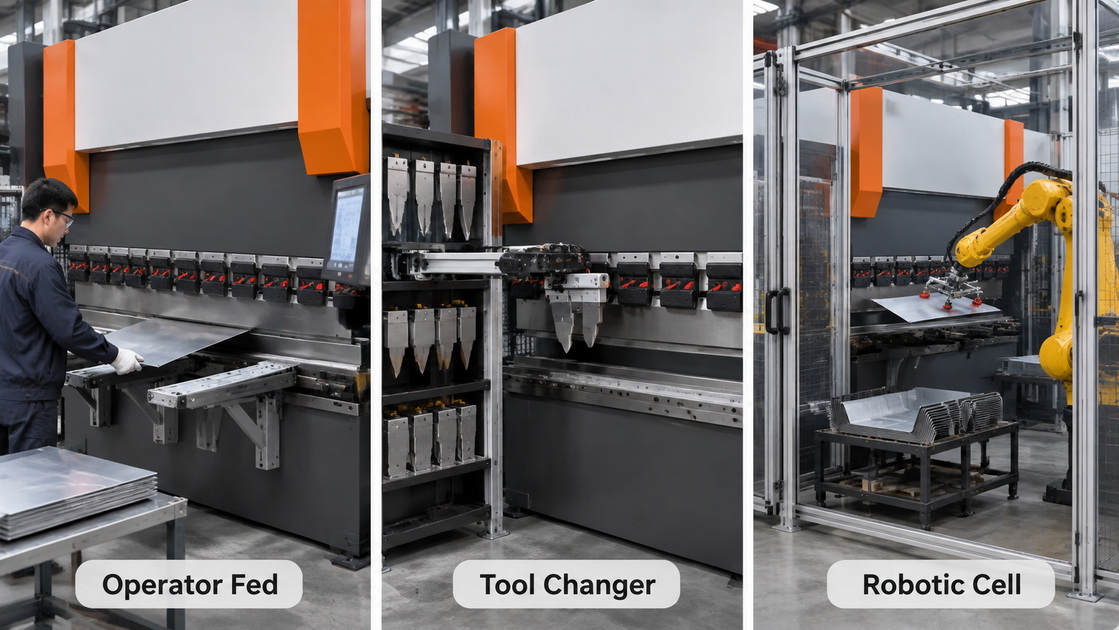
If operators are waiting for programs, consider offline programming: preparing and checking the bend sequence away from the machine while the brake is still producing. If time studies show that changing and arranging punches and dies is the larger delay, evaluate an automatic tool changer instead. Automatic clamping can simplify securing the tooling, but it is not the same as automatically selecting and positioning tools.
Separate two common quality problems before buying an upgrade. Crowning compensates for machine deflection under load to help keep the bend angle consistent along the working length. In-process angle measurement addresses a different problem: it can provide feedback for correction when the actual angle differs from the target, including variation related to material springback. Springback is the tendency of metal to open slightly after the bending force is removed. Ask the supplier which part geometries, materials, and tooling setups its measuring system supports.
Consider a robotic press brake cell if loading, flipping, and unloading consume a substantial share of production time and enough of your work can follow a repeatable handling sequence. The key question is not whether a robot can make one sample. It is whether the cell can run your planned mix after allowing for blank presentation, gripper changes, regripping between bends, finished-part stacking, and replenishment.
A high-mix factory can still justify a cell if parts share tooling and handling requirements. Conversely, a high-volume part can be a poor candidate if its geometry makes it difficult to grip once several flanges have been formed. Keep unsuitable work out of the projected savings unless the supplier can demonstrate a workable solution.
Time the workflow from the last good part of one job to the first approved part of the next, then measure steady-state output separately. Record programming, setup, first-piece inspection, handling, bending, and rework. This distinction matters: a tool changer can shorten changeovers without making each bend faster, while a robot may reduce attended labor without shortening the machine cycle.
Consider an illustrative tool-changer purchase:
- Your shop averages six tool changes per day over 230 production days.
- A representative trial shows a saving of eight minutes per change, or 184 hours of machine availability per year.
- Assume 75% of those hours replace paid overtime or can be redeployed to work valued at $45 per hour. That gives an estimated annual benefit of $6,210.
- With a $24,000 installed premium and $1,200 in additional annual costs, the net annual benefit is $5,010. Simple payback is about 4.8 years, before financing and taxes.
If the released time cannot reduce overtime or support additional work, do not count it as cash savings. Likewise, do not count the same hour both as avoided labor and as extra production margin. For a robotic cell, include integration, guarding, grippers, operator and maintenance training, spare parts, and recovery downtime. Model conservative and expected scenarios using only the part families the cell can run.
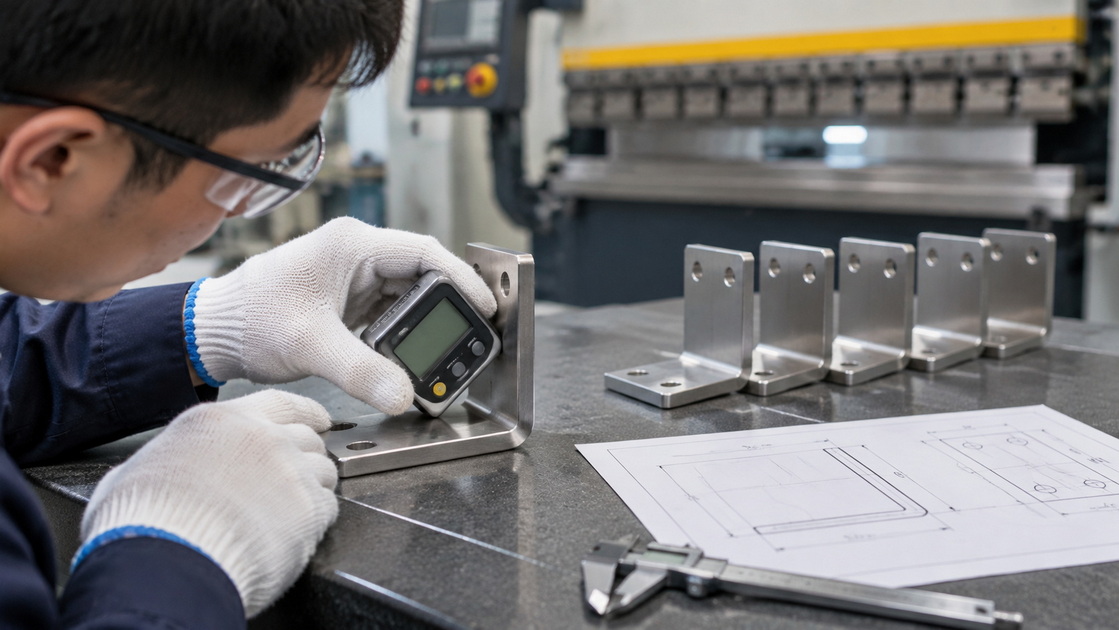
Agree on the test before placing the order. A good factory acceptance test measures the production outcome you are buying, not just the speed of an unloaded machine.
1. Send representative drawings and blanks. Include a high-volume part, a difficult geometry, and a job that requires a substantial tooling change. Specify material grade, thickness, tolerances, and lot variation where relevant.
2. Confirm the complete configuration. Put the controller, backgauge axes, tooling, crowning method, angle measurement, software licenses, and any handling equipment in the quotation. For an OEM or ODM build, document approval responsibilities and who owns the final drawings and control backups.
3. Run full batches, not isolated bends. Record time to first approved part, changeover time, good parts per hour, dimensional results, and manual interventions. For a robotic cell, include replenishment and a normal production stop followed by a safe restart.
4. Verify safeguarding and service readiness. Review point-of-operation protection and access to moving equipment with qualified personnel. For a robotic installation, include the robot's working area and material transfer points in the assessment. Confirm guarding, safe access, and hazardous-energy control requirements for the destination market.
5. Repeat critical checks after installation. Confirm the agreed parts run correctly under site conditions. Obtain program and parameter backups, operator and maintenance training, and a documented spare-parts and service plan before final handover.
A CNC press brake automates the programmed movements included in its configuration. That does not mean it loads blanks, changes tools, measures angles, or unloads parts automatically. Check each function separately in the supplier's quotation.
No. An automatic tool changer can serve an operator-fed machine. It is worth evaluating when tooling changeovers are frequent but your work is too varied for robotic handling to deliver a clear return.
Not necessarily. The result depends on the material, tooling, machine setup, gauging, and inspection method. Ask for first-piece and batch measurements on your own parts rather than relying on a headline accuracy figure.
Possibly. Confirm mechanical space, controller interfaces, tooling compatibility, safeguarding, and supplier support before purchase. Ask what "automation-ready" includes, what has to be retrofitted, and who will validate the modified system.
It can be when small batches recur and share tools, grippers, and handling routines. For one-off jobs with frequent geometry changes, the programming and setup effort may outweigh the handling time saved. Test a representative mix before committing.
1. Bystronic, ByBend Smart: Flexible, High-Speed Press Brake Machine. Technical reference for backgauge configurations, active crowning, angle measurement, and offline programming. [bystronic]
2. Bystronic, Modular Tool Changer: Automatic Tool Change for Press Brakes. Equipment example supporting the distinction between automatic tooling changes and automated part handling. [bystronic]
3. TRUMPF, TruBend Cell 5000: Automated Press Brake. Equipment example for robotic bending, automatic tooling and gripper changes, and angle measurement. [trumpf]
4. U.S. Occupational Safety and Health Administration, Machine Guarding eTool: Powered Press Brakes and Guidelines for Point of Operation Guarding of Power Press Brakes. U.S. references for press brake hazards and safeguarding; destination-specific requirements should be evaluated separately. [osha]


