


Views: 241 Author: CNDY-Press Publish Time: 2026-09-07 Origin: Site


Content Menu
● What Is an All-Electric Press Brake?
>> Typical All-Electric Press Brake Applications
● What Is an Electro-Hydraulic Press Brake?
>> Key Electro-Hydraulic Press Brake Advantages
● All-Electric vs Electro-Hydraulic Press Brake Comparison
● Energy Efficiency and Operating Cost
>> A Practical Energy-Cost Calculation
>> Do Not Buy on Energy Claims Alone
● Precision, Repeatability, and Bend Quality
>> Where All-Electric Machines Excel
>> Where Electro-Hydraulic Machines Excel
● Speed, Throughput, and Production Flow
>> Focus on Total Parts Per Shift
● Tonnage, Material Thickness, and Bending Length
>> Avoid a Common Procurement Mistake
● Maintenance, Reliability, and Shop Environment
>> All-Electric Press Brake Maintenance
>> Electro-Hydraulic Press Brake Maintenance
● How to Choose the Right CNC Press Brake
>> Choose an All-Electric Press Brake If You Need:
>> Choose an Electro-Hydraulic Press Brake If You Need:
>> Consider a Customized Solution If You Need:
>> 1. Is an all-electric press brake more energy-efficient than an electro-hydraulic press brake?
>> 2. Can an all-electric press brake bend thick steel plate?
>> 3. Which press brake offers better bending accuracy?
>> 4. Does an electro-hydraulic press brake require more maintenance?
>> 5. Which machine is better for OEM sheet metal production?
Choosing between an all-electric press brake and an electro-hydraulic press brake is no longer simply a question of "new technology versus traditional technology." The right CNC press brake depends on your sheet-metal thickness, required tonnage, production rhythm, part complexity, energy targets, available floor space, and long-term ownership plan.
From a manufacturing perspective, we see that all-electric CNC press brakes are highly attractive for high-repeat, thin-to-medium sheet applications where speed, low idle power consumption, clean operation, and consistent positioning matter most. Electro-hydraulic press brakes, often called servo-hydraulic press brakes, remain the more flexible option for manufacturers that must process thicker materials, longer bending lengths, larger tools, or higher-tonnage jobs.
For OEM, ODM, and customized sheet metal production projects, CNDY-Press recommends selecting the machine based on the actual bending profile, not only the listed tonnage or initial purchase price. A machine that fits your production mix can reduce rework, shorten setup time, control energy costs, and support stable quality over many years.
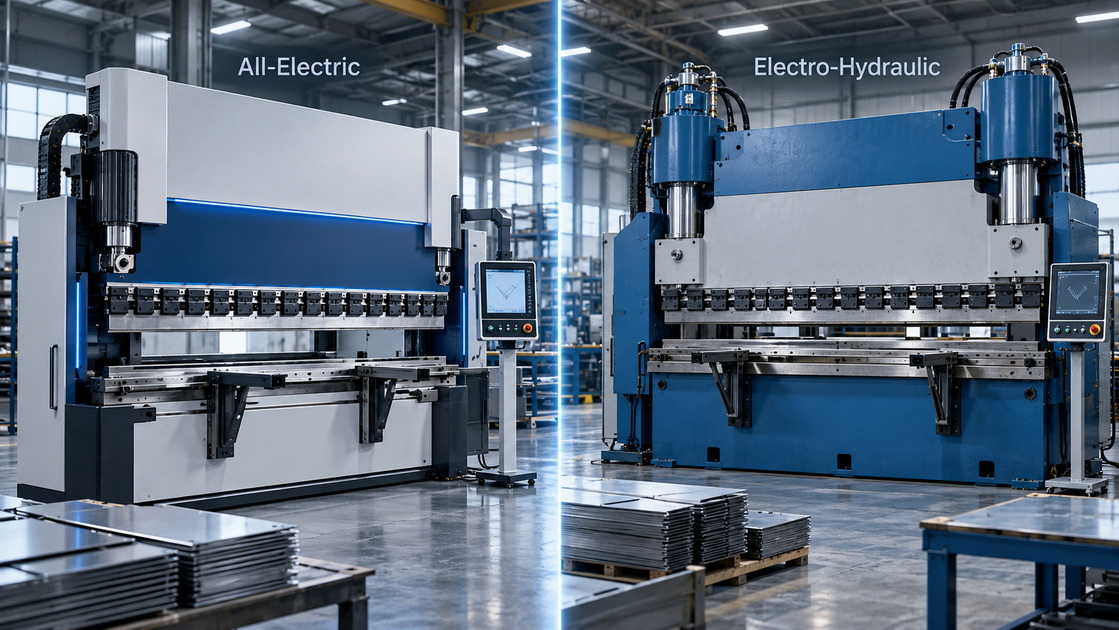
An all-electric press brake uses electric servo motors to generate and control ram movement. Instead of relying on hydraulic oil, pumps, valves, and cylinders to create bending force, the machine typically converts servo motor rotation into linear motion through mechanical transmission systems such as ball screws, belt drives, pulleys, or gear mechanisms.
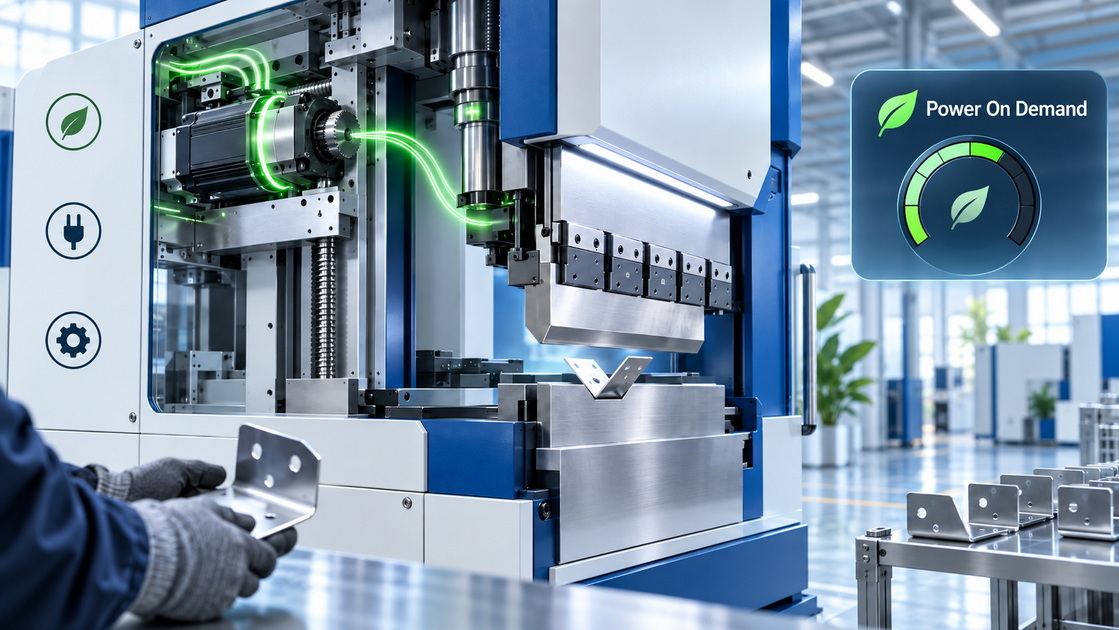
The core operating principle is straightforward: the servo motor supplies power when the ram must move, and power demand falls sharply when the machine is idle. This makes all-electric press brakes especially suitable for fabricators that run frequent short cycles, repeat small-to-medium components, and want to reduce unnecessary energy consumption between bends.
In practical production environments, an all-electric CNC press brake can offer several compelling advantages:
- Low idle energy use because the servo drive does not need to keep a hydraulic pump continuously running.
- Fast acceleration and deceleration, which can improve throughput for short bending cycles.
- Clean operation with no hydraulic oil circuit, reducing the risk of oil leakage.
- Lower routine hydraulic maintenance because there are no hydraulic filters, hydraulic oil changes, or pump-related service tasks.
- Good repeatability for precision metal components, particularly in light-gauge or medium-gauge production.
- Reduced noise and heat generation compared with many conventional hydraulic systems.
The trade-off is that an all-electric press brake may not be the best match for every tonnage range, material thickness, or bending length. Mechanical drive systems must deliver sufficient force across the required stroke and bed length. As tonnage increases, the motor power and mechanical system requirements also increase, which can reduce the relative energy-saving advantage of a purely electric design. The Fabricator notes that electric and hybrid press brakes are particularly well suited to the lower-tonnage segment, while higher-tonnage applications require increasingly large electrical input to generate the needed force.
All-electric press brakes are commonly considered for:
- Electrical cabinets and enclosures
- HVAC accessories and light duct components
- Stainless-steel panels
- Appliance parts
- Furniture frames and brackets
- Elevator components
- Electronics housings
- Precision sheet-metal assemblies
- Automotive interior or lightweight structural parts
- High-volume OEM components with stable part geometry
For these applications, machine utilization, cycle frequency, repeatability, and energy management can be more important than extreme tonnage capacity.
An electro-hydraulic press brake combines CNC control and servo motor technology with hydraulic power transmission. It is often called a servo-hydraulic press brake because servo motors control the hydraulic pump output according to real-time bending demand.
Unlike a conventional hydraulic press brake that may operate a pump continuously at a fixed or near-fixed speed, an electro-hydraulic press brake can regulate pump speed and oil flow based on the ram's movement, pressure requirement, and programmed bending cycle. This approach helps reduce some of the energy loss, heat generation, and noise associated with older hydraulic configurations.
The electro-hydraulic design continues to use hydraulic cylinders to drive the ram. This remains valuable for applications requiring high force, longer worktables, deep throats, heavy tooling, large opening heights, or difficult material conditions.
- Broad tonnage capability for demanding sheet metal and plate bending.
- Strong suitability for thick materials and larger V-die openings.
- Flexible machine sizing, including long-bed and tandem press brake configurations.
- High bending force availability over large working lengths.
- Proven technology across a wide range of industrial fabrication sectors.
- Servo-controlled efficiency improvements compared with conventional fixed-pump hydraulic systems.
- Advanced CNC synchronization, including Y1/Y2 ram-axis control and optional crowning systems.
Servo-hydraulic systems are especially relevant when a manufacturer needs a single machine platform that can handle diverse jobs. For example, a shop may bend thin stainless-steel panels in the morning, thicker carbon-steel brackets in the afternoon, and long structural channels later in the day. In that operating model, flexibility may create more business value than the lowest possible energy use per bend.
Modern press brake technology increasingly combines CNC controls, servo drives, backgauge automation, and adaptive bending functions. This allows electro-hydraulic machines to achieve high accuracy while retaining the force advantages of hydraulic cylinders.
The following comparison helps procurement teams, plant managers, and OEM buyers identify the major differences between the two CNC press brake technologies.
| Comparison Factor | All-Electric Press Brake | Electro-Hydraulic Press Brake |
|---|---|---|
| Primary drive method | Servo motors with mechanical transmission, such as ball screws or belts | Servo-controlled hydraulic pump and hydraulic cylinders |
| Energy consumption | Very low idle power use; energy mainly consumed during ram movement | Lower consumption than conventional hydraulic machines, but hydraulic losses still exist |
| Best production profile | High-volume, repetitive, thin-to-medium material bending | Mixed production, heavy-duty bending, thick material, and high tonnage |
| Typical tonnage suitability | Commonly strongest in lower-to-medium tonnage applications | Broad range, including high-tonnage and long-bed configurations |
| Maintenance needs | Lower hydraulic-related maintenance; no oil changes or hydraulic leak concerns | Requires hydraulic oil, filtration, seals, hose inspection, and system maintenance |
| Machine cleanliness | Clean operation with no hydraulic oil circuit | Clean when maintained well, but hydraulic oil remains part of the system |
| Noise and heat | Generally quieter and cooler during idle periods | Improved over traditional hydraulics, but still generates hydraulic-system heat |
| Initial investment | May be higher for comparable capacity in some markets | Often offers competitive cost and broad configuration options |
| Flexibility for thick plate | More limited, depending on the machine’s mechanical drive capacity | Typically stronger for thick plate and high-force applications |
| Long-term operating cost | Can be favorable for high-cycle production because of power and maintenance savings | Can be favorable when one machine must cover many material types and tonnage demands |
| Custom configuration options | Best for focused, repeatable precision work | Highly adaptable for tonnage, bed length, daylight, stroke, tooling, and automation |
The most important point is that "electric" does not automatically mean "better," and "hydraulic" does not automatically mean "outdated." The best machine is the one that delivers the required bend quality, throughput, safety, uptime, and total cost of ownership for your production environment.
Energy use is one of the strongest reasons buyers consider an all-electric press brake. Since the servo motors draw substantial power mainly during active movement, an all-electric machine can avoid much of the idle energy demand associated with continuously running hydraulic pumps.
Several machine-industry sources report that electric press brake systems can substantially reduce energy consumption compared with conventional hydraulic systems, particularly in high-cycle applications with frequent idle time between bends. Reported figures vary by machine size, material, operator workflow, and production schedule, but savings claims commonly range from approximately 30% to 60% or more when comparing electric systems with traditional hydraulic designs.
However, purchasers should interpret broad percentage claims carefully. Energy savings are not fixed. A machine that runs one shift per week will produce a very different financial result from a machine that runs two or three shifts every day.
Before purchasing a CNC press brake, calculate energy cost using your own operating profile:
Annual Energy Cost=Average Power Draw (kW)×Operating Hours×Electricity Rate
For comparison purposes, separate the calculation into:
1. Active bending time
2. Setup and programming time
3. Material loading and unloading time
4. Operator waiting time
5. Machine standby time
6. Daily, weekly, and annual operating hours
An all-electric press brake often creates its strongest advantage when the machine spends meaningful time waiting between short bending cycles. During those idle moments, the electric drive can sharply reduce energy consumption.
An electro-hydraulic press brake can still be an efficient choice when it uses a servo pump system rather than a traditional continuously running pump. The machine can adjust hydraulic flow based on real production demand instead of operating at maximum output continuously.
A lower kWh figure does not compensate for insufficient tonnage, unsuitable bending length, poor tooling compatibility, or inadequate service support. If an under-sized electric press brake cannot reliably bend your thicker material or longer parts, the apparent energy savings can disappear through rejected work, slower processing, subcontracting, or an additional machine purchase.
Both all-electric and electro-hydraulic CNC press brakes can produce highly accurate work when they are correctly specified, installed, calibrated, and operated with suitable tooling.
Bend quality depends on far more than the drive system. Important variables include:
- Material grade and tensile strength
- Material thickness variation
- Grain direction
- Punch and die geometry
- V-opening selection
- Bend radius requirements
- Springback behavior
- Tool alignment
- Backgauge accuracy
- Ram synchronization
- Crowning compensation
- Operator setup and inspection procedures
All-electric press brakes can provide highly responsive motion control and repeatable ram positioning. Their direct servo-driven systems can be valuable for small precision parts, shallow bends, compact components, and high-repeat programs.
Because there is no hydraulic oil temperature variation affecting the drive system in the same way, electric systems may also support stable performance in applications where thermal consistency is important.
Electro-hydraulic press brakes use synchronized cylinders, CNC-controlled Y1/Y2 axes, and often hydraulic or mechanical crowning to compensate for deflection along the machine bed. This makes them highly capable for longer workpieces and larger bending loads.
For long parts, precision depends heavily on frame rigidity, bed deflection compensation, tooling condition, and the CNC's ability to manage ram position across the bending length. A high-quality electro-hydraulic press brake with appropriate crowning can be a better production solution than an electric machine that lacks sufficient bed length or force.
Expert perspective: When evaluating precision, ask for a sample bend test using your own material, your target thickness, your preferred tooling method, and your required angle tolerance. Catalog specifications are useful, but real production trials are more meaningful.
In high-volume fabrication, production output is not determined only by ram speed. The total cycle includes programming, tool changes, material handling, positioning, bending, inspection, stacking, and movement to the next process.
All-electric press brakes can offer fast response and strong acceleration for repetitive bending tasks. This can make them very productive when part sizes are manageable and programs are stable. Fast response is particularly useful for products such as brackets, control panels, small enclosures, and standardized OEM components.
Electro-hydraulic press brakes can also achieve strong cycle performance, especially when equipped with servo-hydraulic pumps, fast backgauges, efficient CNC controls, and suitable material-handling systems. They are often the better choice when productivity requires greater bending force, longer sheets, multiple-axis backgauges, or complex tools.
When comparing machines, request a production trial based on a representative part. Measure:
- Setup time
- First-part approval time
- Average cycle time
- Parts produced per hour
- Scrap rate
- Operator intervention
- Energy consumption during the test
- Tooling changeover duration
- Final angle consistency
A machine that saves two seconds per cycle may be extremely valuable for a 20,000-piece annual program. For low-volume custom fabrication, however, easier setup, greater flexibility, and higher tonnage capacity may matter more.
Tonnage is often the deciding factor between an all-electric press brake and an electro-hydraulic press brake.
All-electric machines are generally most competitive in lower-to-medium tonnage applications. Industry commentary has identified the sub-100-ton range as a particularly strong fit for electric and hybrid press brake technologies, while higher-tonnage requirements demand more electrical power and may narrow the efficiency gap.
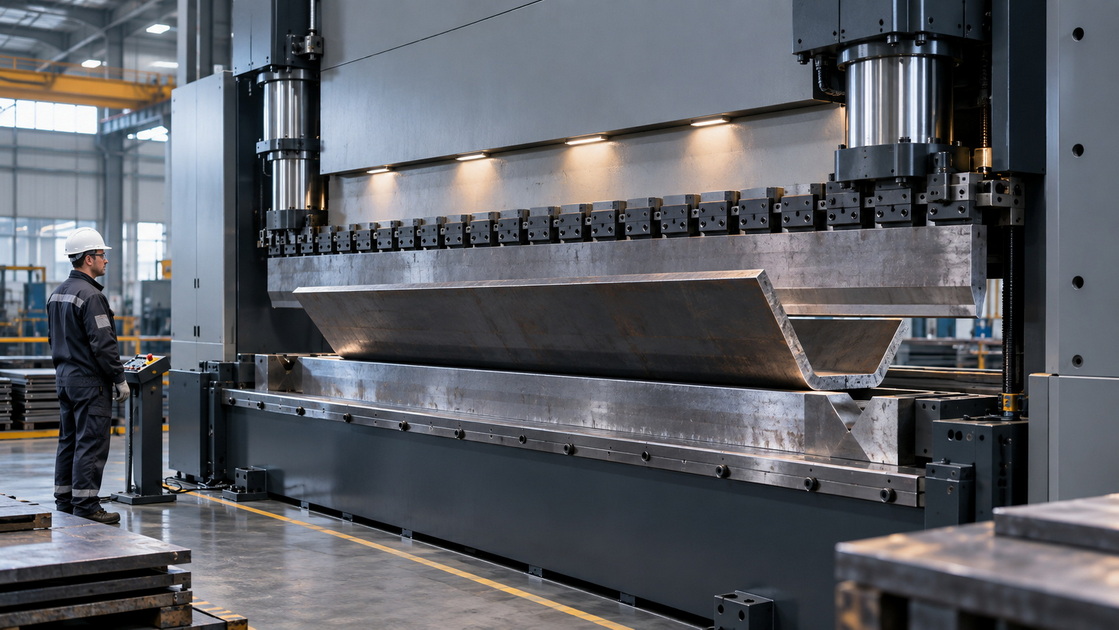
Electro-hydraulic CNC press brakes are usually the more practical solution for:
- Thick carbon steel plate
- High-strength steel components
- Long sheet-metal panels
- Large stainless-steel parts
- Structural brackets
- Heavy machinery components
- Truck body parts
- Construction equipment parts
- Long channel sections
- Tandem press brake applications
Do not select tonnage based only on the thickest material in your warehouse. Instead, identify:
- Your most frequent material thickness
- Your longest bending length
- Your smallest required flange
- Your tightest bend radius
- Your highest-strength material grade
- Your most demanding tool configuration
- Your expected future product mix
A press brake should be sized for the work you perform most often, while retaining enough capacity for strategically important future orders.
At CNDY-Press, we recommend reviewing actual DXF drawings, material specifications, bend lengths, tooling requirements, and annual production volumes before finalizing a customized CNC press brake configuration. This approach is especially important for OEM and ODM buyers with specialized parts.
Maintenance affects uptime, safety, operating cost, and long-term machine value.
All-electric systems eliminate many hydraulic maintenance tasks. There is no hydraulic oil to replace, no oil filter schedule, and lower risk of contamination or leakage from hoses and seals. This can support cleaner workshops and reduce environmental housekeeping requirements.
However, all-electric machines still require disciplined maintenance. Operators and service teams should inspect mechanical transmission components, lubrication points, bearings, ball screws, belts, electrical cabinets, safety devices, tooling clamps, and CNC systems.
Electro-hydraulic machines require planned hydraulic-system maintenance. This typically includes:
- Checking hydraulic oil condition
- Replacing filters according to the maintenance plan
- Inspecting hoses, fittings, valves, and seals
- Monitoring oil temperature
- Checking pump performance
- Verifying ram synchronization
- Maintaining crowning systems
- Inspecting CNC and backgauge accuracy
Modern servo-hydraulic designs can reduce unnecessary heat and system load compared with older hydraulic designs. Still, preventive maintenance remains essential. A well-maintained electro-hydraulic press brake can provide long service life and excellent production stability.
Practical recommendation: Ask your supplier for a preventive-maintenance schedule, recommended spare-parts list, remote technical-support process, installation requirements, and expected service response terms before issuing a purchase order.
Use the following decision framework when comparing an all-electric press brake with an electro-hydraulic press brake.
- High-volume production of repeatable parts
- Thin-to-medium sheet metal bending
- Lower energy consumption during idle periods
- Cleaner production with no hydraulic oil circuit
- Low hydraulic-maintenance requirements
- Fast, responsive bending cycles
- Compact precision components
- A machine dedicated to stable OEM product programs
- Higher tonnage capacity
- Thick plate or high-strength material bending
- Long bending lengths
- Greater flexibility across different product types
- Multi-shift custom fabrication capability
- Larger tools, deeper boxes, or complex formed parts
- Tandem press brake configurations
- A balanced solution for power, accuracy, and broad application coverage
- A non-standard working length
- Special throat depth or open height
- Custom tonnage requirements
- Multi-axis backgauge configuration
- Automatic tool clamping
- Laser angle measurement
- CNC crowning
- Robotic loading or unloading
- Integration with panel benders, shearing machines, laser cutting systems, or automated production lines
CNDY-Press can support customized CNC press brake manufacturing for OEM and ODM projects. The best configuration begins with your production requirements—not with a generic machine model.
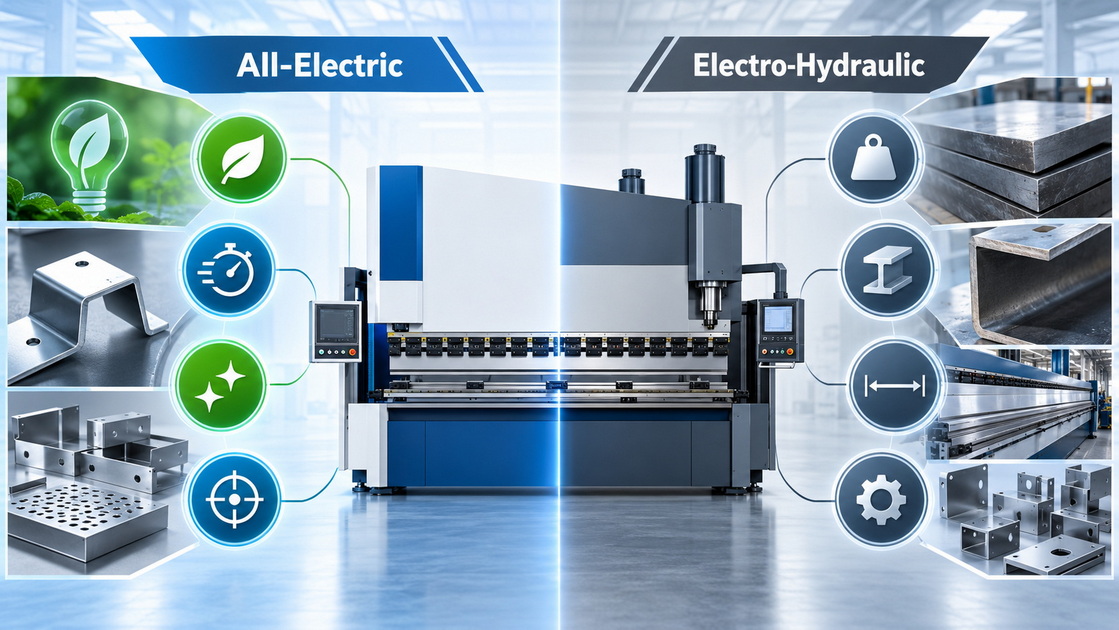
An all-electric press brake is usually the stronger investment for manufacturers focused on energy efficiency, clean production, frequent short-cycle bending, and precision work in thin-to-medium materials. It is particularly compelling for dedicated OEM production lines where part designs are stable and annual quantities are high.
An electro-hydraulic press brake is usually the stronger choice for manufacturers that need versatility, high tonnage, longer working lengths, thick material capacity, and the ability to process a wider variety of sheet-metal parts. Its servo-controlled hydraulic system can deliver an effective balance of bending power, CNC precision, and improved energy management.
The best decision is based on your actual parts, not a generalized machine comparison. Before purchasing, compare production samples, calculate total cost of ownership, verify tooling compatibility, evaluate after-sales support, and confirm that the machine can handle both today's workload and your expected future projects.
In most high-cycle and idle-heavy operations, yes. An all-electric press brake typically consumes significant power mainly when the ram is moving. An electro-hydraulic press brake is also more efficient than a traditional fixed-pump hydraulic model because its servo pump adjusts output according to demand, but it still relies on a hydraulic circuit. The real savings depend on tonnage, shift pattern, material, and actual machine utilization.
It can bend certain thicker materials within its rated tonnage, bending length, tooling, and mechanical drive capacity. However, electro-hydraulic press brakes are generally more suitable for consistently heavy, thick-plate, long-bed, or high-tonnage applications because hydraulic cylinders can deliver high force across a broad machine range.
Both can provide excellent accuracy when paired with a capable CNC control, proper tooling, stable material, synchronized ram motion, and crowning compensation where needed. For long parts and high loads, electro-hydraulic machines with Y1/Y2 synchronization and crowning can be highly effective. For repeatable light-to-medium bending, all-electric machines offer responsive and stable servo motion.
Generally, yes. Electro-hydraulic press brakes require maintenance of hydraulic oil, filters, hoses, seals, valves, and pumps. All-electric press brakes remove most oil-related maintenance tasks, but still require scheduled inspection and servicing of mechanical drive components, lubrication systems, electrical systems, CNC controls, and safety equipment.
For high-volume OEM production with stable designs, repetitive bending, and thin-to-medium materials, an all-electric press brake can be highly efficient. For OEM programs involving diverse part sizes, varying thicknesses, heavy components, or future product changes, an electro-hydraulic press brake may offer better flexibility.
1. The Fabricator. "Understanding Modern Press Brakes." Discusses the relationship between press brake drive technology, tonnage range, and the practical suitability of electric and hybrid systems for lower-tonnage applications. [Read the article]. [thefabricator]
2. Canadian Metalworking. "The Demand for Smart, Fast, and Efficient Press Brakes." Covers market demand for modern press brake technology, including electric and hybrid models. [Read the article]. [canadianmetalworking]
3. ECI. "Understanding CNC Press Brakes: Hydraulic, Mechanical, Electric and Hybrid Differences." Explains the operating differences between electric and servo-hydraulic press brake systems. [Read the article]. [e-ci]
4. AMADA Europe. "New EGB Electric Press Brakes." Describes all-electric press brake development and the removal of hydraulic circuits for energy optimization. [Read the article]. [amada]
5. Mac-Tech. "Comparing Hydraulic and Electric Press Brakes: Key Differences." Reviews energy use, operating principles, and practical distinctions between hydraulic and electric press brakes. [Read the article]. [mac-tech]
6. DurmaPress. "Electric Press Brake: Types, How It Works & Buying Guide." Provides an overview of electric press brake operating principles and energy-use comparisons. [Read the article]. [durmapress]
7. AMADA America. "Press Brakes." Product and technology overview for modern CNC press brake systems, including hybrid solutions. [Read the article]. [amada]


