


Views: 237 Author: CNDY-Press Publish Time: 2026-09-14 Origin: Site


Content Menu
● What Is a 4-Way Press Brake Die?
● Why V-Opening Selection Matters in Press Brake Bending
● Common Applications for 4-Way Press Brake Dies
>> Custom Sheet Metal Fabrication
>> HVAC Duct and Air-Handling Components
>> Electrical Enclosures and Cabinets
>> Automotive, Transportation, and Equipment Parts
>> Maintenance, Repair, and Prototype Work
● Key Benefits of a 4-Way Press Brake Die
● Choosing the Right Four-Way Die Configuration
>> Review Your Material Thickness Range
>> Match the Die to the Bending Method
>> Confirm Press Brake Compatibility
● V-Die Selection Chart for Common Air-Bending Work
● How to Set Up a 4-Way Press Brake Die Correctly
>> Step 1: Inspect the Tooling Before Installation
>> Step 2: Use Safe Lifting and Handling Methods
>> Step 3: Clean and Seat the Die Properly
>> Step 4: Align Punch and Die
>> Step 5: Run a First-Off Test Part
>> Step 6: Document the Approved Setup
● Safety Rules for 4-Way Press Brake Die Operation
● Maintenance Practices That Extend Die Life
>> Weekly or Scheduled Maintenance
● When a 4-Way Die Is Not the Best Choice
● Improve Productivity With the Right Press Brake Tooling
>> 1. What is a 4-way press brake die?
>> 2. What is the main benefit of a 4-way press brake die?
>> 3. How do I choose the correct V-opening?
>> 4. Can a 4-way die bend stainless steel and aluminum?
>> 5. Is a 4-way die suitable for high-volume production?
A 4-way press brake die gives sheet metal fabricators four V-opening options in one rotating die block. When specified and set up correctly, it can reduce tooling changes, improve job flexibility, and support more consistent air-bending results across common material thicknesses.
For manufacturers handling OEM and ODM sheet metal projects, tooling decisions affect more than bend quality. They influence setup time, throughput, labor safety, material waste, machine loading, and delivery reliability. At CNDY-Press, we view the 4-way press brake die as a practical productivity tool—not a universal replacement for every dedicated die set. The best results come from matching die geometry, material properties, bending method, machine capacity, and part requirements.
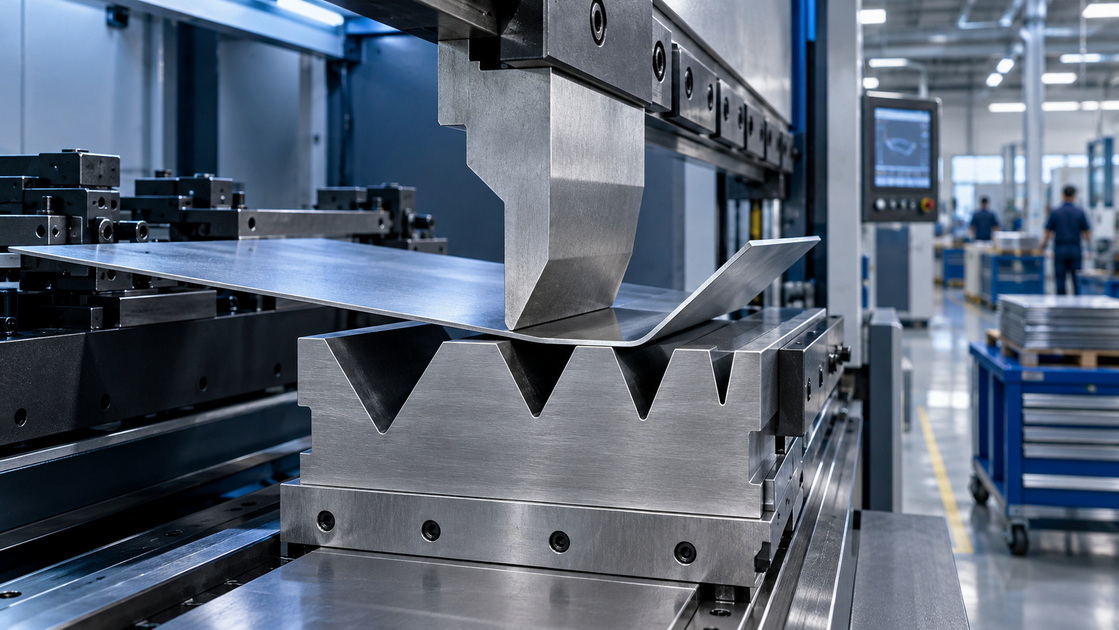
A 4-way press brake die, also called a four-way die block or multi-V die, is a lower die designed with four different V-openings on its four working faces. Instead of removing one bottom die and installing another when the required V-opening changes, the operator rotates the die block—typically by 90 degrees—to access a different V-groove.
In a standard press brake bending operation:
- The upper punch moves downward with the press brake ram.
- The sheet metal rests across the shoulders of the lower V-die.
- The punch pushes the material into the V-opening.
- The selected V-opening influences the inside bend radius, required bending force, minimum flange length, and risk of marking or cracking.
The major advantage is simple: one tooling block can support multiple common air-bending applications.
A four-way die is especially useful for job shops, contract manufacturers, HVAC component producers, prototype departments, and OEM suppliers that bend varied materials and thicknesses in short or medium production runs.
However, it is important to understand its limitation. A 4-way die offers versatility, but it does not automatically deliver the best possible solution for every geometry, tolerance, flange length, material grade, or high-volume production process. Specialized dies remain necessary for hemming, radius bending, acute angles, channel forming, box bending, heavy plate, and other demanding applications.
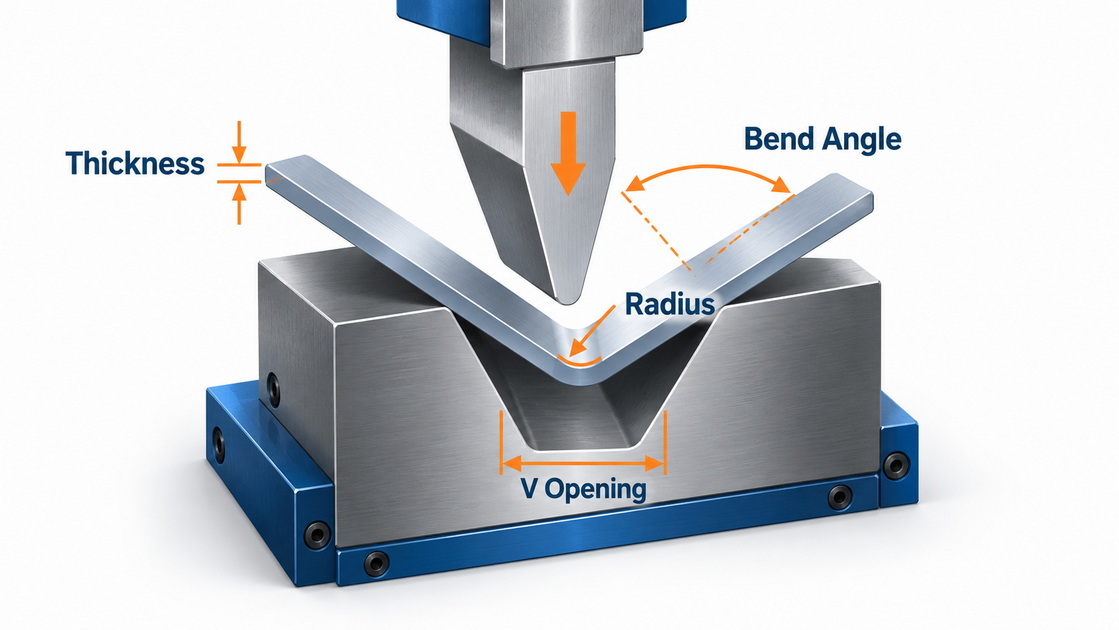
The V-opening is one of the most important variables in sheet metal bending. It affects the finished bend radius, press brake tonnage requirement, minimum flange size, surface marking, springback behavior, and overall part consistency.
For conventional air bending of mild steel, a widely used starting guideline is the Rule of 8:
V≈8×t
Where:
- V = V-die opening width
- t = material thickness
For example, a 2 mm mild-steel sheet may start with a V-opening near 16 mm. This is a preliminary guideline, not a final production instruction. Material tensile strength, temper, grain direction, bend radius requirement, punch radius, flange dimensions, coating condition, and machine/tooling load limits must all be checked before production.
In air bending, the punch does not necessarily force the sheet fully into the bottom of the die. Instead, the material forms over the V-die shoulders, and the inside radius "floats" according to the die opening and material properties. For low-alloy cold-rolled steel around 60 KSI tensile strength, the air-formed inside radius is often approximately 15–17% of the V-opening. Stainless steel can produce a larger percentage, while softer aluminum can form a smaller percentage under comparable conditions.
This is why selecting the wrong die opening can create production problems:
- A V-opening that is too narrow can sharply increase tonnage.
- A narrow V-opening can increase surface marking and crack risk.
- A V-opening that is too wide can produce a larger inside radius.
- A wide V-opening may not support short flange lengths.
- An unsuitable die opening can reduce dimensional consistency.
- A mismatch can overload the press brake, tooling, or workpiece.
A typical 4-way die block contains four V-grooves of different widths. For example, one die may provide V-openings suitable for thin-gauge sheet, medium-gauge mild steel, thicker stainless steel, or heavier fabrication work.
The exact configuration varies by manufacturer and application. A die could include four progressively wider openings, such as small, medium, large, and extra-large V-grooves. The correct combination should be selected based on the material range your shop bends most frequently.
1. Identify the actual material thickness, not only the nominal gauge.
2. Confirm the material type, tensile strength, temper, and coating.
3. Select the appropriate V-opening for the bending method.
4. Confirm that the chosen opening accommodates the required flange length.
5. Verify press brake tonnage and tooling load limits.
6. Align the punch and die accurately.
7. Run a controlled first-off test bend.
8. Measure angle, inside radius, flange dimension, and springback.
9. Adjust ram depth, angle correction, crowning, or tooling selection as needed.
10. Lock in approved setup parameters for repeat production.
A 4-way die reduces physical changeovers because the operator can rotate the die block instead of retrieving, lifting, aligning, clamping, and storing a separate lower die. This can be highly valuable when a press brake handles frequent changes between different thicknesses and part families.
A 4-way press brake die for sheet metal bending is most useful when a production department needs flexibility across several material gauges or part designs.
Job shops often receive low-volume, high-mix orders. A single shift may include brackets, covers, enclosures, machine guards, electrical cabinets, mounting plates, panels, and fabricated assemblies.
In this environment, a multi-V die can reduce tool searching and shorten setup time between compatible bending jobs.
HVAC manufacturers regularly bend galvanized steel, aluminum, stainless steel, and coated sheet. Different duct components may require different V-openings because material thickness and bend geometry vary.
A four-way die gives operators quick access to more than one V-width without fully changing lower tooling.
Enclosure manufacturers commonly bend thin-to-medium gauge sheet-metal panels with flanges, returns, doors, brackets, and frames. The right V-opening helps control bend radius, flange support, and cosmetic surface quality.
For pre-painted, galvanized, or stainless materials, manufacturers should also evaluate die shoulder condition and the risk of finish marking.
OEM and ODM suppliers may manufacture brackets, protective panels, reinforcements, covers, interior components, agricultural-machine parts, and equipment housings. A 4-way die can support prototype work, pilot production, and mixed part schedules where material thickness changes often.
Maintenance departments and prototype shops frequently need to produce one-off or short-run components quickly. In these situations, the time saved by rotating a die block can outweigh the benefits of installing a highly specialized lower die.
| Benefit | Operational Value | Best Fit |
|---|---|---|
| Four V-openings in one block | More bending options without repeatedly replacing the lower die | High-mix production |
| Faster changeovers | Less time spent locating, lifting, aligning, and clamping separate dies | Job shops and OEM suppliers |
| Reduced tooling storage | Fewer individual die sets may be needed for common applications | Space-constrained workshops |
| Improved process flexibility | Operators can adapt more quickly to different material thicknesses | Prototype and short-run work |
| Lower handling frequency | Fewer heavy tooling changes can reduce manual handling exposure | Shops with frequent setups |
| Better standardization | Common die configurations can simplify training and setup sheets | Multi-shift operations |
| Potential tooling cost control | One multi-V die can cover several routine V-opening needs | New or expanding facilities |
The productivity benefit is real, but it should be measured correctly. A 4-way die saves time only when the die openings, tool profile, press brake clamping system, and part mix are genuinely compatible with the work being produced.
For a long, repetitive production run using the same material and geometry, a dedicated die may still be the most stable and efficient choice.
Selecting a four-way die is not simply about choosing four random V-openings. The most useful die is one that fits your actual production mix.
Start with the materials your facility bends most often.
Ask these questions:
- What is the thinnest sheet commonly processed?
- What is the thickest sheet commonly processed?
- Are you bending mild steel, stainless steel, aluminum, galvanized sheet, brass, copper, or high-strength steel?
- What is the actual thickness range after accounting for supplier tolerances?
- Are coated or cosmetic surfaces involved?
- Do the parts require controlled inside radii or short flanges?
For air bending, the traditional Rule of 8 provides a useful starting point for mild steel. A die opening near eight times the material thickness is often used as a baseline, while practical selection may vary depending on the material and job requirements.
Different bending methods use tooling differently.
| Bending Method | Tooling Behavior | 4-Way Die Suitability |
|---|---|---|
| Air bending | Sheet contacts punch and V-die shoulders; angle is controlled by ram depth | Highly suitable for common applications |
| Bottoming | Material is pressed more deeply into the die profile | Possible, but geometry and tonnage require closer control |
| Coining | Material is forced into the die under very high pressure | Usually less suitable for general multi-V tooling |
| Hemming | Requires dedicated multi-stage tooling | Usually requires specialized dies |
| Radius bending | Requires radius-specific tooling | Often requires dedicated tooling |
| Box or channel bending | Clearance and tool shape are critical | May require gooseneck or specialized tooling |
For a standard CNC press brake operation, many fabricators use 4-way dies primarily for air bending. Air bending is flexible because the same punch-and-die combination can produce multiple bend angles by controlling ram penetration. But this flexibility does not eliminate the need to validate radius, tonnage, springback, and flange limitations.
Before purchasing or using a 4-way die, verify:
- Press brake tonnage capacity
- Bed length and working length
- Ram and bed alignment
- Tooling height
- Die holder and clamping system
- American, European, Wila, or other tooling style
- Maximum allowable tonnage per meter or per foot
- Machine crowning capability
- Backgauge range and part clearance
- Punch profile and tip radius
- Material and workpiece handling method
Never assume that a die is compatible simply because it physically fits on the press brake bed. A tooling mismatch can create inaccurate bends, damaged tools, overloaded machine components, or a serious safety risk.
The following chart is a starting reference for mild-steel air bending using the approximate Rule of 8. It must be checked against your machine maker's documentation, die manufacturer's load ratings, material certificates, and actual production trials.
| Material Thickness | Starting V-Opening | Typical Use Consideration |
|---|---|---|
| 1.0 mm | 8 mm | Thin sheet; monitor marking and flange support |
| 1.5 mm | 12 mm | Common enclosure and panel range |
| 2.0 mm | 16 mm | General fabrication baseline |
| 2.5 mm | 20 mm | Requires tonnage verification |
| 3.0 mm | 24–25 mm | Confirm inside radius and minimum flange |
| 4.0 mm | 32 mm | Check machine load and crowning needs |
| 5.0 mm | 40 mm | Use robust tooling and verify tonnage |
| 6.0 mm | 48–50 mm | Higher-load work; review tool load rating carefully |
The exact V-opening should not be selected by thickness alone. Consider the finished inside radius, material grade, tensile strength, grain direction, coating, required bend angle, and flange geometry. For instance, the same V-opening can produce different inside radii in aluminum, mild steel, and 304 stainless steel because each material responds differently during air bending.
Proper setup matters as much as die selection. A technically correct die can still produce poor bends if alignment, clamping, ram depth, or backgauge settings are wrong.
Check each face of the die block for:
- Cracks
- Chipped V shoulders
- Dents
- Rust
- Burrs
- Excessive wear
- Damaged clamping surfaces
- Contamination from metal chips or adhesive residue
Any defect on a V-shoulder can transfer marks to the workpiece or create inconsistent bending results.
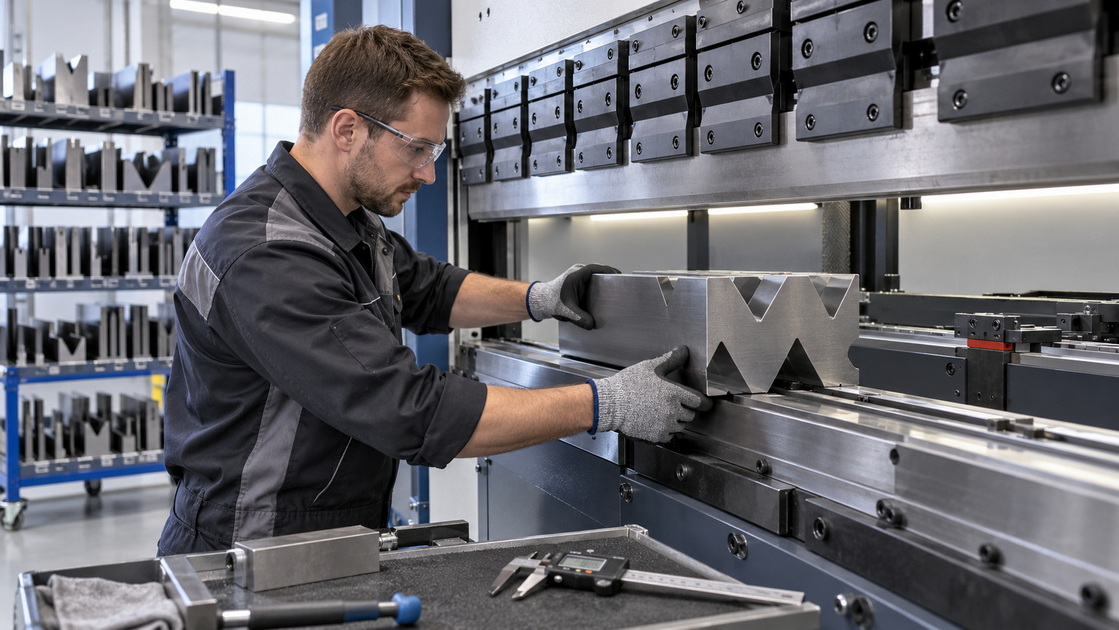
Four-way die blocks can be heavy. Use approved lifting devices, magnetic lifters where suitable, die carts, or other handling equipment recommended by your facility's safety procedures.
Do not drop, drag, or force tooling into position. Impact damage can affect die geometry, create hidden cracks, and compromise safe operation.
Clean the press brake bed, die holder, and die surfaces. Chips or debris beneath the die can cause uneven seating and misalignment.
Position and clamp the die securely. Confirm that the selected V-opening faces upward and remains centered beneath the punch.
Punch-to-die alignment should be verified before full-force bending. Misalignment can cause:
- Uneven bend angles
- Off-center loading
- Tool wear
- Material distortion
- Punch damage
- Die shoulder damage
- Unpredictable springback
Use low-speed or inching-mode test movement according to your machine procedures. Confirm clearance and alignment before bending production parts.
Never start full production without inspecting the first bent part.
Measure:
- Bend angle
- Inside radius
- Flange length
- Overall part dimensions
- Surface marking
- Springback
- Part twist
- Consistency across the bend length
If the bend angle varies across a long part, investigate crowning, ram deflection, material variation, tooling condition, and setup alignment.
For repeatability, record:
- Material grade and actual thickness
- V-opening used
- Punch type and radius
- Bend angle
- Ram depth or CNC program
- Backgauge positions
- Crowning settings
- Part orientation
- Lubrication or protective-film requirements
- Inspection dimensions
This converts operator knowledge into a repeatable manufacturing process—especially valuable for OEM and ODM production programs.
A 4-way die can reduce tooling changeovers, but it does not remove press brake hazards. The point of operation remains a serious pinch-point area.
Press brake safeguarding should be based on machine condition, tooling, task, workpiece geometry, operator access, and applicable regulations. In the United States, safeguarding discussions commonly reference OSHA general machine-guarding requirements under 29 CFR 1910.212 and industry guidance such as ANSI B11.3 for power press brakes.
Key safety practices include:
- Train operators on the specific CNC press brake and tooling system.
- Use appropriate guarding, light curtains, laser-based systems, barriers, or other safeguarding methods based on the risk assessment.
- Verify that safety systems are functional before operation.
- Never bypass, defeat, or casually disable safety devices.
- Use proper tooling lifting equipment.
- Keep hands outside the point-of-operation hazard zone.
- Use safe workholding and part-support methods for large sheets.
- Confirm ram stopping performance and machine safety functionality.
- Lock out and isolate energy sources before maintenance where required by procedure.
- Keep the work area clean and free of loose tooling, scrap, and oil.
Safety requirements vary by jurisdiction, machine type, and operating method. Manufacturers and users should consult local regulations, the press brake manufacturer's documentation, and qualified safety professionals before establishing operating procedures.
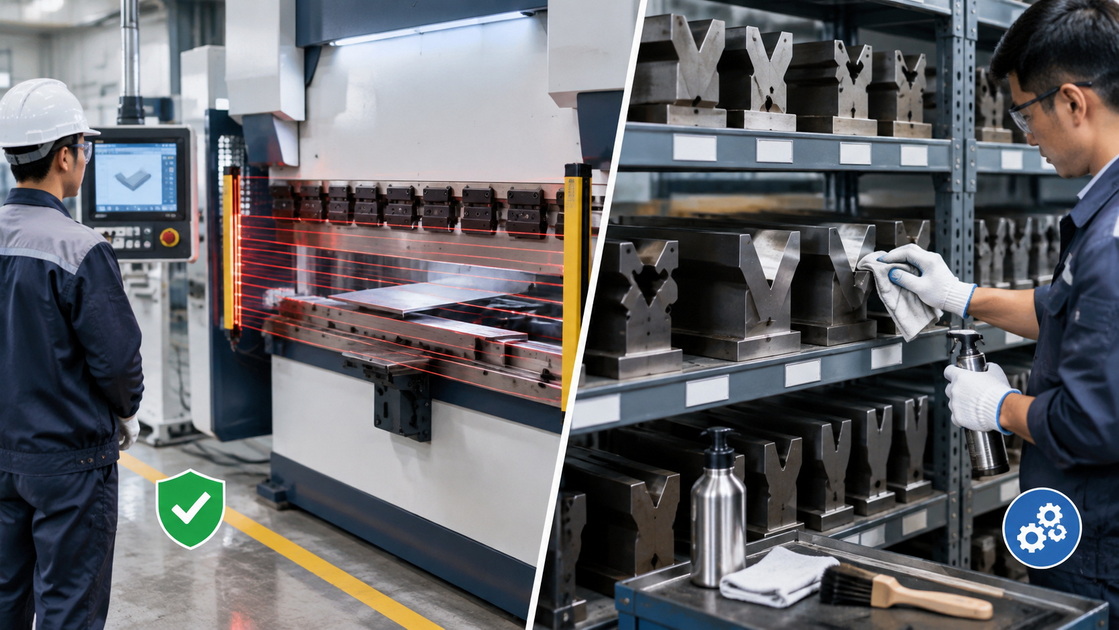
Regular maintenance protects bend accuracy, reduces downtime, and extends tooling life.
- Remove chips, dust, and residues after each shift.
- Inspect the active V-opening and die shoulders.
- Wipe tools dry if moisture is present.
- Check for surface damage before starting production.
- Confirm secure clamping and correct tool orientation.
- Apply a suitable light corrosion-protection oil when tools are stored.
- Inspect for wear on all four die faces.
- Rotate die usage where appropriate to distribute wear.
- Check storage racks, lifting accessories, and die labels.
- Review recurring bend defects for signs of tooling wear.
- Verify that operators are following approved setup procedures.
Avoid using abrasive cleaning tools that can damage precision surfaces. Store dies in a clean, dry, organized location, and avoid stacking tools in a way that damages V-shoulders or creates handling risks.
A four-way die is versatile, but it is not always the correct tool.
Consider dedicated tooling when you need:
- Tight-tolerance forming over long production runs
- Very narrow flanges
- Hemming operations
- Radius bends
- Acute-angle bends
- U-channel or box-forming clearance
- Complex profiles
- High-strength or thick plate bending
- Specialized cosmetic surface protection
- Automated tool-change compatibility
- Very high-volume production with minimal variation
The best tooling strategy often combines multi-V dies for flexible day-to-day work with dedicated tool sets for repeat, high-value, or geometry-specific production.
A 4-way press brake die can be a highly effective investment for fabricators that routinely bend different sheet thicknesses, materials, and part types. It reduces unnecessary lower-die changes, supports faster setup, improves tooling organization, and gives operators more flexibility during mixed production schedules.
But successful bending depends on more than rotating a die block. You must verify material properties, V-opening selection, punch compatibility, required tonnage, flange geometry, machine alignment, safeguarding, and first-off inspection.
CNDY-Press supports manufacturers with CNC press brakes, sheet metal fabrication equipment, customized OEM and ODM solutions, and technical guidance for practical bending applications. Whether you are planning a new production line, improving press brake changeovers, selecting tooling, or developing a custom sheet-metal manufacturing program, our team can help you evaluate your requirements.
A 4-way press brake die is a lower die block with four V-openings on different faces. The operator rotates the block to access a different V-width instead of changing to a separate lower die.
Its main benefit is flexibility. It provides multiple common V-openings in a single tool, helping reduce setup time in high-mix fabrication environments.
For mild-steel air bending, a common starting point is \(V \approx 8 \times t\), where \(t\) is material thickness. Then verify material type, tensile strength, desired radius, flange length, tonnage, tool load rating, and machine capacity.
Yes, provided the V-opening, punch radius, tonnage, and tool load rating are suitable for the specific material. Stainless steel, aluminum, and mild steel behave differently and may produce different bend radii and springback values under the same tooling setup.
It can be suitable when the production mix requires frequent changes between compatible V-openings. For long, repetitive runs with highly controlled tolerances, dedicated lower dies may provide better standardization and efficiency.
1. [CNHAWE — Complete Guide to 4-Way Press Brake Dies for Sheet Metal Bending] — Source article covering 4-way die structure, applications, selection, maintenance, and the practical V-opening guideline. [cnhawe]
2. [The Fabricator — The Rules of Press Brake Tool Selection] — Discussion of the Rule of 8 as a starting principle for V-die opening selection. [thefabricator]
3. [The Fabricator — Getting Back to Air Forming and Bending Basics on the Press Brake] — Technical explanation of floating inside radius behavior in air bending and differences across materials. [thefabricator]
4. [The Fabricator — An Overview of Press Brake Safeguarding] — Information about press brake hazards, safeguarding concepts, and operator training considerations. [thefabricator]
5. [The Fabricator — Safeguarding Press Brakes Without Sacrificing Productivity] — Discussion of OSHA general machine-guarding requirements and ANSI-based press brake safeguarding practices. [thefabricator]
6. [International Organization for Standardization — ISO 9001 Quality Management] — Reference for quality-management-system principles relevant to repeatable manufacturing and process documentation.


