


Views: 247 Author: CNDY-Press Publish Time: 2026-07-01 Origin: Site


Content Menu
● What Is an Up-Moving vs. Down-Moving Press Brake?
● How the Bending Motion Affects Precision
>> Force flow and deflection behavior
● Positioning and Backgauge Control
● Safety Differences: Up-Moving vs. Down-Moving
>> Standards and regulatory context
>> How motion direction influences guarding
● Practical Safety Tips From the Shop Floor
● Precision & Safety Comparison Table
● When to Choose Up-Moving vs. Down-Moving
● Customizing Press Brakes for Your Application
● Real-World Use Cases: How Plants Decide
● Best Practices to Maximize Precision and Safety (Any Design)
● How CNDY-Press Can Support Your Project
● FAQ
Up-acting (up-moving) and down-acting (down-moving) press brakes can both deliver high precision and safety, but they achieve this in different ways that matter for real-world CNC bending, operator protection, and long-term ROI. Understanding these differences helps you specify the right machine for your parts, operators, and factory layout. [practicalmachinist]
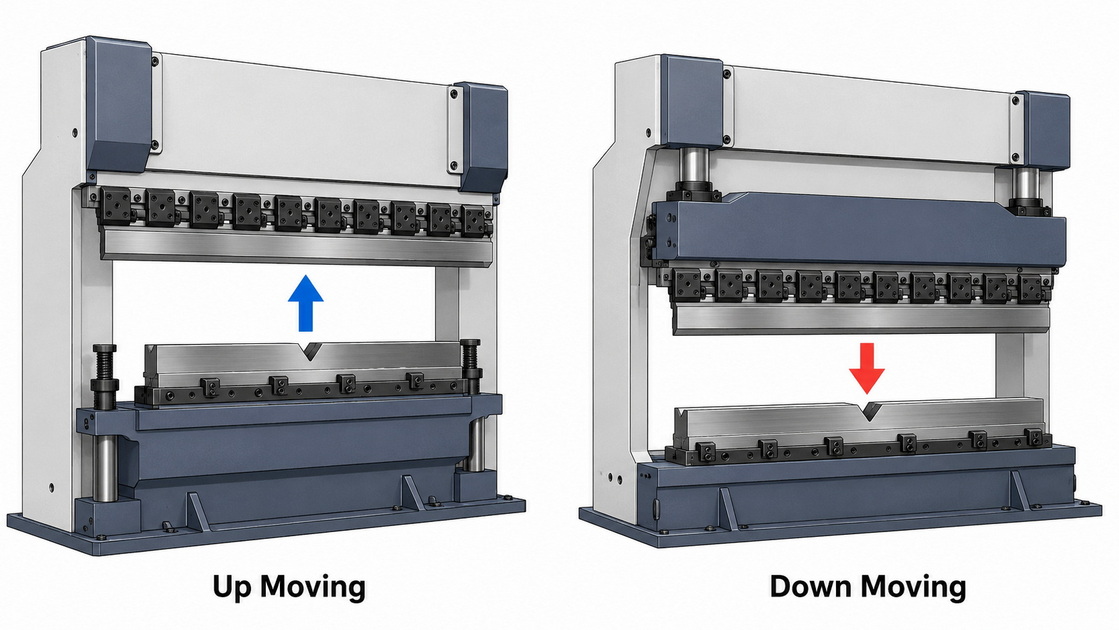
An up-moving (up-acting) press brake is a machine where the bottom beam/table moves upward toward a fixed upper beam, bending the sheet against the punch and die. In contrast, a down-moving (down-acting) press brake has a moving upper ram that travels downward toward a fixed lower bed. [huxleydesign]
From an operator's standpoint, this changes:
- How the sheet moves during the bend
- How safety devices are positioned
- How deflection is managed for precision on long parts
In modern CNC systems, both architectures can integrate advanced controls, crowning, and safety guarding; the difference is how they deliver accuracy, ergonomics, and cycle-time efficiency. [practicalmachinist]
In a down-moving press brake, the upper ram drives force into a rigid lower bed, which often incorporates hydraulic or mechanical crowning to compensate for deflection. This design makes it straightforward to apply CNC-controlled crowning across the bed to maintain consistent angles along long parts. [huxleydesign]
In an up-moving design, the moving lower beam is the active component, and the upper beam remains fixed. When the lower beam is engineered with high rigidity and accurate guidance, it also achieves excellent bending accuracy, but its deflection behavior and compensation method can differ by manufacturer. [practicalmachinist]
Key precision points:
- Repeatability: Modern CNC down-moving brakes commonly achieve positional repeatability in the ±0.01 mm range with quality linear encoders and servo valves. [huxleydesign]
- Angle consistency: Both architectures use crowning or adaptive bending systems to correct angle variation along the bend length. [eminacademy]
- Thermal stability: Machines with well-managed hydraulic circuits and temperature compensation keep angle deviation tight over long shifts. [huxleydesign]
From a practical perspective, precision is no longer about "which type is inherently more accurate," but which offers better crowning, feedback, and frame stiffness in your tonnage range. [eminacademy]
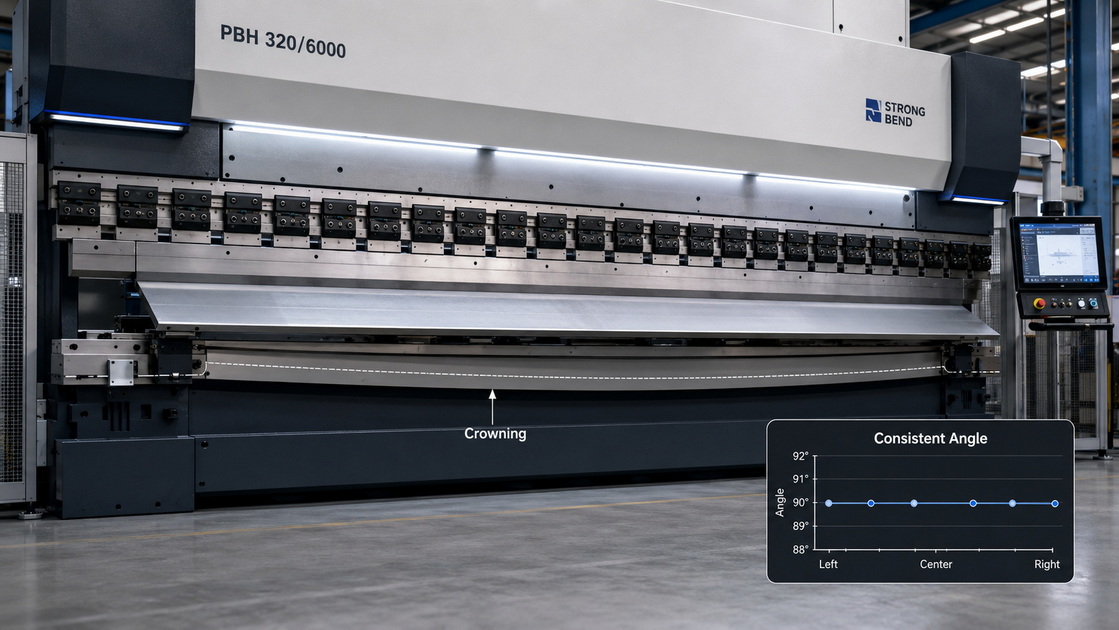
Both up- and down-moving CNC press brakes rely heavily on backgauges and multi-axis control to achieve repeatable precision. [huxleydesign]
- Down-moving press brakes often combine a robust multi-axis backgauge (X, R, Z1/Z2, sometimes more) with angle-measuring systems and automatic corrections, offering strong performance in high-mix, tight-tolerance environments. [huxleydesign]
- Up-moving press brakes can integrate the same backgauge technology, and operators often comment that their hands and the sheet start moving with the material as soon as the lower beam rises, which can enhance "feel" and control for some setups. [practicalmachinist]
When specifying a machine, look at the CNC system, backgauge accuracy, and available adaptive bending options first, then select the motion type that fits your workflow and safety philosophy. [eminacademy]
Press brake safety requirements are typically governed by machine-specific standards (such as ANSI B11.3 in North America) and general machine guarding guidelines (e.g., OSHA frameworks for power presses). These standards define safe distances, required guarding, and functional safety requirements for stopping and monitoring movements. [blog.ansi]
- Down-moving press brakes:
- The moving upper ram approaches the operator's hands and the workpiece, so front light curtains, laser safety devices, or camera systems are typically placed to monitor the hazard zone. [eminacademy]
- Guarding focuses on preventing fingers and hands from entering the closing gap under the ram.
- Up-moving press brakes:
- The lower beam moves up and tends to "carry" the sheet and operator's hands away from the primary pinch point, which some operators find more intuitive. [practicalmachinist]
- Guarding still must control access to the tooling area, but motion can make it easier to maintain a safe hand position because the sheet itself moves upward.
In both cases, safe operation depends far more on the safety system design and operator training than on the motion direction alone. Modern CNC press brakes typically include: [blog.ansi]
- Dual-channel safety circuits and monitored valves
- Emergency stops and mode selectors (setup, single-stroke, automatic)
- Interlocked guards and approved presence-sensing devices
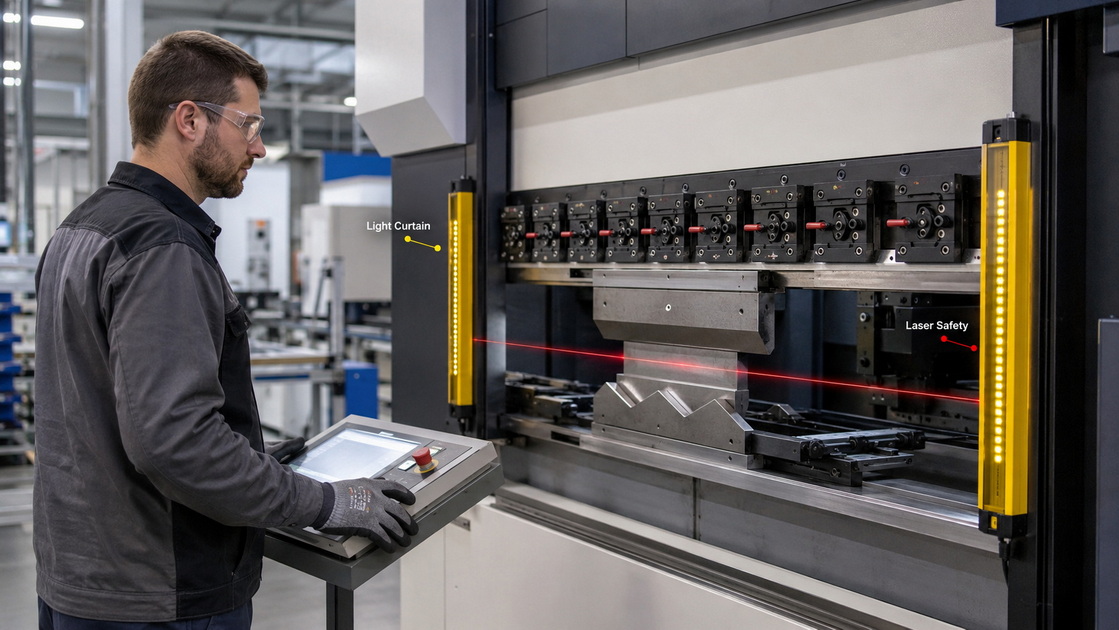
From a hands-on perspective, the best safety results come from consistent procedures, regardless of up- or down-moving design. [eminacademy]
Key practices include:
1. Pre-operation inspection – Check safety devices, pedal switches, guards, and hydraulic systems before shift start. [eminacademy]
2. Tooling checks – Ensure punches and dies are clean, properly clamped, and aligned; run a slow "dry stroke" at low pressure after any setup change. [eminacademy]
3. Mode discipline – Restrict continuous modes to trained operators and use setup modes for teaching or tool change.
4. Safe hand position – Train operators to work with gauged back positions, not fingers near the pinch point, and to respect minimum safety distances defined by standards. [blog.ansi]
Whether you choose an up-moving or down-moving brake, integrating these practices into SOPs is what actually reduces accidents and unplanned downtime. [blog.ansi]
| Aspect | Up-Moving (Up-Acting) Press Brake | Down-Moving (Down-Acting) Press Brake |
|---|---|---|
| Primary moving element | Lower beam/table moves upward (practicalmachinist) | Upper ram moves downward (huxleydesign) |
| Operator "feel" | Hands and sheet rise with the beam, some operators feel more in control (practicalmachinist) | Sheet is driven down toward fixed bed, familiar to many shops (huxleydesign) |
| Angle consistency on long parts | High with proper design and crowning, depends on frame and control (eminacademy) | High with CNC crowning and adaptive bending, widely adopted (eminacademy) |
| Safety focus | Guarding around rising table and tooling zone, emphasis on hand tracking (blog.ansi) | Guarding against descending ram, strong use of light curtains/lasers (blog.ansi) |
| Typical market adoption | Common in certain brands/regions and niche preferences (practicalmachinist) | Very common globally in CNC press brakes (huxleydesign) |
| Integration with advanced CNC | Supports multi‑axis backgauge and angle control (huxleydesign) | Supports multi‑axis backgauge and angle/adaptive systems (huxleydesign) |
From a buyer's and manufacturing engineer's perspective, the decision is rarely only about motion direction; it is about matching the machine to the process and workforce.
You might prioritize an up-moving press brake when:
- Your operators value the sheet "riding up" with the beam, improving their sense of control on specific part geometries. [practicalmachinist]
- You want to align with existing shop practice where up-acting brakes have been standard and your tooling and fixtures are optimized for them.
- Your layout or handling equipment (e.g., conveyors or stacking systems) is designed around an upward motion path.
A down-moving press brake is often preferred when:
- You need a widely supported, standard architecture that matches global training materials and service support. [huxleydesign]
- You rely heavily on advanced crowning, adaptive angle correction, and multi-axis backgauges for complex, low-variation, high-tolerance work. [eminacademy]
- You want easier integration with existing automation cells or robotic bending lines that assume a down-acting ram.
The most effective strategy is usually to evaluate sample parts on both architectures, measure angle repeatability, ergonomic impact, and changeover time, then select the design that best fits your volume and mix.
For OEM and ODM projects, it often makes sense to customize the press brake configuration instead of choosing a purely standard catalog model. [a-3fab]
Common custom options include:
- Special backgauge fingers for large panels or deep boxes
- Custom tooling for radius bends, hems, or non-standard profiles
- Extended open height and throat depth for tall parts or deep flanges
- Integrated material support arms to reduce operator strain on heavy blanks
Manufacturers focused on complete sheet-metal solutions can adapt both up-moving and down-moving designs using application-specific hydraulic, mechanical, and CNC packages to optimize for your production mix. [sheet-metal-fabrication]
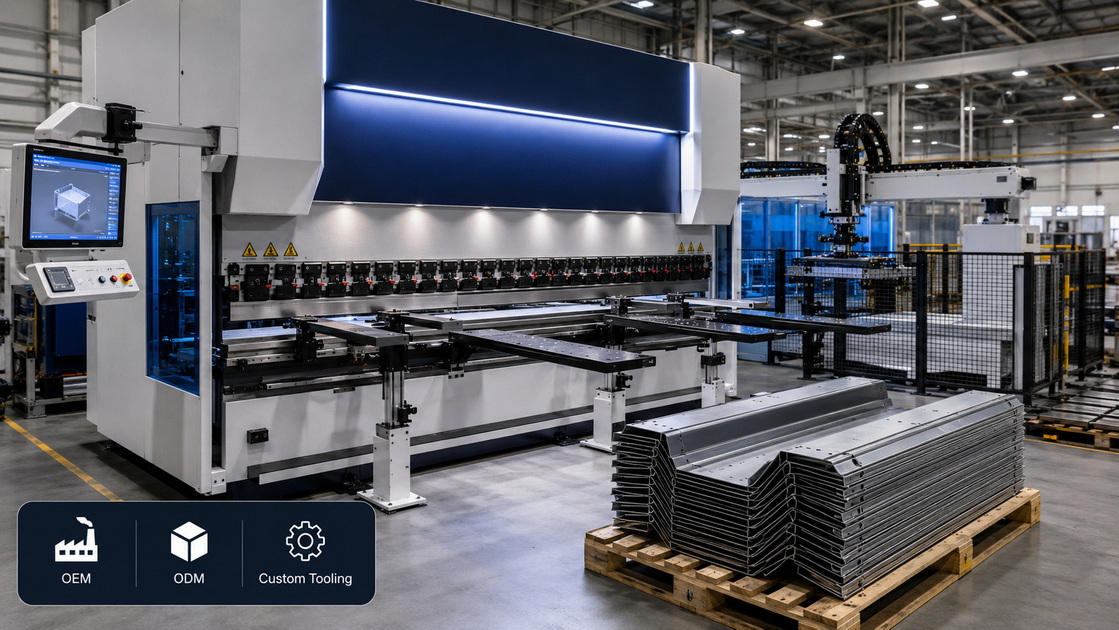
In practice, metal fabrication plants often base their decision on industry, part families, and labor profile. [a-3fab]
Examples:
- A high-mix job shop serving construction, agriculture, and transportation may prioritize flexible down-moving CNC brakes with quick tooling change and adaptive angle measurement to handle constant changeovers. [a-3fab]
- A plant specializing in repeat, high-volume panels with experienced up-acting operators may stay with up-moving brakes, emphasizing operator familiarity, ergonomics, and integration with existing jigs. [practicalmachinist]
In both scenarios, precision and safety targets are attainable, but the "right" choice is the one that keeps your OEE, scrap rate, and incident rate trending in the right direction over years of production.
No matter which press brake type you choose, a few best practices consistently separate top-performing shops from the rest. [eminacademy]
- Invest in operator training – Teach not just button sequences but bending theory (bend allowance, springback, tooling selection).
- Standardize setups – Document preferred tooling, sequences, and CNC programs for recurring parts to reduce variation.
- Leverage test bends – Use scrap for initial bends and let the CNC store optimal corrections per material and batch. [huxleydesign]
- Maintain tooling and hydraulics – Worn tools or unstable hydraulics undermine both precision and safety.
- Audit safety systems – Periodically test light curtains, lasers, interlocks, and e-stops to ensure compliance with standards such as ANSI B11.3 where applicable. [blog.ansi]
As a manufacturer specializing in CNC press brakes and complete sheet metal processing solutions, CNDY-Press can help you evaluate whether up-moving or down-moving architectures better fit your production strategy.
For OEM and ODM customers, this typically includes:
- Reviewing your part drawings, materials, and thickness ranges
- Assessing precision and safety requirements based on your industry standards
- Proposing an optimized press brake configuration, motion type, and tooling package
- Providing lifecycle support from installation and training to maintenance and upgrades
By combining engineering expertise, application consultation, and custom manufacturing, you can specify a press brake solution that delivers stable precision, robust safety, and predictable operating costs over its service life. [sheet-metal-fabrication]
If you are planning a new bending line, replacing legacy equipment, or designing an OEM/ODM cell around CNC press brakes, consider involving CNDY-Press early in the project.
Share a representative set of parts (DXF/STEP files, material specs, and annual volumes), and we can help you:
- Compare up-moving vs. down-moving configurations for your exact case
- Quantify expected precision, cycle time, and safety margins
- Define a customized press brake package that aligns with your budget and long-term growth
1. Which is more precise: up-moving or down-moving press brakes?
Both can reach very high precision when combined with a rigid frame, CNC crowning, and quality tooling. In modern equipment, control system quality and machine build matter more than motion direction. [eminacademy]
2. Are up-moving press brakes safer than down-moving designs?
Not inherently; safety depends on guarding, safety controls, and operator training, all of which are defined by machine-specific standards such as ANSI B11.3. Both designs can meet strict safety requirements. [eminacademy]
3. Do I need different tooling for up-moving and down-moving machines?
Most standard punches and dies are compatible with both, as long as tool clamping systems match the machine design. For special geometries, your press brake supplier can recommend optimized tooling. [eminacademy]
4. Which design is better for automation and robotics?
Many automated bending cells are built around down-moving press brakes, mostly due to market prevalence and existing integration templates. That said, up-moving designs can be automated as long as the integrator accounts for motion paths. [huxleydesign]
5. How should I decide between up-moving and down-moving for a new plant?
Evaluate sample parts on both machine types, measure angle consistency, cycle time, and ergonomic impact, and consider local service support and operator familiarity. A supplier with OEM/ODM experience can guide this evaluation. [eminacademy]
1. Emin Academy – "CNC Press Brake vs Manual Press Brake: Key Differences Explained."
https://eminacademy.com/blog/cnc-press-brake-vs-manual-press-brake.html [eminacademy]
2. ANSI – "ANSI B11.3-2022: Safety Requirements for Power Press Brakes."
https://blog.ansi.org/ansi/ansi-b11-3-2022-power-press-brakes/ [blog.ansi]
3. A-3 Fab – "Common Industries Using Custom Metal Fabrication."
https://a-3fab.com/2025/06/common-industries-that-rely-on-custom-metal-fabrication/ [a-3fab]
4. Emin Academy – "Top 10 Press Brake Safety Tips Every Operator Should Know."
https://eminacademy.com/blog/press-brake-safety-tips.html [eminacademy]
5. Practical Machinist – "Press Brake - Up Acting vs Down Amada."
https://www.practicalmachinist.com/forum/threads/press-brake-up-acting-vs-down-amada.337269/ [practicalmachinist]
6. Huxley Design – "The Ultimate Guide to Sheet Metal Press Brake."
https://huxleydesign.com/sheet-metal-press-brake/ [huxleydesign]


