


Views: 213 Author: CNDY-Press Publish Time: 2026-10-21 Origin: Site


Content Menu
● Tandem Press Brake vs Large Press Brake: What Is the Difference?
>> What Is a Tandem Press Brake?
>> What Is a Large Press Brake?
● Tandem Press Brake vs Large Press Brake Comparison
● Which Long Sheet Metal Applications Favor Tandem Bending?
>> Workshops With Mixed Component Lengths
>> Facilities With Installation Constraints
>> Production With Variable Future Demand
● When Is a Single Large Press Brake the Better Choice?
>> Long Components Dominate the Schedule
>> Buyers Want to Avoid an Inter-Machine Junction
>> Dedicated Handling and Automation Are Planned
● Why Combined Tonnage Can Be Misleading
>> Check the Load on Each Machine
>> Confirm Usable Bending Length
>> Calculate for the Actual Material
● The Main Technical Comparison
>> Long Machines Deflect Under Load
>> Tandem Systems Need Coordinated Compensation
>> Measure More Than Bend Angle
● The Demonstration Part May Avoid the Difficult Load Case
● Handling Often Determines Real Productivity
>> Test the Complete Part Cycle
● A Workload-Based Investment Example
● How to Validate the Supplier's Proposal
>> Prepare a Representative Part Pack
>> Agree on Factory Acceptance Criteria
>> Confirm Installation and Safety Responsibilities
● Discuss Your Long-Part Bending Project With CNDY-Press
>> 1. Can a tandem press brake operate as two separate machines?
>> 2. Is a tandem press brake more accurate than a large press brake?
>> 3. Does tandem operation double the available force?
>> 4. Can existing machines be converted into a tandem system?
>> 5. Which option is cheaper to maintain?
A tandem press brake often makes sense when a factory needs to bend very long sheet metal while retaining the option to process shorter components on separate machines. A large press brake can be the better choice when long-part production dominates and buyers want a single machine architecture without an inter-machine junction.
Neither configuration is universally superior. In a tandem press brake vs large press brake comparison, the deciding factors are part geometry, force distribution, accuracy requirements, production mix, handling, and installation conditions.
My recommended starting point is workload: establish what the factory must produce over a normal month, not simply the longest component it might bend.
For CNDY-Press, that application-first approach provides a practical foundation for discussing CNC press brakes, OEM and ODM projects, and customized sheet metal processing equipment.
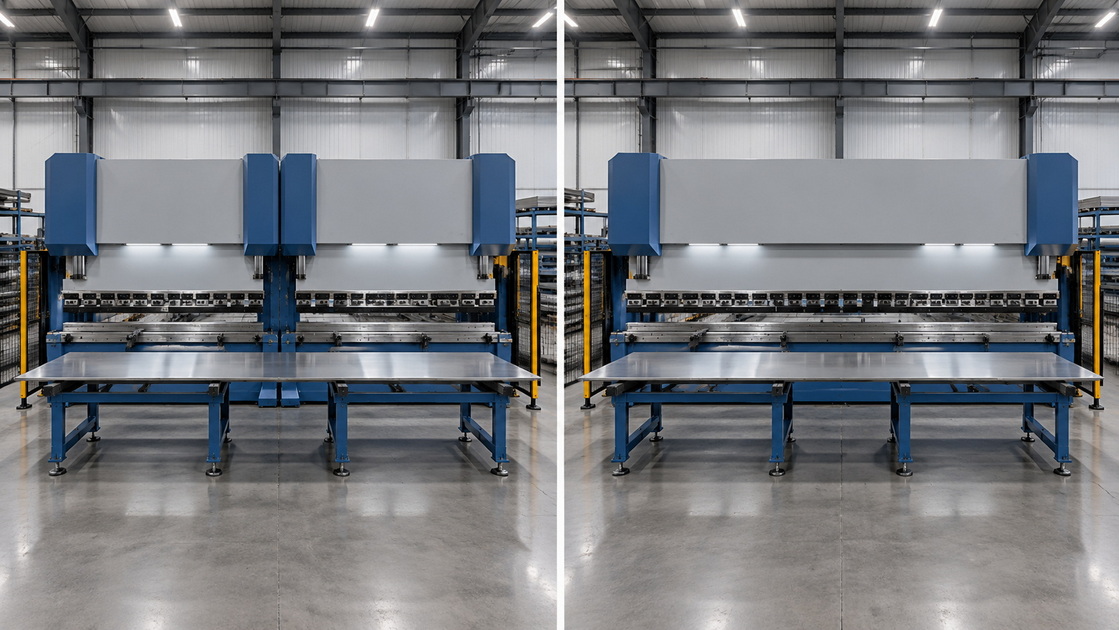
A tandem press brake combines two appropriately engineered machines positioned side by side and synchronized to bend one long workpiece.
The machines must coordinate ram movement, tooling alignment, bending force, and compensation. Some configurations also allow independent operation for shorter parts.
However, two existing press brakes cannot automatically become a tandem system. Compatibility, control integration, safeguarding, alignment, and manufacturer engineering must be established.
Here, "large press brake" means one long-bed machine with a single integrated machine architecture, rather than a synchronized pair.
It may have substantial bending length, high force capacity, or both. Length and tonnage are separate specifications: a long machine does not automatically have enough capacity for thick plate.
A large machine also does not necessarily have a simple two-cylinder arrangement. Its design depends on the manufacturer and application.
| Purchasing factor | Tandem press brake | Single large press brake |
|---|---|---|
| Main advantage | Long-part capability plus potential independent operation | One integrated long-part bending system |
| Strongest workload fit | Mixed short and long components | Frequent long-component production |
| Control requirement | Synchronization across machines | Coordination within one machine |
| Compensation challenge | Alignment and compensation across the junction | Deflection compensation across a long structure |
| Force assessment | Each machine and the combined system | Local and overall machine capacity |
| Installation | Multiple aligned units | One potentially larger transport and installation package |
| Maintenance | Multiple machine systems | One machine system, with design-specific complexity |
| Downtime resilience | Some independent work may remain possible | Primary bending capacity may be unavailable |
| Handling | Requires a coordinated long-part workflow | Requires a coordinated long-part workflow |
These are selection tendencies, not guarantees. The quoted configuration and acceptance trial should determine the final decision.
Tandem bending is attractive when a factory produces occasional long channels, panels, or profiles alongside substantial shorter work.
When independent operation is supported, the machines may serve separate jobs between long-part orders.
That flexibility is valuable only if staffing, tooling, material supply, and scheduling allow both machines to operate productively. Two available machines do not automatically double finished output.
A tandem arrangement may help where a single large machine creates transport, doorway, foundation, or overhead-clearance difficulties.
Industry reporting describes an installation where two six-meter machines suited a building that could not accommodate the height of a proposed single twelve-meter machine beneath its crane.
This is a useful example, not a universal rule. Compare actual equipment drawings and installation requirements.
A tandem configuration can support a broader mix of component lengths.
However, expansion should not be assumed to be straightforward. If future linking is planned, obtain written confirmation of compatibility and integration requirements before buying the first machine.
If most orders require nearly the full bending length, the flexibility of independent tandem operation may provide little benefit.
A single large press brake can offer a more direct production arrangement, without repeated decisions about reserving two machines for one long job.
A tandem system remains two distinct machines. Their alignment, tooling arrangement, and compensation must produce an acceptable bend across the transition.
A single long machine removes that particular junction. It still requires suitable crowning, tooling, calibration, and material control.
Consequently, "single machine" should not be treated as an automatic guarantee of better accuracy.
For a dedicated long-part line, one integrated machine may suit the proposed loading and unloading layout.
Tandem systems can also support handling equipment. The correct comparison is the complete production cell, including access, gripping or support, part rotation, and safeguarding.
Consider a hypothetical tandem system comprising two machines rated at 250 metric tons-force each.
The combined rating does not mean a short component positioned entirely on one machine can receive 500 metric tons-force.
Likewise, an unevenly positioned long workpiece may load the two machines differently.
The supplier must verify individual machine loading, permissible force distribution, tooling limits, and the approved bending position.
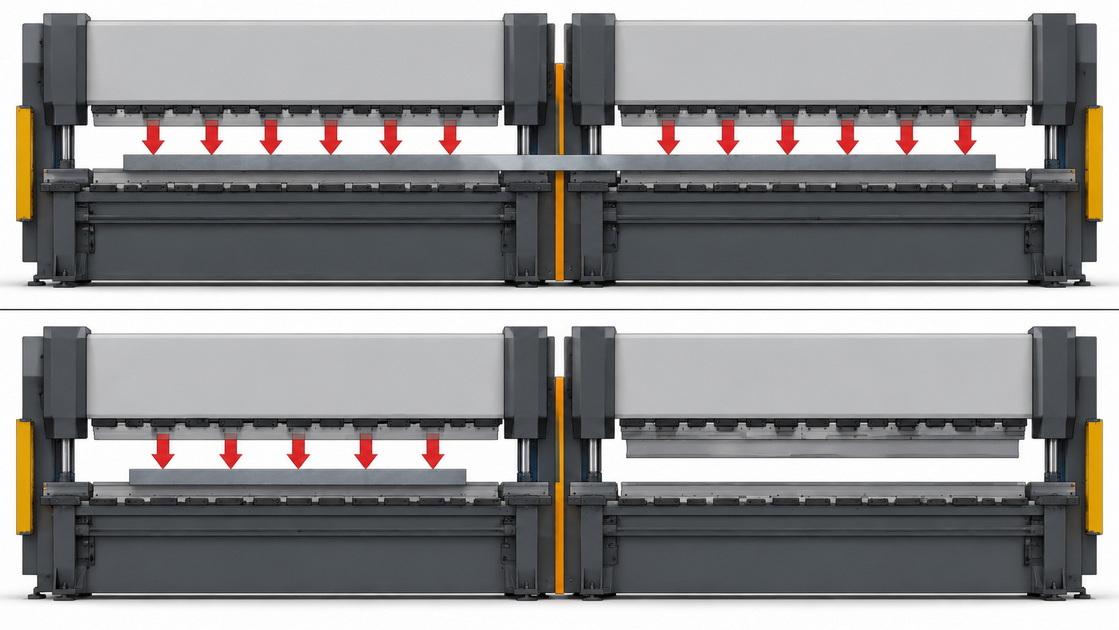
Two nominal machine lengths should not simply be added and treated as guaranteed continuous working length.
Check tooling coverage, junction geometry, frame clearances, and any restricted bending arrangements. Request a drawing showing the usable tooling line.
Force requirements depend on material properties, thickness, bend length, die opening, and bending method.
Air bending, bottoming, and coining are not interchangeable force cases. Require calculations for representative components, including tooling capacity and off-center loading limits where applicable.
The ram and bed respond to bending force. Without suitable compensation, the resulting angle can vary along the workpiece.
Crowning compensates for this behavior, but its effectiveness depends on the machine, load case, setup, and control system.
A tandem arrangement must manage each machine's behavior while maintaining an acceptable result across the junction.
It is insufficient for both machines to display the same nominal angle or ram position. The complete system must produce the required geometry.
Ask suppliers to explain alignment procedures, compensation settings, recalibration requirements, and the response to synchronization faults.
Long-part acceptance should address:
- Angle variation along the bend.
- Flange dimensions.
- Bow and twist.
- Straightness.
- Surface damage.
- Repeatability across consecutive parts.
A component can meet angle requirements at selected positions yet still fail assembly because it is twisted or bowed.
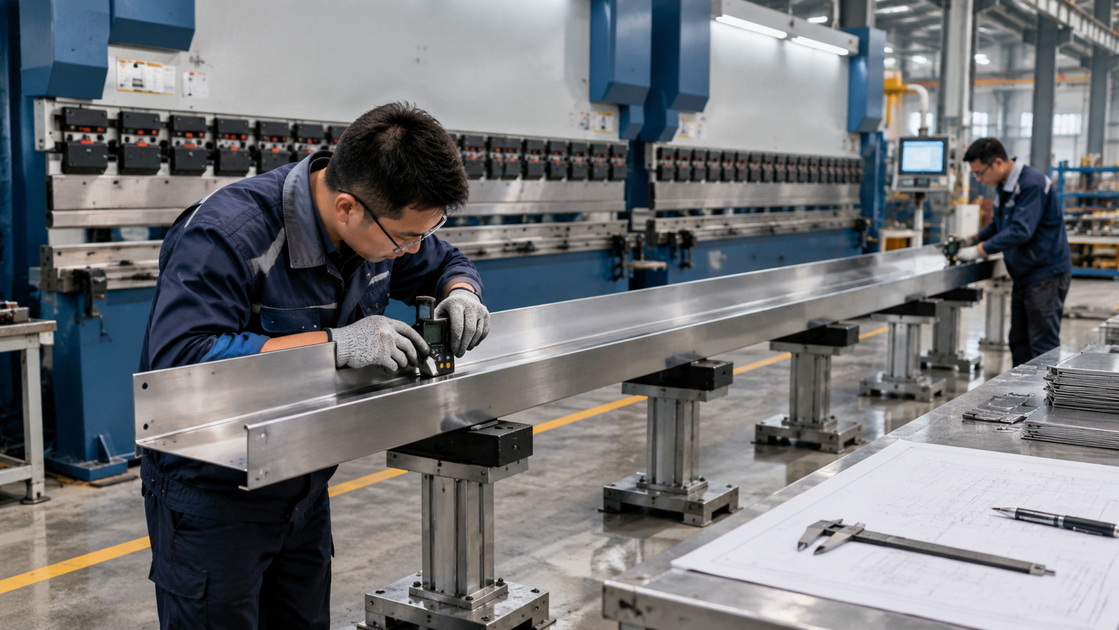
A centered, uniformly loaded sample can make either configuration look convincing.
Your production may include unequal bend lengths, cutouts, variable material properties, or parts positioned away from the ideal demonstration location.
For tandem evaluation, pay particular attention to components that cross the machine junction and create unequal loading.
Ask for a representative test matrix:
1. A full-length component.
2. A shorter component on each individual machine, where independent operation is specified.
3. A junction-spanning component with the intended geometry.
4. Repeated production after a tooling change.
5. A component with the most difficult handling sequence.
Do not exceed approved loading conditions to create a test. The supplier should first confirm the permitted arrangements.
Long sheet metal can flex under its own weight, making loading, gauging, rotation, and unloading demanding.
Faster ram motion may provide little benefit if operators spend most of the cycle supporting and repositioning the workpiece.
Evaluate sheet followers, lifting assistance, support tables, and sufficient access around the machine.
Measure:
- Loading and positioning.
- All bends and repositioning.
- Unloading.
- Inspection.
- Normal interruptions.
Record operator numbers and handling equipment. A demonstration using additional people should not be compared with a production plan staffed differently.
Safeguarding must remain functional throughout the trial.
The following example is hypothetical, not a CNDY-Press customer result.
Assume a factory requires:
- 300 hours annually for long-part production.
- 1,200 machine-hours for shorter components.
A tandem system may offer scheduling advantages if its two machines can run shorter jobs independently during overlapping periods.
However, that opportunity depends on having two operators or suitable automation, enough tooling, and sufficient downstream capacity.
A single large machine might complete the same demand successfully if its schedule has adequate capacity.
Therefore, compare annual production plans rather than assuming tandem is more economical because it contains two machines.
Include equipment, foundations, freight, tooling, handling, training, maintenance, labor, and downtime exposure in the ownership model.
Provide drawings, material specifications, thickness ranges, tolerances, surface requirements, quantities, and normal batch sizes.
Include the heaviest and most awkward components—not only the longest.
Define measurement positions, sample quantities, material identification, setup conditions, and acceptable geometric variation.
For tandem systems, include junction performance and independent operation if those capabilities are part of the purchase.
Review foundations, floor loading, access, lifting arrangements, utilities, overhead clearance, and maintenance space.
Ask who performs final alignment and what must be repeated after relocation or significant service.
Specify the intended safeguarding and the response to a fault affecting either machine. Independent operation during a fault must never be assumed to be safe or available.
CNDY-Press develops, manufactures, sells, and services CNC press brakes and related sheet metal equipment, including OEM, ODM, and customized projects.
Any proposed tandem capability, control integration, or independent operating mode should be confirmed explicitly in the technical agreement.
Some configurations can. Confirm separate controls, safeguarding, operating procedures, and any tooling or layout restrictions in the proposal.
Not inherently. Accuracy depends on design, alignment, compensation, tooling, material, and setup. Compare finished parts under agreed test conditions.
The nominal system rating may combine machine capacities, but usable force depends on load distribution and individual limits. It is not available at every position.
Possibly, but only after an engineering assessment. Controls, hydraulics, geometry, synchronization, safety functions, and structural compatibility must be reviewed.
There is no universal answer. Tandem introduces multiple machine systems; a large single machine may involve larger or specialized components. Compare planned maintenance and service access.
1. The Fabricator. "A Guide to Tandem Press Brakes." September 5, 2023. Industry discussion of independent operation, synchronization, force distribution, crowning, installation constraints, and application selection. [thefabricator]
2. LVD Group. "PPEB-H Press Brakes." Manufacturer description of single and tandem configurations, independent operation, heavy-duty construction, and CNC crowning. [lvdgroup]
3. LVD Strippit. "PPEB Press Brakes." Technical brochure covering synchronized operation, separate controls, custom machine features, and deflection compensation. [cdn.thomasnet]
4. Bystronic. "Xpert 250–1000: Sheet Metal Bending." Model-specific examples of large-machine and tandem capacities. Its specifications are not attributed to CNDY-Press. [bystronic]
5. Ursviken. "How Does a Tandem Press Brake Work?" May 28, 2025. Manufacturer explanation of linked-machine operation and long-workpiece applications. [ursviken]
6. Occupational Safety and Health Administration. "Machine Guarding eTool: Powered Press Brakes." Guidance on point-of-operation hazards, workpiece movement, and safeguarding. [osha]
7. CNDY-Press. "About Us." Company scope, OEM/ODM services, customization, training, and maintenance support. No unverified tandem specifications or customer outcomes are claimed. [cndypress]


