


Views: 222 Author: CNDY-Press Publish Time: 2026-05-30 Origin: Site


Content Menu
● What Is a Standard CNC Press Brake?
● What Is a Robotic Bending Cell?
● Side‑by‑Side Comparison: Standard Press Brake vs. Robotic Bending Cell
>> Core Decision Factors Table
● Cost, ROI, and Total Cost of Ownership
>> Initial Investment vs. Long‑Term Payback
>> Key ROI drivers for robotic bending cells
● Productivity, Quality, and Safety
>> Productivity and Throughput
● Flexibility, Changeovers, and Part Mix
● Integration, Software, and Data (Expert Perspective)
● Practical Implementation Roadmap for Robotic Bending Cells
● When a Standard CNC Press Brake Is Still the Best Choice
● When a Robotic Bending Cell Becomes a Strategic Must‑Have
● How CNDY‑Press Can Help You Decide
● Clear Next Step: Should You Automate Now?
● FAQ
Standard press brakes still win on flexibility and cost for many shops, but robotic bending cells can transform high‑volume, repetitive bending into a safer, more predictable and profitable operation when volumes and labor pressures justify the investment. [durmapress]
If you run a sheet‑metal job shop or in‑house fabrication line, you are likely asking whether a standard CNC press brake is still enough or if it is time to move toward a robotic bending cell and lights‑out production. As a manufacturer focused on CNC press brakes and automated sheet‑metal systems, CNDY‑Press has seen this decision move from "future plan" to "urgent priority" over the last 3–5 years. [action-machinery]
From my experience working with fabricators worldwide, the real question is not "manual vs robot" in general, but "for which parts, in which volumes, and under which constraints does each option create more value?". Robotic bending cells shine in high‑volume, repeatable parts with stable designs, while standard press brakes remain extremely competitive for short runs, frequent changeovers, and complex one‑off parts. [cnhawe]
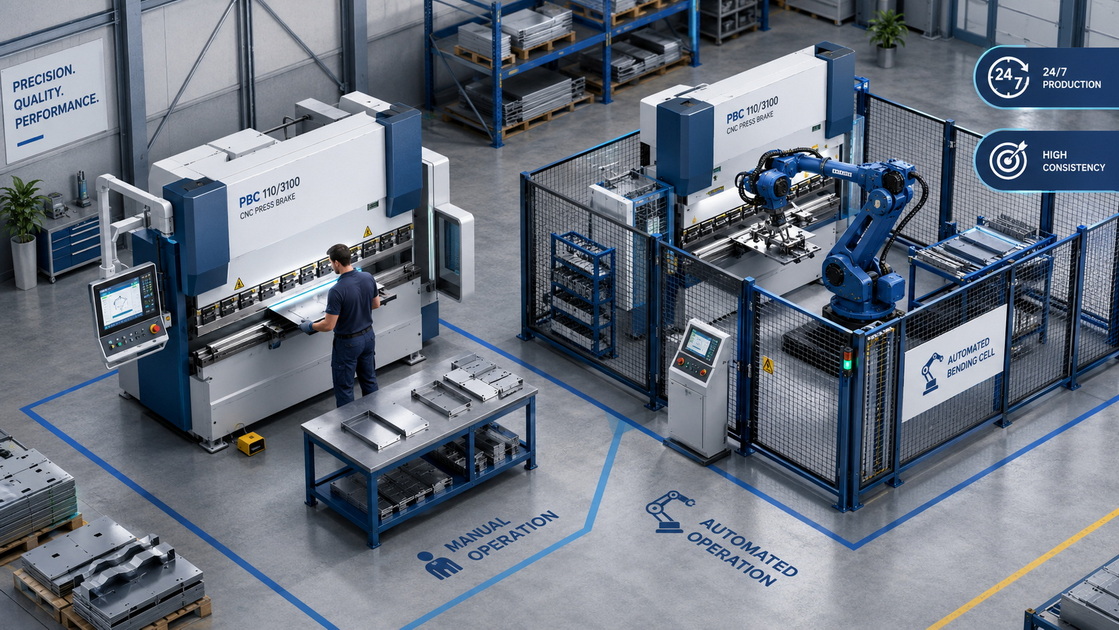
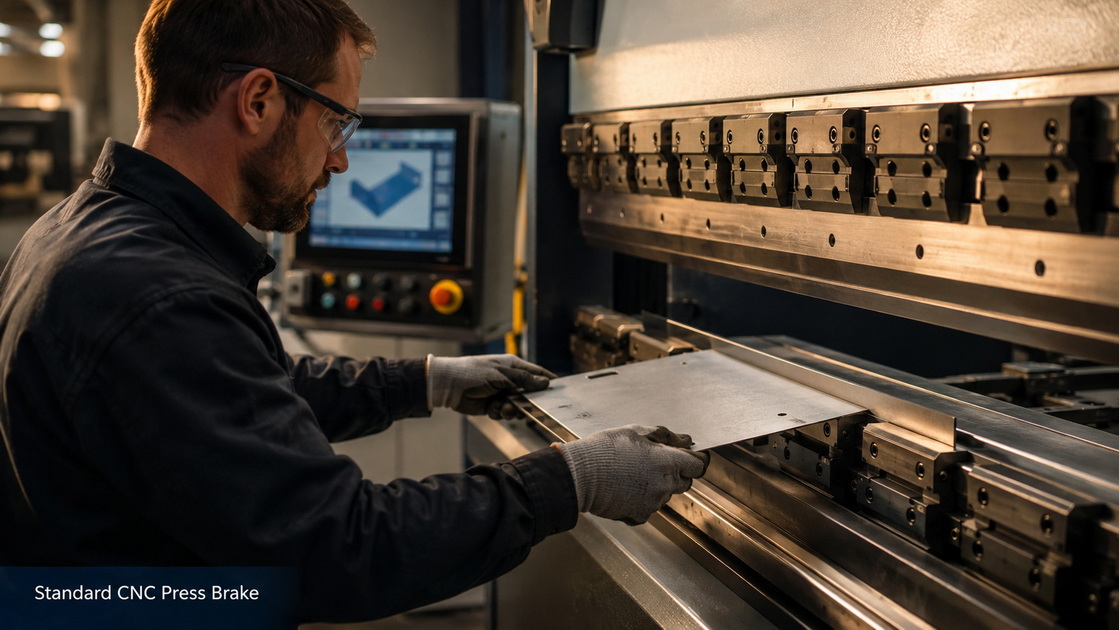
A standard CNC press brake is a machine where a human operator loads blanks, positions them against backgauges, triggers the bend, and handles the finished part. The CNC system controls axes, angle compensation, crowning, and bending sequences, but material handling and judgment are still done by people. [adhmt]
Typical characteristics:
- Lower initial investment compared with full robotic cells. [shen-chong]
- High flexibility for different materials, thicknesses, and geometries.
- Relies on skilled operators to ensure repeatability and quality.
- Ideal for small to medium batches, prototypes, and engineering changes. [durmapress]
From an operator's perspective, a well‑configured CNC press brake feels like a precision tool that responds to their expertise: they see, feel, and correct issues in real time, but their productivity is constrained by physical fatigue, shift length, and manual handling. [e-ci]
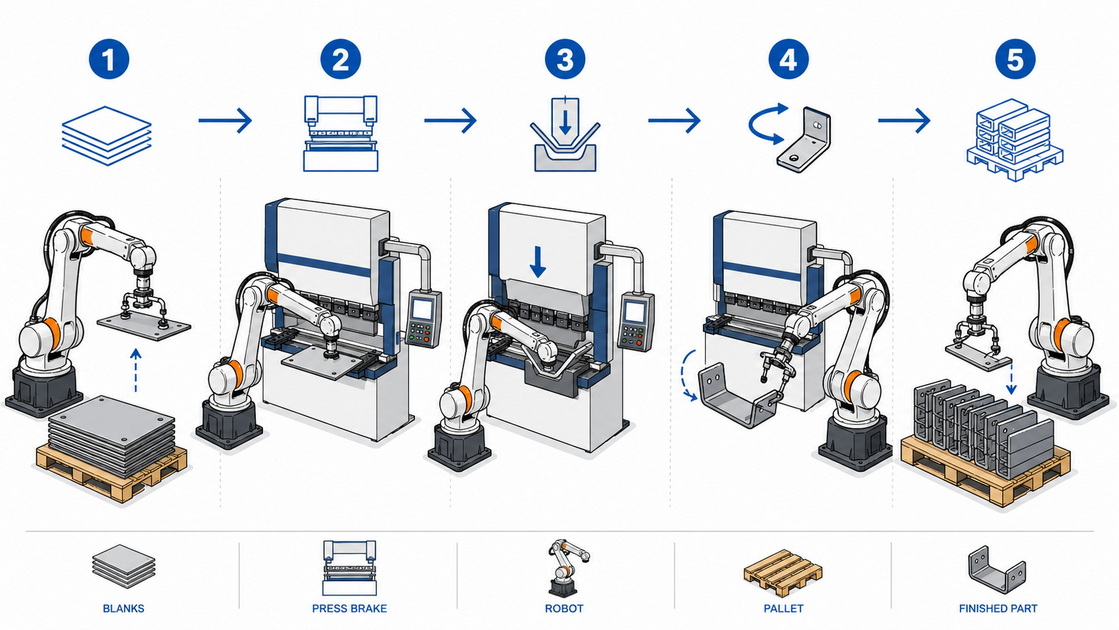
A robotic bending cell combines a CNC press brake with an industrial robot and peripheral automation (conveyors, stackers, safety systems, vision, and offline programming). The robot handles loading, positioning, bending, and stacking of parts according to a predefined program. [action-machinery]
Key features:
- Integrated robot for automated loading and unloading.
- Offline programming to simulate cycles, optimize robot paths, and avoid collisions. [linkedin]
- Safety systems (light curtains, scanners, fencing) for 24/7 or "lights‑out" production. [olympustechnologies.co]
- Often integrated with upstream cutting and downstream welding or assembly in smart‑factory environments. [growthmarketreports]
From a production manager's viewpoint, a robotic bending cell behaves like a highly consistent "virtual operator" that can run long shifts with stable cycle times, assuming part mix and quality are controlled. [e-ci]
| Factor | Standard CNC Press Brake | Robotic Bending Cell |
|---|---|---|
| Upfront investment | Lower machine cost, minimal automation add‑ons (shen-chong) | Higher capex: press brake + robot + safety + software (shen-chong) |
| Labor dependence | Needs skilled operator per shift | One operator can supervise multiple cells (e-ci) |
| Best for volumes | Low to medium, mixed jobs (durmapress) | Medium to high, repeatable parts (durmapress) |
| Changeover flexibility | Very high, easy to switch jobs | Requires reprogramming and gripper changes (cnhawe) |
| Cycle time & throughput | Operator‑dependent, varies by shift | Stable, predictable cycle times (fanucamerica) |
| Quality consistency | Good, but sensitive to fatigue and turnover | Very high consistency once tuned (action-machinery) |
| Safety & ergonomics | Improved with guards, but still manual handling | Strong safety envelope, low physical strain (cnhawe) |
| Integration with Industry 4.0 | CNC data, basic connectivity (cnhawe) | Full data integration, OEE tracking, smart factory (action-machinery) |
A case study from a North American fabricator showed that adding an automated brake press tending cell increased throughput and stabilized cycle times while reducing direct labor per part. For that shop, automation made sense because their part mix was relatively stable and volumes were growing. [fanucamerica]
- Standard press brakes typically range widely in price, depending on tonnage, length, and technology, but they do not require robot hardware or advanced offline programming. [shen-chong]
- Robotic bending cells bundle the press brake, robot, safety enclosures, grippers, vision, and specialized software, often more than doubling the base machine cost. [shen-chong]
However, when you spread the investment across years of high‑volume production, robotic cells can deliver lower cost per part due to reduced labor and higher utilization. [growthmarketreports]
1. Labor savings: One operator can supervise multiple cells, feed parts, and handle exceptions instead of standing at one brake all day. [fanucamerica]
2. Higher utilization: Robots can run nights, weekends, and breaks, achieving closer to 70–85% effective uptime in stable environments. [action-machinery]
3. Quality and scrap reduction: Consistent motion and positioning reduce angle variation and rework. [olympustechnologies.co]
4. Fewer injuries and downtime: Less manual handling reduces ergonomic issues and unplanned absenteeism. [olympustechnologies.co]
A well‑run standard CNC press brake can be extremely productive in the hands of an expert operator, but performance is vulnerable to fatigue, shift changes, and operator variability. Robotic bending cells provide repeatable cycle times and can achieve significantly higher output in high‑volume series by eliminating non‑value‑adding motions. [durmapress]
Industry reports and automation providers highlight that automated press brake cells consistently increase output and stabilize takt times, especially where part handling is heavy or awkward. [e-ci]
- Standard brakes rely on operator feedback and occasional re‑measurement.
- Robotic cells rely on precise positioning, angle measurement, and adaptive programming to keep bends within tolerance. [cnhawe]
When integrated with advanced sensors and CNC features, automated cells achieve more stable angle control and reduce scrap, particularly valuable in stainless and high‑value materials. [action-machinery]
Automation is one of the most effective ways to remove operators from repetitive, heavy, and hazardous material handling around press brakes. Modern robotic cells integrate safety scanners, light curtains, emergency stops, and restricted zones in accordance with standards such as ANSI B11.3 and OSHA guidelines. [cnhawe]
For companies facing aging workforces or difficult labor markets, this safety and ergonomics improvement is often as important as pure throughput gains. [olympustechnologies.co]
If your business model is "high mix, low volume", a standard CNC press brake remains extremely hard to beat. Setup consists of:
- Fast tool change.
- Quick program editing.
- Visual inspection and on‑the‑fly adjustments by the operator. [mantechmachinery.co]
Robotic bending cells can absolutely handle mixed production, but every new part requires:
- Verified CAD/CAM or offline programs.
- Gripper and tooling compatibility checks.
- Simulation for collision and reach analysis. [linkedin]
For short runs, the engineering and programming time can exceed the savings from automation. That is why many advanced shops run a hybrid strategy: keep at least one flexible CNC press brake for prototypes and low volumes, and dedicate robotic cells to stable, high‑runner parts. [prima-press]
From an Industry 4.0 standpoint, robotic bending cells open a path to connected, data‑driven fabrication:
- Integration with MES/ERP and scheduling systems enables automatic job sequencing and part traceability. [growthmarketreports]
- Offline programming lets engineers optimize robot motion, cycle time, and tool setups before hitting the shop floor. [linkedin]
- Real‑time data (OEE, alarms, angle deviations) can be fed into dashboards for continuous improvement. [linkedin]
Research on integration strategies for robotic cells emphasizes clear objectives, compatibility with existing machinery, and scalable cell design. When these elements are handled well, a robotic bending cell stops being an isolated island and becomes a key node in a smart factory network. [growthmarketreports]
If you are considering automation, an implementation roadmap reduces risk and accelerates ROI. Drawing on best practices from robotic press brake integration guides and general robotic cell deployment frameworks: [olympustechnologies.co]
1. Assess part portfolio and automation fit
- Identify high‑volume, high‑repeatability parts with stable designs.
- Quantify current labor hours, changeover times, and scrap rates. [olympustechnologies.co]
2. Define clear business objectives
- For example: reduce cost per part by 20%, free operators for complex jobs, or enable lights‑out weekend shifts. [olympustechnologies.co]
3. Confirm integration readiness
- Check layout, material flow, and existing CNC capabilities.
- Plan for safety systems, part infeed/outfeed, and IT connectivity. [cnhawe]
4. Simulate, pilot, and refine
- Use 3D simulation and offline programming to validate cell design and cycle times. [cnhawe]
- Pilot with a focused family of parts, then expand.
5. Train your team and manage change
- Upskill operators into cell technicians who handle programming, monitoring, and troubleshooting. [linkedin]
- Communicate that automation is there to eliminate low‑value tasks, not skilled jobs.
Based on current industry data and shop‑floor experience, a standard CNC press brake remains the better answer when: [adhmt]
- Your part mix changes daily and batch sizes are small.
- You focus on custom work, prototypes, and frequent engineering changes.
- You are still building core bending expertise and process standards.
- Budget is limited and payback horizons must be very short.
In these scenarios, investing in a high‑quality CNC press brake with good backgauges, angle measurement, and user‑friendly controls can deliver fast productivity gains without the complexity of full robotics. [mantechmachinery.co]
On the other hand, it may be time to automate when: [e-ci]
- You run large batches or repeat the same parts monthly or weekly.
- Labor costs and skilled‑operator shortages are limiting your growth.
- You already have stable upstream processes (e.g., laser cutting with good nesting and consistent blanks).
- Your customers demand tight delivery windows and consistent quality at competitive prices.
Market research shows robust growth in robotic bending cells driven by the adoption of Industry 4.0 and the need for higher productivity across automotive, machinery, and appliance sectors. Automation providers also report that press brake automation is now a key lever for efficiency and cost savings, not just a prestige project. [growthmarketreports]
As a manufacturer focused on CNC press brakes and complete sheet‑metal solutions, CNDY‑Press can support you across the entire decision process:
- Application engineering to analyze your part "DNA" and recommend the right tonnage, length, and level of automation. [adhmt]
- OEM/ODM capabilities to customize tooling, backgauges, and robotic cells around your unique workflows.
- Stepwise automation strategies: from standard CNC press brakes to semi‑automated solutions, up to fully integrated robotic bending cells.
If you are not ready for a full robotic cell today, we can design a future‑ready CNC press brake with interfaces and options that make a later upgrade smoother and more cost‑effective. [adhmt]
To make this decision concrete, answer three questions:
1. Are at least 30–40% of your bending hours spent on stable, repeatable parts?
2. Do you expect labor costs or shortages to worsen over the next 3–5 years? [e-ci]
3. Is your upstream cutting process capable of delivering consistent blanks with minimal variation? [olympustechnologies.co]
If you answered "yes" to most of these, it is likely time to build a business case for a robotic bending cell. If not, a high‑performance standard CNC press brake is still a strong, future‑proof investment—and you can design it with automation in mind.
1. Will a robotic bending cell replace my press brake operators?
In most shops, robots do not eliminate jobs; they redefine roles. Operators shift from manual handling to programming, supervision, and quality control, while the robot handles repetitive bending. [olympustechnologies.co]
2. What batch size justifies a robotic bending cell?
There is no universal number, but robotic cells generally make sense when you have recurrent part families with stable designs and sufficient annual volume to amortize programming and setup time. [durmapress]
3. How long does it take to install and commission a robotic bending cell?
Depending on complexity, integration projects often run from several weeks to a few months, including design, simulation, installation, and training. [olympustechnologies.co]
4. Can I start with a standard CNC press brake and add a robot later?
Yes. Many new CNC press brakes are shipped "robot‑ready", with interfaces and safety provisions that allow later integration of a tending robot when volumes justify it. [cnhawe]
5. Is offline programming really necessary?
For robotic bending cells, offline programming is a major productivity driver because it allows you to develop and test programs without stopping the cell, while also optimizing paths and avoiding collisions. [adhmt]
1. Durma Press, "Manual vs Robotic Press Brake: Which One Is Better for Production?"[durmapress]
2. ADH Machine Tool, "Offline Press Brake Programming vs Integrated Robotic Bending – What Truly Delivers Lights‑Out Throughput?" [adhmt]
3. Action Machinery, "Future of Manufacturing: Automated Press Brakes & Robotics"[action-machinery]
4. CNHAWE, "CNC Press Brake for Metal Fabrication: Trends in 2026"[cnhawe]
5. Growth Market Reports, "Robotic Press Brake Bending Cell Market Research Report"[growthmarketreports]
6. ECI, "Unlocking Efficiency: The Power of Press Brake Automation" [e-ci]
7. CNHAWE, "Adding a Press Brake Robot in 2025: Complete Guide" [cnhawe]
8. ShenChong, "Robotic Press Brake Price: Factors, Cost Breakdown and Trends" [shen-chong]
9. FANUC America, "Automated Brake Press Tending Helps Thunder Creek Increase Output and Reduce Labor"[fanucamerica]
10. LinkedIn, "Integration Strategies for Robotic Cells in Manufacturing" [linkedin]
11. Prima‑Press, "Flexible Bending Center Panel Bending Machine vs Press Brake Robotic Bending Cell"[prima-press]
12. Olympus Technologies, "Safety and Efficiency: The Dual Benefits of Press Brake Automation"[olympustechnologies.co]
13. Olympus Technologies, "Integration Checklist for Press Brake Tending Robots" [olympustechnologies.co]


