


Views: 222 Author: CNDY-Press Publish Time: 2026-05-19 Origin: Site


Sheet metal rolling and heavy plate rolling may look similar on paper, but they demand completely different CNC rolling machine capacities, setups, and investment decisions. Understanding these differences is critical if you want to control costs, ensure reliable forming quality, and avoid overspecifying or underspecifying your next CNC plate rolling machine. [himalayamachine]
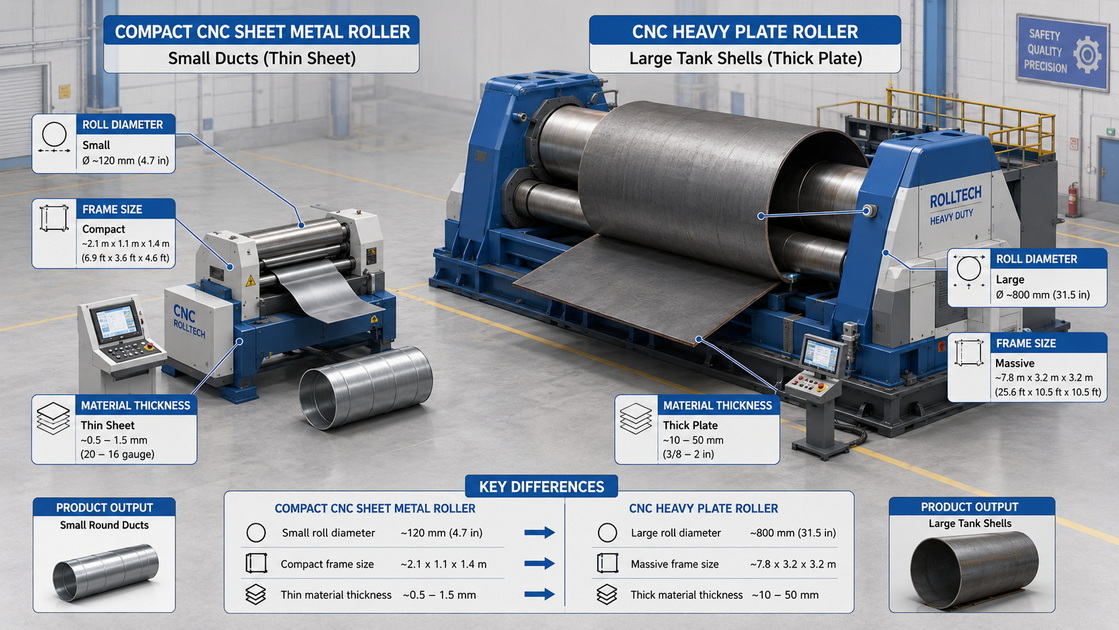
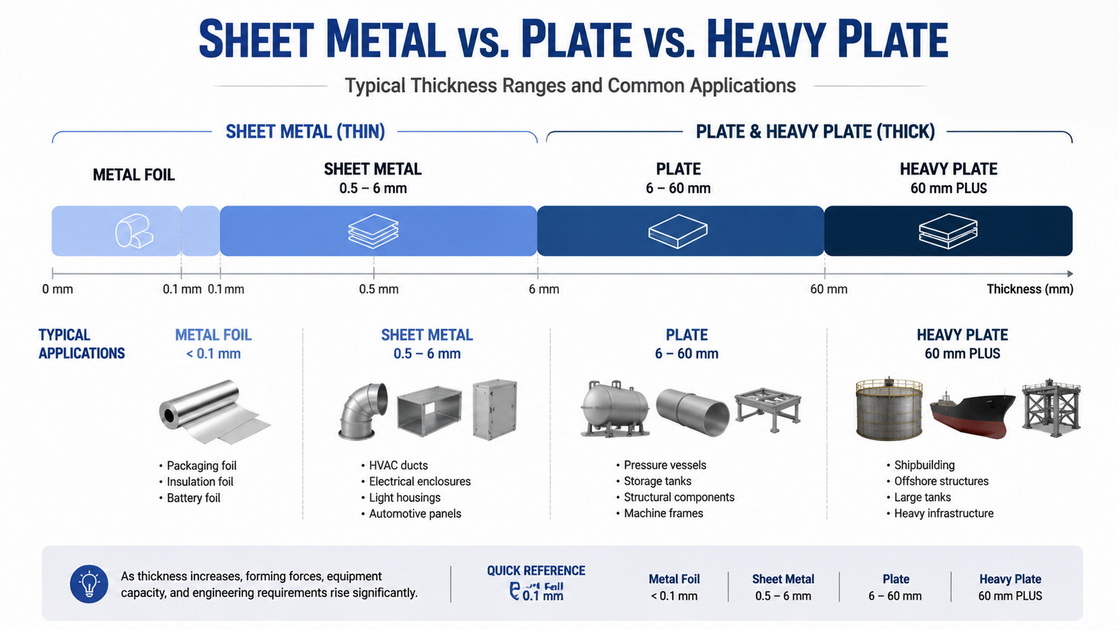
In industrial fabrication, "sheet metal" usually refers to thinner materials (around 0.5–6 mm), while "heavy plate" covers significantly thicker sections that can easily exceed 50 mm in demanding applications. This distinction drives everything from frame design and roller diameter to power demand and required CNC control levels. [harsle]
- Sheet metal rolling: Focus on speed, flexibility, and precise curvature for ducts, panels, enclosures, and light structures. [himalayamachine]
- Heavy plate rolling: Focus on massive forming force and rigidity for tanks, ship sections, wind towers, pressure vessels, and heavy structural components. [plateroller]
As a manufacturer that engineers CNC plate rolling machines for both light-gauge sheet metal and heavy plate applications, CNDY‑Press sees many buyers underestimate the impact of thickness, width, and grade on real-world machine capacity and lifetime ROI. [hinesbending]
For capacity selection, the single most important factor is your maximum material thickness and yield strength. [bendmakusa]
- Typical sheet metal rolling range: Up to about 6 mm thickness, often mild steel or stainless for HVAC, cabinets, and general fabrication. [himalayamachine]
- Typical heavy plate rolling range: 20–200 mm or more for structural and pressure applications, depending on machine size and configuration. [plateroller]
A heavy plate rolling machine may specify bending thickness in the 50–200 mm range with corresponding pre-bending capacity around 40–160 mm. In practice, you should always select a machine slightly above your maximum thickness, especially if you expect stronger grades (e.g., high-strength low-alloy steels) or future projects requiring thicker material. [harsle]
From an engineering standpoint, the forming force rises nonlinearly with both thickness and material strength, so trying to roll heavy plate on a "sheet metal" machine is not just inefficient—it is a serious mechanical and safety risk. [bendmakusa]
Heavy plate rolling demands an entirely different structural philosophy than light sheet metal rolling. [bendmakusa]
- Sheet metal CNC rollers
- Lighter, more compact frames optimized for precision bending, faster speeds, and lower forming loads. [himalayamachine]
- Smaller-diameter rollers with fine control suited to tighter radii on thin materials. [himalayamachine]
- Heavy plate CNC plate rolling machines
- Robust, heavy-duty frames designed to absorb massive rolling forces without deformation. [bendmakusa]
- Large-diameter rolls to deliver higher torque, handle thick sections, and maintain straightness over long bending lengths. [plateroller]
Machine sizing often uses heuristics such as roll length, roll diameter, and multipliers of the top roll diameter to estimate safe single-pass rolling limits. The longer the rolls, the larger their diameter must be to maintain stiffness and avoid deflection under load, which translates directly into cost and installed footprint. [bendmakusa]
When you move from sheet metal to heavy plate, the power plant of the machine changes just as dramatically as the frame. [plateroller]
- Sheet metal rolling
- Typically driven by standard motor and gearbox combinations.
- Emphasis on nimble speed control and fine positioning for small radii and thin stock. [himalayamachine]
- Heavy plate rolling
- High-power hydraulic systems and large drives are standard to generate sufficient torque and rolling pressure. [plateroller]
- Lower rolling speeds but far higher forming forces, especially during pre-bending and edge squaring. [plateroller]
Across both segments, CNC controls have become a key differentiator: advanced systems provide automatic sequencing, stored programs, and even Industry 4.0 connectivity. For demanding heavy plate work and tight tolerances, CNC plate rollers enable repeatability, automatic correction, and easier handling of variable radii or complex shapes. [china-rolling-machine]
Your typical job mix will heavily influence whether you should prioritize sheet metal capacity, heavy plate capacity, or a balanced solution. [shen-chong]
- Sheet metal applications
- HVAC ducts, gutters, cabinet bodies, guards, light structural components, enclosures. [himalayamachine]
- Higher cycle counts, shorter takt times, more frequent setup changes.
- ROI driven by speed, flexibility, and ease of use.
- Heavy plate applications
- Wind towers, storage tanks, shipbuilding, boilers, large-diameter pipe, industrial vessels. [custommarketinsights]
- Lower part counts but very high part value and strict quality requirements.
- ROI driven by uptime, forming accuracy, and avoiding rework or cracks.
Global demand for heavy plate rolling is being driven by infrastructure, energy, and shipbuilding growth, with plate rolling machine market forecasts showing healthy expansion supported by CNC and IoT upgrades. [china-rolling-machine]
| Dimension | Sheet Metal Rolling Needs | Heavy Plate Rolling Needs |
|---|---|---|
| Typical thickness | Approx. 0.5–6 mm sheet | From ~20 mm up to 200 mm+ plate (himalayamachine) |
| Machine frame | Compact, light to medium duty | Very rigid, heavy-duty welded frame (himalayamachine) |
| Roller diameter | Small, optimized for tight radii | Large, to handle high torque and stiffness (himalayamachine) |
| Power system | Standard motor drives | High-power hydraulic and heavy drives (himalayamachine) |
| Speed focus | Higher speed, frequent changeovers | Slower, controlled rolling with high forces (himalayamachine) |
| CNC features | Precise positioning, easy programming | Advanced CNC, multi-pass programs, automation (harsle) |
| Typical sectors | HVAC, enclosures, light fabrication (himalayamachine) | Shipbuilding, towers, tanks, heavy structures (himalayamachine) |
From our experience supporting OEM and ODM projects, the most successful buyers follow a structured, data-driven selection process for CNC rolling machine capacity. [hinesbending]
1. List your maximum thickness per material grade (e.g., S235 vs S355).
2. Confirm your maximum working width for each product family. [harsle]
3. Identify the highest yield-strength material you plan to roll in regular production.
As a rule, you should choose a machine rated slightly above this combination of thickness and strength to ensure process stability and future-proofing. [harsle]
1. Estimate the percentage split between sheet metal jobs and heavy plate jobs in your pipeline.
2. Map each product to required minimum inside radius and tolerance band.
3. Decide whether your priority is universal flexibility or deep specialization in heavy plate capacity.
This step often reveals that some buyers can cover 80% of their needs with a medium-plate CNC machine and outsource or schedule the rare extreme thickness jobs differently. [shen-chong]
1. If you run high-volume sheet metal or repetitive heavy plate parts, prioritize CNC automation and program storage. [hinesbending]
2. For complex geometries and variable radii, select machines with multi-axis CNC control, advanced interpolation, and possibly Industry 4.0 data integration. [china-rolling-machine]
3. Factor in training and service support; well-implemented CNC systems can significantly reduce rework and operator dependency. [hinesbending]
1. Review roll diameter, frame design, and stated maximum rolling and pre-bending capacities. [bendmakusa]
2. Check that the vendor's capacity calculator or engineering support accounts correctly for your material characteristics. [plateroller]
3. Confirm that the machine can handle edge prebending at your maximum plate thickness, not just mid-span rolling. [plateroller]
For OEM/ODM programs, CNDY‑Press typically runs a project-specific verification, using real customer drawings and material data to validate safety margins on rolling force and motor sizing. [china-rolling-machine]
Working across different industries, several recurring mistakes appear in sheet metal vs heavy plate capacity decisions. [shen-chong]
- Mistake 1 – "We'll just push the thin-plate machine harder."
Thin-sheet rollers lack the structural stiffness and hydraulic muscle to safely form heavy plate, leading to premature wear, misalignment, and potentially catastrophic failure. [bendmakusa]
- Mistake 2 – Overspecifying a heavy plate machine for light work
Investing in a machine sized for 80 mm plate when your daily work is 3–5 mm sheet erodes ROI through higher energy use, larger footprint, and more complex operation. [shen-chong]
- Mistake 3 – Ignoring material grade evolution
As designers move to higher-strength steels to reduce wall thickness, forming forces can increase even when nominal thickness falls. [harsle]
An experienced CNC plate rolling partner will ask probing questions about your future product roadmap, material strategy, and cost targets before proposing a capacity range. [china-rolling-machine]
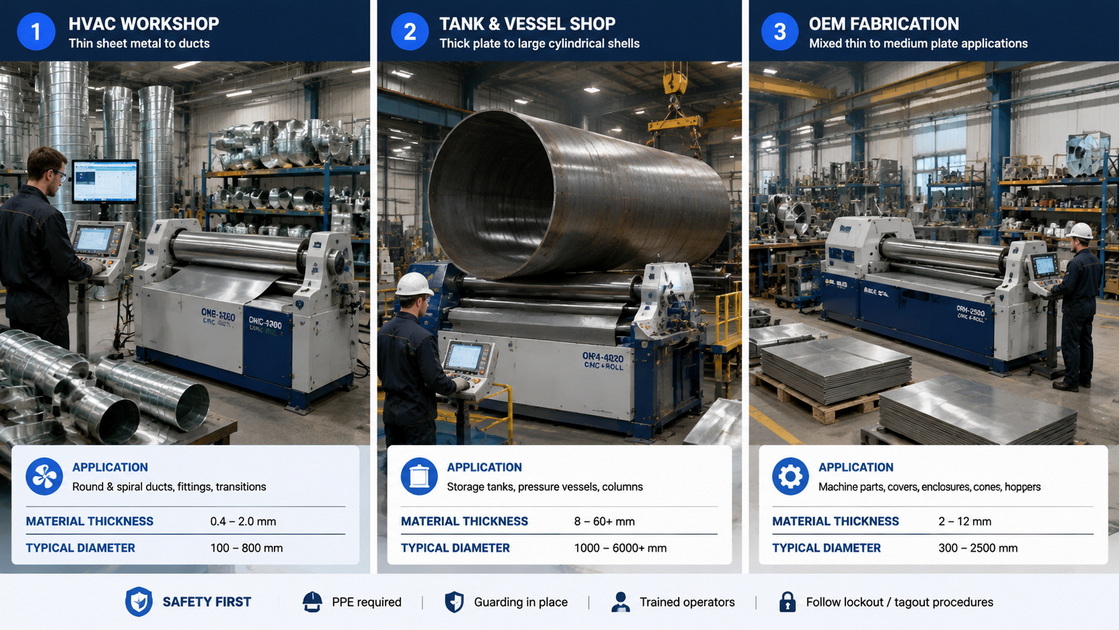
- Materials: 0.8–3 mm mild steel and stainless sheet.
- Typical parts: Ducts, covers, small cylindrical housings.
This shop needs sheet metal‑oriented CNC rolling capacity: compact frame, smaller diameter rolls, high positioning accuracy, and fast setup. A heavy plate machine would be unnecessarily slow and expensive to operate for this profile. [shen-chong]
- Materials: 16–60 mm plate, with some jobs up to 80 mm.
- Typical parts: Storage tanks, pressure vessels, large-diameter pipe.
Here, a heavy plate CNC plate rolling machine with large-diameter rolls, high-power hydraulics, and robust prebending capacity is essential. CNC automation is valuable for multi-pass programs and consistent cylindricity, especially in high-strength steel. [hinesbending]
- Materials: 2–25 mm mix across different product families.
- Typical parts: Enclosures, medium-pressure tanks, structural components.
For such OEMs, a balanced medium-plate CNC machine may be optimal, optionally combined with a dedicated light-gauge roller for high-speed sheet metal parts. The key is to model your volume and margin by segment before locking in a capacity range. [harsle]
Standard catalogs rarely fit perfectly when you combine sheet metal and heavy plate requirements under one roof. This is where OEM and ODM customization becomes a strategic advantage. [china-rolling-machine]
From a buyer's perspective, OEM/ODM collaboration on CNC plate rolling capacity can deliver:
- Custom roll lengths, diameters, and frame reinforcements tuned to your exact product range.
- Tailored CNC control layouts, integrated safety systems, and automation interfaces for upstream/downstream equipment. [china-rolling-machine]
- Application‑specific tooling for cones, ovals, polycentric shapes, and thick edge prebending. [bendmakusa]
Manufacturers that export globally and support both standard and custom plate rolling projects report strong demand for such tailored solutions, especially as industrial automation and digitalization accelerate. [custommarketinsights]
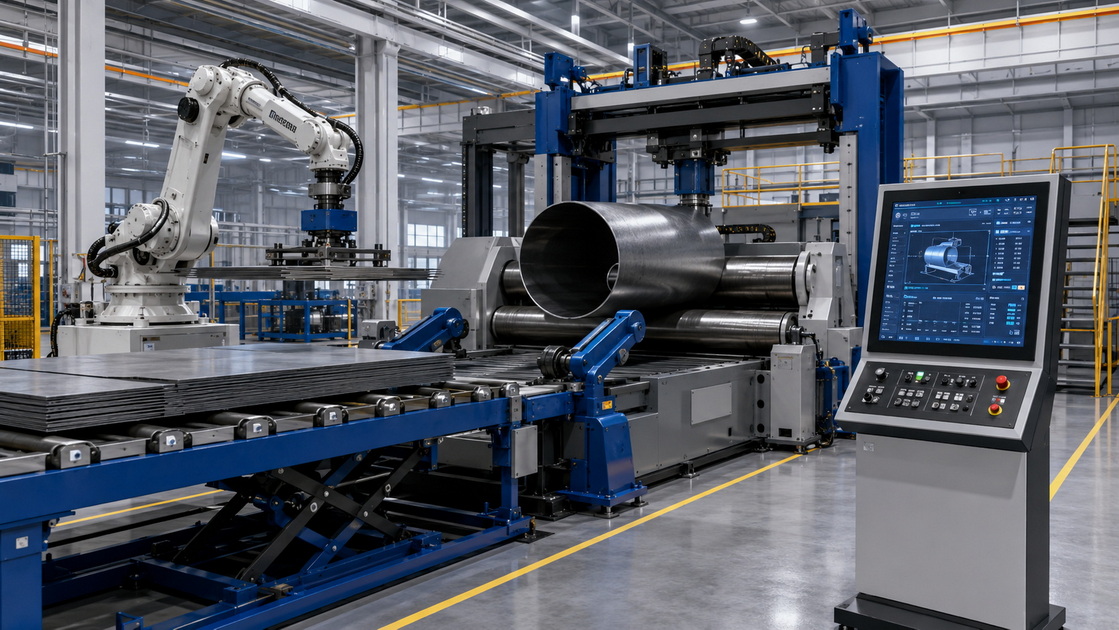
Choosing between sheet metal and heavy plate rolling capacity—and everything in between—should be a data‑driven engineering decision, not a guess based on nameplate values. If you are planning a new production line, upgrading legacy equipment, or launching an OEM/ODM project that spans multiple thickness ranges, involve a specialist early. [harsle]
CNDY‑Press can help you analyze your part mix, simulate rolling scenarios, and design a CNC plate rolling solution that aligns capacity, CNC intelligence, and automation level with your actual business model. Share your drawings, target materials, and production volumes, and our engineers will propose a tailored CNC rolling capacity roadmap you can build on.
1. How do I know if I need a sheet metal roller or a heavy plate roller?
You can start by mapping your maximum material thickness, width, and grade, then comparing these to machine specifications and safety margins. If your regular work stays within typical sheet metal ranges (up to about 6 mm) and focuses on light fabrication, a sheet metal machine is usually sufficient, while tank and structural work above 20 mm normally requires a heavy plate roller. [himalayamachine]
2. Can one CNC machine handle both thin sheet metal and heavy plate effectively?
Some medium-plate CNC machines can cover a wide thickness range, but there are trade‑offs in speed, finesse, and operating cost at the thin end. High-volume sheet metal producers often pair a dedicated light-gauge roller with a heavier machine rather than forcing a single unit to cover all scenarios. [shen-chong]
3. Why is pre‑bending capacity so important for heavy plate?
Pre‑bending determines whether the machine can close the leading and trailing edges of thick plate without flat spots, which is critical for tanks and pressure vessels. A machine rated only for mid‑span rolling at your thickness may still struggle with high-quality pre‑bending, leading to rework or welding challenges. [plateroller]
4. How do CNC controls improve heavy plate rolling quality?
CNC systems store multi-pass programs, control roll positions precisely, and can integrate with measurement and Industry 4.0 systems for traceability. This boosts repeatability, reduces dependence on a few expert operators, and shortens setup time for complex or variable-radius parts. [china-rolling-machine]
5. When is an OEM/ODM custom CNC plate rolling machine justified?
If your product mix, thickness range, or automation concept does not fit standard catalog models, or you expect large long-term volumes, OEM/ODM customization can optimize frame design, roll sizing, CNC features, and peripheral automation around your process. This usually results in higher productivity and lower lifetime cost per part than a generic machine that only roughly matches your requirements. [custommarketinsights]
1. Himalaya Machine. "Plate Rolling Machines vs. Sheet Rolling Machines: Key Differences."[himalayamachine]
2. Custom Market Insights. "Plate Rolling Machine Market Size." [custommarketinsights]
3. HARSLE. "How to Choose the Right Rolling Machine Easily?" [harsle]
4. PlateRoller.com. "Guide to Plate Rolling Process and Calculator." [plateroller]
5. Bendmak. "Plate Rolls: The Manufacturer's Buying Guide to Finding the Best." [bendmakusa]
6. Hines Bending Systems. "Plate Rolling Machine Manufacturers: The #1 Best." [hinesbending]
7. China‑Rolling‑Machine.com. "The Key Power of CNC Plate Rollers in the Metalworking Industry." [china-rolling-machine]
8. Shenchong. "How To Choose The Best Roller Machine?" [shen-chong]
9. China‑Rolling‑Machine.com. "Why Is Plate Roller Machine ODM the Ideal Solution for Industrial Automation?" [china-rolling-machine]


