


Views: 222 Author: CNDY-Press Publish Time: 2026-06-08 Origin: Site


Content Menu
● What Is Press Brake Tooling?
● Why Press Brake Tooling Matters More Than You Think
● Core Elements: Punches and Dies
● Punch Types and When to Use Them
>> Sash Punch
>> Swan Neck and Gooseneck Punches
● Die Types and Their Practical Roles
>> Single V Die
>> Two‑Way Self‑Centering V Dies
>> Multi‑V Dies
>> Flattening and Hemming Dies
>> Tool Holders and Clamping Systems
● Tooling Materials and Hardness: Why Chrome‑Moly Matters
● Tooling Styles: American, European, and New Standard
>> New Standard Tooling System
● How Tooling Affects Bending Accuracy
● Practical Framework: How to Choose the Right Press Brake Tooling
>> 3. Workpiece Length and Flange Length
>> 5. Bend Shape and Part Geometry
>> 6. Type of Bending: Air, Bottoming, Coining
>> 7. Budget and Production Volume
>> 8. Tonnage Capacity and Safety
● Maintaining and Storing Press Brake Tooling
● CNC Press Brakes, Offline Programming, and Tooling Strategy
● When to Upgrade Your Press Brake Tooling
● Call to Action: Get Expert Support for Your Next Bending Project
● FAQ
As someone who has spent years working with CNC press brakes in real production environments, I can tell you that the difference between profitable bending and constant rework usually comes down to your tooling, not just your machine brand or tonnage. Whether you are running a high‑mix job shop or standard OEM parts, choosing and maintaining the right press brake tooling directly affects bend accuracy, cycle time, and tool life. [blog.saleslayer]
In this guide, I'll walk through press brake tooling from a practitioner's perspective—what it is, how it works on modern CNC press brakes, which punch and die styles matter most, and how to choose, maintain, and upgrade tooling for real‑world sheet metal applications. This article is written for manufacturing engineers, production managers, and metal fabricators who want to move beyond generic definitions and make data‑driven decisions about their tooling strategy. [blog.thomasnet]
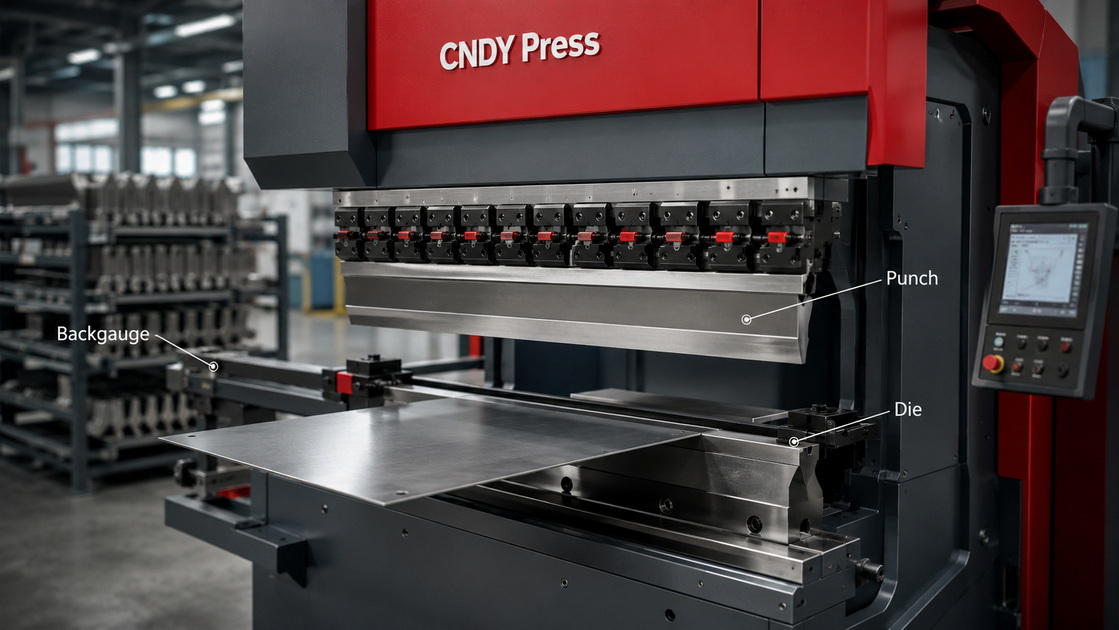
Press brake tooling consists of swappable punches (top tools) and dies (bottom tools) that form sheet metal into a desired angle or profile under tonnage. The tooling is not built into the press brake itself; instead, operators select and mount different tool sets to handle different materials, thicknesses, and geometries. [robertsiegers]
In any modern fabrication shop—especially those using CNC press brakes—tooling is what actually touches the workpiece and defines the final bend angle and radius. Because of the wide variety of applications (from simple brackets to complex enclosures and profiles), there has been an explosion of specialized tool designs on the market. [plantautomation-technology]
From a distance, two press brakes with the same tonnage and stroke can look similar—but on the shop floor, it is tooling that determines what you can actually produce reliably and profitably. Without appropriate tooling, your press brake is limited in bend angle range, material type, flange length, and profile complexity. [blog.thomasnet]
Well‑matched tooling allows you to:
- Expand application range: Handle different materials, thicknesses, and geometries without buying a new machine. [robertsiegers]
- Improve accuracy and repeatability: Reduce rework, scrap, and manual adjustments. [blog.saleslayer]
- Increase throughput: Use multi‑V dies, channel‑forming dies, or quick‑change systems to shorten setup and cycle times. [blog.saleslayer]
In many OEM and ODM projects, the right tooling strategy is the key to delivering consistent quality across long production runs while keeping total cost per part under control. [plantautomation-technology]
Every press brake tooling setup is built around two fundamental components: the punch and the die. [robertsiegers]
- Punch (top tool) – Exerts force downward, pushing the material into the die opening to form the bend. [robertsiegers]
- Die (bottom tool) – Supports the workpiece, defines the bend radius and opening, and absorbs the force transmitted by the punch. [robertsiegers]
Getting this pair right is more important than almost any other bending parameter, including many machine settings. [blog.saleslayer]
Over the years, I've learned that choosing punches based only on what is available in the tool cabinet ("whatever is free right now") is a guaranteed way to chase angles and fight springback. Below are the most common punch types you'll see in CNC press brake environments and how they are used in practice. [robertsiegers]
A standard punch has a relatively thick body with a narrow, strong tip designed to handle higher tonnage loads. The inward side has a slight concave curve, allowing shorter flange bends than a fully straight profile. [robertsiegers]
Use a standard punch when you:
- Bend thicker materials that require higher tonnage. [robertsiegers]
- Run general‑purpose jobs where parts do not have deep return flanges or collision‑risk geometries. [robertsiegers]
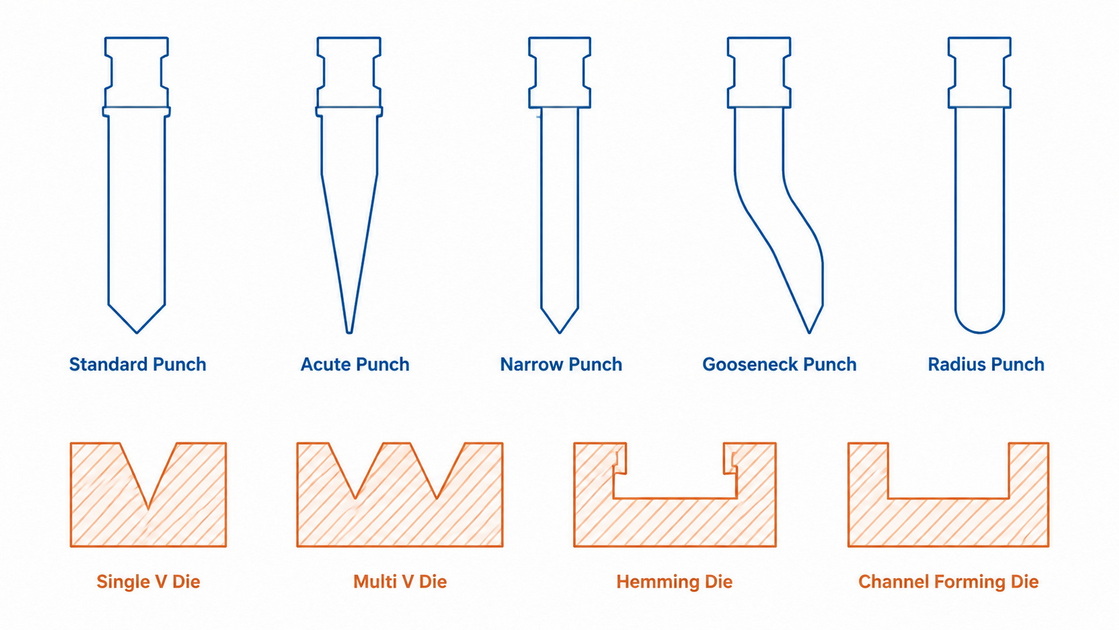
An acute angle punch (often just called an acute punch) is designed for bending angles less than 90°, commonly below 30°, but can usually form up to about 89°. It typically has a bulky body with a sharp, precise tip. [robertsiegers]
This punch is ideal when:
- You produce acute flanges that will later be flattened or opened to a final angle. [robertsiegers]
- You need consistent sharp inside corners on small brackets or enclosures. [robertsiegers]
A narrow punch, sometimes called a sword punch, has a uniform, slim profile with low thickness along its length. It is used in tight spaces where larger punches simply cannot fit. [robertsiegers]
Typical applications include:
- Closing box or square profiles where side walls restrict tool clearance. [robertsiegers]
- Short return flanges close to previous bends. [robertsiegers]
A sash punch combines a narrow body with a tip angled inward towards the inside of the machine. This tip geometry allows the tooling to "reach around" corners to create bends that would otherwise collide with the punch body. [robertsiegers]
You will see sash punches used for:
- Door jambs and frame profiles, especially in construction and architectural fabrication. [robertsiegers]
- Parts where a previous bend partially blocks access for standard punches. [robertsiegers]
Swan neck and gooseneck punches are engineered to create U‑profile bends without the bent legs colliding with the punch body. Their shape creates an unsupported line of force, meaning they typically handle lower tonnage than straight punches. [robertsiegers]
Use these when:
- Forming deep U‑channels or profiles with long return flanges. [robertsiegers]
- You need to avoid collision with pre‑bent sections while still using a single‑hit bending operation. [robertsiegers]
A radius punch has a rounded tip, rather than the sharp tip of most V‑style punches, and is used to create U‑shaped bends with a larger inside radius. These punches often require matching U‑shaped dies and increase the importance of correct die selection. [robertsiegers]
Common use cases:
- Soft bends in cosmetic parts where a sharp angle would leave marks. [robertsiegers]
- Stronger materials where a larger bend radius is required to prevent cracking. [robertsiegers]
If punches define force direction, dies define how that force is distributed into the material. Good die selection can dramatically reduce tool wear and improve edge quality. [blog.saleslayer]
A single V die is the most fundamental die type, with one V‑shaped opening. It is simple, robust, and widely used in general‑purpose bending. [robertsiegers]
These dies have two V openings in parallel, allowing operators to quickly switch between two different V sizes without retooling. [robertsiegers]
Benefits:
- Faster workflows when you frequently change material thickness or bend radius. [robertsiegers]
- Less downtime compared to physically swapping out dies. [robertsiegers]
Multi‑V dies include multiple V openings of different sizes in a single die block. By rotating the die, you can select the opening that matches your material and radius requirements. [robertsiegers]
This is particularly useful in:
- Job shops handling many different material thicknesses in a single shift. [robertsiegers]
- Prototype environments where parameters are still being tuned. [robertsiegers]
Flattening and hemming dies close previously formed acute bends or complete hems. Older designs used spring‑loaded mechanisms; newer designs may be more compact and durable. [robertsiegers]
You need these whenever you:
- Produce safety edges or hemmed flanges for doors, panels, and enclosures. [robertsiegers]
- Want to reduce sharp edges that pose safety risks or cosmetic issues. [robertsiegers]
Channel forming dies can create U‑shaped channels in a single pass that would otherwise require two operations with traditional V dies. [robertsiegers]
They are ideal for:
- High‑volume production of channels and profiles where cycle time is critical. [robertsiegers]
- Designs that benefit from fewer handling steps and more consistent geometry. [robertsiegers]
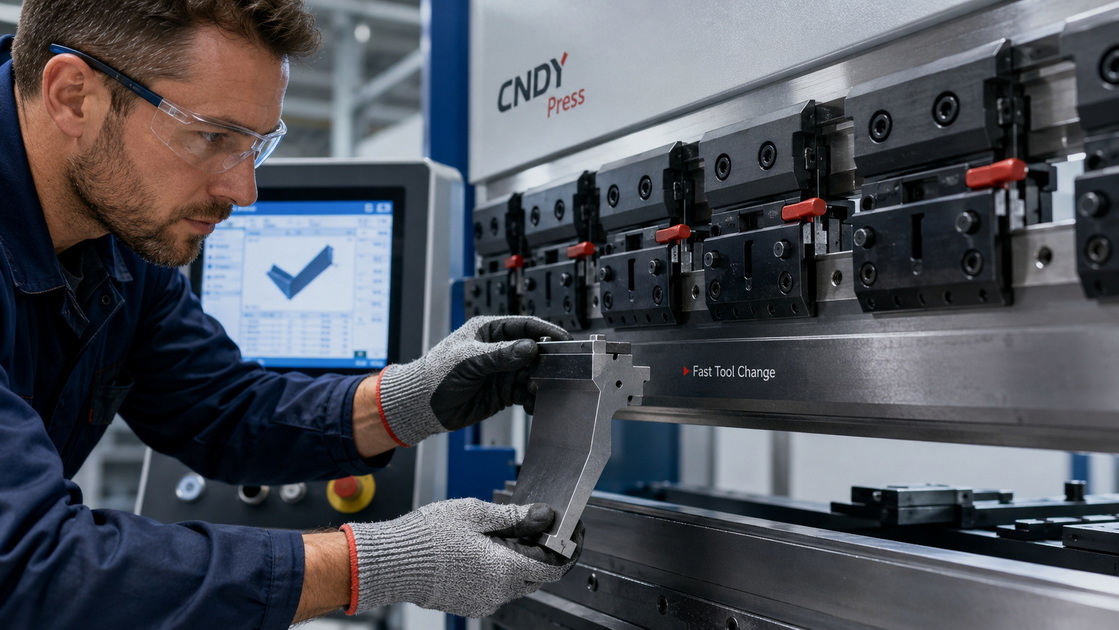
Modern tool holders and clamping systems are more than simple mechanical supports; they significantly influence precision and changeover speed. Manual or automatic clamping systems on CNC press brakes often provide quick‑change levers, higher clamp pressure, and reduced vibration, all of which contribute to better bend consistency. [blog.saleslayer]
For heavy industrial use, chromium‑molybdenum alloy steel (chrome‑moly) is widely regarded as a premium material for press brake tooling. It offers high strength and corrosion resistance, which translates into long service life and better resistance to mechanical damage. [robertsiegers]
Typical press brake tooling hardness is around 45 HRC on the Rockwell scale, compared to approximately 28 HRC for common stainless steels. This hardness difference allows tooling to bend stainless parts without suffering permanent deformation—provided it is used within rated tonnage. [robertsiegers]
It is important to note that:
- Hardness is not the same as tonnage capacity; hardness measures resistance to indentation and surface damage, not load limits. [robertsiegers]
- Overloading tools beyond rated tonnage will still cause failures, even in high‑hardness materials. [robertsiegers]
Beyond punch and die shapes, you also need to decide on tooling style, which affects compatibility, flexibility, and upgrade paths. [robertsiegers]
American‑style tooling uses a reduced clamping surface area and directs pressure along a straight line through the tool. It typically features a ½‑inch‑wide tang and is generally more cost‑effective than other systems. [robertsiegers]
Pros:
- Lower tooling cost for many standard applications. [robertsiegers]
- Widely available in North American markets. [blog.thomasnet]
Cons:
- Requires very accurate grinding of reference surfaces to maintain tip alignment. [robertsiegers]
- Fewer geometry options compared to European systems. [robertsiegers]
European‑style tooling is characterized by its offset holder design and slimmer profiles. It offers a broader range of geometries and typically applies higher clamping pressure for improved precision. [robertsiegers]
Advantages:
- More options—often roughly double the tool variety compared with American style in many catalogs. [robertsiegers]
- Slim profiles that offer better clearance for complex parts. [robertsiegers]
The New Standard tooling system, introduced by Wila and adopted by many manufacturers, is built around auto‑clamping and self‑seating mechanisms. [robertsiegers]
Key characteristics:
- Automatic seating ensures the tool is correctly positioned, reducing user‑dependent alignment errors. [robertsiegers]
- High‑speed changeovers with features like spring‑loaded fast‑change buttons for tools under about 27.6 pounds and pin‑locking for heavier segments. [robertsiegers]
For high‑mix production and frequent setup changes, New Standard‑type systems can deliver a significant productivity boost. [blog.saleslayer]
From an engineering standpoint, tooling is one of the main drivers of press brake accuracy. Even with a high‑end CNC press brake, you will not achieve consistent results with inappropriate or worn‑out tooling. [blog.saleslayer]
Accuracy is affected by:
- Punch and die angles – In air bending, the final angle is driven primarily by the punch tip angle; in bottoming, it is controlled by both punch and die angles. [robertsiegers]
- Tool wear and surface condition – Indentations and scratches on the tool can create internal defects in the material and cause angle variation. [robertsiegers]
- Tool alignment and clamping – Poorly seated tools introduce cumulative error across long bends. [robertsiegers]
This is why many high‑precision shops invest not only in machines, but also in high‑quality ground tooling and advanced clamping systems. [blog.saleslayer]
When selecting tooling for a new project or a long‑term OEM program, I recommend working through the following decision framework. [blog.saleslayer]
Start with the material type: mild steel, stainless, aluminum, high‑strength steels, etc. Harder, less ductile materials require higher‑quality tooling and often larger bend radii to prevent cracking. [robertsiegers]
Apply rules such as the "rule of 8" for mild steel, where the inside bend radius is roughly V/8 (V is the die opening width), as a baseline. Stronger materials may require a larger bend radius for the same thickness, which in turn requires a larger die opening. [robertsiegers]
Consider both minimum and maximum flange lengths:
- The die opening must be small enough that minimum flanges do not drop into the die. [robertsiegers]
- Punch size and tool strength must be adequate to handle maximum flange lengths without overloading the machine or tooling. [robertsiegers]
The target bend angle and inside radius determine which punches and dies are viable. [robertsiegers]
- Large bend angles can often use thicker punches. [robertsiegers]
- Acute angles require specialized acute punches and carefully matched dies. [robertsiegers]
The overall shape of the bend and part dictates whether you can use standard tools or need specialized designs such as gooseneck, sash, or channel‑forming tools. For example, channel‑forming dies may convert a two‑hit process into a single pass, significantly improving throughput. [robertsiegers]
Not all tooling is suitable for all bending modes:
- Air bending – Flexible, uses less tonnage but more sensitive to material variation. [robertsiegers]
- Bottoming – Higher pressure, more consistent angles but requires accurate tooling and more tonnage. [robertsiegers]
- Coining – Very high tonnage, permanently imprints the bend radius and angle into the material. [robertsiegers]
Match your tooling to the bending process used by your specific press brake and production strategy. [robertsiegers]
For large production volumes, it often makes sense to invest in special and niche tooling that reduces cycle time or improves first‑pass yield. For low‑volume or prototype work, standard tooling may be sufficient—even if it requires more passes to achieve complex geometries. [blog.saleslayer]
Every punch and die is rated for a specific tonnage capacity. Exceeding these limits risks: [robertsiegers]
- Breaking tooling and damaging the press brake. [robertsiegers]
- Creating unsafe conditions that can cause serious operator injury. [robertsiegers]
Always confirm that the selected punch and die pair meets or exceeds your calculated bending tonnage. [robertsiegers]
From an operational standpoint, maintenance and storage can easily add several years to your tooling life if done correctly. [robertsiegers]
Key best practices include:
- Daily cleaning – Remove grease, dirt, and contaminants at the end of each shift using recommended cleaners. [robertsiegers]
- Regular resharpening and reconditioning – Prevent dull edges that increase wear, tonnage requirements, and risk of material cracking. [robertsiegers]
- Proper lubrication before operation – Follow manufacturer recommendations to reduce friction and wear. [robertsiegers]
- Respecting rated limits – Never exceed the specified tonnage capacity. [robertsiegers]
- Controlled storage environment – Keep tooling in a dry, chemical‑free area to avoid corrosion and pitting. [robertsiegers]
- Routine inspection – Check for cracks, chipping, or excessive wear; remove damaged tools from service immediately. [robertsiegers]
Well‑maintained tooling not only lasts longer, it also protects your CNC press brake from unnecessary shock loads and alignment issues. [blog.saleslayer]
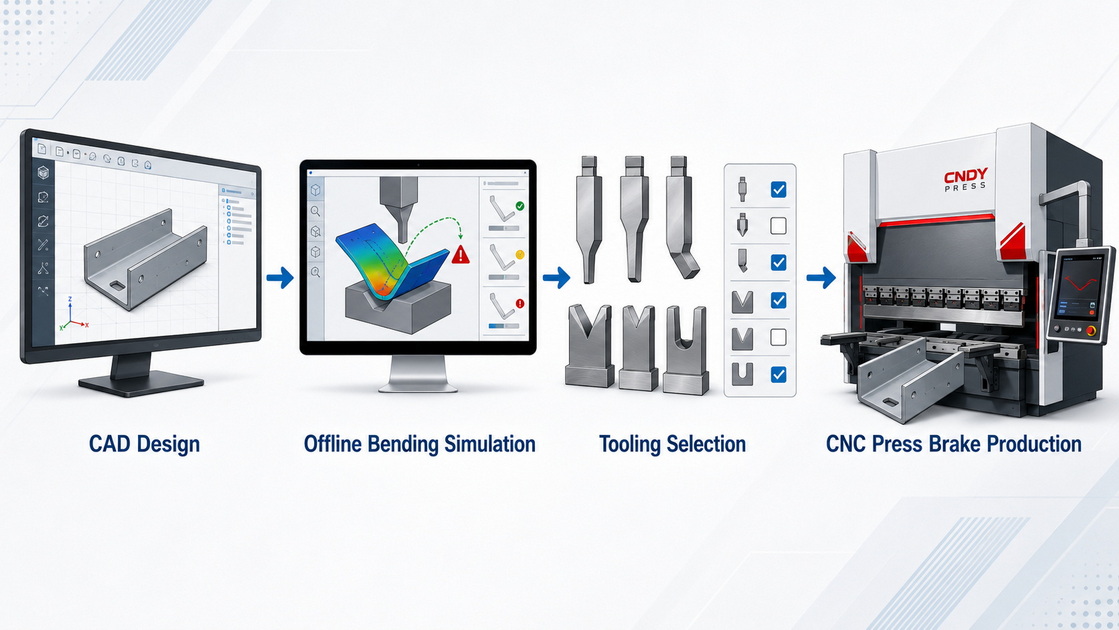
In modern CNC shops, press brake tooling is increasingly tied to digital workflows and offline programming. When you define tooling libraries in your CAM system and synchronize them with your CNC press brake, you can: [blog.saleslayer]
- Simulate bends and detect collisions in software before setting up the machine. [blog.saleslayer]
- Standardize tooling setups across shifts and operators, improving repeatability and reducing training time. [blog.saleslayer]
- Optimize tool segmentation (for example, using combinations of 10 mm, 15 mm, 20 mm, etc.) to support different part lengths without changing the base tools. [blog.saleslayer]
For OEM and ODM projects, it is often more efficient to lock in a tooling standard early in the project, then align CAD models, flat patterns, and bend deductions around those specific tools. This avoids later conflicts between theoretical bend models and what is actually achievable with your installed press brake tooling package. [blog.saleslayer]
As a manufacturer, it is tempting to "make do" with existing tooling as long as you can still produce parts, but there are clear signals that it is time to upgrade. [blog.saleslayer]
Consider investing in new or higher‑standard tooling when you notice:
- Frequent angle corrections or shimming during setups. [robertsiegers]
- Visible surface marking or inconsistent radii on cosmetic parts. [robertsiegers]
- Extended changeover times due to manual alignment and older clamping systems. [blog.saleslayer]
- A shift in your production mix towards higher‑strength materials or more complex profiles. [robertsiegers]
Moving to modern European or New Standard tooling, especially in combination with CNC crowning and offline programming, can significantly increase both capacity and quality without changing the base press brake. [blog.saleslayer]
If you are planning a new OEM or ODM project, introducing higher‑strength materials, or struggling with inconsistent bend quality, it is often more effective to review your tooling strategy with an experienced manufacturing partner rather than buying more machines. [blog.saleslayer]
At CNDY‑Press, our engineering team can:
- Recommend complete press brake + tooling configurations matched to your parts and volumes.
- Help you standardize tooling libraries for CNC offline programming.
- Support custom punch and die designs for difficult geometries or high‑volume parts.
Contact our press brake specialists today to discuss your application data, sample drawings, and quality requirements so we can propose a tailored tooling solution for your production line.
1. What is the most important factor when choosing press brake tooling?
The most critical factor is the combination of material type, thickness, and desired bend geometry, since these directly determine the required die opening, punch angle, and tonnage. [robertsiegers]
2. How often should press brake tooling be resharpened?
Resharpening frequency depends on material type, production volume, and surface quality requirements, but as a rule, inspect tools regularly and recondition them as soon as you see rounding or chipping on the working edges. [robertsiegers]
3. Is it worth investing in New Standard tooling if I already have American tooling?
If your production involves frequent setups, complex parts, or tight tolerances, New Standard‑style systems with auto‑clamping and fast change can often pay back through reduced setup time, improved accuracy, and less scrap. [blog.saleslayer]
4. Can I use the same tooling for air bending and bottoming?
Some tools can be used in both modes, but not all tooling is designed for the higher pressures of bottoming or coining, so always check the manufacturer's specifications and tonnage ratings. [robertsiegers]
5. How does tooling hardness affect tool life?
Higher hardness (around 45 HRC) generally improves resistance to wear and indentation, especially when bending harder materials like stainless steel, but tooling must still be used within its rated tonnage and proper maintenance schedule to achieve maximum life. [robertsiegers]
1. Moore Machine Tools. "Press Brake Tooling Primer – Moore Machine Tools."
<https://mooremt.com/press-brake-tooling/> [robertsiegers]
2. Robert Siegers. "SEO for Manufacturers: Strategies to Dominate Search in 2025."
<https://robertsiegers.com/en/seo-for-manufacturers> [robertsiegers]
3. Semrush. " What It Is & How It Affects SEO."
<https://www.semrush.com/blog/eeat/> [semrush]
4. Sales Layer. "SEO for Manufacturing Companies: The 2026 Strategy Guide."
<https://blog.saleslayer.com/seo-for-manufacturing-companies> [blog.saleslayer]
5. Thomas. "SEO For CNC Machine Shops – Thomas Blog."
<https://blog.thomasnet.com/seo-for-cnc-machine-shops> [blog.thomasnet]
6. Boostability. "2024 Ultimate Guide."
<https://www.boostability.com/resources/google-e-e-a-t-guide/> [boostability]
7. Plant Automation Technology. "Impact of SEO on CNC industry growth."
<https://www.plantautomation-technology.com/articles/how-seo-can-drive-business-growth-for-cnc-manufacturers> [plantautomation-technology]


