


Views: 213 Author: CNDY-Press Publish Time: 2026-08-10 Origin: Site


Content Menu
● What Is Press Brake Tonnage?
● Press Brake Tonnage Calculation Formula
>> Example: Mild Steel Air Bending
>> Why Thickness Has Such a Large Effect
● Six Variables That Determine Bending Force
>> 1. Material Tensile Strength
>> 6. Tooling Geometry and Load Rating
● Machine Capacity and Safe Working Tonnage
>> Centerline and Off Center Loads
● Press Brake Tonnage Selection Workflow
>> Step 1: Gather Complete Part Information
>> Step 2: Select the Initial V Die
>> Step 3: Calculate Air Bending Force
>> Step 4: Apply Method and Tooling Factors
>> Step 5: Verify Machine and Tooling Limits
>> Step 6: Validate With a Production Sample
● Common Press Brake Tonnage Mistakes
>> Using Generic Material Values
>> Confusing Air Bending With Coining
>> Selecting a Die Opening Only to Reduce Tonnage
>> Assuming More Force Solves Springback
● Expert Guidance for Press Brake Buyers
>> 1. What is press brake tonnage?
>> 2. How do I calculate press brake tonnage?
>> 3. Why does stainless steel require more press brake tonnage?
>> 4. Does a wider V die reduce required tonnage?
>> 5. Can I use the full rated tonnage of my press brake?
Selecting the correct press brake tonnage is one of the most important decisions in sheet-metal fabrication. Too little force can lead to incomplete bends, poor angle control, excessive springback, and rework. Too much force can overload tooling, damage the machine frame, create permanent deflection, and increase safety risks.
For CNC press brake buyers, tonnage is not simply the number shown on the machine nameplate. It is the result of a calculation that combines material tensile strength, sheet thickness, bending length, V-die opening, bending method, tooling type, and load distribution.
CNDY-Press manufactures CNC press brakes and sheet-metal processing equipment for fabrication businesses. For OEM and ODM projects, machine selection should begin with the most demanding production part—not the average part. The equipment must safely handle the longest bend, highest-strength material, greatest thickness, and most complex tooling operation expected in production.
Press brake tonnage is the force required to bend a sheet-metal workpiece into the desired angle and shape. It is normally expressed in metric tons, tons-force, or kilonewtons.
The required bending force changes according to:
- Material type and tensile strength
- Material thickness
- Bend length
- V-die opening
- Punch radius
- Bending method
- Required bend angle
- Tooling configuration
- Number of bends formed in one stroke
- Load position across the press brake bed
The same CNC press brake may bend thin aluminum easily but require significantly more force to bend stainless steel of the same thickness. Likewise, doubling material thickness does not simply double the required force. Because thickness has a squared effect in typical tonnage calculations, relatively small thickness increases can create a substantial rise in bending-force requirements.
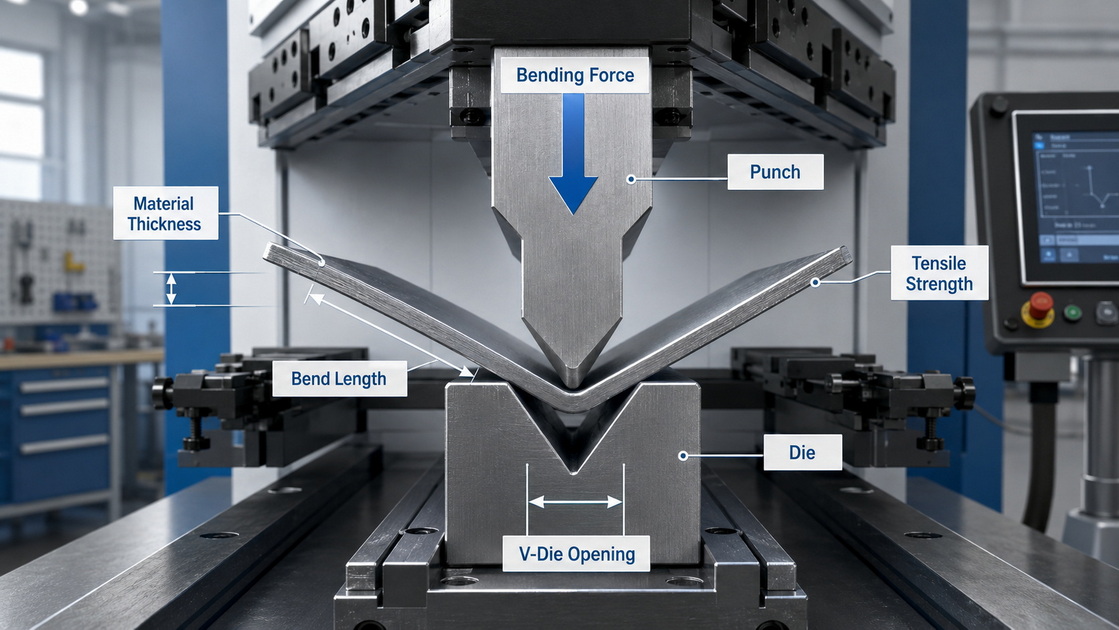
For air bending, a widely used metric formula is:
Where:
| Symbol | Meaning | Typical Unit |
|---|---|---|
| FFF | Required bending force | Newtons or kilonewtons |
| RmR_mRm | Material tensile strength | N/mm² or MPa |
| SSS | Material thickness | mm |
| LLL | Bend length | mm |
| VVV | V-die opening width | mm |
To convert kilonewtons to metric tons-force:
Metric Tons=kN/9.80665
This formula is a useful starting point for standard air bending. It should be adjusted when material type, bending method, die opening, tooling geometry, or working conditions differ from the original assumptions.
Assume the following production conditions:
- Material: Mild steel
- Tensile strength: 450 MPa
- Material thickness: 3 mm
- Bend length: 1,000 mm
- V-die opening: 24 mm
- Bending method: Air bending
F=239,625 N=239.6 kN
239.6÷9.80665=24.4 metric tons
The calculation indicates that this bend requires approximately 24.4 metric tons under the stated conditions. The final machine selection should include an appropriate safety margin, tooling review, machine-load assessment, and physical sample validation.
Thickness is squared in the tonnage formula. If material thickness doubles, required bending force can increase by approximately four times when other variables remain the same.
| Mild Steel Thickness | Relative Tonnage Requirement |
|---|---|
| 1 mm | 1× |
| 2 mm | 4× |
| 3 mm | 9× |
| 4 mm | 16× |
| 6 mm | 36× |
This is why a 100-ton press brake may easily bend thin sheet metal but may not be suitable for long bends in thicker plate.
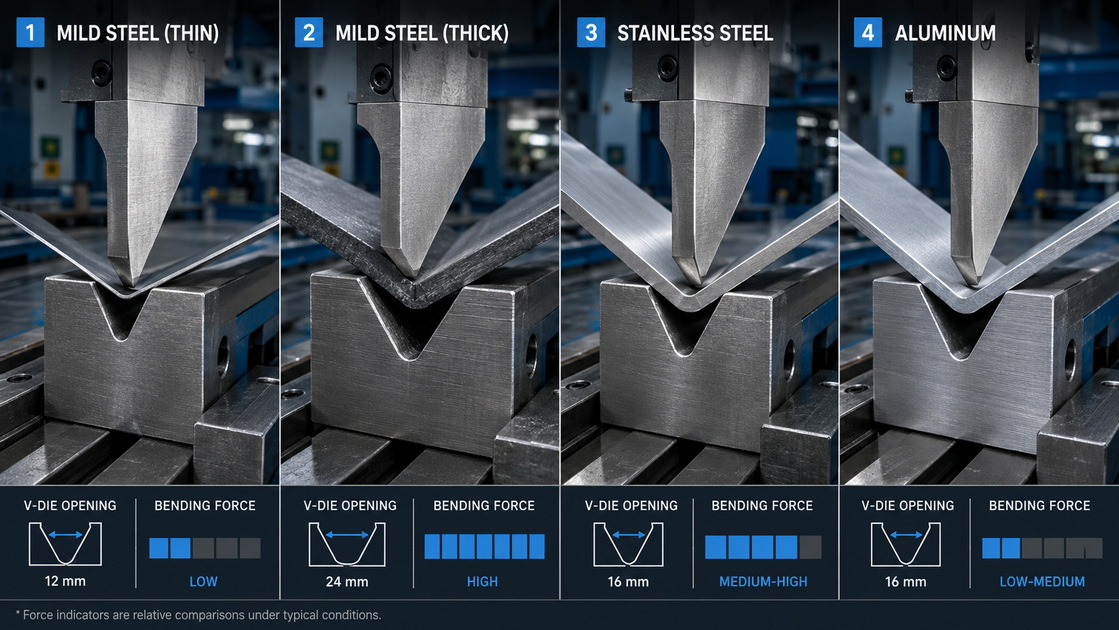
Tensile strength describes how much stress a material can withstand before failure. Higher-strength materials require more bending force.
| Material | Relative Force Requirement | Main Consideration |
|---|---|---|
| Mild steel | Baseline | Common reference material for tonnage charts |
| Stainless steel | Higher than mild steel | Higher strength and greater springback |
| High-strength steel | Significantly higher | Requires careful tonnage and radius control |
| Aluminum | Often lower than mild steel | Lower force but greater marking or cracking risk |
| Brass | Varies by alloy | Material condition affects bending behavior |
| Titanium alloy | High | Requires precise tooling and process control |
Material certificates should be reviewed whenever possible. Two sheets described by the same general material name may have different tensile-strength ranges depending on grade, heat treatment, supplier, and manufacturing process.
Thickness has one of the strongest effects on press brake tonnage. Small changes in sheet thickness can significantly increase force requirements.
Do not rely only on nominal thickness. Measure actual material thickness, especially when working with thick plate, coated sheet, hot-rolled steel, imported coils, or material from multiple suppliers.
Longer bends require more total force because the press brake applies load across a larger distance.
However, total tonnage is not the only concern. Load per unit length and load position on the press brake bed must also be reviewed.
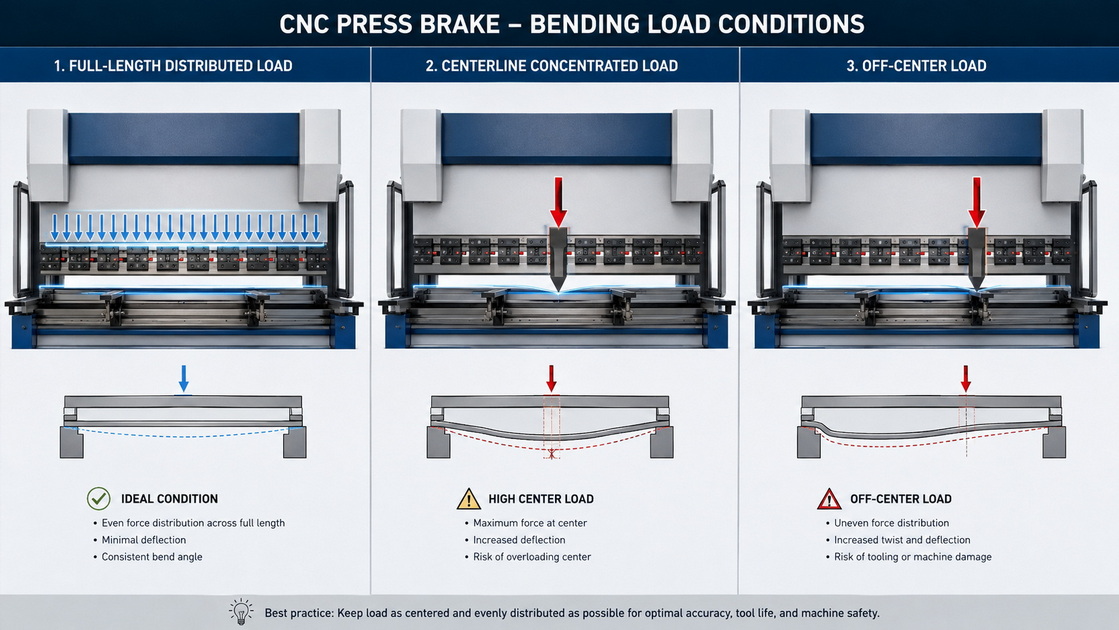
A short bend in the center of a long press brake can create a concentrated load. Even when the total calculated tonnage is below the rated machine capacity, a concentrated centerline load may exceed the local design limit.
The V-die opening directly affects bending force.
- A smaller V-die opening increases required tonnage.
- A larger V-die opening reduces required tonnage.
- A wider V-die can increase the inside bend radius.
- A narrow V-die can increase marking, cracking, and tooling wear.
A common starting guideline for air bending mild steel is to use a V-die opening around eight times the material thickness. This is not a fixed rule. Material strength, desired radius, flange length, bend quality, and surface-finish requirements must also be considered.
The selected bending method can significantly change tonnage requirements.
| Method | Description | Relative Force Requirement | Typical Use |
|---|---|---|---|
| Air bending | Material contacts the punch tip and die shoulders | Lowest | Flexible, common CNC bending |
| Bottom bending | Material is pressed more deeply into the die | Higher | Improved angle control |
| Coining | Material is forced deeply into the die | Much higher | Tight tolerances and reduced springback |
| Hemming | Folding an edge over itself | Higher than standard air bending | Safety edges and finished panels |
| Offset bending | Produces two bends in one operation | Higher | Z profiles and special forms |
Air bending is widely used because it offers flexibility and generally requires less force. Bottom bending and coining require substantially more force, so air-bending calculations should never be applied directly to a coining operation.
The press brake is only one part of the load system. The punch, die, clamp, tool holder, and machine bed must all be suitable for the required force.
Before starting production, confirm:
- Punch load rating
- Die load rating
- Tooling length
- Tool material and hardness
- V-die opening
- Punch tip radius
- Clamping-system capacity
- Tool segmentation
- Machine centerline-load limit
- Machine maximum tonnage
- Force distribution across the bed
A machine rated for 160 tons does not mean every tooling setup can safely use 160 tons. Tooling may have lower load limits, and the press brake may have different full-length, off-center, and centerline-load capacities.
A common purchasing mistake is selecting a press brake based only on maximum rated tonnage.
A 100-ton machine can only safely perform a bending operation when all of the following conditions are satisfied:
1. The calculated bending force is within the machine rating.
2. The punch and die are rated for the calculated load.
3. The load position does not exceed centerline or off-center limits.
4. The bend length is compatible with the machine bed.
5. The material and V-die opening match the calculation.
6. The bending method is correctly identified.
7. The machine frame and crowning system can maintain the required accuracy.
Press brakes are designed to carry loads in specific ways. A full-length bend distributes force across the bed, while a short bend at the center can concentrate stress in a much smaller area.
For example, a 200-ton machine may safely perform a 200-ton load distributed across its full working length but may not safely carry the same force concentrated over a short central section.
Before purchasing a press brake, request:
- Full-length tonnage chart
- Centerline-load limit
- Off-center-load limit
- Tooling-load limits
- Frame-deflection guidance
- Crowning-system information
This is especially important for thick plate, short bends, high-strength steel, and specialized tooling.
Prepare the following information before requesting a machine quotation:
- Material type and grade
- Tensile-strength range
- Actual material thickness
- Bend length
- Required bend angle
- Desired inside radius
- Production volume
- Number of bends per part
- Bending method
- Existing-tooling information
- Surface-quality requirements
- Largest and most difficult production part
The most demanding production component should guide equipment selection.
Choose a suitable V-die opening based on material thickness, desired bend radius, minimum flange length, and forming method.
A die that is too narrow can increase tonnage, accelerate tool wear, and damage the material surface. A die that is too wide may create an inside radius that does not meet part specifications.
Use a verified formula, tonnage chart, or calculation tool to estimate bending force based on material strength, thickness, bend length, and V-die opening.
Calculation tools provide useful estimates, but they cannot fully account for material-batch variation, tooling condition, grain direction, part geometry, or unique production conditions.
Confirm whether the job uses air bending, bottom bending, coining, hemming, offset tooling, or multi-bend tooling.
Bottom bending, coining, offset tools, and hemming operations can require considerably more force than standard air bending.
Compare the calculated force with machine capacity, tooling capacity, clamp capacity, and load-distribution limits.
Do not use the machine nameplate capacity as the only approval criterion.
A physical sample is essential, particularly for high-value material, long bends, thick plate, stainless steel, high-strength steel, or tight-tolerance components.
Check the sample for:
- Final bend angle
- Inside bend radius
- Springback
- Surface marks
- Cracking
- Tool deflection
- Machine deflection
- Repeatability
- Operator safety
- Cycle time
Material strength can vary between suppliers and grades. Applying a standard mild-steel value to stainless steel, high-strength steel, or unknown imported material can produce unsafe calculations.
Air bending, bottom bending, and coining require different force levels. A correct air-bending calculation can become dangerously low if the actual process bottoms or coins the material.
A larger V-die can reduce required force, but it also changes the inside radius and can affect minimum flange length or product specifications.
Punches and dies can fail before the press brake reaches its maximum tonnage. Tooling load charts should be reviewed for every high-force application.
A short heavy bend near the center of the machine can create local overload even when total tonnage appears acceptable.
Springback is influenced by material elasticity, tensile strength, thickness, bend radius, and bending method. Increasing force without reviewing tooling and bend angle may damage the part or machine without improving bend quality.
The most useful tonnage question is not "What tonnage machine should I buy?" It is "What machine and tooling configuration can safely produce my full part range?"
A business producing thin aluminum brackets may not need a high-tonnage machine. A workshop producing long stainless-steel panels, thick machine guards, high-strength structural parts, or large fabricated enclosures may require additional tonnage, stronger tooling, effective crowning, and a more rigid frame.
CNDY-Press supports customized CNC press-brake configurations for different bending lengths, material types, control systems, tooling requirements, automation needs, and production environments.
Correct press brake tonnage selection protects the machine, tooling, material, operators, and production schedule. Required bending force should be calculated from real material properties, thickness, bend length, V-die opening, bending method, and tooling configuration.
The most reliable process is to calculate air-bending force, apply the correct bending-method factors, verify machine and tooling limits, review centerline-load conditions, and confirm the process with a physical sample.
For fabrication businesses requiring customized CNC press brakes, sheet-metal equipment, tooling support, or OEM and ODM manufacturing solutions, CNDY-Press can help evaluate machine specifications around real production requirements.
Press brake tonnage is the force required to bend sheet metal into a specific angle or shape. It depends on material strength, thickness, bend length, V-die opening, tooling, and bending method.
For standard air bending, calculate the force using material tensile strength, material thickness squared, bend length, and V-die opening. Then verify the result against machine capacity, tooling limits, and load-distribution limits.
Stainless steel usually has higher tensile strength than mild steel. It resists deformation more strongly, requires more bending force, and often produces greater springback.
Yes. A wider V-die opening generally reduces bending force because the material bends over a larger opening. However, it can also increase the inside bend radius and affect flange support.
Not always. Safe capacity can vary according to bend length, load position, tooling limits, centerline load, and off-center loading. Review the machine manufacturer's load charts and tooling limits before production.
1. [ACCURL, Press Brake Tonnage] [accurl]
2. [Bystronic, How to Calculate Press Brake Tonnage] [bystronic]
3. [CINCINNATI Incorporated, Press Brake Tonnage Load Calculator] [e-ci]
4. [RMFG, Press Brake Tonnage Chart and Calculator] [rmfg]
5. [CNDY-Press, CNC Press Brake and Metal Processing Equipment Manufacturer] [cndypress]


