


Views: 222 Author: CNDY-Press Publish Time: 2026-05-09 Origin: Site


In modern tube and pipe fabrication, pipe laser cutters are rapidly replacing traditional sawing as manufacturers race to reduce cycle times, minimize waste, and handle more complex geometries. As someone who works with OEM and ODM projects for sheet metal and tube processing, I've seen first-hand how fiber tube laser cutting reshapes production floors compared to band saws and cold saws. [mac-tech]
For a manufacturer like CNDY-Press, investing in advanced tube laser systems is not just about speed; it is about building a more flexible, automated and data-driven fabrication cell that can serve global customers with tighter tolerances and faster lead times. [dne]
A pipe laser cutter (often a fiber laser tube cutting machine) uses a focused laser beam and CNC-controlled axes to cut round, square and special-shaped tubes with high precision. The machine can automatically load tubes, clamp, rotate and move them under the beam to create straight cuts, miters, holes, slots and complex contours in one continuous process. [rmtus]
Because the "tool" is a laser beam with a very small spot size, the kerf is narrow, heat input is controlled, and edge quality is typically ready for welding with little or no secondary finishing. [ud-machine]
Traditional sawing uses band saws, circular saws or cold saws with toothed blades to cut tubes to length. These machines excel at straight cuts on simple profiles but struggle with complex features; secondary operations like drilling, milling or punching are usually needed for holes and notches. [jqlaser]
Sawing equipment has a lower upfront price and is simple to operate, which explains why many small and medium workshops still rely on it for basic tube cutting tasks. However, the trade-off is lower precision, slower throughput for complex jobs, and more manual handling. [antishilathe]
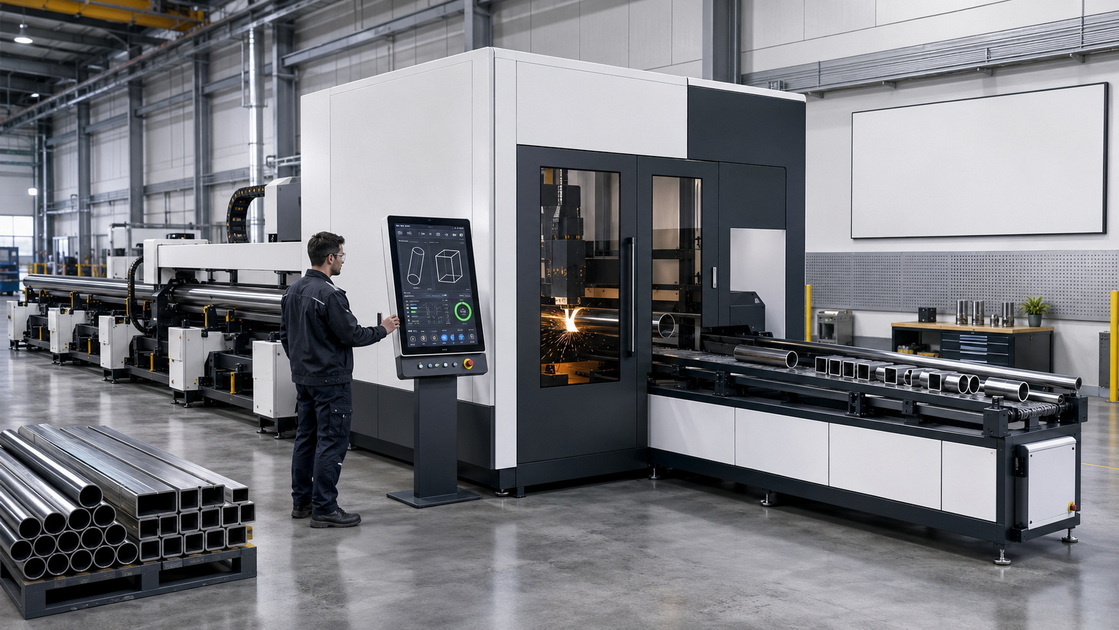
From an engineer's perspective, the biggest visible difference on the shop floor is throughput. A tube laser can turn a multi-step cutting–drilling–notching–deburring workflow into a single automated operation. [hg-star]
Industry data and case studies show that:
- Fiber tube lasers can be many times faster than traditional cutting methods for multi-feature parts, because they cut and pierce at high speed and minimize part handling. [longxinlaser]
- Continuous "flying cutting" functions allow the beam to cut multiple features without stopping, especially on long production runs. [sytechprecision]
- Changeovers between different tube sizes or part programs can often be completed in under a minute on a modern CNC laser. [rmtus]
By contrast, sawing lines require:
- Manual loading/unloading, or at best, semi-automatic feeding. [jqlaser]
- Separate stations for drilling holes, cutting slots or preparing weld ends. [hg-star]
- Frequent tool changes and blade replacements, which interrupt production. [antishilathe]
In real projects, this means a production cell built around a pipe laser cutter regularly ships more finished parts per shift than a comparable cell based on saws, drills and manual labor, especially in mid-to-high volume scenarios. [dne]
Fiber tube lasers achieve very high positioning accuracy and repeatability, driven by servo-controlled CNC axes and a non-contact cutting "tool". The result is: [ud-machine]
- Tight tolerances across long batches. [rmtus]
- Clean, burr-minimized edges that often need no rework before welding or assembly. [ud-machine]
- Minimal thermal deformation due to the controlled heat-affected zone. [rmtus]
Traditional saws can produce acceptable tolerances for basic length cutting, but:
- Edge quality depends heavily on blade condition and operator skill. [calderamfg]
- Burrs and rough surfaces are common, requiring grinding or deburring. [jqlaser]
- Achieving high repeatability over large batches is more challenging, especially in smaller shops. [calderamfg]
A modern pipe laser cutter can cut:
- Round, square and oblong holes directly on the tube wall. [hg-star]
- Slots, tabs and special shapes for interlocking structures. [hg-star]
- Bevel cuts and angled ends ready for automatic welding. [hg-star]
- Intersecting pipe profiles for frames, manifolds and trusses in one setup. [dne]
Traditional sawing is fundamentally limited to straight cuts and basic miters. Any additional features require multiple machines and setups, which slows down the process and increases the risk of errors. [longxinlaser]
From a financial perspective, many managers initially hesitate because a pipe laser cutter has a higher purchase price than a saw. However, a full cost-of-ownership view shows a different picture. [longxinlaser]
- Pipe laser systems cost more to acquire but reduce labor, scrap and secondary operations, leading to lower cost per part over time. [sytechprecision]
- Traditional saws are inexpensive to purchase, but ongoing labor, blade consumption, rework and WIP handling push up the true operating cost. [antishilathe]
As one industry analysis notes, tube laser cutting generally leads in precision, efficiency, flexibility and overall quality, while traditional methods only remain competitive for low-precision, low-cost jobs. For manufacturers targeting export markets or demanding sectors like automotive, construction machinery or high-end furniture, the throughput and quality gains of laser cutting often justify the ROI within a few years. [sytechprecision]
Key ROI factors include:
1. Reduced process steps: One setup replaces multiple machines and operators. [dne]
2. Less scrap and waste: Precise nesting and narrow kerf save material. [ud-machine]
3. Lower rework: Minimal deburring and better fit-up in welding. [rmtus]
4. Higher capacity: Faster cutting plus automation support more orders without proportional labor increases. [sytechprecision]
For a sheet metal and tube fabrication supplier like CNDY-Press servicing OEM/ODM customers, these drivers directly translate into better pricing, tighter delivery schedules and stronger long-term partnerships.
As factories adopt Industry 4.0 concepts, automation and data connectivity are becoming decisive.
Modern tube laser systems commonly support:
- Automatic loading and unloading of tubes and profiles. [shen-chong]
- CAD/CAM integration for direct import of 3D tube models and automatic nesting. [antishilathe]
- Barcode or ERP integration to streamline job scheduling and tracking. [longxinlaser]
These features reduce manual handling, lower labor costs, and make it easier to track performance data such as OEE and scrap rates. [antishilathe]
Traditional saws, in contrast, often rely on manual measurement, marking and feeding, with minimal data capture. For high-mix, high-volume production where traceability and repeatability matter, this gap becomes a strategic disadvantage. [calderamfg]
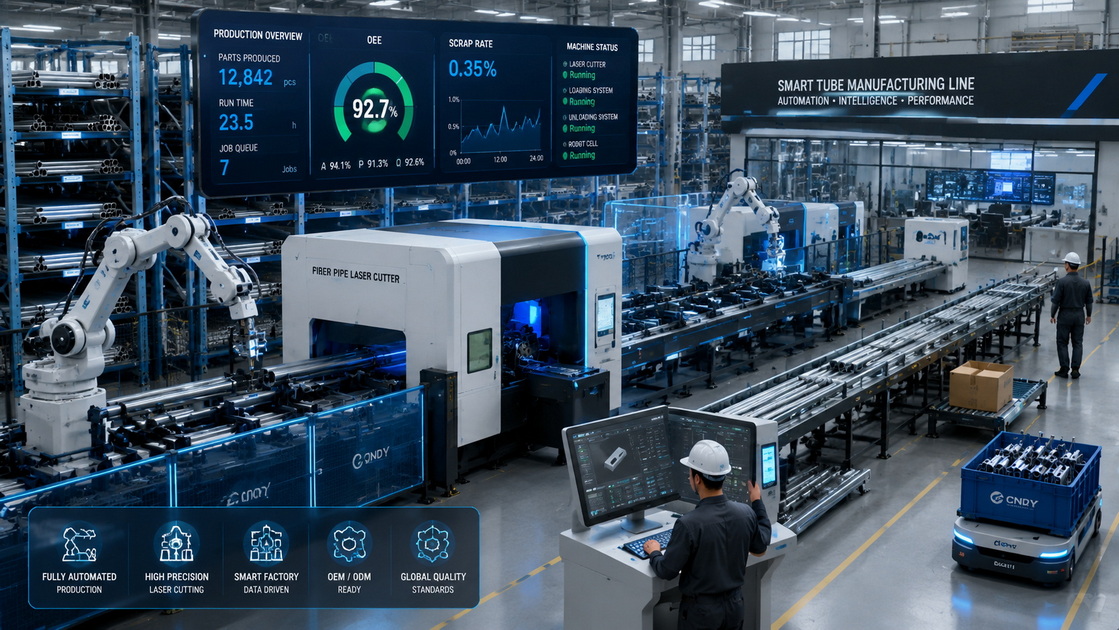
Pipe laser cutters are built with enclosed cutting areas, light curtains, interlocks and advanced control systems, which can significantly improve operator safety compared to open saws when installed and used correctly. [asianstarcnc]
Traditional sawing is mechanically simpler and has a lower learning curve, but operators are more exposed to moving blades, chips and noise. In busy workshops, this can translate into higher risk of minor injuries and fatigue, especially over long shifts. [jqlaser]
Fiber lasers are flexible across materials and thicknesses, and they handle different tube sizes with quick changeovers using programmable chucks and supports. Maintenance is generally predictable: lenses, nozzles and filters are consumables, but there is no blade wear in the traditional sense, and fiber laser sources are designed for long service life. [shen-chong]
Sawing systems require more frequent blade changes and adjustments, and cutting performance varies dramatically with blade choice and condition. This variability can be problematic for manufacturers chasing consistent high quality for international customers. [jqlaser]
Despite the advantages of pipe laser cutters, traditional sawing still has a clear role in many fabrication businesses.
Sawing is a rational choice when:
- You only need simple straight cuts with loose tolerances, especially in small batches. [dne]
- Material is very thick or heavy, where specialized saws remain cost-effective. [calderamfg]
- Capital budget is limited and labor costs are relatively low. [jqlaser]
In these cases, a hybrid model is common: keep a few saws for basic, low-value cuts while moving value-added, complex tube components onto a dedicated laser line. This is often the strategy we recommend to customers upgrading from a purely traditional workshop toward a mixed, more automated environment. [longxinlaser]
From an OEM/ODM perspective, particularly for a supplier like CNDY-Press that provides customized tube parts as part of full sheet-metal assemblies, the shift from sawing to pipe laser cutting delivers several strategic advantages:
- Design freedom: Engineers can integrate slots, tabs and locating features directly into tubes, simplifying downstream welding fixtures and assembly. [ud-machine]
- Shorter development cycles: CAD/CAM integration means you can go from digital model to first article in hours instead of days, which is critical when iterating designs with overseas customers. [shen-chong]
- Global quality alignment: Consistent precision and traceability align better with the quality expectations of international brands in automotive, construction equipment and industrial machinery. [dne]
In practice, this allows an OEM/ODM manufacturer to move from being a "cut-to-length vendor" to a value-added engineering partner that can co-develop more efficient structures, reduce weld time and simplify assembly for the end user.
For fabrication managers and business owners, the following checklist can help decide whether a pipe laser cutter is the right upgrade from traditional sawing:
1. Evaluate your part mix
- Do more than 30–40% of your tube parts involve holes, notches, slots or angles? If yes, you likely benefit strongly from laser automation. [hg-star]
2. Analyze your total cost
- Include labor for handling, drilling, deburring and quality issues, not just the hourly machine rate. [sytechprecision]
3. Review customer requirements
- Are customers pushing for tighter tolerances, better fit-up or cleaner welds? Laser cutting can become a competitive differentiator. [rmtus]
4. Consider your growth plan
- If you expect rising volumes or more complex projects, investing in a pipe laser cutter improves scalability and makes it easier to win higher-value contracts. [longxinlaser]
For CNDY-Press, which already focuses on full sheet metal processing lines and turnkey solutions, integrating or upgrading to advanced pipe laser systems is a natural extension of its existing technology roadmap.
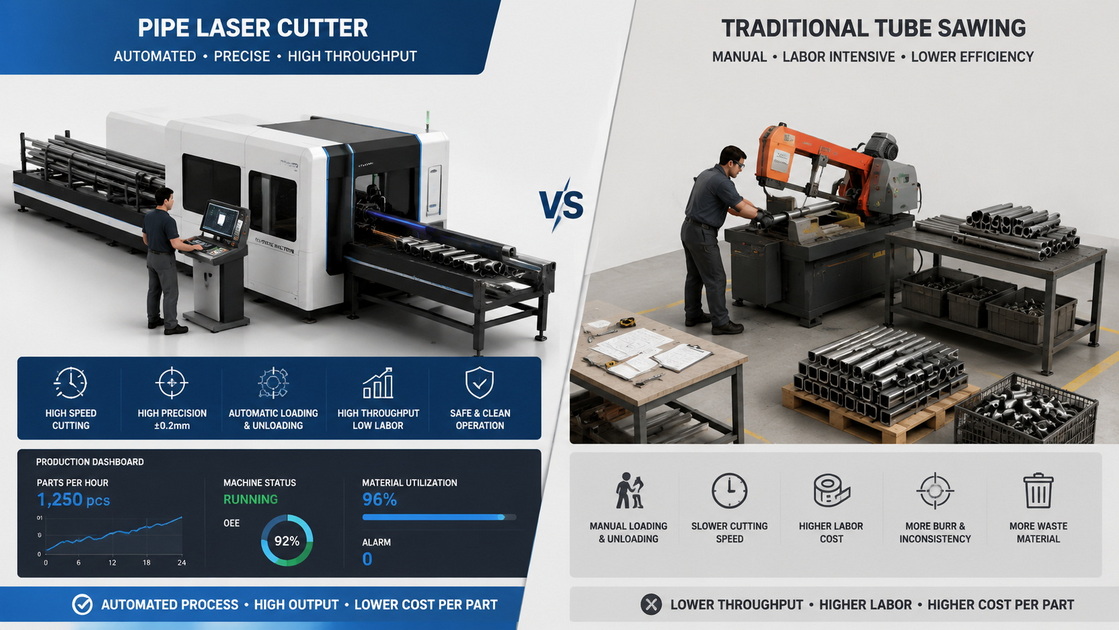
| Aspect | Pipe Laser Cutter | Traditional Sawing |
|---|---|---|
| Cutting speed | Very high, continuous cutting; excels on complex tube parts (dne) | Moderate; good for straight cuts only (jqlaser) |
| Feature complexity | Holes, slots, notches, bevels in one setup (dne) | Mostly straight cuts; complex features need multiple processes (jqlaser) |
| Precision and repeatability | High accuracy and clean edges (rmtus) | Adequate for basic jobs; more variation (jqlaser) |
| Automation level | High; supports auto loading, CAD/CAM, integration (antishilathe) | Low to medium; often manual or semi-auto (jqlaser) |
| Upfront investment | High equipment cost (jqlaser) | Low to moderate (jqlaser) |
| Operating cost per part | Low; less labor, scrap and rework (dne) | Higher; blades, labor, rework (jqlaser) |
| Changeover time | Very fast with CNC; under a minute in many cases (rmtus) | Slower; manual adjustments and measurements (jqlaser) |
| Typical applications | High-precision, high-mix or high-volume tube parts (dne) | Basic tube length cutting, low-cost jobs (jqlaser) |
If your current tube fabrication still relies heavily on traditional sawing, now is the time to explore how a pipe laser cutter can transform your productivity, quality and competitiveness. By partnering with an OEM/ODM-focused manufacturer like CNDY-Press, you can configure a fiber laser tube cutting solution that matches your material range, part mix and automation goals.
Whether you need a single tube laser machine, a fully automated line or a combined sheet metal and tube processing cell, our team can help you evaluate ROI, plan the transition from sawing, and support you from concept to commissioning.
Ready to revolutionize your tube fabrication speed? Contact CNDY-Press today to discuss your next laser tube cutting project or request a customized proposal.
1: Is a pipe laser cutter always better than traditional sawing?
A1: Not always. Pipe laser cutters excel in speed, precision and complex features, while traditional sawing remains cost-effective for simple, low-precision straight cuts and limited budgets. [jqlaser]
2: What tube sizes can a fiber laser tube cutting machine handle?
A2: Most modern machines support a wide range of diameters and wall thicknesses, and can process round, square and rectangular tubes with quick setup changes. Exact ranges depend on the specific model. [shen-chong]
3: How does laser tube cutting improve welding quality?
A3: Laser-cut tubes have tighter dimensional tolerances and cleaner edges, which improve fit-up, reduce gaps and minimize spatter and rework during welding operations. [ud-machine]
4: What materials can be processed on a pipe laser cutter?
A4: Fiber lasers can cut carbon steel, stainless steel, aluminum and other metals used in structural frames, machinery, furniture and automotive components, while maintaining good edge quality across different thicknesses. [shen-chong]
5: How long does it take to see ROI after switching from sawing to laser tube cutting?
A5: Payback time varies with volume and part complexity, but many manufacturers recover their investment within a few years thanks to higher throughput, less scrap and reduced labor and secondary operations. [sytechprecision]
1. Mac-Tech – "Tube Laser Cutting vs. Traditional Methods: A Comparative Study."
- [https://mac-tech.com/metal-fab-equip/tube-laser-cutting-vs-traditional-methods-a-comparative-study/] [mac-tech]
2. JQ Laser – "Saw Tube Cutting VS Laser Tube Cutting."
- [https://www.jqlaser.com/saw-tube-cutting-vs-laser-tube-cutting/] [jqlaser]
3. Antishilathe – "Laser Cutting vs. Saw Cutting: Understanding the Best Cutting Method."
- [https://antishilathe.com/blog/laser-cutting-vs-saw-cutting/] [antishilathe]
4. DNE Global – "Tube Laser Cutting vs. Traditional Sawing, Plasma and Flame Cutting."
- [https://www.dne.global/News/info_itemid_5538.html] [dne]
5. HGSTAR – "Comparison Between Laser Pipe Cutting and Saw Blade Pipe Cutting."
- [https://www.hg-star.com/comparison-bewteen-laser-pipe-cutting-and-saw-blade-pipe-cutiing/] [hg-star]
6. RMT – "Benefits of Fiber Laser Tube Cutting."
- [https://www.rmtus.com/benefits-of-fiber-laser-tube-cutting] [rmtus]
7. SC Machinery – "Tube Fiber Laser Cutting Machine Ultimate Guide."
- [https://www.shen-chong.com/zh/tube-and-pipe-fiber-laser-cutting-machine-ultimate-guide/] [shen-chong]
8. Caldera Manufacturing Group – "Laser Cutting vs. Saw Cutting."
- [https://calderamfg.com/resources/blog/laser-cutting-vs-saw-cutting/] [calderamfg]
9. Sytech Precision – "5 Advantages of Using Laser Tube Cutting."
- [https://www.sytechprecision.com/2024/08/5-advantages-of-using-laser-tube-cutting/] [sytechprecision]
10. UD Machine – "Laser Tube Cutting: Revolutionizing Metal Fabrication with Precision and Efficiency."
- [https://ud-machine.com/blog/laser-cutting-of-tubes/] [ud-machine]


