


Views: 222 Author: CNDY-Press Publish Time: 2026-05-22 Origin: Site


As someone who has spent years working with fiber laser cutting systems and OEM/ODM sheet metal projects, I can say that nitrogen assist gas is often the difference between "acceptable" parts and production‑ready components straight off the machine. [atlascopco]
In this guide, I'll walk you through how nitrogen laser cutting works, when to choose it over oxygen or air, how to set your parameters, and what it means for cost, quality, and productivity—with a focus on real manufacturing environments and long‑term operation. [novair-usa]
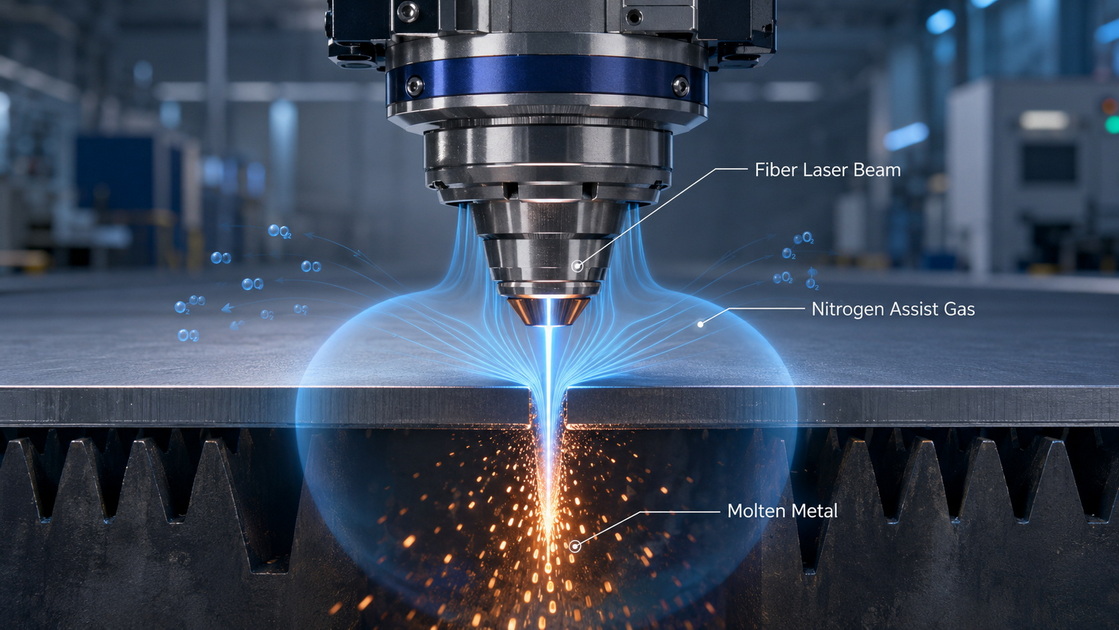
Nitrogen laser cutting is a process where the laser uses high‑pressure nitrogen as the assist gas instead of oxygen or compressed air. The nitrogen stream blows molten metal out of the kerf and shields the hot cut zone from oxygen, preventing oxide formation. [linkedin]
Key characteristics:
- Inert gas atmosphere: Nitrogen does not react with molten metal, so you get bright, oxide‑free edges. [linkedin]
- Clean cut geometry: A narrow kerf and smooth surface finish are achievable, especially on thin stainless and aluminum. [linkedin]
- High purity requirement: Industrial nitrogen laser cutting typically uses gas purity of 99.995–99.999% to maintain edge quality. [linkedin]
From an operator's perspective, nitrogen cutting feels like moving from "cut and polish" to "cut and assemble"—most parts come off the table ready for bending, welding, or coating with minimal rework. [linkedin]
Nitrogen's advantages come down to its inert behavior and the way it interacts with the molten pool during cutting. [atlascopco]
Core benefits:
- No oxidation, no scale – The nitrogen jet pushes away ambient oxygen from the cut zone, so oxide layers and discoloration do not form on the edge. [linkedin]
- Better corrosion resistance – Oxide‑free edges reduce the chance of rust initiation on carbon steels and preserve passivation on stainless steels. [linkedin]
- Improved paint/powder adhesion – Clean, bright surfaces allow coatings to bond more uniformly, reducing failures in salt spray or outdoor applications. [linkedin]
- Reduced post‑processing – Less grinding and cleaning saves labor and protects dimensional tolerances. [linkedin]
For manufacturers serving aerospace, medical, food equipment, and high‑end architectural projects, these benefits often justify the higher gas cost compared with oxygen or air. [linkedin]
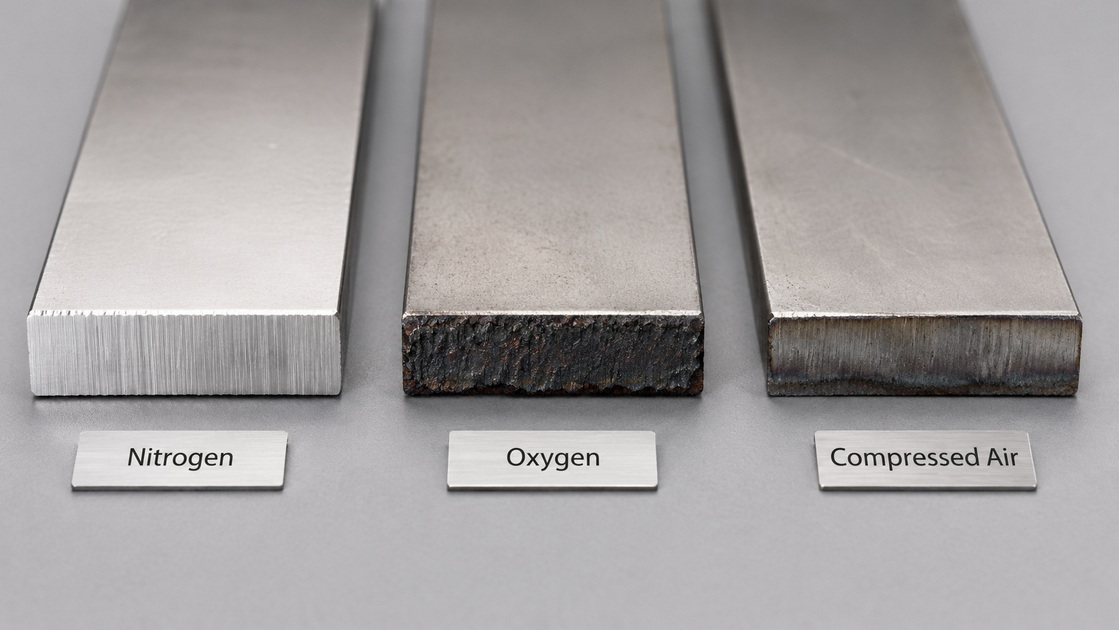
In conventional oxygen‑assisted cutting, oxygen reacts with hot metal in an exothermic reaction, effectively "burning" its way through and leaving a dark, oxidized edge. [atlascopco]
With nitrogen:
- The high‑pressure nitrogen jet physically displaces oxygen around the cut, forming an inert envelope. [linkedin]
- This inert atmosphere prevents exothermic oxidation and keeps the metal surface metallic, not burnt. [linkedin]
- The result is a clean, rust‑free edge that usually does not require grinding or pickling before downstream processes. [linkedin]
In high‑volume production, this consistency is critical: edge appearance and weld behavior remain stable across thousands of parts, as long as gas purity and pressure are kept within spec. [linkedin]
Nitrogen is widely used to cut both ferrous and non‑ferrous metals when edge quality is more important than maximum speed. [atlascopco]
Common materials:
- Stainless steel – Nitrogen maintains bright, oxide‑free edges that match the corrosion resistance and appearance of the base material. [linkedin]
- Mild (carbon) steel – For thin gauges (≤ 3 mm), nitrogen gives cleaner edges than oxygen, ideal for painted or visible parts. [linkedin]
- Aluminum – Nitrogen minimizes oxide formation on edges, which is important for welding and finishing. [linkedin]
- Copper and brass alloys – Inert assist gas helps control oxidation on these highly conductive, reflective materials. [linkedin]
From a production engineer's point of view, nitrogen is the default choice whenever parts will be visible, painted, powder‑coated, or welded in critical assemblies. [senfenglaserusa]
Getting nitrogen cutting right is mostly about controlling pressure, purity, nozzle geometry, and focal position. [novair-usa]
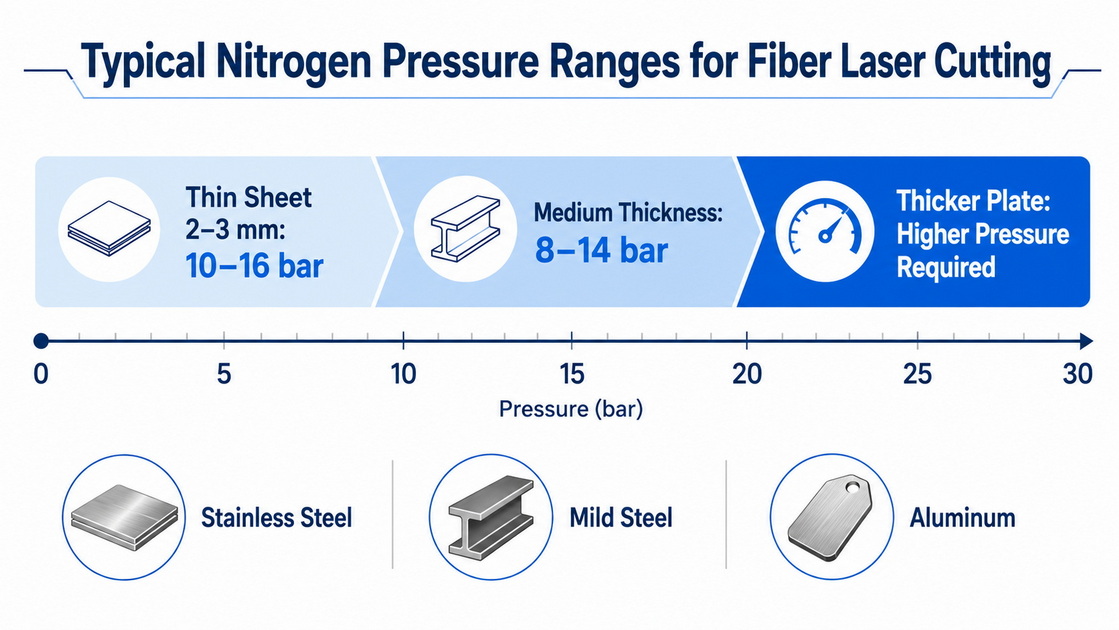
- General range for fiber laser cutting: 8–14 bar (116–203 psi) for most stainless and mild steel thicknesses. [linkedin]
- Thin sheet (2–3 mm): pressures may be increased up to around 20 bar to maximize speed and keep edges bright. [novair-usa]
- Thicker sections: often require higher pressures and flow, but with diminishing returns in speed and cost efficiency. [novair-usa]
- Nitrogen purity: Aim for 99.995–99.999% for stainless and aluminum to avoid micro‑oxidation and discoloration. [linkedin]
- Focal position: Typically set at or just below the bottom of the sheet to create a clean channel for molten metal evacuation. [linkedin]
- Nozzle diameter: Larger nozzles increase gas flow and cost but are beneficial for thicker plates; smaller nozzles suit thin sheets. [linkedin]
- Stand‑off distance: Should be shorter than nozzle diameter to maintain laminar flow and prevent turbulence that roughens the edge. [linkedin]
For OEM/ODM projects with repeated part families, it's good practice to log the exact laser power, speed, gas pressure, nozzle size, and focus offset that yield your best cut quality on each material/thickness combination. [senfenglaserusa]
Stainless steel is where nitrogen laser cutting truly shines. [linkedin]
- Shiny, oxide‑free edges straight from the table, ideal for decorative, food, or medical applications. [linkedin]
- Typical pressures: 8–14 bar with high purity nitrogen (~99.995% or higher). [linkedin]
- Minimal post‑processing: usually only micro‑burr removal if necessary. [linkedin]
Oxygen is still common for thick mild steel, but nitrogen is increasingly used where finish matters. [atlascopco]
- Better edge quality and less grinding for thin gauges (≤ ~3 mm). [linkedin]
- Pressures generally in the 8–14 bar range, tuned to thickness and nozzle size. [linkedin]
- Ideal for painted panels, enclosure doors, and visible brackets where oxide would cause adhesion or corrosion issues. [linkedin]
Aluminum brings unique challenges: high thermal conductivity and reflective surfaces. Nitrogen helps control these. [senfenglaserusa]
- Reduced oxidation on cut edges, improving welding performance and coating adhesion. [linkedin]
- Requires careful control of power and speed to avoid burrs and micro‑melting. [linkedin]
- Proper nozzle alignment and adequate pressure are critical to keep molten aluminum from re‑attaching in the kerf. [linkedin]
Because of its ability to deliver precision and clean edges, nitrogen laser cutting is used across many sectors. [linkedin]
Key industries:
- Aerospace – turbine components, brackets, and structural details in stainless and special alloys. [linkedin]
- Automotive – body components, interior/exterior trim, and custom exhaust or chassis parts. [linkedin]
- Electronics – precise enclosures and chassis where small dimensional deviations cause assembly issues. [linkedin]
- Medical – stainless instruments, implants, and components where any oxidation is unacceptable. [linkedin]
- Construction & architecture – façade panels, structural connectors, and exposed metalwork requiring high aesthetic standards. [linkedin]
From the perspective of a machine builder like CNDY‑Press, we see nitrogen cutting adopted whenever customers target high‑value, high‑spec markets and want to reduce manual finishing operations. [tiecas]
Quality control for nitrogen laser cutting should be systematic and data‑driven. [senfenglaserusa]
Key quality metrics:
- Edge roughness (Ra) – Lower Ra values indicate smoother edges and better process stability. [linkedin]
- Kerf width – Consistent kerf ensures parts fit downstream jigs, weld fixtures, and assemblies. [linkedin]
- Dross and burr formation – Excess dross points to issues with power, speed, or gas settings. [linkedin]
Testing and monitoring:
- Visual inspection to check for discoloration, striations, and micro‑cracks. [linkedin]
- Non‑destructive measurement using optical tools or CMMs for critical tolerances. [linkedin]
- Parameter logging (power, speed, gas pressure, nozzle size) for each job to quickly reproduce optimal settings. [linkedin]
- Nitrogen purity and flow monitoring to catch contamination or supply issues before they affect entire batches. [linkedin]
For high‑volume users, automated inline inspection can flag deviations in real time, reducing scrap and rework. [tulip]
A major strategic decision for manufacturers is whether to generate nitrogen on site or rely on cylinders/liquid deliveries. [linkedin]
On‑site systems (PSA or membrane) can produce nitrogen with 99.5–99.999% purity for laser cutting. [novair-usa]
Benefits:
- Lower long‑term cost compared with recurring cylinder or liquid deliveries. [linkedin]
- Higher reliability – no downtime waiting for trucks or managing empty cylinders. [linkedin]
- Modular scalability – capacity can grow with additional generator modules. [linkedin]
- Real‑time purity monitoring to ensure cutting quality is not compromised. [linkedin]
Supporting equipment for nitrogen laser cutting typically includes: [linkedin]
- High‑pressure compressors
- Gas boosters for thicker materials
- Buffer tanks and optimized piping
- Safety valves and over‑pressure protection
- Filtration and moisture removal
- Pressure and flow monitoring instruments
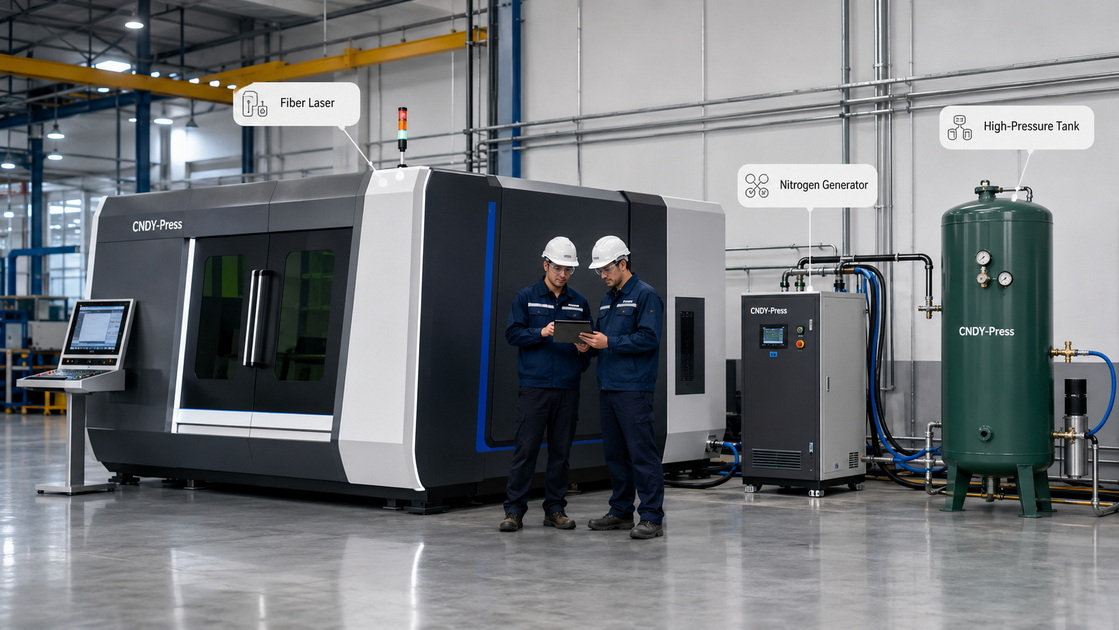
For OEM and OEM‑plus scenarios, machine builders like CNDY‑Press can integrate nitrogen generation and gas handling into a turnkey cutting system, simplifying commissioning and ongoing maintenance. [linkedin]
Nitrogen laser cutting is generally safe when proper procedures are followed, but there are two main risk categories: laser safety and gas safety. [atlascopco]
Laser‑related safety:
- Operator training on laser classifications, interlocks, and emergency stops. [linkedin]
- Appropriate laser safety eyewear matched to the laser wavelength. [linkedin]
- Enclosures or light‑tight cutting cells where feasible. [linkedin]
Gas‑related safety:
- Ventilation systems to remove fumes and particulates. [linkedin]
- Oxygen monitoring in enclosed areas, since nitrogen can displace oxygen and create asphyxiation risks. [linkedin]
- Regular leak checks on fittings, hoses, and high‑pressure lines. [linkedin]
- Ensuring all components are rated for maximum working pressure. [linkedin]
Robust safety practices protect both your workforce and your productivity—unplanned incidents can shut a laser shop down for days. [tulip]
Compared with many thermal cutting methods, nitrogen laser cutting has a relatively favorable environmental profile. [linkedin]
Advantages include:
- Minimal harmful emissions – nitrogen is inert, so it does not generate additional chemical by‑products in the cutting zone. [linkedin]
- Lower logistics footprint when on‑site nitrogen generation reduces transport miles for bottled gases. [linkedin]
- Less chemical post‑processing because edges are clean, reducing use of pickling pastes, solvents, and abrasives. [linkedin]
- Better scrap recyclability – precisely cut skeletons and off‑cuts are easier to sort and recycle. [linkedin]
- Higher energy efficiency per part due to fast cycle times and reduced rework. [linkedin]
For manufacturers under pressure to hit ESG targets, fiber lasers with nitrogen assist are a strong alternative to older, more polluting cutting technologies. [tulip]
Many new buyers ask whether nitrogen is "too expensive" compared with oxygen or compressed air. The real answer is: it depends on what you optimize for—gas cost, total cost per part, or quality. [atlascopco]
Cost factors:
- Higher gas consumption and pressure mean nitrogen cutting can have a higher per‑hour gas cost, especially on thick plate. [linkedin]
- Reduced post‑processing (less grinding, cleaning, and rework) often offsets the extra gas cost. [linkedin]
- On‑site nitrogen generation shifts spending from variable delivery fees to a capital investment with lower long‑term operating expense. [linkedin]
- A steady nitrogen supply reduces downtime risk, which is often more expensive than the gas itself. [linkedin]
In many professional shops, the cost per finished, ready‑to‑ship part is lower with nitrogen, even if the cost per hour of gas usage is higher. [marketveep]
The right assist gas depends on material, thickness, and quality requirements. [atlascopco]
| Factor | Nitrogen laser cutting | Oxygen laser cutting | Compressed air cutting |
|---|---|---|---|
| Edge quality | Clean, bright, oxide‑free edges (linkedin) | Dark, oxidized edges, more scale (linkedin) | Light oxidation/discoloration possible (linkedin) |
| Gas cost | Higher per unit and pressure (linkedin) | Generally lower (linkedin) | Lowest (on‑site air) (linkedin) |
| Post‑processing | Minimal to none (linkedin) | Often needed (grinding, cleaning) (linkedin) | Sometimes needed for visible parts (linkedin) |
| Speed on thick mild steel | Slower than oxygen (linkedin) | Faster due to exothermic reaction (linkedin) | Moderate, depends on setup (linkedin) |
| Best use cases | Stainless, aluminum, visible or coated parts (linkedin) | Thick mild steel where speed matters (linkedin) | Cost‑sensitive parts, non‑critical finishes (linkedin) |
From an expert's perspective: use nitrogen where quality matters, oxygen where thickness and speed dominate, and air where cost is the primary driver and finish is less critical. [atlascopco]
Based on field experience supporting OEM/ODM customers, these practical steps can significantly improve your nitrogen cutting results:
1. Start from the material, not the power rating: Define your most common materials and thicknesses, then tune parameters for those combinations first. [senfenglaserusa]
2. Dial in one thickness at a time: For each sheet thickness, systematically vary cutting speed and gas pressure while keeping power constant, and record results. [senfenglaserusa]
3. Monitor nozzle wear and alignment: Worn or misaligned nozzles can destroy cut quality even when power and pressure are "correct." [linkedin]
4. Use scrap tests before mass production: Always confirm parameters on scrap from the same batch before moving to full‑sheet nests. [senfenglaserusa]
5. Review gas usage monthly: Combine CNC logs and gas meter data to optimize cutting paths and nesting for lower nitrogen consumption. [marketveep]
On CNDY‑Press fiber laser machines, we typically recommend customers build standard parameter libraries for their top 10 materials and thicknesses, then continuously refine those libraries as new jobs and alloys come in. [bogongcnc]
If you are evaluating fiber laser cutting machines or looking to upgrade your existing nitrogen cutting capability, our team at CNDY‑Press can help you:
- Select the right fiber laser power, table size, and automation for your materials and volumes. [bogongcnc]
- Design a nitrogen supply system (on‑site generation or integrated high‑pressure gas handling) tailored to your production. [linkedin]
- Develop cutting parameter libraries for your priority materials, including stainless, mild steel, aluminum, and special alloys. [senfenglaserusa]
Talk to our engineering team to review your drawings, materials, and target cycle times, and we'll propose a complete nitrogen laser cutting solution optimized for quality, cost per part, and future expansion. [tiecas]
If your priority is high‑quality, oxide‑free edges, nitrogen is usually better than compressed air. Air contains about 21% oxygen, which can cause light oxidation and discoloration on cut edges, often requiring extra finishing. Nitrogen's inert nature prevents this and keeps edges shiny and clean, which is critical for stainless, aluminum, and visible parts. [atlascopco]
Most stainless and mild steel applications run between 8–14 bar (116–203 psi). Thinner sheets around 2–3 mm may benefit from higher pressures up to roughly 20 bar to increase speed and keep the edge bright. Always tune pressure together with power, speed, and nozzle size for your specific machine. [novair-usa]
Nitrogen can cut thicker plate, but gas consumption and cost rise quickly at higher pressures and flow rates. For very thick mild steel, oxygen is often faster and more economical, while nitrogen is preferred for thinner gauges and high‑finish requirements. [atlascopco]
On‑site nitrogen generation is not mandatory, but it often becomes cost‑effective when you run your fiber laser for multiple shifts or have high annual cutting hours. Generators reduce dependence on deliveries, lower long‑term nitrogen costs, and provide a stable, continuous gas supply. [linkedin]
Because nitrogen prevents oxidation, it leaves an oxide‑free, metallic surface that promotes strong adhesion for paint and powder coatings. This reduces the risk of flaking, underfilm corrosion, and coating defects, especially in outdoor or high‑humidity environments. [linkedin]
1. ACCURL. "Nitrogen Laser Cutting: Process, Advantages and Costs."
https://www.accurl.com/blog/nitrogen-laser-cutting/ [linkedin]
2. Atlas Copco. "Laser Cutting Process and Assist Gases: Why You Need Nitrogen."
https://www.atlascopco.com/en-us/compressors/wiki/compressed-air-articles/what-is-laser-cutting [atlascopco]
3. NOVAIR. "Laser Cutting Nitrogen Requirements: Purity, Pressure & Flow Rate."
https://www.novair-usa.com/laser-cutting-nitrogen-requirements/ [novair-usa]
4. Senfeng USA. "Top 5 Key Factors That Affect Fiber Laser Cutting Quality."
https://www.senfenglaserusa.com/fiber-lasers/top5-key-factors-that-affect-fiber-laser-cutting-quality/ [senfenglaserusa]
5. MarketVeep. "Best Practices for Your Content SEO Strategy in Manufacturing."
https://www.marketveep.com/blog/4-best-practices-for-your-content-seo-strategy-in-manufacturing [marketveep]
6. Tiecas. "A Guide to Writing Industrial Blogs."
https://www.tiecas.com/guide-to-writing-industrial-blogs/ [tiecas]
7. Bogong CNC. "Techniques for Adjusting the Cutting Area of Fiber Laser Cutting Machines."
https://bogongcnc.com/techniques-for-adjusting-the-cutting-area-of-fiber-laser-cutting-machines/ [bogongcnc]


