


Views: 222 Author: CNDY-Press Publish Time: 2026-05-20 Origin: Site


As someone who has spent years helping OEMs and job shops transition from traditional sheet metal processes to fiber laser cutting machines, I can say this clearly: metal laser cutting is no longer a "nice‑to‑have" capability, it is a core productivity engine for modern fabrication. In this guide, I'll share how metal laser cutting really works on the shop floor, where fiber laser machines outperform older technologies, and what engineers, buyers, and plant managers should look for when selecting equipment. [dallan]
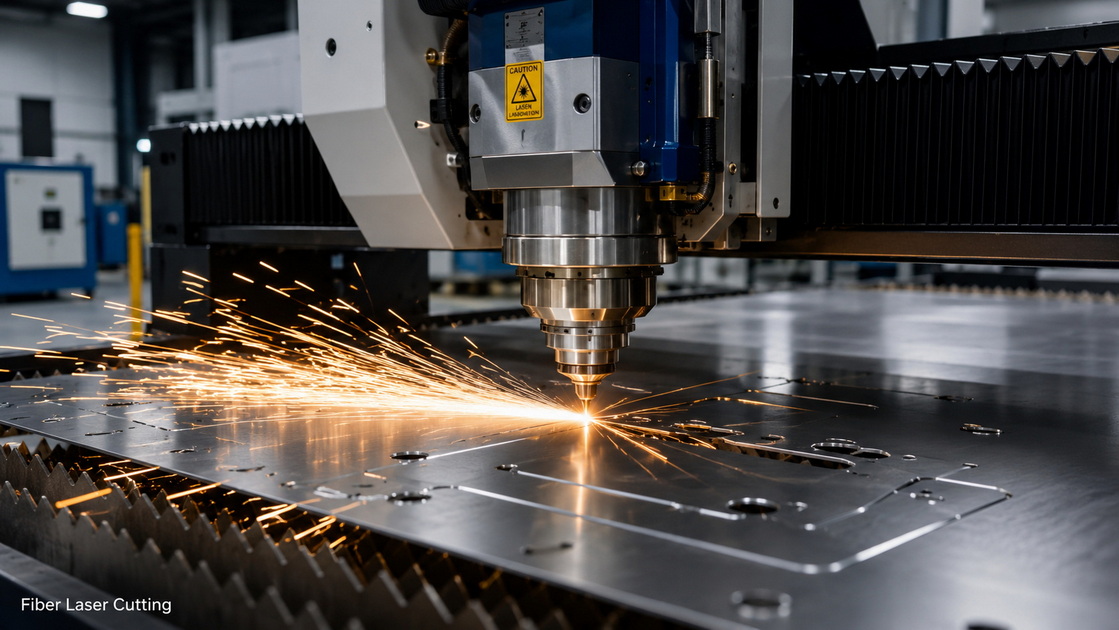
Metal laser cutting is a non‑contact process that uses a highly concentrated laser beam to melt or vaporize metal along a programmed path, achieving precise, repeatable cuts with minimal mechanical stress. Compared with mechanical methods such as punching or sawing, laser cutting offers finer tolerances, cleaner edges, and far greater freedom in part geometry.
Typical industrial metal laser cutting applications include:
- Sheet metal chassis, brackets, and enclosures for machinery and electronics.
- Precision components for automotive, aerospace, and medical devices.
- Architectural and signage panels with intricate decorative patterns. [athenaswc]
For most factories today, the question is no longer "Can metal be cut with a laser?" but "Which laser technology – fiber or CO₂ – is the best fit for our material mix, thickness, and throughput targets?"
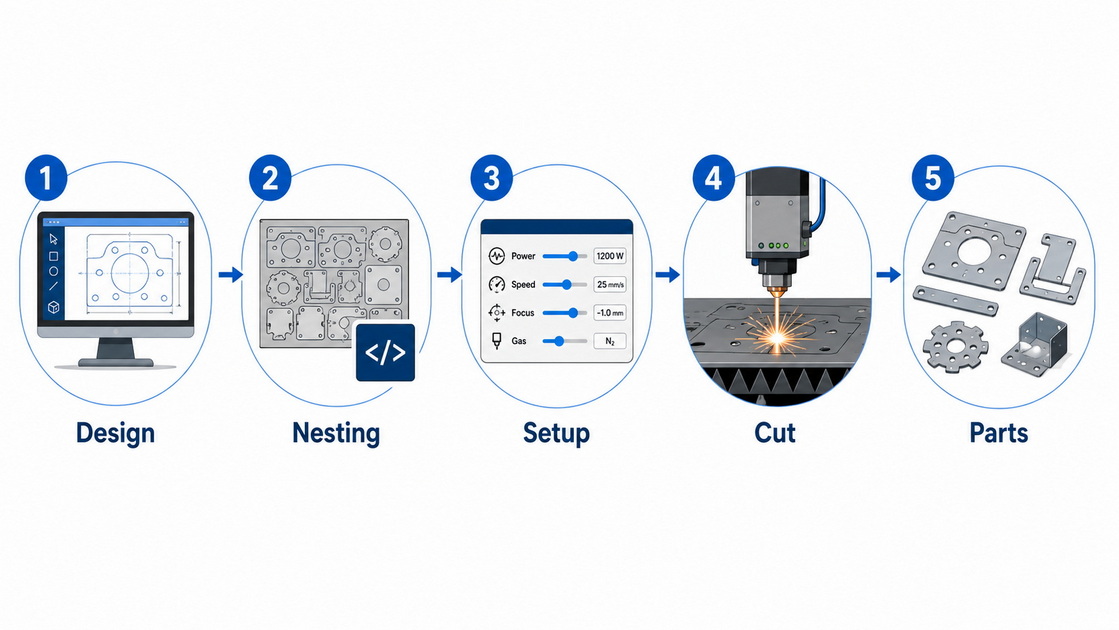
From an engineer's perspective, a reliable laser cutting process comes down to controlling heat, motion, and gas flow. In practice, the workflow looks like this:
1. Designing the cutting pattern
Parts are created in CAD, then exported to CAM or nesting software that optimizes sheet usage and generates the CNC program. [athenaswc]
2. Setting process parameters
The operator selects laser power, cutting speed, focus position, and assist gas according to material type, thickness, and required edge quality.
3. Executing the cut
The CNC controller drives the cutting head along the programmed path while the laser beam melts the metal and assist gas ejects molten material (slag) from the kerf.
4. Cooling and post‑processing
Parts cool on the bed; operators then remove micro‑tabs, deburr critical surfaces if needed, and prepare parts for subsequent forming or finishing.
From my experience, the difference between an average and a world‑class laser cutting operation usually lies in parameter libraries and disciplined process control, not just machine power ratings. [athenaswc]
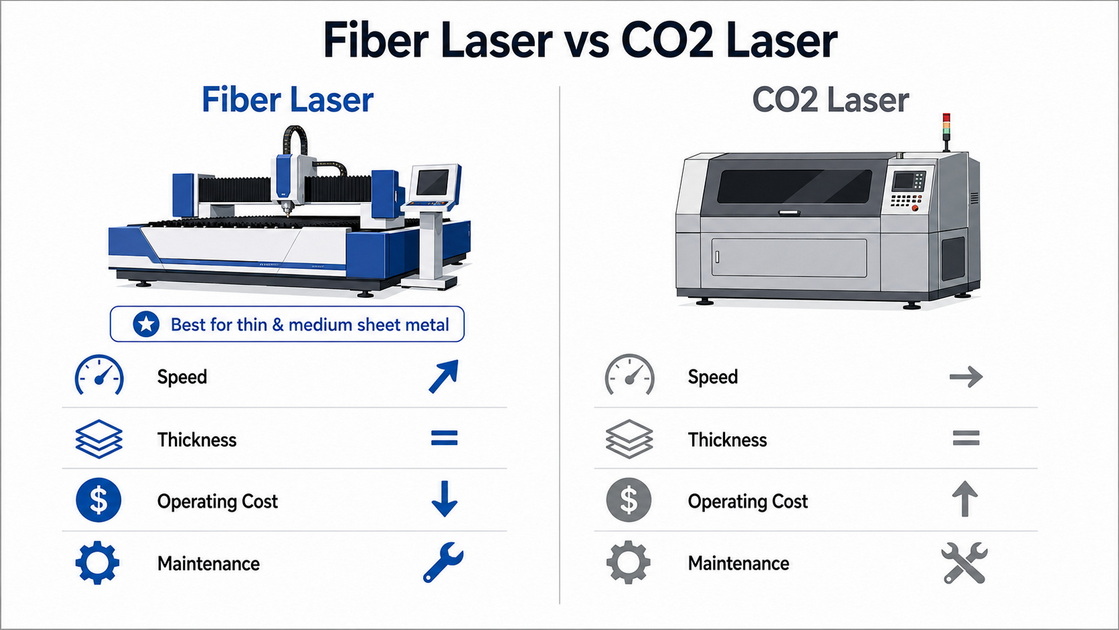
Both fiber lasers and CO₂ lasers can cut metal, but they behave very differently in real production. The choice impacts energy consumption, cut quality on specific materials, and long‑term cost per part. [dallan]
Fiber laser cutters use solid‑state technology and a shorter wavelength, which yields a narrower, more energy‑dense beam. In practice, that means:
- Higher cutting speeds and acceleration on thin to medium‑thickness sheet metal.
- Excellent edge quality on stainless steel, mild steel, and aluminum when parameters are tuned correctly.
- Lower operating cost because of high electrical efficiency and minimal maintenance compared with CO₂ resonators.
The trade‑off is that fiber laser cutting often requires higher volumes of nitrogen assist gas to achieve oxide‑free edges, especially on stainless steel and high‑value parts.
CO₂ lasers generate a wider beam at a longer wavelength and can be equipped with higher nominal power, which historically made them attractive for thicker sections. Key characteristics include:
- Good performance on thicker plates where edge quality requirements are moderate.
- Lower initial capital cost (CAPEX) compared with high‑power fiber systems, though modern pricing is closing the gap.
- Higher operating costs (OPEX) due to gas consumption in the resonator and greater maintenance needs.
For most new sheet metal investments, I now see fiber laser cutting machines chosen as the default because they deliver more parts per kilowatt and per square meter of floor space. [blog.saleslayer]
Regardless of brand, a modern metal laser cutting system is built around several critical subsystems.
- Laser resonator – Generates the beam (fiber source or CO₂ tube).
- Cutting head and optics – Focuses the beam to a tiny spot; includes nozzles, lenses, and height sensing.
- CNC controller and drive system – Coordinates X/Y (and sometimes tube/rotary) motion with laser output.
- Assist gas system – Supplies oxygen, nitrogen, or air at controlled pressures for ejection and edge control.
- Chiller and safety enclosure – Maintains temperature stability and protects operators from radiation and fumes.
In OEM and ODM environments, reliability of these components directly affects delivery commitments, so I always recommend buyers pay attention not only to peak power, but to servo brands, controller ecosystem, and after‑sales support. [blog.saleslayer]
Dialing in the right cutting parameters is where experienced operators add real value. The main levers include:
- Laser power (W/kW) – Higher power enables thicker material cutting and faster speeds, but must be balanced against heat input and burr formation.
- Cutting speed – Directly influences productivity and edge quality; excessive speed can cause dross, while too slow can overheat parts.
- Pulse frequency (for pulsed modes) – Impacts heat affected zone, kerf quality, and ability to cut fine features.
- Focus spot size and position – Smaller, well‑positioned spots yield narrow kerfs and cleaner edges, especially on thin sheets.
- Assist gas pressure and type – Oxygen promotes fast cutting with oxidized edges; nitrogen and clean air deliver bright, oxide‑free surfaces.
Typical dimensional tolerances achievable with metal laser cutting are around ±0.1–0.2 mm on thin sheet, ±0.2–0.5 mm on 1–5 mm, and ±0.5–1.0 mm on thicker plate, assuming a well‑maintained machine and stable process settings.
Different metals react differently to laser energy due to reflectivity, thermal conductivity, and alloy composition.
- Mild (carbon) steel – Affordable, robust, with good weldability; widely used in machinery, construction, and general fabrication.
- Stainless steel – Corrosion‑resistant and ideal for food, medical, and architectural applications.
- Aluminum – Lightweight, conductive, and increasingly specified in automotive and aerospace components.
- Brass and copper – Highly conductive and reflective; modern fiber lasers can cut them effectively with the right optics and safety measures.
- Galvanized steel, titanium, nickel alloys, and precious metals – Used where corrosion resistance, high‑temperature performance, or aesthetics matter.
For most B2B buyers, the "workhorse" materials remain mild steel, stainless steel, and aluminum, which offer predictable performance and excellent compatibility with fiber laser cutting.
In real projects, the choice is rarely "laser vs nothing," but laser vs plasma, waterjet, or mechanical cutting. Laser cutting stands out in several ways:
- High speed on thin and medium sheet metal, especially with fiber lasers.
- Excellent accuracy and repeatability, making it suitable for tight‑tolerance assemblies.
- Clean, narrow kerf with minimal burring, which reduces downstream deburring and rework.
- Non‑contact process, eliminating tool wear and minimizing sheet deformation.
- Complex geometries and micro‑features possible without dedicated tooling.
Where plasma or waterjet still make sense:
- Plasma cutting can be attractive for very thick, structural steel where edge quality is less critical.
- Waterjet cutting handles non‑metallics and very thick composites with no heat affected zone.
For most OEM and contract manufacturing scenarios focused on sheet metal in the 1–25 mm range, fiber laser cutting offers the best mix of speed, quality, and cost per part. [dallan]
Metal laser cutting underpins a wide range of industrial supply chains. [athenaswc]
- Automotive – Brackets, mounts, battery enclosures, and structural reinforcements.
- Aerospace – Lightweight, high‑strength components and complex brackets.
- General manufacturing – Machine frames, panels, safety guards, and custom parts.
- Electronics – Chassis, heatsinks, and precision EMC shielding parts.
- Construction and architecture – Facades, railings, decorative panels, and signage.
- Medical – Instrument components and equipment frames.
In OEM/ODM projects, a well‑configured fiber laser cutting line allows manufacturers to offer short lead times, design flexibility, and scalable volume production from prototypes to mass manufacturing. [blog.saleslayer]
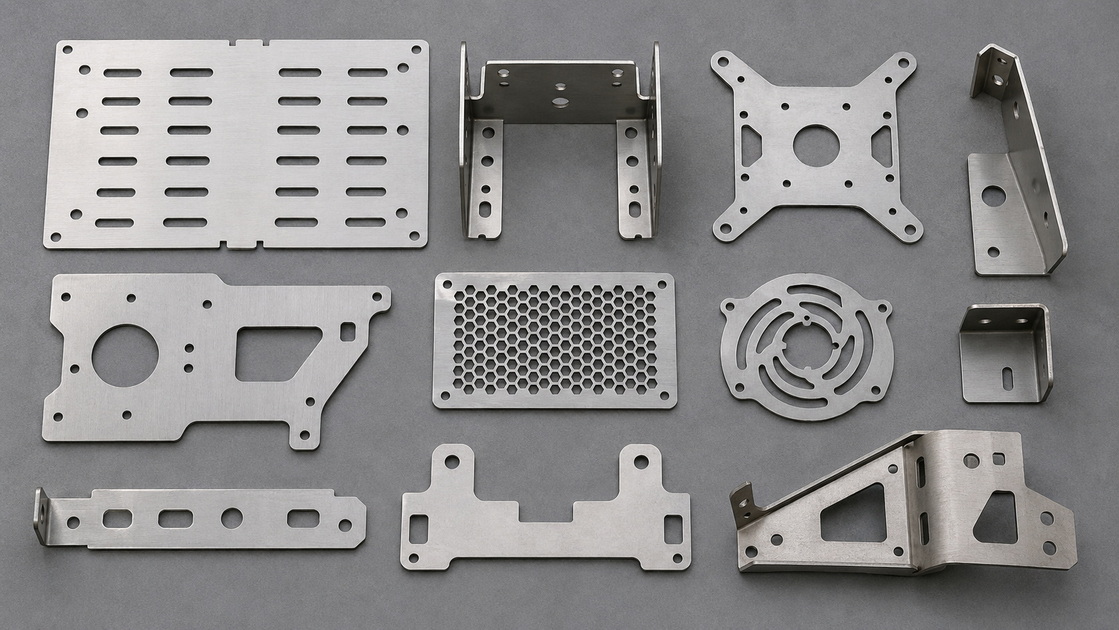
From the perspective of both machine builder and job shop, good design practices can dramatically improve yield and edge quality. [reddit]
- Account for kerf width in your CAD models so finished dimensions match functional requirements.
- Avoid extremely sharp corners and tiny unsupported "islands", which are prone to overheating or warping.
- Space parts appropriately on the sheet to prevent heat accumulation and distortion.
- Standardize hole diameters and slot widths to streamline parameter libraries and reduce testing.
- For nested programs, many experienced programmers cut internal features first, then outer profiles, to maintain sheet stability. [reddit]
For engineers and industrial designers, involving your laser cutting partner early in the DFM (Design for Manufacturability) stage is one of the fastest ways to reduce cost and improve robustness. [athenaswc]
High‑power lasers are extremely safe when systems are properly enclosed and procedures are followed, but they must be treated with respect.
Before cutting:
- Clean the sheet surface to remove oil, heavy rust, or debris that might affect beam absorption.
- Verify nozzle condition, lens cleanliness, and machine calibration.
- Confirm assist gas type, pressure, and supply for the full job.
During operation:
- Use appropriate PPE (certified eye protection, gloves, and fire‑resistant clothing as needed).
- Ensure ventilation and filtration are adequate for fumes and particulate.
- Never leave a laser running unattended, especially when cutting flammable materials or thick plate.
Regular maintenance—lens cleaning, alignment checks, filter changes—directly influences cut quality and machine lifespan.
From a buyer's perspective, there are two cost dimensions: outsourced cutting services and in‑house machine ownership. [blog.saleslayer]
- Service providers often charge by cutting time, typically in the range of roughly 1–1.5 currency units per minute for thin sheet, with complex parts and thick materials commanding higher prices.
- Total part cost also depends on setup time, nesting efficiency, material utilization, and any secondary operations such as bending or coating.
For in‑house equipment, metal laser cutter prices vary widely:
- Entry‑level machines for light industrial use start in the tens of thousands in local currency.
- Industrial‑grade fiber laser cutting systems with automation and multi‑kilowatt sources can reach hundreds of thousands or more, depending on configuration.
When evaluating ROI, manufacturers typically compare:
- Current outsourcing spend and lead time.
- Expected utilization (hours per week).
- Labor savings and throughput gains compared with mechanical processes. [marketveep]
Real‑world cutting speed depends on machine power, beam quality, and process optimization. As a broad guideline:
- On thin sheet (1–2 mm), fiber laser cutting speeds may range from about 100 to 1000 inches per minute, depending on material and quality requirements.
- On thicker plates (≥ 6 mm), speeds typically drop to tens or low hundreds of inches per minute to maintain cut quality.
Maximum thickness capability depends on power and laser type, but fiber and CO₂ machines can commonly cut:
- Mild steel up to around 25 mm.
- Stainless steel up to roughly 19 mm.
- Aluminum up to about 12 mm, with higher power enabling more in some setups.
For OEM projects, I recommend aligning target thickness ranges with machine selection from the start, rather than pushing a single system to cover every possible scenario. [dallan]
When manufacturers select a fiber laser cutting machine for sheet metal, the most successful projects usually consider:
- Required material mix and thickness (mild steel, stainless, aluminum, copper alloys).
- Desired automation level (single table, shuttle table, automatic loading/unloading, tower storage).
- Integration with upstream and downstream processes (press brakes, welding lines, powder coating). [blog.saleslayer]
- After‑sales service, parameter support, and availability of remote diagnostics from the OEM. [blog.hubspot]
For OEM and ODM customers working with a partner such as CNDY‑Press, the advantage is the ability to co‑engineer machine configuration and fixturing around specific product families, instead of accepting a generic catalog solution. [athenaswc]
If you are evaluating fiber laser cutting machines for sheet metal production or exploring OEM/ODM partnerships, this is the ideal time to align your equipment roadmap with your product strategy. [blog.saleslayer]
- Share your material thickness range, annual volumes, and current bottlenecks.
- Request a technical consultation and sample cutting on representative parts.
- Explore customized automation, integration, and tooling tailored to your product lines.
A focused discussion with an experienced machine builder and manufacturing partner can reveal fast wins in productivity, quality, and total cost per part. [iodigital]
1. Can metal be cut with a laser?
Yes. Metal laser cutting is one of the most efficient methods for processing sheet and plate, offering precise cuts, complex geometries, and high‑quality edges across many alloys.
2. What is the best metal for laser cutting?
There is no single "best" metal; however, mild steel, stainless steel, and aluminum are the most commonly used due to their combination of machinability, cost, and performance.
3. How thick can fiber laser machines cut?
Typical industrial systems can cut mild steel up to about 25 mm, stainless steel up to around 19 mm, and aluminum up to roughly 12 mm, depending on power and configuration.
4. Is laser cutting metal expensive?
Service pricing often falls in the range of roughly 1–1.5 units of currency per minute of cutting for thin materials, with total part cost influenced by complexity, material, and secondary operations.
5. How do fiber lasers compare with plasma cutting for steel?
Fiber lasers deliver cleaner edges, finer features, and better tolerance control on thin and medium‑thickness steel, while plasma systems remain competitive for very thick structural steel where edge finish is less critical.
1. MarketVeep. "4 Best Practices for Your Content SEO Strategy in Manufacturing."
https://www.marketveep.com/blog/4-best-practices-for-your-content-seo-strategy-in-manufacturing [marketveep]
2. Athena SWC. "SEO for Metal Fabrication Companies: Why Technical Content Wins More Qualified Leads."
https://www.athenaswc.com/resources/blog/seo-for-metal-fabrication-companies-why-technical-content-wins-more-qualified-leads/ [athenaswc]
3. iO Digital. "Google E‑E‑A‑T: Creating Content That Puts People First."
https://www.iodigital.com/en/insights/blogs/google-e-e-a-t-creating-content-that-puts-people-first [iodigital]
4. Sales Layer. "SEO for Manufacturing Companies: The 2026 Strategy Guide."
https://blog.saleslayer.com/seo-for-manufacturing-companies [blog.saleslayer]
5. Productive Blogging. "15 Easy Ways to Improve Your Website's E‑E‑A‑T."
https://www.productiveblogging.com/eat/ [productiveblogging]
6. HubSpot. "Is Your Website EEAT-Compliant? What Developers Should Keep In Mind."
https://blog.hubspot.com/website/eeat-compliance [blog.hubspot]
7. Dallan. "Sheet Metal Laser Cutting Optimization: Coil‑Fed Laser vs Traditional Laser."
https://www.dallan.com/en/news/sheet-metal-laser-cutting-optimization-coil-fed-laser-vs-traditional-laser/ [dallan]
8. Reddit – r/lasercutting. "What Are Your Go‑To Design Tips for Optimizing Laser Cutting Files?"
https://www.reddit.com/r/lasercutting/comments/1qqnnxu/what_are_your_goto_design_tips_for_optimizing/ [reddit]


