


Views: 222 Author: CNDY-Press Publish Time: 2026-06-19 Origin: Site


Content Menu
● Overview – How Maintenance Philosophy Differs
● Key Maintenance Components – Fiber Laser vs. Mechanical Cutting
>> Fiber Laser Cutting Machine – Main Maintenance Areas
>> Traditional Mechanical Cutting – Main Maintenance Areas
● Maintenance Tasks And Frequency – A Practical Comparison
● Maintenance Cost Structure – Consumables, Labor, And Downtime
>> Consumables And Spare Parts
>> Labor And Skill Requirements
● Reliability And Uptime – What We See In The Field
● Expert Insight – Daily And Weekly Maintenance Checklist For Fiber Lasers
● Expert Insight – Hidden Maintenance Risks In Mechanical Cutting
● Case Example – Migrating A Job Shop From Mechanical To Fiber Laser
● Total Cost Of Ownership – Maintenance As A Strategic Factor
● How CNDY‑Press Supports Low‑Maintenance Fiber Laser Solutions
● FAQ
>> 1. Is fiber laser cutting always cheaper to maintain than mechanical cutting?
>> 2. How often do I need to replace fiber laser nozzles and lenses?
>> 3. Do fiber laser cutting machines require less operator maintenance?
>> 4. What type of maintenance training is needed for fiber laser operators?
>> 5. Can fiber laser cutting completely replace mechanical cutting in a factory?
After more than a decade helping factories migrate from traditional mechanical cutting (shearing, punching, plasma, flame) to fiber laser cutting machines, I have seen the same pattern again and again: teams underestimate how much maintenance strategy changes when you switch technologies. In this guide, I will compare maintenance for fiber laser cutting and mechanical cutting equipment from a practical, shop‑floor perspective, drawing on our experience at CNDY‑Press as an OEM and ODM sheet‑metal processing equipment manufacturer. [shop.adhmt]
Traditional mechanical cutting equipment relies on physical contact (blades, punches, torches) to separate material, so most maintenance revolves around wear, lubrication, alignment, and heat. In contrast, fiber laser cutting machines use a focused laser beam and non‑contact process, shifting maintenance toward optics, gas, cooling, cleanliness, and electronics. [genedge]
From a total cost of ownership angle, many manufacturers now accept higher upfront investment in fiber laser systems because of their lower routine maintenance, fewer consumables, and reduced unplanned downtime compared with older methods. However, this only holds true if the laser is maintained systematically. [accurl]
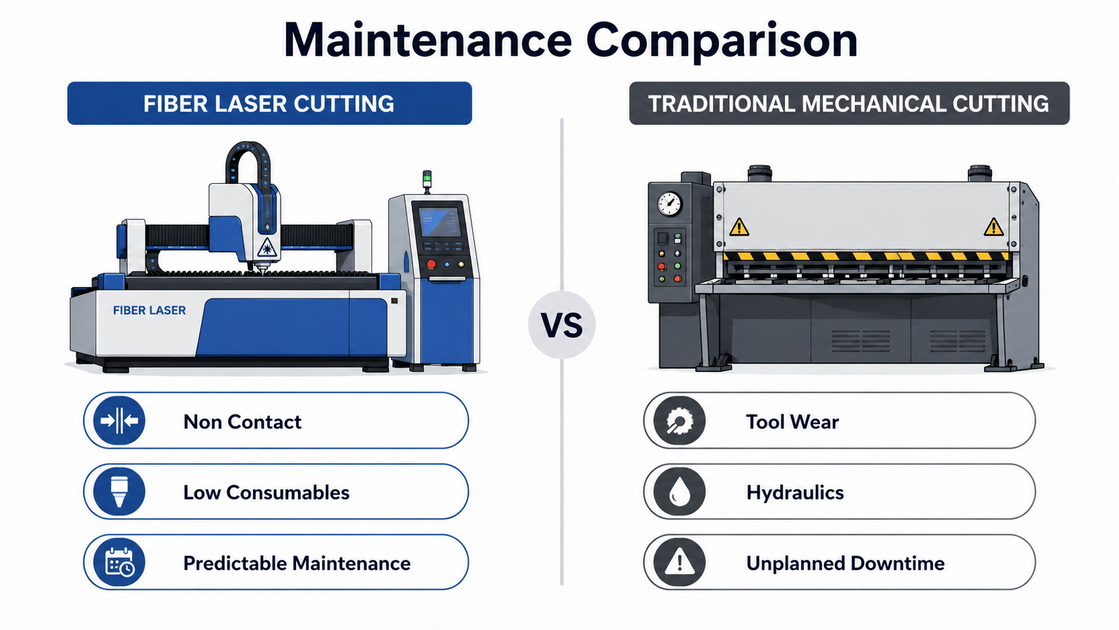
For a modern fiber laser cutting machine, critical maintenance usually focuses on: [siu-indo]
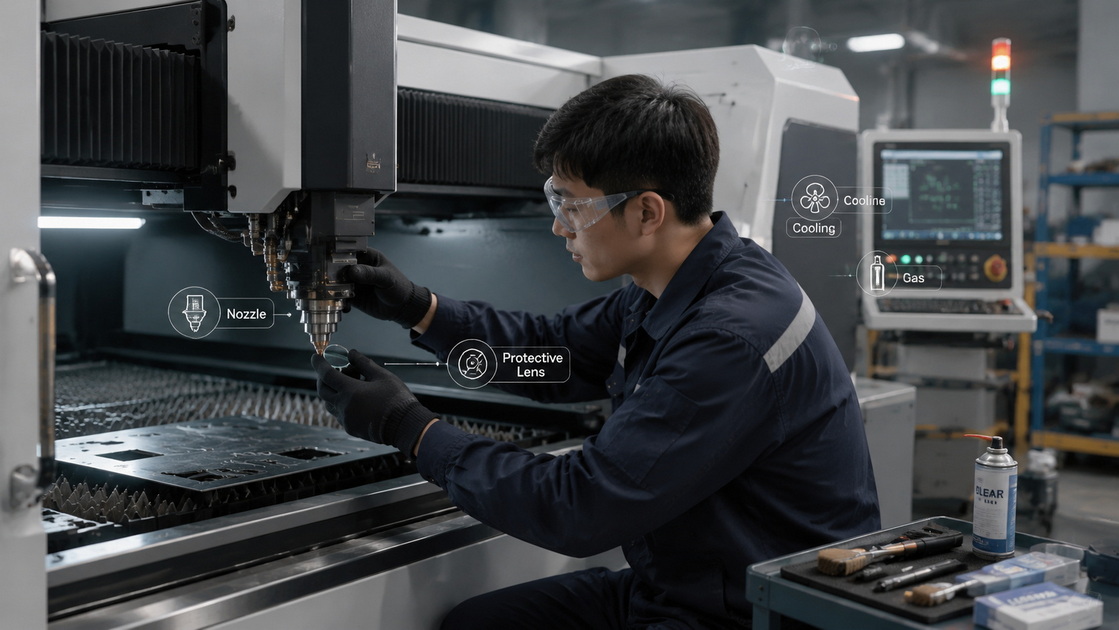
- Optics – protective windows, lenses, and occasionally mirrors in the cutting head.
- Nozzle and torch – cleaning or replacing worn nozzles, checking coaxiality.
- Cooling system – chiller (water quality, temperature, flow), coolant levels, leak checks. [southernfabsales]
- Assist gas system – filters, pressure stability, dryness of nitrogen/oxygen/air supply. [siu-indo]
- Mechanical axes – guide rails, racks, bearings, lubrication and backlash checks.
- Dust extraction – filters and dust collector maintenance to keep the optical path and electronics clean. [mazak]
Most of these tasks are predictable and schedule‑based, and many fiber laser systems now include built‑in diagnostics for preventive maintenance. [mazak]
For traditional mechanical cutting (shears, punches, turret presses, older plasma or flame systems), maintenance emphasis tends to be: [mac-tech]
- Blades and tools – sharpening, regrinding, or replacing punch/die sets and shear blades.
- Hydraulics and lubrication – oil changes, leak checks, pump maintenance.
- Mechanical wear – gibs, slides, bearings, clutch/brake mechanisms.
- Thermal and slag issues (for flame/plasma) – torch tips, slag removal, fume extraction.
Because these processes involve direct mechanical impact or open flames, wear is higher and less uniform, and unexpected tool failures are common if maintenance is not disciplined. [shop.adhmt]
The table below summarizes typical maintenance workload differences for fiber laser cutting vs. traditional mechanical cutting in a production environment. [forsuncnc]
Table – Typical maintenance focus by technology
| Area | Fiber laser cutting | Traditional mechanical cutting |
|---|---|---|
| Cutting interface | Clean/replace nozzles, protect window | Sharpen blades, change punches/dies, replace tips |
| Motion system | Lubricate linear guides and racks | Lubricate slides, gibs, mechanical linkages |
| Cooling | Maintain chiller, coolant, temperature | Often limited or air cooled |
| Dust/fume handling | Maintain dust collector and filters | Slag removal, fume extraction, chip handling |
| Hydraulics/pneumatics | Mainly pneumatics, few or no hydraulics | Hydraulic circuits, oil, seals, pumps |
| Planned downtime | Predictable, often scheduled at off‑shift | Tool failures can cause unplanned stops |
In our OEM projects, we regularly see 30–50% fewer unplanned stoppages on well‑maintained fiber laser lines compared to older punch/shear combinations handling similar throughput. [mac-tech]
For fiber laser cutting, the main consumables affecting maintenance cost include: [kirinlaser]
- Cutting nozzles and ceramic holders.
- Protective lenses/windows in the cutting head.
- Filters for assist gas and dust collection.
- Occasional optics or fiber components in extreme environments.
By contrast, mechanical cutting often consumes: [shop.adhmt]
- Shear blades and regrinding services.
- Punch and die sets (especially for high‑mix parts).
- Torch tips and electrode parts for older plasma/flame systems.
- Hydraulic oil, seals, and related components.
Industry case studies show that while a fiber laser cutting machine has higher initial purchase cost, it typically offers lower ongoing maintenance and consumable spend compared with traditional equipment over its lifetime. [leapion]
Fiber lasers demand more focused technical training for operators and maintenance staff, particularly in areas like optics handling, chiller management, and software calibration. However, once your team is trained, routine tasks are not more time‑consuming than mechanical maintenance; in many plants they are actually faster. [siu-indo]
Mechanical cutting equipment sometimes allows basic tool changes by general operators, but deeper maintenance (hydraulics, mechanical overhauls) often requires experienced technicians and longer interventions. [genedge]
One of the reasons fiber laser technology has expanded so quickly in sheet metal processing is its high reliability and uptime when properly maintained. Tube laser and flatbed fiber laser systems, for example, typically show lower maintenance requirements than traditional sawing, drilling, and punching equipment due to their non‑contact nature. [accurl]
For our own clients, the most impactful changes after adopting fiber laser cutting are:
- More predictable uptime thanks to programmable preventive maintenance routines.
- Reduced mechanical fatigue failures (no blades crashing into material, no eccentric punches).
- Lower risk of thermal distortion and slag‑related downtime compared with older thermal processes. [genedge]
Of course, this assumes the machine is installed in a suitable environment and operators follow the maintenance schedule.
Drawing on best‑practice guides and manufacturer recommendations, here is a practical maintenance checklist you can adapt for your fiber laser cutting system. [kirinlaser]
Daily tasks
- Inspect and, if needed, clean the nozzle and protective window.
- Check assist gas pressure and dryness (for example nitrogen or oxygen).
- Clean the cutting area, remove scrap and dust from the work zone. [mazak]
- Verify coolant temperature and levels on the chiller.
Weekly tasks
- Clean or inspect air and gas filters.
- Check linear guides and racks for contamination; perform scheduled lubrication as specified. [siu-indo]
- Inspect electrical connections for obvious damage or looseness.
Monthly or quarterly tasks
- Clean/replace dust collector filters and inspect ducting. [mazak]
- Verify beam alignment and perform calibration cuts if required.
- Review maintenance logs and adjust preventive schedules.
Many modern fiber laser machines integrate on‑screen maintenance reminders and diagnostic tools, helping operators stay on track. [siu-indo]
When we audit plants that still rely heavily on traditional mechanical cutting, we often find that hidden maintenance risks are accepted as "normal". [mac-tech]
Common issues include:
- Deferred blade sharpening, leading to burrs, more rework, and increased tonnage loads on presses.
- Hydraulic leaks that are tolerated until they become safety or performance problems.
- Inconsistent slag removal and fume extraction on flame/plasma tables, affecting cut quality and worker health.
These issues don't always show up directly as "maintenance cost" in the ERP system, but they erode quality, throughput, and safety, all of which carry real financial impact.
One sheet‑metal job shop we supported operated a mix of mechanical shears, turret punches, and flame cutting tables. Maintenance was mostly reactive: repairs when something broke, hurried tool changes, and occasional contractor visits.
After introducing a CNC fiber laser cutting machine with a clear maintenance plan:
- Unplanned downtime on cutting operations dropped significantly, with most stops becoming scheduled pauses for nozzle or lens cleaning.
- Maintenance logs shifted from "emergency repairs" to "planned inspections", giving management better control over capacity.
- Tooling and consumable spend was reduced because many complex shapes were cut on the laser instead of needing special punch tooling.
This transition required upfront training and a culture shift, but from the second year on, the maintenance cost per ton of processed material stabilized at a much lower level than before, aligning with broader industry research. [leapion]
When evaluating fiber laser cutting vs. traditional mechanical cutting, maintenance should not be treated as a minor line item; it is a strategic part of total cost of ownership (TCO). [accurl]
Key TCO aspects where fiber lasers typically excel:
- Predictable maintenance cycles, enabling better scheduling and less overtime.
- Lower energy consumption compared to several older cutting technologies. [shop.adhmt]
- Decreased reliance on special tool inventories, especially in high‑mix production.
Market analyses of the metal fabrication sector consistently show that companies upgrading to fiber laser solutions see long‑term gains in productivity and cost control, even where initial capital expenditure is higher. [leapion]
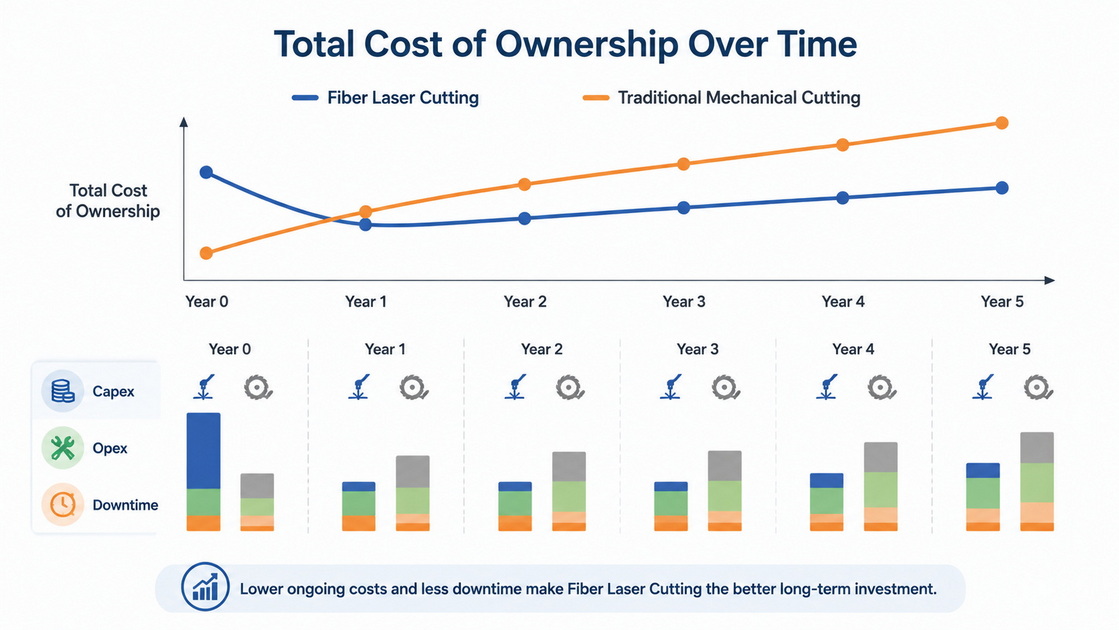
If you are currently relying on traditional mechanical cutting and are evaluating fiber laser cutting machines, maintenance should be central in your decision, not an afterthought. [genedge]
As a fiber laser cutting machine and sheet‑metal processing equipment manufacturer, CNDY‑Press offers:
- OEM and ODM customization of fiber laser cutting systems tailored to your materials, thickness range, and throughput requirements. [ranling-intelligent.en.made-in-china]
- Guidance on maintenance‑friendly layouts, including dust extraction, cooling systems, and operator access.
- Training and documentation to help your team implement predictive maintenance routines, reducing downtime and maximizing ROI.
Share your current cutting setup, production volume, and pain points, and we can help you compare maintenance and TCO scenarios between fiber laser and traditional cutting so you can invest with confidence.
Not in every case, but in many applications fiber laser cutting delivers lower overall maintenance costs due to fewer mechanical wear parts, reduced tooling needs, and more predictable service intervals. The exact answer depends on your material mix, working hours, and current equipment. [mac-tech]
Replacement frequency depends on material, cutting thickness, and cleanliness, but many shops treat nozzles and protective windows as consumables and keep spares in stock. With proper cleaning and gas quality, these components can last a long time in standard production. [forsuncnc]
They require different maintenance, not simply less. Daily cleaning of the nozzle, optics, and cutting area is essential, but there is typically less manual intervention with heavy mechanical parts than in traditional cutting systems. [mazak]
Operators should be trained on safe optics handling, chiller monitoring, gas system checks, and basic diagnostics, in addition to standard CNC operation. Many suppliers, including OEM and ODM manufacturers, provide structured training packages with new machines. [southernfabsales]
In many sheet‑metal applications, fiber laser cutting can take over a large share of the work, especially for flat parts and complex contours. However, some shops still retain mechanical shears or punches for specific high‑volume simple parts where existing tooling is already optimized. [accurl]
1. ADH Machine – "Fiber Laser Cutting vs Traditional Mechanical Cutting: A Performance Analysis". [shop.adhmt]
2. SIU Indo – "Maintenance Tips for Fiber Laser Cutting Machines". [siu-indo]
3. Mazak – "Maintenance Recommendations for Fiber Lasers". [mazak]
4. Mac-Tech – "Tube Laser Cutting vs. Traditional Methods: A Comparative Study". [mac-tech]
5. Accurl – "Advantages of Fiber Laser Cutting: What are the 27 Benefits?". [accurl]
6. Leapion – "Comparison of Fiber Laser Cutting Machine and Traditional Cutting Machines". [leapion]
7. Forsun CNC – "How To Do Daily Maintenance For Fiber Laser Cutting Machine?". [forsuncnc]
8. Southern Fab Sales – "How to Keep Your Fiber Laser Machine Running at Top Performance". [southernfabsales]
9. Dowell Laser – "Fiber Laser Cutting Machine Manufacturer". [dwcnclaser]
10. Made‑in‑China – "OEM ODM Industrial CNC Fiber Laser Cutting Equipment". [ranling-intelligent.en.made-in-china]


