


Views: 222 Author: CNDY-Press Publish Time: 2026-05-05 Origin: Site


Laser cutting gases are not just a technical detail; they are one of the main levers you can use to boost cut quality, productivity, and profit in a metal fabrication shop. From my experience helping OEM and job shops optimize fiber laser lines, the most successful teams treat gas selection and parameters as a strategic decision, not a consumable to buy at the lowest price. [enoptimize]
Laser cutting is now the backbone of modern sheet metal fabrication, and assist gases sit at the center of that process. The right combination of gas type, purity, pressure, and delivery system can be the difference between profitable lights‑out production and costly rework. In this guide, I'll walk through how oxygen, nitrogen, argon, helium, compressed air, and gas mixtures really behave on the shop floor—and how manufacturers like CNDY‑Press use them to improve throughput, edge quality, and ROI. [rankingbyseo]
Laser cutting uses a high‑energy beam to melt or vaporize material while an assist gas blows molten metal out of the kerf. CNC control systems position the beam with high accuracy, and the assist gas stabilizes the cut, protects optics, and shapes the final edge quality.
For fiber lasers, gases are even more critical because cutting speeds are higher—often several times faster than older CO₂ systems—so any weakness in gas purity, pressure, or supply shows up immediately as burrs, slag, or inconsistent edges. Choosing between reactive gases (oxygen) and inert gases (nitrogen, argon, helium) directly influences cut color, heat‑affected zone, and post‑processing needs.
Laser cutting gases are active process partners that influence cooling, oxidation, cutting speed, and downstream finishing. Beyond simply blowing molten metal out of the cut, they protect the lens from debris and help control the thermal profile of the cut zone.
In practice, shops usually rely on a mix of:
- Oxygen (O₂) – reactive, boosts heat and helps cut thick mild steel at lower laser power.
- Nitrogen (N₂) – inert, prevents oxidation and leaves bright, clean edges.
- Argon (Ar) and helium (He) – inert, high‑end options for ultra‑critical cuts and sensitive alloys.
- Compressed air – cost‑effective "everyday gas" for non‑cosmetic parts and thinner materials.
- Argon/helium blends – niche blends for aerospace and medical components where absolute surface integrity is required.
For oxygen, typical recommended purity is around 99.97% or higher, while nitrogen for high‑quality stainless or aluminum cutting is usually 99.99%+. Even small purity drops can reduce cutting speed or increase oxidation, so gas quality is not a theoretical parameter—it's a direct cost and quality driver.
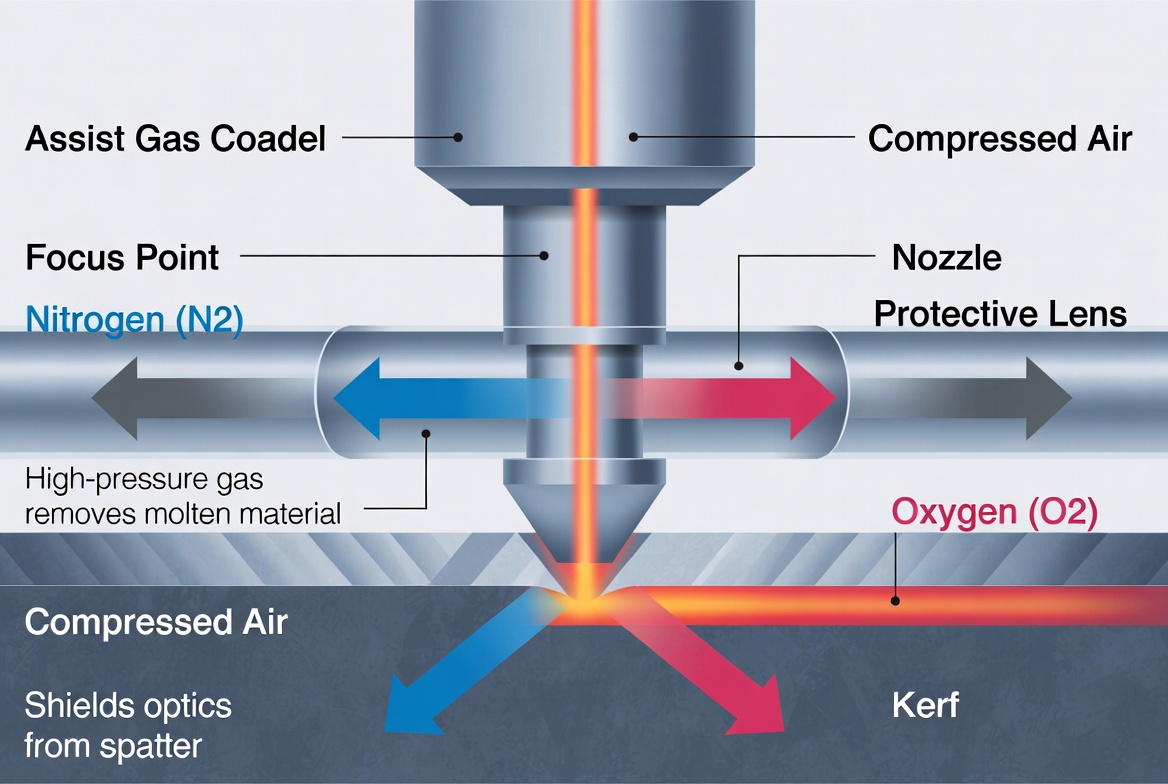
Assist gases are mandatory in industrial laser cutting for three main reasons:
- Molten metal removal – they physically eject molten material from the kerf, preventing re‑solidified dross on the edge.
- Cooling and protection – they cool the cut zone and shield both the workpiece and lens from excessive heat and spatter.
- Chemistry control – reactive gases like oxygen create exothermic heat, while inert gases like nitrogen prevent oxidation and scaling.
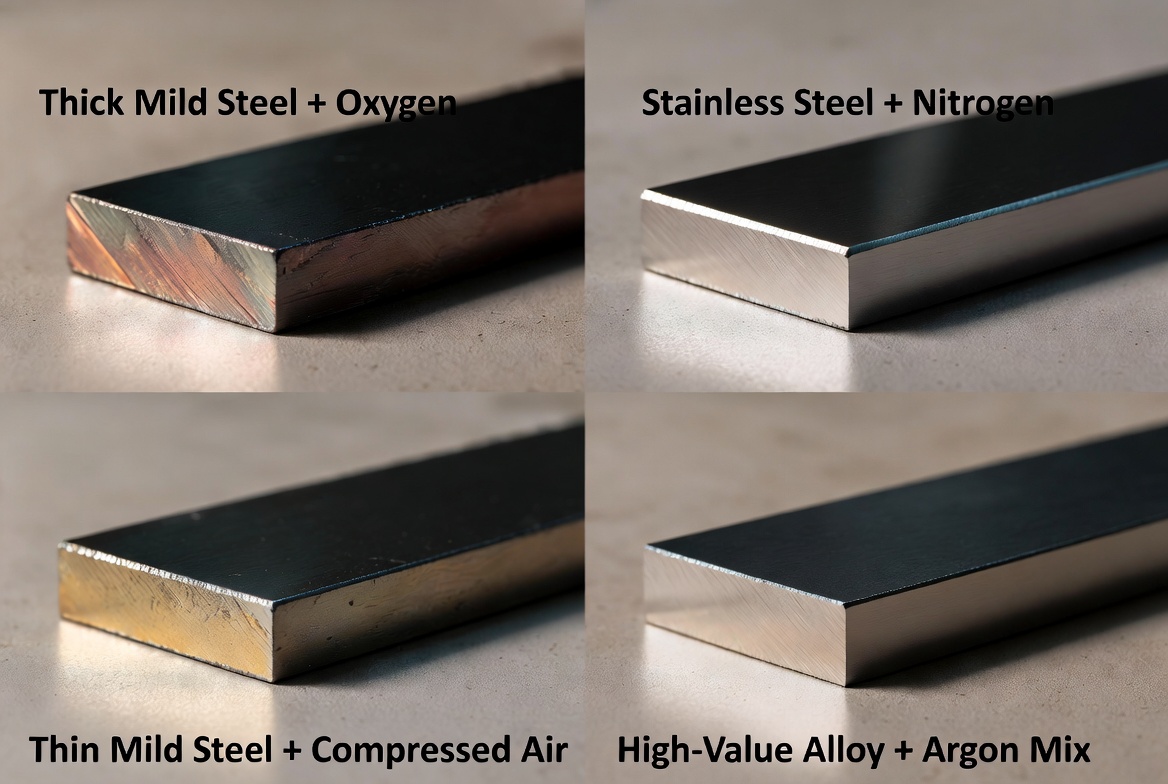
These effects carry over into welding, bending, painting, and coating. A part cut with oxygen may need extra grinding or shot blasting to remove oxide layers, while a nitrogen‑cut part often goes straight to forming or powder coating.
Early CO₂ laser systems relied heavily on oxygen for mild steel because the exothermic reaction delivered the extra heat needed to cut thicker plate. As fiber lasers matured, manufacturers began to prioritize speed, cleanliness, and multi‑material capability, which drove a shift toward high‑pressure nitrogen cutting.
High‑value industries such as aerospace, automotive, and electronics later pushed gas development further, experimenting with argon, helium, and argon‑helium blends to minimize heat‑affected zones and surface contamination. Today, with fiber lasers becoming the default in sheet metal shops, compressed air and on‑site nitrogen systems are at the center of cost‑reduction strategies. [adhmt]
Oxygen is a reactive gas that supports an exothermic reaction in steel, adding heat to the cut and enabling thick mild steel to be cut with comparatively low power. This makes oxygen particularly attractive when you need to process 10–22 mm plate efficiently on a fiber or CO₂ laser.
Key characteristics:
- Typical pressure: roughly 3–10 Bar for mild steel.
- Typical flow: around 20–22 m³/hr for 8–10 mm steel.
- Purity: often specified near 99.97% to maintain stable cutting behavior.
Trade‑offs: oxygen tends to slow cutting speed on thin materials and leaves a dark, oxidized edge that may require grinding or blasting before coating. However, hourly gas cost is low, which keeps it popular for heavy structural parts where appearance is secondary.
Nitrogen is an inert gas that does not chemically react with the metal, so it produces bright, oxide‑free edges on stainless steel, aluminum, mild steel, and galvanized sheet. It is the default choice for visible components, food‑grade equipment, and parts that go straight to painting or powder coating.
Typical parameters:
- Pressure: often in the 15–30 Bar range, depending on thickness.
- Flow rate: commonly 50–150 m³/hr for thicker materials.
- Purity: usually 99.99% or even up to 99.999% for premium, discoloration‑free edges.
The higher pressure and volume mean nitrogen costs more per hour than oxygen or compressed air, but you gain in reduced post‑processing and consistent cosmetic quality.
Argon is inert and especially useful for metals that react with nitrogen, such as titanium and some nickel‑based alloys. It helps keep the heat‑affected zone narrow and reduces the risk of embrittlement or microcracking in sensitive materials.
Helium offers very high thermal conductivity and is usually reserved for extremely fine cuts where minimizing dross and heat input is critical. It is common in thin, high‑value parts where the material cost or safety requirements justify the higher gas price.
Both gases are typically used with purities of 99.99% or better in aerospace and medical applications.
Compressed air is often the most cost‑effective assist gas, especially for thin mild steel and non‑cosmetic parts. It contains roughly 21% oxygen and 78% nitrogen, giving a compromise between speed and edge cleanliness.
In real shop conditions, compressors often operate between 75 and 175 psi; for 1.5 mm mild steel, effective cutting is typically at the upper end of that range, sometimes with boosters pushing up to 150–200 psi. Air cutting can leave grayish or slightly oxidized edges on stainless steel, which may not suit visible parts, and it demands good drying and filtration to protect optics.
The primary "cost" of air is electricity for compressors plus maintenance on filters and dryers, but for many high‑volume operations, air significantly reduces gas spend compared with bottled or bulk nitrogen. [adhmt]
Gas mixtures combine the strengths of different gases to increase cutting speed and cut quality. For example, mixing oxygen into nitrogen can improve speed for stainless steel while reducing nitrogen consumption. Tests have shown that 8 mm stainless steel can reach around 8800 mm/min with a nitrogen–oxygen mix versus about 7500 mm/min with pure nitrogen, while cutting gas consumption by roughly 40%.
Argon–helium blends (often 50–75% argon with the balance helium) are used in high‑stakes fields where even minor surface contamination can compromise performance, such as implants or flight‑critical parts. [sciencedirect]
From a production perspective, the oxygen‑versus‑nitrogen decision usually comes down to a balance of edge quality, material thickness, and total cost per part.
Oxygen advantages:
- Best for thick mild steel where added heat from the exothermic reaction supports penetration.
- Lower gas volume and pressure requirements, reducing hourly gas cost.
Oxygen drawbacks:
- Oxidized, darker edge that often requires secondary finishing.
- Slightly lower precision and higher heat‑affected zone compared with inert gases.
Nitrogen advantages:
- Bright, oxide‑free edge suitable for visible or painted parts.
- Minimal post‑processing and better dimensional accuracy.
Nitrogen drawbacks:
- Requires high pressure and high flow, increasing gas cost.
For fiber laser users, a common strategy is to cut thick structural parts with oxygen and everything cosmetic with nitrogen, then gradually introduce compressed air and gas mixtures where tests show acceptable edge quality at lower cost.
Gas purity directly affects oxidation, edge color, and cutting stability. For oxygen, purities above roughly 99.5% are typical, and minor purity drops (for example, from 99.97% to 99.95%) can noticeably affect speed and cut consistency on thin material. Nitrogen for high‑end work is often specified at 99.99–99.999% to minimize any risk of discoloration or contamination.
Impurities can also contaminate lenses and nozzles, causing inconsistent beam quality and requiring more frequent maintenance.
Pressure must be high enough to clear molten metal completely while avoiding turbulence or excessive nozzle wear.
Typical trends:
- Oxygen: 3–10 Bar for mild steel, with relatively modest flow rates around 20 m³/hr on 8–10 mm material.
- Nitrogen/compressed air: 15–30 Bar and significantly higher flow volumes, often above 100 m³/hr for thicker materials.
Higher flow generally improves edge cleanliness but increases consumption, so an optimal point must be found for each material and thickness.
Cutting speed depends heavily on gas type and settings. For example, 8 mm mild steel might run near 2800 mm/min with oxygen, while nitrogen can push speeds above 7000 mm/min, and mixed gases can nudge that even higher. That speed gain must be weighed against additional gas cost and power consumption.
Gas temperature matters as well. Liquid nitrogen, for example, is stored at very low temperatures and must be vaporized before use, while compressed air exits the compressor hot and needs cooling and drying to avoid condensation and oil carryover at the cutting head. Uncontrolled gas temperature can affect gas density, pressure stability, and ultimately cut quality.
Different materials react very differently to assist gases, so parameter settings must be tailored carefully.
- Carbon/mild steel: Often cut with oxygen for thickness and cost, or nitrogen/air for improved edge quality and minimal oxidation.
- Stainless steel: Usually cut with nitrogen for bright, oxide‑free edges that are ready for welding or polishing.
- Aluminum: Favors nitrogen or air, as oxygen can cause excessive oxidation and unstable cuts.
- Copper and brass: Fiber lasers combined with high‑quality nitrogen or air cut reflective metals effectively, but parameters must be tuned to prevent back‑reflection issues.
- Composites and plastics: Often require lower pressures and inert gases (nitrogen, argon) to avoid burning, discoloration, or fumes. [sciencedirect]
For complex part families, many shops standardize on a parameter library for each gas/material/thickness combination, then continuously refine based on scrap analysis and operator feedback. [bigmarketing]
Reactive gases such as oxygen tend to produce a rougher edge with more dross and an oxide layer that may interfere with welding, coating, or tight‑tolerance assembly. Inert gases—or air with carefully controlled parameters—produce cleaner edges with minimal thermal distortion.
To optimize edge quality:
- Keep nozzles clean and properly centered to ensure stable flow.
- Adjust focus position and standoff distance to match the gas type and material.
- Use high‑purity gas and maintain consistent pressure throughout long cuts.
Fabricators that take a holistic view—considering cutting, bending, welding, and coating together—often find that higher gas cost at the laser is offset by major savings in grinding and rework. [rankingbyseo]
Assist gas consumption varies with gas type, material, and thickness. Nitrogen is the biggest gas consumer due to the high flow needed for oxide‑free edges, while oxygen uses less volume but can add cost through post‑processing.
For high‑volume shops, on‑site nitrogen generation via membrane or PSA systems is one of the most effective cost‑reduction tactics. These systems extract nitrogen from ambient air, achieving purities up to 99.999% when required. Although the initial investment is significant, the cost per cubic meter is usually much lower than delivered cylinders or bulk tanks, and supply becomes more secure and predictable. [adhmt]
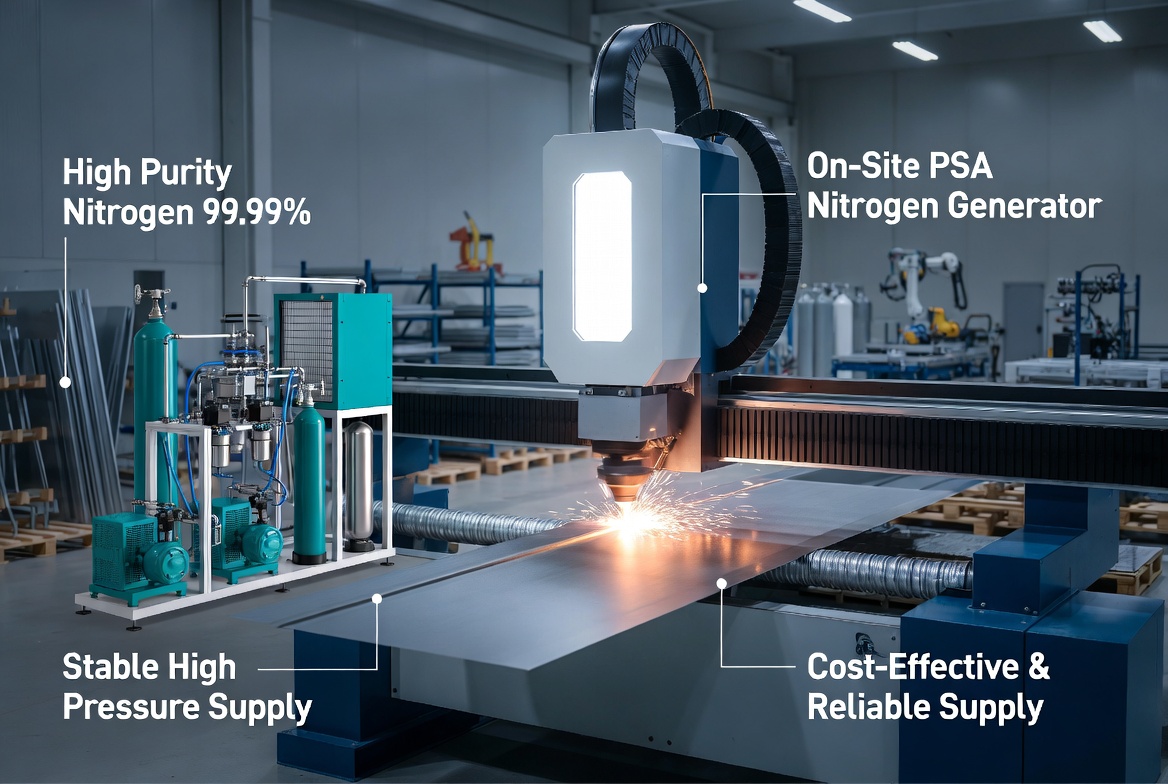
Common strategies I see in successful fiber‑laser shops include:
- Using compressed air for non‑critical edges and thin mild steel.
- Fine‑tuning gas flow and nozzle size to match material and minimize waste.
- Grouping jobs by material and thickness to reduce frequent parameter changes and purge cycles.
- Investing in robust filtration and drying so compressors and generators run efficiently and optics stay clean.
- Choosing shorter, larger‑diameter pipelines to minimize pressure drop and reduce the need for extra boosters.
Safety is non‑negotiable when you are handling high‑pressure gases. Poor storage or maintenance increases both accident risk and unplanned downtime.
For smaller or mixed‑gas operations, individual cylinders and racks are common; they must be stored upright, away from heat sources, and regularly inspected for damage or leaks. Larger users often switch to bulk tanks or mini‑tanks with proper anchoring, ventilation, and temperature control.
Liquid nitrogen tanks typically use vaporizers to maintain consistent flow and pressure, and regular inspections must follow local safety regulations.
Basic best practices include:
- Reliable leak detection in storage and production areas.
- Clear labeling of all gas lines and cylinders.
- Scheduled checks for hoses, regulators, and fittings.
- Formal training for all operators who change bottles or adjust gas parameters.
Well‑maintained gas systems protect your people and keep your laser cutting equipment at peak performance. [bigmarketing]
Imagine a job shop cutting 3 mm stainless enclosures, 1.5 mm mild‑steel brackets, and 12 mm structural plates in one shift. A typical optimization roadmap looks like this: [rankingbyseo]
1. Run 3 mm stainless with high‑purity nitrogen for bright edges that go straight to finishing.
2. Test 1.5 mm mild steel with compressed air; if edges are acceptable, switch from nitrogen to air to reduce cost.
3. Cut 12 mm plate with oxygen to leverage the exothermic reaction and keep power draw manageable.
4. Add on‑site nitrogen generation once nitrogen volume exceeds a set threshold for annual savings.
By aligning gas choices with actual quality needs instead of using a single "default" gas for everything, shops routinely cut gas cost per part while speeding up overall throughput. [adhmt]
| Application scenario | Recommended gas | Primary benefit | Main trade‑off |
|---|---|---|---|
| Thick mild steel structural parts | Oxygen | High penetration with lower laser power. | Oxidized edge, more finishing. |
| Visible stainless steel panels | Nitrogen | Bright, oxide‑free edges. | High gas pressure and consumption. |
| Thin mild‑steel brackets, non‑cosmetic | Compressed air | Very low gas cost and good speed. | Slight oxidation, gray edges possible. |
| Titanium or sensitive alloys | Argon | Protects surface chemistry, narrow HAZ. | Higher gas price, slower cuts. |
| Ultra‑critical aerospace/medical parts | Argon/helium blend | Exceptional edge quality, minimal dross. sciencedirect | Highest gas cost, complex supply. |
For OEM and ODM projects, gas strategy should be built into your equipment and process decisions from day one. As a manufacturer of fiber laser cutting machines and complete sheet metal processing lines, CNDY‑Press can help you:
- Configure machines for oxygen, nitrogen, air, and mixed‑gas cutting.
- Integrate on‑site nitrogen generation and high‑pressure compressors.
- Develop application‑specific cutting parameter libraries for your materials and part families.
If you are planning a new line or want to reduce the gas cost of your existing laser operations, contact our engineering team to discuss a tailored solution for your factory.
Q1. Which gas is best for laser cutting mild steel?
For thick mild steel, oxygen is typically the most efficient because its exothermic reaction adds heat and reduces the required laser power. For thin mild‑steel parts, nitrogen or compressed air may be better if you need cleaner edges.
Q2. Why is nitrogen so popular for stainless steel cutting?
Nitrogen is inert and prevents oxidation, so stainless parts come off the machine with bright, clean edges that require little or no post‑processing before welding or painting.
Q3. Is compressed air safe to use on a fiber laser?
Yes, provided you have adequate pressure, good filtration, and proper drying, compressed air is widely used on fiber lasers for thin steel and aluminum to lower assist‑gas costs.
Q4. When does on‑site nitrogen generation make sense?
On‑site nitrogen generation becomes attractive when consumption is high and continuous, because it lowers gas cost per cubic meter and removes dependency on cylinder or bulk deliveries. [adhmt]
Q5. How do I know if my gas purity is causing cut problems?
Symptoms of purity issues include unexpected oxidation, variable edge color, increased dross, and sudden changes in cutting speed or stability despite unchanged parameters. In such cases, checking gas certificates, filters, and supply lines is a good first step.
1. ACCURL – *Laser Cutting Gases* (original article and data on gas types, parameters, and safety).
2. ADH Machine Tool – *Laser Cutting Machine Gas Consumption* (insights on gas efficiency and improvement tracking). [adhmt]
3. ScienceDirect – *Laser cutting of CFRP using novel cutting strategies* (impacts of laser cutting on material properties and HAZ). [sciencedirect]
4. enOptimize – *Digital Marketing & SEO for Laser Cutting Shops* (best practices for industrial laser cutting SEO and content positioning). [enoptimize]
5. Ranking By SEO – *SEO for Manufacturing Companies: Complete Guide* (manufacturing SEO strategies, including content depth and internal linking). [rankingbyseo]
6. Wellows – *E‑E‑A‑T Checklist for SEO* (framework for demonstrating expertise, experience, authority and trust in technical articles). [wellows]
7. BigMarketing – *Manufacturing SEO: 10 Proven Strategies for Top Rankings* (guidance on headers, schema, and technical blog UX for manufacturers). [bigmarketing]


